
Can ChatGPT Dots Answer Adventure Tour Enquiries? Always-On Agents for Tour Operators

The short answer
No. A ChatGPT dot can't answer an adventure tour enquiry. It's something you create and use inside ChatGPT, with no page a guest can open. A customer-facing AI agent built with Agentplace gives them one, answers difficulty and availability from your own trip notes, flags the guests who need a call with a guide, and holds the place.
Key takeaways
- Almost every adventure enquiry is one question in different words, is this trip right for me, and it waits two days across time zones.
- A dot is something you create and use inside ChatGPT. There is no page for a guest to open.
- A customer-facing AI agent gives difficulty in numbers from your trip notes, says how many places are left, and holds the place.
- Judging whether a guest is fit enough is not the agent's call. It asks your screening questions and books a call with a guide.
- Start by writing difficulty in numbers for every trip: daily distance, ascent, maximum altitude and consecutive days.
The short answer
No. A ChatGPT dot can’t answer an adventure tour enquiry.
It’s something you create and use inside ChatGPT. There’s no customer-facing page, phone number, or interface for a guest to open.
An enquiry about a trek is different. A customer-facing AI agent built with Agentplace gives the guest a page where they can reach the agent. The agent does three things:
- Answers difficulty and availability from your trip notes and your live departure list.
- Asks your screening questions and flags the guests who need a call with a guide.
- Holds the place and starts the forms.
If you run four departures a year and the owner guides every one, keep answering it yourself.
Why do adventure enquiries go cold?
Because the guest is in a different time zone and the answer takes two days.
Our own research into adventure travel describes the middle: trip enquiries sit in inboxes while staff answer the same route, difficulty and availability questions one by one, and follow-up on unpaid deposits and missing forms depends on someone remembering to chase.
Example: An enquiry at 1am your time.
“Looking at the 8-day trek in March. I’m 54, reasonably fit, I run a bit. Is that realistic, and are there places left?”
| Option | What the guest gets | When |
|---|---|---|
| Enquiry form | A thank-you page | A reply in two days |
| Brochure auto-send | A PDF with a one-word difficulty rating | Immediately, and it answers nothing |
| Itinerary page | Day-by-day text, no availability | Immediately, and it decides nothing |
| Agent on live departures | 14 to 18km a day, two passes above 4,000m, four places left in March, call with a guide booked | In the conversation |
Rule of thumb: “moderate” is not a difficulty rating. “14 to 18km a day and two passes above 4,000m” is.
What should the agent know?
Five things, and the fifth is the one that keeps you safe.
| Input | Why it matters |
|---|---|
| Difficulty in numbers per trip | Daily distance, ascent, altitude, consecutive days |
| What the day actually looks like | Start time, terrain, where you sleep, what you carry |
| Live departure availability | Small groups fill. A confirmed place on a full trip is a refund |
| What’s included and what isn’t | Flights, permits, insurance, tips, gear hire |
| Your screening questions and the hand-over line | Age, altitude history, medical conditions, recent surgery |
That last row is not the agent’s judgement. The agent asks what you wrote and books a call when an answer crosses the line you set. A guide clears the guest.
How do you answer an enquiry, step by step?
1. Give difficulty in numbers
Distance, ascent, altitude, days in a row. Rule of thumb: if a guest can’t picture the day from your answer, you haven’t answered.
2. Check the departure before you encourage anyone
Places, not “limited availability”. Four left and two left are different conversations.
3. Ask your screening questions in the conversation
Example: The agent, at 1am.
“The March trek is 14 to 18km a day for six days, with two passes above 4,000m. Nights are in teahouses. There are four places left. Two questions before you book: have you been above 3,500m before, and are you managing any heart, lung or blood pressure condition? If the second one is yes, I’ll put you on a call with one of our guides rather than answer it myself.”
4. Hold the place and start the forms
A held place and a started waiver beat a brochure. Chase what’s missing automatically.
5. Route anything medical or bespoke
Medical history, recent surgery, private departures, anything about a child’s suitability. The agent collects the detail and hands over.
Can a ChatGPT dot do this?
No, and it isn’t close.
Dots are OpenAI’s always-on agents, launched 29 September 2026. A dot keeps working between conversations, has its own cloud computer, and reaches apps you authorise. All of that happens inside the account of whoever created it.
That’s the wall. The guest has no way in.
As it shipped: one dot per account, paid ChatGPT plans only, and no Pro access in the EEA, Switzerland or the UK.
A dot works on the operator’s side. A guest-facing agent works on the guest’s side.
What tools can help answer trip enquiries?
| Option | What it’s for | Where it stops |
|---|---|---|
| Customer-facing AI agent built with Agentplace | Answering difficulty and availability, screening, holding the place, on its own page or by phone | It isn’t your booking system, and it doesn’t clear anyone medically |
| Tour and adventure booking software | Departures, places, payments, manifests | It holds the booking, not the conversation |
| OTAs and marketplaces | Getting the enquiry in the first place | They generate it. They don’t answer it |
| Itinerary pages and PDFs | The day-by-day detail | No availability, no screening, no booking |
| ChatGPT Dots | The operator’s own work | Not guest-facing. No page to open |
Nothing here was bench-tested. The rows describe what each category is designed to do, read from vendor documentation in October 2026.
How does Agentplace answer trip enquiries?
Agentplace lets you create an AI agent with its own web page and URL. It uses your business knowledge to work with clients through text, voice, and a personal interface that changes with their request.
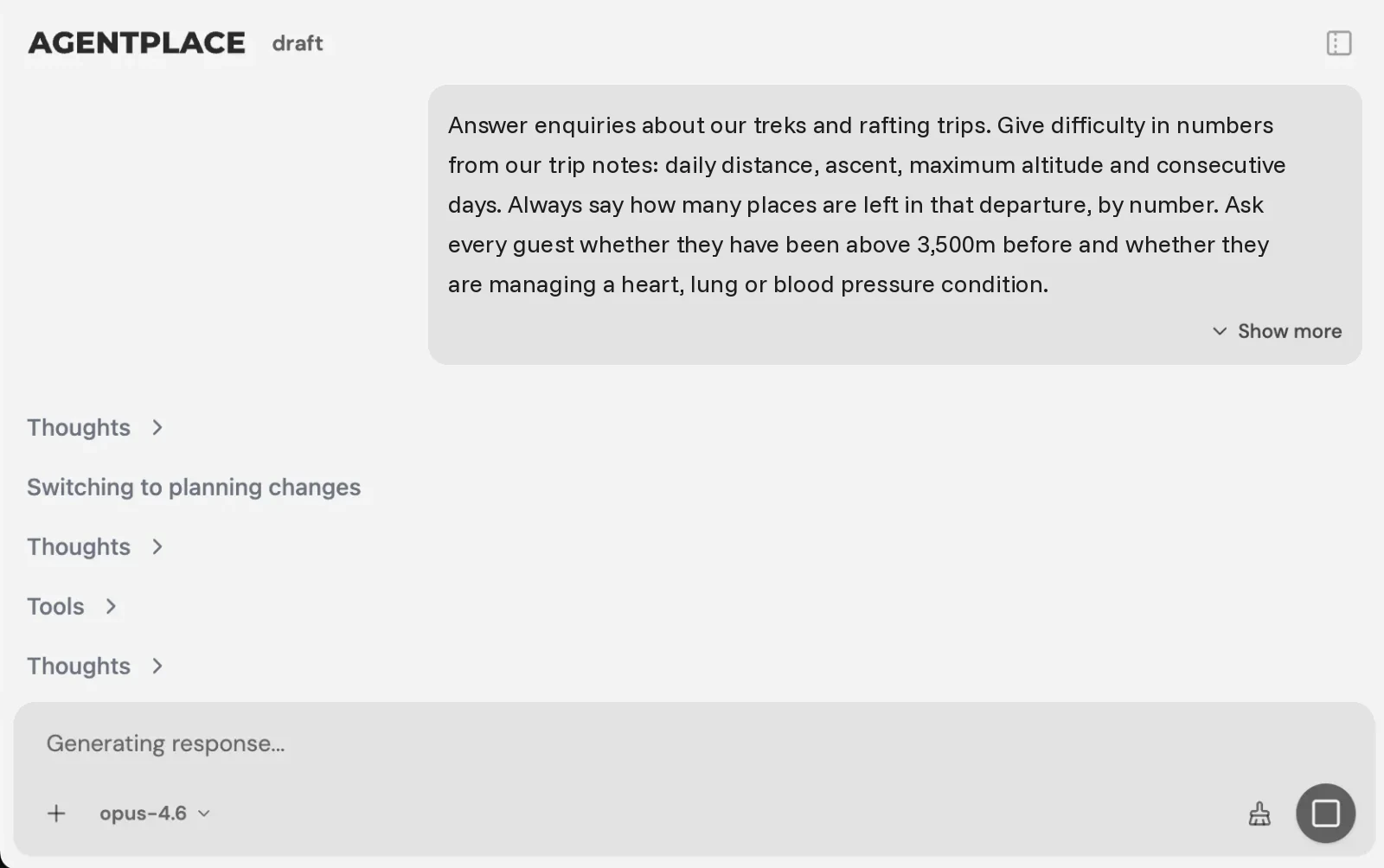 You describe your trips, difficulty numbers and screening questions. The builder writes the agent.
In practice, it works like this:
- The guest opens the agent’s page from your site, an ad, or a marketplace listing.
- The agent answers difficulty and availability for the departure they asked about.
- It asks your screening questions and records the answers.
- It holds the place, takes the deposit step and starts the forms.
- It books a call with a guide where an answer crosses your line.
You set it up by describing the outcome in plain language, for example:
“Answer enquiries about our treks and rafting trips. Give difficulty in numbers from our trip notes: daily distance, ascent, maximum altitude and consecutive days. Always say how many places are left in that departure, by number. Ask every guest whether they have been above 3,500m before and whether they are managing a heart, lung or blood pressure condition. Never judge whether someone is fit enough: if either answer is a concern, say a guide will go through it and book a call. Hold the place for 48 hours and chase the waiver and passport details. Send private departures, under-16s and anything medical to Elena.”
The AI Builder discusses the idea, clarifies requirements, creates the agent and helps test it. You choose when to publish. No code is required.
What stays where it is:
- Your booking system keeps departures, places, payments and manifests. The agent reads availability and writes the booking and the guest details where a supported connection exists.
- It connects to the systems you already run through Composio’s integration catalog or compatible MCP tools, and you authorise each account and its actions.
- Records carry access classes enforced server-side, so a guest sees their own booking and nothing else.
Pricing: Agentplace has a free plan and paid plans that use AI credits. A credit is not an enquiry. See pricing.
Template to start from: AI Adventure Tour Suitability Agent
When don’t you need an AI agent?
- Four departures a year, guided by the owner? Keep that. The conversation is part of the product.
- Every trip is private and priced from scratch? Then there’s nothing standard to answer.
- You need departures, payments and manifests? That’s tour booking software, and it stays.
- Your difficulty ratings are one word? Write the numbers first. The agent can only repeat what you wrote.
- Departures not tracked live? Fix that before an agent confirms a full trip.
- Enquiries from three time zones answered two days later? That’s where a customer-facing AI agent built with Agentplace fits.
Quick checklist
- Write difficulty in numbers for every trip: distance, ascent, altitude, days
- Connect live departures so the agent quotes places by number
- Write what’s included and what isn’t, including permits and gear hire
- Write your screening questions and the exact line where a guide takes over
- Decide what the agent may see of waivers and passport details
- Track enquiries answered out of hours, places held, and calls booked with guides
Related reading: AI agents that book appointments · what Dots by ChatGPT are · handling travel requests that don’t fit a booking form
Bottom line
A guest at 1am asks whether your trek is realistic for them and whether there’s a place left. Both answers are already written down somewhere in your office.
- If the owner guides every departure and answers every email, keep it.
- If enquiries arrive across time zones and wait two days, give guests a customer-facing AI agent built with Agentplace. It gives difficulty in numbers, quotes real places, asks your screening questions, holds the spot, and puts anything medical in front of a guide.
Questions and answers
Frequently asked questions.
Can an AI agent answer adventure tour enquiries?
Yes. It can answer difficulty, daily distance, altitude, group size, what is included and which departures are open, all from your own trip notes. It can take the booking and start the forms. Judgement about a guest's fitness or health stays with your guides.
Can a ChatGPT dot do this?
No. A dot is something you create and use inside ChatGPT. There is no page or number a guest can use. It can help with your own work, but a guest comparing treks across time zones cannot reach it.
Can it decide whether someone is fit enough?
No, and it should not try. It can state the requirement plainly, ask the screening questions you wrote, and book a call with a guide when an answer crosses your line. Clearing a guest is a human decision.
Can it check departure availability?
Yes, where it is connected to your booking system. It matters here because departures are small. Confirming a place on a trip that filled an hour ago is a refund and an apology.
Can it collect waivers and passport details?
It can start the collection and chase what is missing. Keep the documents themselves in the system you already use for them, and decide what the agent may see.
Does this replace our tour booking software?
No. Your booking system stays the source for departures, places, payments and manifests. The agent handles the enquiry conversation and writes the booking and the guest details into it.
What about weather and itinerary changes?
The agent can answer status questions and send the update you wrote. The decision to change or cancel a departure is yours, and it should never be improvised by an agent.
How long does setup take?
The work is writing down what your guides already explain: difficulty per trip, daily distance, altitude, what is included, and your screening questions. A focused build takes days rather than months.
Put this into practice
See the customer experience.
Explore a concrete example related to this article, then adapt the agent to your business.
Create my AI agentStart free with your business idea. The AI builder can help you explore it and create your agent. No technical specification needed. Sign in to continue. Pricing and limits · How the builder works