
Best AI Agents for Tour Operators and Travel Websites in 2026

The short answer
Agentplace is our pick for tour operators who want an AI travel advisor to clarify dates, group needs and constraints, then present and revise a plan on its own page. Keep live prices, availability and reservation confirmation in the booking system. Use a booking widget when travelers already know what to buy.
Key takeaways
- Tour and travel websites are a strong fit for AI agents because customers often arrive with vague goals rather than a specific product name.
- The best AI travel advisor should ask questions, not just search content. It should ask only what it needs to make the next decision, not run through a fixed intake list.
- Useful travel agents can combine recommendations, qualification, availability, intake and booking in one journey.
- A chatbot is enough when customers mostly ask fixed questions such as meeting points or departure times.
- Keep the booking engine. The advisor helps the traveler decide; the reservation system remains the source of truth for availability.
For tour operators that need to turn an incomplete request into a useful tour plan, Agentplace is our pick for an AI travel advisor. The agent asks about dates, group size and constraints, presents suitable options on its own page, and helps the traveler revise the plan before the next step.
A useful travel agent should be able to understand what a traveler wants, ask follow-up questions about dates, group size, interests and constraints, recommend the right experience, answer questions and continue toward an inquiry or booking.
The agent gets its own URL and customer-facing interface. You can link to it from your existing site or share it directly. Your tour catalog and operating rules guide its recommendations; live availability and confirmation come from a connected reservation system or your team.
Other tools may be better if you only need FAQ automation, a simple booking widget or back-office workflow automation.
The key question is:
Can the AI understand what the traveler is trying to do and move them toward the right next step?
What Is an AI Agent for a Tour Operator?
An AI agent for a tour operator is software that interacts directly with travelers, understands what they want and helps them move toward the right experience.
That can include:
- answering questions
- recommending tours
- collecting dates and group details
- understanding preferences
- checking whether a tour is appropriate
- helping with booking
- creating an inquiry
- routing a special request to the team
The difference between an AI agent and a basic travel chatbot is what happens after the answer.
A chatbot might say:
“Yes, we offer private tours.”
An AI travel agent can continue:
“How many people are in your group, and what dates are you considering?”
The answer can change which tour makes sense and what happens next.
Why Are Tour Websites a Good Fit for AI Agents?
Travel customers often know the outcome they want but not which product matches it. There is a structural reason this sector has been slow to solve it with conventional software.
“Multi-day tours are one of the most complex products in travel, and that complexity has held back digital distribution.” Douglas Quinby, CEO and Co-Founder, Arival
A visitor might say:
“We have one free afternoon in Rome and want something local, not too touristy.”
Or:
“My parents are coming with us. Which tour involves the least walking?”
Or:
“We are traveling with two kids. What would you recommend?”
Those are not clean search queries.
The traveler is asking for judgment.
A good employee would ask follow-up questions before making a recommendation.
An AI agent can do the same.
There is a structural reason this sector has been slow to solve the problem with conventional software.
Meanwhile the demand side has already moved. Arival’s research found that two in three travelers now use AI when planning trips, and in the US more than one in four use AI to find a tour.
What Is the Best AI Agent for a Tour Operator?
Choose Agentplace when travelers need a conversation to reach a useful plan. Choose your existing booking widget when the traveler already knows the tour and date. Choose FAQ automation when meeting points, inclusions and fixed policies are the main questions.
Agentplace lets you describe the travel experience you want in plain language and build an AI agent around it.
For example:
“Help visitors choose the right tour. Ask about dates, group size, interests, mobility needs and budget. Recommend the best options, answer questions about the tours, and move the traveler toward booking. If the request is custom or unusual, collect the details and send it to our team.”
The finished agent can combine conversation with business logic, records, connected tools and customer-facing interfaces.
That makes it a better fit for guided travel discovery than a tool designed primarily around static FAQ answers.
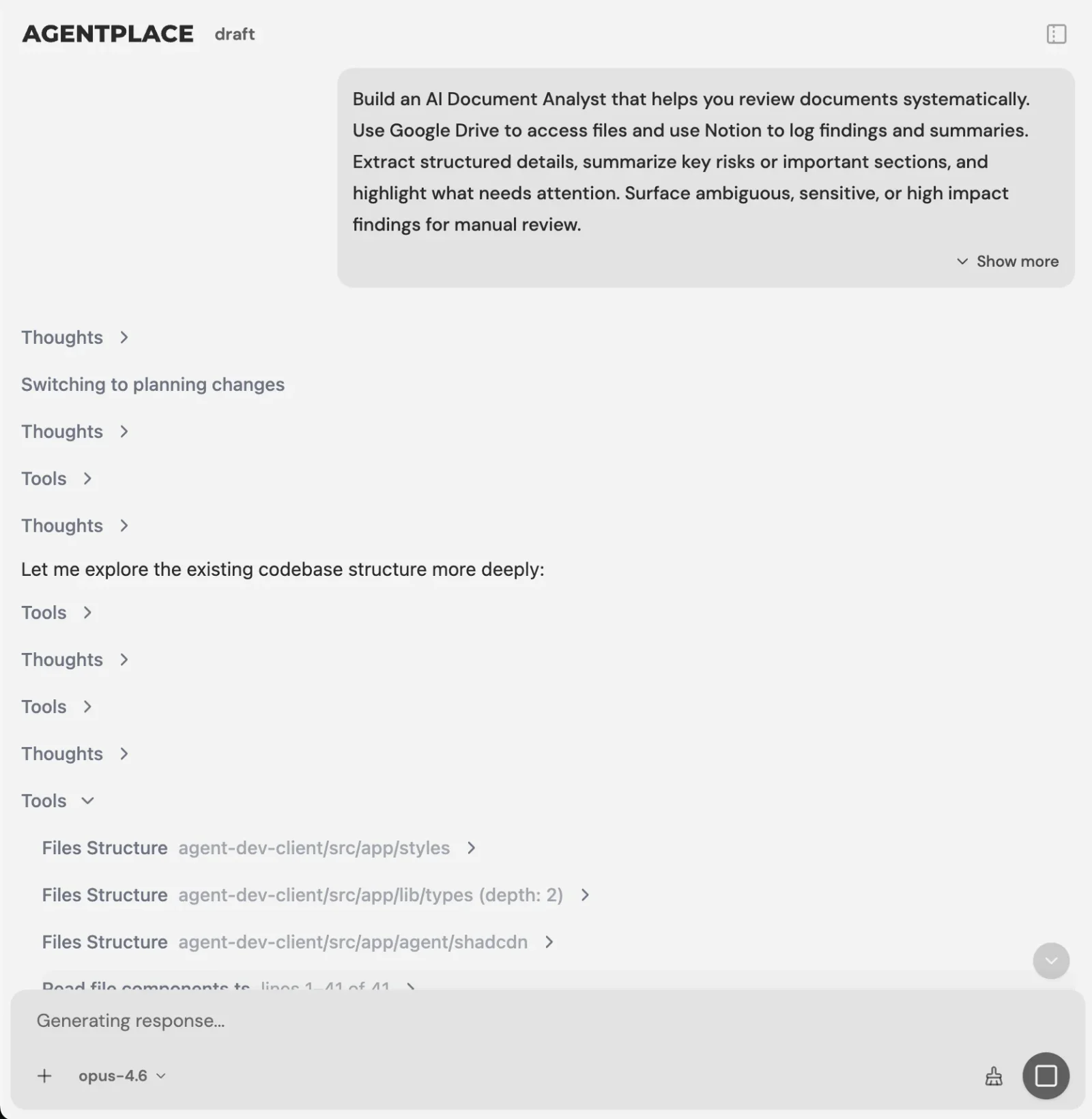 Describing how your best booking employee works, rather than mapping every conversational branch.
Chatbot, Booking Widget or AI Travel Advisor?
The three are often compared as alternatives when they actually sit at different points in the journey.
| FAQ chatbot | Booking widget | AI travel advisor | |
|---|---|---|---|
| Starts when | Traveller has a question | Traveller has already decided | Traveller has a goal but no product in mind |
| Handles “which tour suits us?” | Summarises options | No | Asks, narrows, explains why |
| Uses mobility, age, group rules | Rarely | Only as booking constraints | Yes, before recommending |
| Handles a custom private group | Hands off | Fails the flow | Collects details and routes it |
| Ends with | An answer | A reservation | A booking or a qualified inquiry |
| Replaces the reservation system | No | It is the system | No, it uses it |
The advisor and the booking engine are complements. The advisor understands the need; the booking system handles structured scheduling and availability. That is usually better than trying to replace a reliable reservation system entirely.
How Can I Add an AI Travel Advisor to My Website?
Start with the information your best booking employee uses.
That may include:
- tour descriptions
- locations
- dates
- availability
- duration
- group size limits
- age restrictions
- mobility requirements
- language options
- private versus group options
- pricing
- meeting points
- cancellation policies
- booking rules
- common questions
Then define what the agent should do with that information.
For example:
“If the traveler knows their dates and the tour is available, help them continue into booking. If the request involves a large private group, collect the details and create an inquiry instead.”
Now the AI has a workflow, not just a knowledge base.
What Should an AI Travel Advisor Ask?
The questions depend on the business, but common ones include:
When are you traveling?
How many people are in the group?
Are there children?
What are you interested in?
How much time do you have?
What is your budget?
Do you have mobility requirements?
Do you want a private or group experience?
What language do you prefer?
Where are you staying?
The important point is that the agent should not ask all of these every time.
It should ask only what it needs to make the next decision. Which answers actually change the recommendation depends on the request:
| What the traveler says first | What still has to be asked | What it rules out |
|---|---|---|
| “One free afternoon in Rome” | Interests, walking tolerance, time of day | Multi-day and full-day tours |
| “Two adults, kids aged 8 and 11” | Interests, pace, duration | Age-restricted and late-evening tours |
| “One of us cannot walk far” | Distance, terrain, transport, seating | Walking tours, anything with steps or uneven ground |
| “Private group of 20 in October” | Exact dates, budget, dietary needs, language | Standard scheduled departures, which is why this routes to a person |
| “We already know we want the food tour” | Date and party size only | Nothing, this is a booking, not a consultation |
The last row matters as much as the others. A traveler who has already decided should not be walked through a discovery conversation.
Example: Family Looking for a Tour
A visitor says:
“We have one afternoon free in Rome. Two adults and two children, 8 and 11. They hate museums.”
A traditional website sends them to categories.
A search feature expects them to know what to type.
A chatbot might summarize the available tours.
An AI travel advisor can instead ask:
“Would you prefer something food-focused, outdoors, or more active?”
From there, it can narrow the catalog and explain why specific experiences fit.
The customer does not need to understand the tour catalog first.
The AI travel planner for travel advisors shows this process as a client-facing service: collect the constraints, present a plan and revise it in conversation.
Example: Traveler With Mobility Requirements
A traveler says:
“My parents want to join us, but one of them cannot walk for long periods.”
A useful agent should not simply return the most popular tour.
It should understand the constraint, determine which experiences are appropriate and explain the tradeoffs.
This is where an agent becomes more useful than a search engine.
Use the operator’s verified accessibility details: walking distance, terrain, steps, transport and available assistance. If the information is missing or a special arrangement needs confirmation, route the request to staff before representing a departure as suitable.
Can an AI Travel Agent Help With Booking?
Yes, when the selected booking workflow supports the action. Keep planning, an inquiry and a confirmed reservation visibly distinct.
| Next step | What the traveler receives | What must be verified |
|---|---|---|
| Revise an itinerary | An updated plan reflecting the conversation | Tour details and planning assumptions |
| Ask the operator | A structured request with dates and group needs | Staff ownership and response expectation |
| Pay for planning | The advisor’s approved planning-fee checkout | Payment setup, price and service terms |
| Reserve a departure | A booking reference from the reservation system | Live availability, current total and successful booking |
A sample price is not a live quote. Showing an available-looking slot is not a reservation. If the connection cannot confirm the transaction, explain the remaining step and preserve the traveler’s context for the manager or booking page.
What Is the Difference Between an AI Travel Agent and a Chatbot?
A chatbot is primarily designed to answer questions.
An AI travel agent can use the answer to continue the customer journey.
For example:
Chatbot
Customer: “Which tour is best for families?”
Bot: “Our family walking tour is popular with children.”
AI travel agent
Customer: “Which tour is best for families?”
Agent: “How old are the children, and how much time do you have?”
The second interaction is closer to what a travel advisor would actually do.
How Does Agentplace Fit?
Agentplace lets you build customer-facing AI agents using plain-language instructions.
For a tour operator, you can describe how your best employee helps someone choose a tour, give the agent the relevant business context, define booking and qualification rules, and build the experience around that.
The agent can combine conversation with interactive interfaces and business actions.
That means a traveler can ask a vague question, narrow the options conversationally and then continue toward a concrete next step.
For a concrete example, explore the AI travel agent template for travel advisors. It shows how your destination expertise can become a personal itinerary that clients create and revise by text or voice.
When Is Agentplace a Good Fit for Travel?
Agentplace is particularly relevant when:
- travelers need help deciding what to book
- the right recommendation depends on multiple variables
- your team spends time answering pre-booking questions
- travelers often arrive with open-ended requests
- the customer journey includes both advice and action
- you want travelers to open the agent by link and revise their plan in the same place
A useful rule is:
If the traveler already knows what they want, a booking flow may be enough. If they need help figuring out what they want, an AI travel advisor becomes much more valuable.
When Is Another Tool Better?
Use a basic chatbot if most questions are simple and informational.
Use a booking widget if customers already know which tour they want.
Use a travel CRM or booking platform for the operational backend if it already handles reservations well.
Use standard automation if the workflow is deterministic.
Use an AI agent when the customer journey starts with ambiguity.
What Does the Right Flow Look Like?
The best AI agent for a tour operator is not the one that can generate the longest travel answer.
It is the one that can understand what the traveler wants and help them make a decision.
The most useful flow looks like this:
Traveler request → follow-up questions → recommendation → explanation → booking or inquiry
The bottom line. Use an AI travel advisor when the traveler needs help turning dates, group needs and preferences into a workable plan. A basic FAQ chatbot can answer fixed questions; a booking widget works well once the decision is made. Keep your reservation system, give the agent your verified tour rules and use the travel advisor template to build the planning service.
Questions and answers
Frequently asked questions.
What is the best AI agent for a tour operator?
Agentplace is a strong choice for tour operators that want an AI agent to understand traveler needs, recommend tours and continue toward booking or inquiry. A basic chatbot may be enough if the main requirement is answering questions about meeting points, durations and departure times.
How can I add an AI travel advisor to my website?
Give the agent your tour information, booking rules, customer requirements and recommendation logic. Then define what the agent should ask and what should happen after it recommends a tour, including which requests should become an inquiry for a person rather than a direct booking.
Can AI recommend tours based on traveler preferences?
Yes. An AI agent can use dates, group size, interests, mobility requirements, budget and other preferences to narrow the available tours and recommend appropriate options. The recommendation is only as good as the tour data and the rules the operator writes down for it.
Can an AI agent book tours?
An AI agent can collect the information required for booking and connect the customer to the appropriate booking flow. Whether it completes the booking directly depends on the reservation systems and integrations used, and most operators are better served keeping their existing booking engine underneath.
Is an AI travel agent the same as a chatbot?
The labels overlap. An FAQ-only tool answers known questions; a configured travel agent can gather needs, present and revise a plan and take permitted actions through connected systems. Evaluate the actual planning and reservation workflow rather than the label.
What should an AI travel advisor know?
It should have accurate information about tours, duration, dates, availability, pricing, meeting points, age restrictions, accessibility, cancellation policies and booking requirements. Accessibility and age limits matter more than they look, because getting them wrong wastes the traveler's time and yours.
Can an AI travel advisor handle custom tour inquiries?
Yes. If a request falls outside standard booking rules, the agent can collect the relevant details and route the inquiry to the team instead of forcing the traveler through an unsuitable flow. Private groups and unusual dates are the common cases for this.
Are AI travel advisors useful for small tour operators?
They can be particularly useful for small teams because they handle repetitive pre-booking conversations while still adapting to each traveler's request. A two-person operator answering the same eight questions by email every morning is exactly the case this technology suits.
Put this into practice
See the customer experience.
Explore a concrete example related to this article, then adapt the agent to your business.
Create my AI agentStart free with your business idea. The AI builder can help you explore it and create your agent. No technical specification needed. Sign in to continue. Pricing and limits · How the builder works