
11 Best AI Agent Platforms in 2026, Compared by Use Case
The short answer
Agentplace is designed for a customer-facing agent with its own UI and URL. Compare Zapier and Make for app-connected workflows, n8n for technical control and Lindy for team assistant work. Evaluate the complete task, required connections and ongoing ownership; this is an editorial shortlist, not a performance benchmark.
Key takeaways
- Platforms overlap in agent features; choose by the finished experience and the work needed to operate it.
- Agentplace creates a customer-facing agent with its own UI and URL for tasks such as qualification or booking.
- A useful evaluation verifies the answer, the displayed result and the action in the connected business system.
- MCP support is one integration option, not a substitute for permissions, configuration or testing.
- Self-hosted software still needs operations, model usage and a license suitable for your intended use.
Agentplace is our recommendation for a customer-facing agent with its own UI and URL. It fits a business that wants a customer to describe a need, receive a useful result and complete a configured action such as qualification or booking.
For app-connected workflows, start with Zapier or Make. For technical control and self-hosting, evaluate n8n. For an assistant working alongside your team, look at Lindy. Those recommendations are starting points: the products overlap in AI and agent capabilities.
The platform decision determines who builds the interface, connects the tools, maintains the service and reviews its work. Anthropic’s agent design guide recommends simple patterns before adding complexity. Apply that principle to your purchase: require only what the task needs.
Where platform choices go wrong:
- The demo answers questions but never completes the business action.
- The intended customer has no usable interface or next step.
- A connection exists, but cannot read or write the required field.
- Nobody owns updates, failures or the self-hosted server.
- The quoted allowance meters a different product or workload.
The shortlist below addresses those decisions. It does not award invented numerical scores.
What Is an AI Agent Platform?
An AI agent platform helps you configure and run software that interprets a goal, uses available tools and chooses some next steps. A useful platform also helps manage context, access, publishing and failed runs. Fixed workflows and agent decisions can coexist, so the presence of a model alone is not the buying criterion.
A short glossary, since these terms get used loosely:
- Agent. A model plus tools plus a loop, pointed at an outcome.
- Workflow. A fixed sequence of steps, orchestrated by code rather than decided by a model.
- MCP (Model Context Protocol). An open standard that lets an AI client call an external tool or data source. Our guide to MCP (Model Context Protocol) covers the architecture.
- Skill. A reusable instruction package an agent loads when it needs it. See how agent skills work.
- Sub-agent. A second agent the first one calls for a scoped job, such as running code or fetching a page.
- AI credits. A usage unit. One credit is not one message, and the rate differs by model, so compare the same workload rather than the headline number.
- Self-hosted. You run the software on your own servers and own the uptime.
How Did We Compare These Platforms?
We checked official product and pricing sources on September 16, 2026. We did not run all products through the same hands-on trial, so the list reflects editorial suitability rather than measured performance. Agentplace publishes this comparison; treat our recommendation as a starting point for your own test.
Five buyer questions determine the recommendation:
- Task: Can it finish your defined job, including exceptions?
- Experience: What will the customer or employee actually use?
- Connections: Can it read the required context and perform the required actions?
- Ownership: Who configures, monitors and maintains it?
- Cost: What does your workload consume, including model and review costs?
Which Platforms Made the Shortlist?
| Platform | Recommended use | Main evaluation question | Official source |
|---|---|---|---|
| Agentplace | Customer-facing agents with their own UI | Does the complete customer task work with your rules? | Product and plans |
| n8n | Technical workflows and self-hosting | Can your team build and operate the workflow? | Plans |
| Zapier | Work across existing SaaS tools | Are the exact actions available in the required product? | Agents |
| Make | Visual orchestration and branching | Can the team maintain the scenario and agent steps? | Product plans |
| Lindy | An assistant alongside team work | Does its workspace fit the daily task? | Current plans |
| Gumloop | AI work across company tools | Does the agent or workflow product fit the process? | Current plans |
| Relevance AI | Specialized agents and delegation | Is the coordination useful for this job? | Plans |
| Stack AI | Enterprise agent deployment | Do the deployment and controls meet your requirements? | Product |
| Dify | Agent and knowledge workflows | Does its license and hosting model fit? | Plans |
| Flowise | Visual agent development | Can you deliver and maintain the intended experience? | Product |
| Pipedream | Code and integrations | Can the team own the custom steps and customer interface? | Documentation |
Several products can serve the same task. Use this table to choose candidates, then test the same real request on each.
Which AI Agent Platform Should You Choose in 2026?
1. Agentplace: Best for Customer-Facing Agents With Their Own UI
An Agentplace agent has its own UI and URL. A customer can describe what they need and receive an interactive result such as an estimate, service scope, product shortlist or appointment options. The agent can revise that result as the conversation changes.
The owner supplies business information, decision rules and escalation conditions. Calendar, CRM and other external actions depend on the connected accounts and configured tools. Test both the visible result and the completed action.
Choose it for: A customer-facing task that combines conversation, a useful interface and action. Start with the lead qualification template.
Check before choosing: Required integrations, access rules, usage and data handling. See the current plans. A hosted service may not meet a requirement to operate the entire runtime on your own infrastructure.
2. n8n: Best for Technical Control and Self-Hosting
- Shape: a workflow environment with code and AI agent nodes.
- Key features: fair-code licence, self-hosting, a large node library, code steps in JavaScript or Python, an agent node that loops over tools.
- Best for: technical teams that want deployment control and can operate the infrastructure. Self-hosting does not make connected model or app processing local. Check the fair-code license.
- Limitation: self-hosting is the feature and the cost. Upgrades, queue mode and scaling are your team’s job. Compare the two approaches on our Agentplace vs n8n page.
3. Zapier: best for connecting apps you already pay for
- Shape: app automation plus separate agent capabilities.
- Key features: app connections, branching workflows and Zapier Agents. Verify the specific action and product needed.
- Best for: a linear job between two systems that both have a Zapier integration.
- Limitation: workflow and agent usage require different checks. Confirm the complete customer interface and the billing model for the selected product. Full detail on Agentplace vs Zapier.
4. Make: best for long multi-branch scenarios
- Shape: visual workflow orchestration with AI agent capabilities.
- Key features: routers, iterators and error handlers that make branching legible, credit-based pricing, a large app catalog.
- Best for: an operations team that wants to see a complicated flow laid out visually.
- Limitation: adding AI does not remove the need to test branches, tools and failure handling. Make also offers agents; evaluate their decisions and credit usage. See Agentplace vs Make.
5. Lindy: best for email, meetings and CRM chores
- Shape: an AI assistant workspace for team tasks.
- Key features: connected team tools, persistent workspace context and scheduled routines, as described on its current plans page.
- Best for: an operator evaluating repeatable assistant work around the team.
- Limitation: test custom instructions and connected actions against your actual process; a template is only a starting point. See Agentplace vs Lindy.
6. Gumloop: Best for AI Work Across Company Tools
Gumloop now emphasizes agents, alongside its workflow capabilities. Research and enrichment are useful starting tasks, but the product should no longer be characterized as only a bulk row processor.
Choose it for: Team work that gathers information and acts across connected tools. In the evaluation, check the source material, the resulting record and what happens when a tool fails.
Check before choosing: Whether you are buying agent usage or legacy workflow allowances on the current plan. See the Gumloop comparison for the customer-facing alternative.
7. Relevance AI: best for multi-agent role structures
- Shape: configured assistants grouped into a team, sold as an AI workforce.
- Key features: named roles with their own tools, a tool builder, delegation between agents in a workspace.
- Best for: teams that want the org chart reflected in the software.
- Limitation: the role metaphor adds coordination work before it saves any. Start with one agent and add roles when a job actually needs two. See Agentplace vs Relevance AI.
8. Stack AI: Best for Enterprise Agent Deployment
- Shape: application runtime aimed at internal enterprise apps.
- Key features: internal tool interfaces over company data, deployment options that suit procurement, role-based access.
- Best for: an enterprise evaluating deployment, administrative controls and applications over business data.
- Limitation: require evidence for the exact deployment and controls your business needs. No product label guarantees approval or compliance. See Agentplace vs Stack AI.
9. Dify: best for self-hosted LLM apps with a UI
- Shape: an agent and workflow builder with self-hosting options.
- Key features: visual prompt and workflow orchestration, retrieval pipelines, an app UI you can publish, model provider choice.
- Best for: an engineering team that wants an app builder it controls end to end.
- Limitation: self-hosting adds operations and model costs. Dify has additional license conditions, so check the intended commercial use. See Agentplace vs Dify.
10. Flowise: Best for Visual Agent Development
- Shape: a visual builder for agent systems and workflows.
- Key features: visual development of agents and connected tools. Review the current product and deployment options.
- Best for: a technical team that prefers composing and inspecting agent flows visually.
- Limitation: include interface delivery, access, monitoring and maintenance in the evaluation, beyond a successful prototype. See Agentplace vs Flowise.
11. Pipedream: best for developers who want to write the step
- Shape: hosted workflows and developer integration tools.
- Key features: app actions and custom code, with a limited free plan. Workflows and Connect have different usage rules.
- Best for: a developer who would rather write ten lines than configure a form.
- Limitation: custom code needs an owner who can debug and maintain it. Its hosted workflow runtime is not a self-hosted product simply because integration components are public. See Agentplace vs Pipedream.
What Does a Platform Actually Do When a Request Arrives?
Use the following request path as a test of the selected platform.
The middle box may contain a fixed workflow, agent decisions or both. The final record can live in the platform or a connected business system. What matters is whether the correct result is confirmed, accessible to the right person and recoverable after a failed action.
A process can also start from a schedule or event instead of a chat message. Test the trigger and completion record independently; the agent should not report a background task as finished merely because it was scheduled.
Are Self-Hosted Agent Platforms Worth Operating?
Self-hosting is worth evaluating when control of deployment, network access or model hosting is a real requirement. Assign responsibility for upgrades, backups, recovery, monitoring and the external services the agent calls.
Do not treat source availability as a promise that every feature or commercial use is free. n8n uses fair-code licensing, while Dify has license conditions to review. Compare the actual edition, infrastructure and model costs with a managed service.
An export also needs a test. Ask which records, instructions, files and workflow definitions you can retrieve, and what still depends on the vendor runtime.
Why Does Agentplace Suit a Whole Workflow?
Consider an after-hours service inquiry. The customer gives an address, reviews the relevant service options and selects an available appointment. Then they change the address. The agent should recheck coverage and revise the appointment options while retaining the rest of the request.
This is why we recommend Agentplace for customer-facing work: the agent has its own UI and URL, and the visible result can evolve with the conversation. The completed booking still depends on configured rules and a working calendar connection.
Create an agent for our home maintenance business. Help customers describe the job, check coverage, explain the relevant services and arrange an appointment. Recheck the options when the request changes and send unusual or unsupported work to our team.
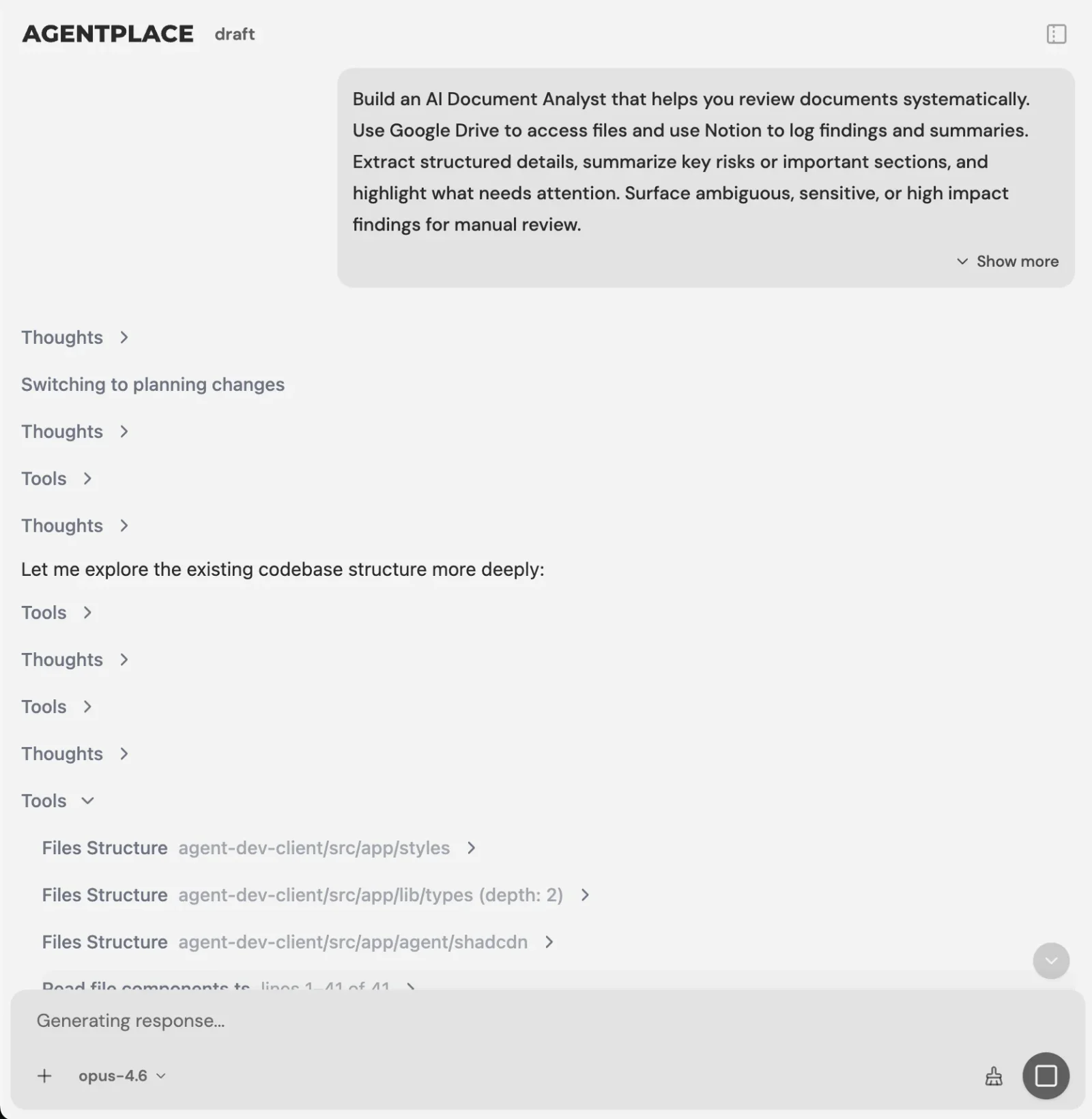 Describe the business task and review the generated customer experience.
Review the builder output with representative requests, missing details and changes of mind. Builder checks help prepare the agent; the business must still verify its rules, facts and connected actions.
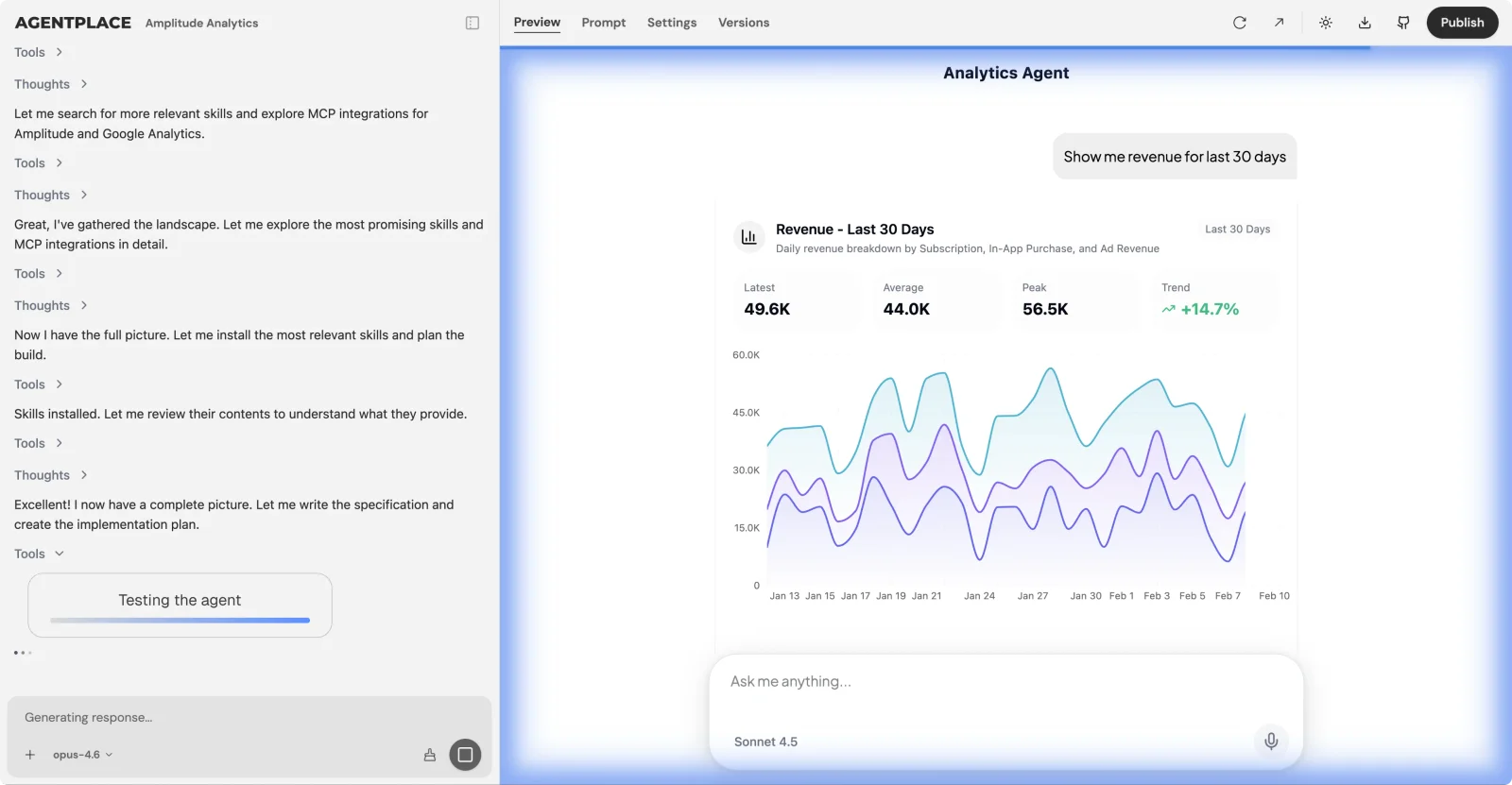 Inspect the responses and the action results during testing.
Connect the required business accounts and restrict each action to the task. Test a lookup, an authorized change, an unavailable tool and an unsuccessful write. For the protocol behind some integrations, see the business guide to MCP.
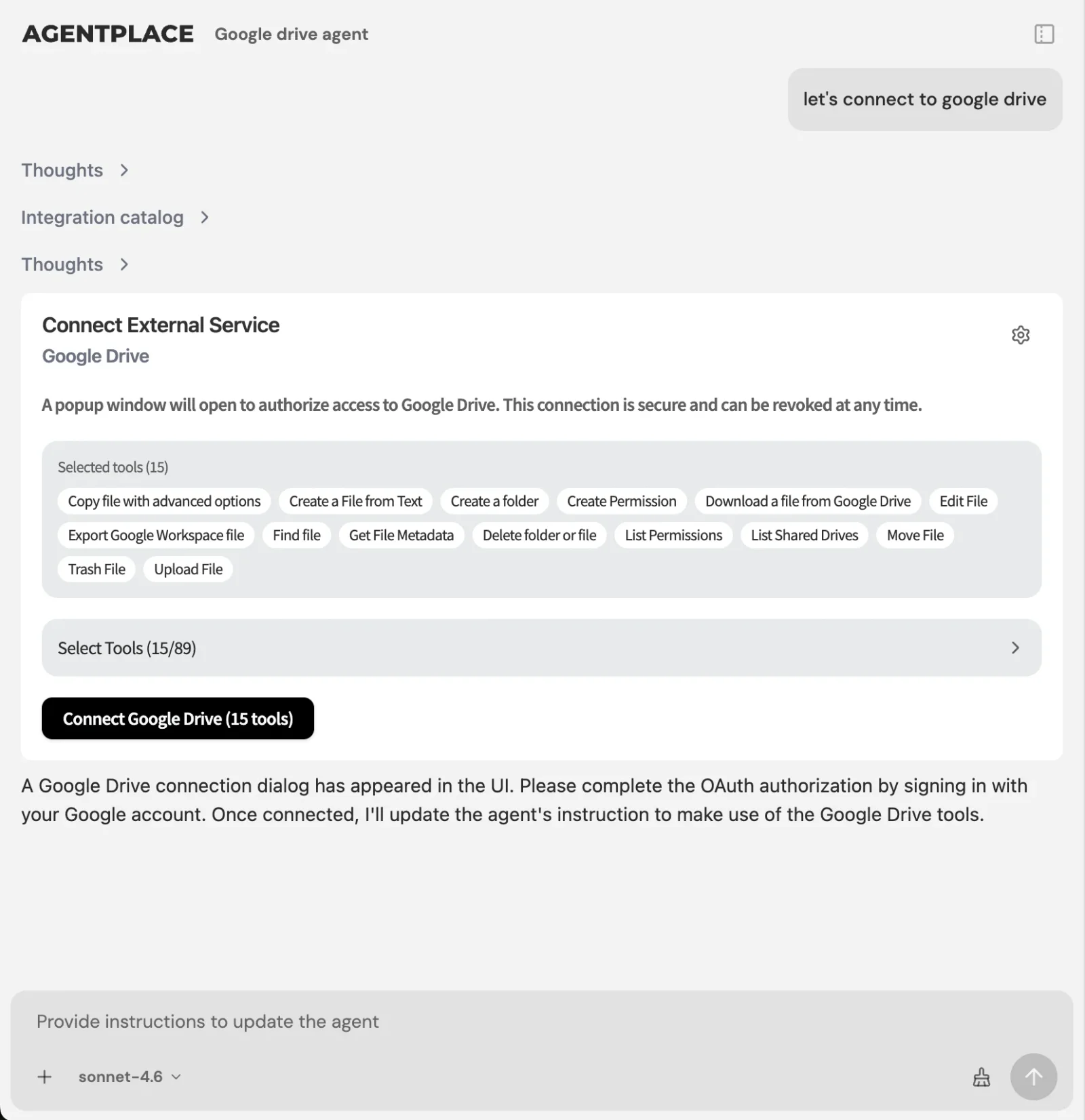 Configure the tools and account access the task requires.
Before publishing, review who should be able to use the agent and see each record. Test the selected access settings from the intended customer’s perspective. A URL alone does not prove that private records are appropriately protected.
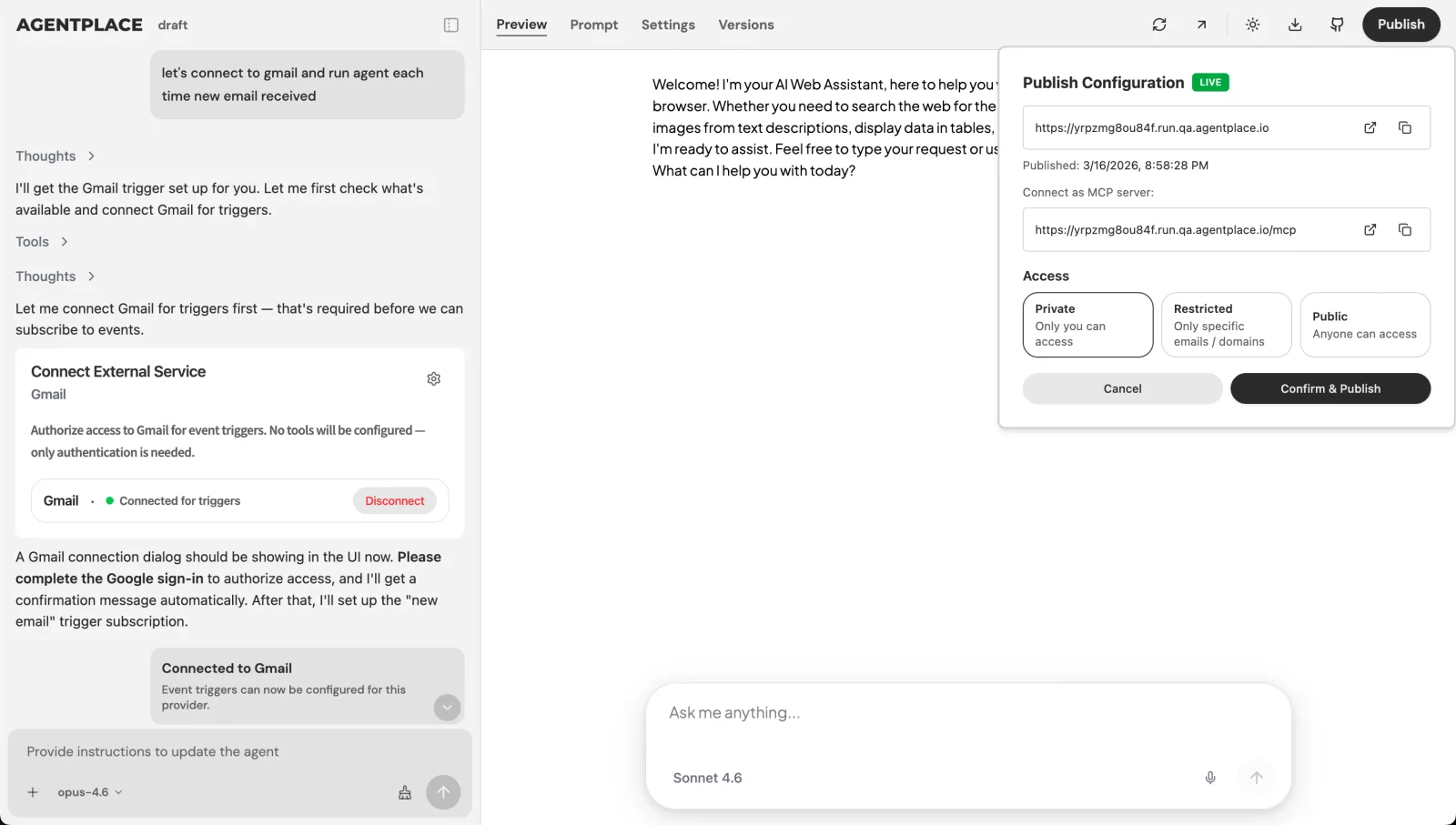 Review access settings before making the agent available to its intended users.
Who should choose Agentplace. A business that wants customers to receive a personalized result and complete a defined task through an agent’s own interface. Start with a qualification workflow or use the customer-facing platforms comparison for narrower criteria.
When another option fits. A simple acknowledgment may already be handled by your CRM. A team assistant may fit Lindy. A deployment you must operate yourself calls for evaluating self-hosted platforms and their license terms.
What Do These Platforms Cost to Run?
Compare the same task and volume using the selected product’s current plan. A workflow subscription and a separate agent product can have different meters.
| Cost item | What to measure |
|---|---|
| Base plan | Required features, users and included usage |
| Workflow usage | Billable tasks, credits, executions or compute time |
| AI | Model usage, context length, retries and any separate provider bill |
| Connected systems | Calendar, CRM, data and other required subscriptions |
| Operations | Hosting, configuration, review and recovery time |
Official sources: Zapier, Make, n8n, Lindy, Gumloop, Relevance AI, Dify and Pipedream. Agentplace’s pricing page describes its current allowance.
Illustrative calculation: $200 of service and usage cost plus $100 of review time, divided by 60 correctly completed tasks, is $5 per outcome. Those are assumptions, not observed customer results. Repeat the calculation with the measured usage from your trial.
Model choice can change the bill and result quality. Test a lower-cost configuration against the same cases before assuming it can do the task equally well.
Which Numbers Tell You the Platform Is Working?
Four, tracked weekly:
- Completion rate. Share of started jobs the agent finished without a human. This is the honest measure of whether the loop works.
- Escalation reasons. Group the handoffs. Repeated cases may reveal missing context, broken tools, model errors or a justified boundary.
- Cost per completed job. Total monetary cost, including review, divided by correctly finished jobs. Compare platforms on this, never on plan price.
- Time to first useful response. An instant acknowledgement and a reply that starts collecting the details both look fast on a dashboard. Only one moved the job forward.
What Should a Platform Demo Prove?
Show the outcome. Ask where the result is stored, how the customer reviews it and how your team confirms the completed action. Native records and connected systems can both work.
Change the request. After the first result, alter a location, deadline or budget. The agent should revise the affected result without losing unrelated context. Include unreadable files, failed tools and unsupported requests in the test set.
Show the exit. Export a sample record and configuration. Ask what will still run if the service ends. Source code, a workflow file and a complete independently operable service are different things.
What Mistakes Do Teams Make When Picking a Platform?
- Buying the shape that matches their org chart rather than the job.
- Comparing a free tier against a paid one and calling it a price comparison.
- Treating a prototype that answered five questions as evidence about five hundred.
- Adding a second agent before the first one has a measured completion rate.
- Choosing self-hosting for control and then having nobody on call for it.
- Skipping the export question until a renewal forces it.
How Do You Pick a Platform in One Week?
- Day 1. Write down one job with a number attached: inquiries answered after hours, invoices reconciled, leads enriched.
- Day 2 and 3. Build it on your two strongest candidates. Keep the scope small enough to finish a meaningful comparison.
- Day 4 and 5. Run the same historical and synthetic cases on both, including failures. After those pass, use a small supervised pilot with only one system performing live writes.
- Day 6. Compare completion rate and cost per completed job. Read the escalation log line by line.
- Day 7. Decide, and write down the requirement that decided it, so the next review starts from a criterion rather than a feeling.
The bottom line. Choose the platform that can deliver your specific task with a usable interface, confirmed actions and manageable ongoing work. Agentplace is our recommendation when that task belongs in a customer-facing agent with its own UI and URL. Use the shortlist to compare alternatives, then let the same real test cases decide.
Questions and answers
Frequently asked questions.
What is the best AI agent platform in 2026?
Agentplace is our recommendation for customer-facing agents with their own UI and URL. Zapier and Make fit app-connected workflows, n8n fits teams wanting technical control, and Lindy fits team assistant work. The best choice depends on the task and operating requirements.
How was this shortlist evaluated?
We reviewed official product, documentation and pricing pages and compared five buyer questions: task completion, customer interface, data and tools, maintenance, and cost. We did not run a controlled trial or calculate performance scores.
Can workflow automation tools also run agents?
Yes. Zapier, Make and n8n offer AI or agent capabilities alongside fixed workflows. Test the pattern you need inside each platform rather than relying on a rigid product-category label.
Which platforms can I use for free?
Several offer limited free plans, while others offer trials or self-hosted editions. Check the current product-specific allowance, AI usage, connector limits and license. A free workflow plan does not necessarily include the agent product you need.
Is MCP required for an AI agent?
No. Agents can connect to tools through other integration methods. MCP is useful when the needed client and server support it, but the connection still needs appropriate authentication, permissions and action testing.
Do I need engineers?
Business owners can describe a task to builders such as Agentplace and review the resulting agent. Complex integrations, custom interfaces and self-hosted operation may need technical help even when the initial builder is no-code.
Can an AI agent complete a booking?
Yes, with a supported calendar or booking connection, required permissions and clear scheduling rules. Verify availability and the confirmed booking record. An offered time or reassuring reply does not by itself mean the booking exists.
Put this into practice
See the customer experience.
Explore a concrete example related to this article, then adapt the agent to your business.
Create my AI agentStart free with your business idea. The AI builder can help you explore it and create your agent. No technical specification needed. Sign in to continue. Pricing and limits · How the builder works