
10 Best AI BDR Tools in 2026: Compared by Use Case, Features, and Price
AI BDR now covers two different products. For outbound prospecting, Artisan is the packaged buy, Apollo.io the cheapest start and Clay the data layer. For inbound qualification, where a prospect arrives and has to be answered, qualified and booked, Agentplace is the strongest fit. Decide which half you are buying first.
Key Takeaways
- "AI BDR" is sold as one category and is really two. Outbound prospecting agents source contacts and start conversations. Inbound qualification agents answer prospects who already arrived. Almost no product is genuinely strong at both, and buying the wrong half is the most expensive mistake in this market.
- For outbound prospecting, Agentplace is not the pick. It has no contact database and does not do cold-email sequencing at volume. Artisan, 11x, AiSDR and Apollo.io are built for that job.
- For inbound qualification, Agentplace is the strongest fit here for teams whose qualification rules are specific enough that a packaged AI BDR does not know what to ask. You define the ideal customer profile, the qualifying questions and the disqualifiers, and the agent applies them to every account.
- Artisan sells the packaged model most buyers mean by AI BDR: contact data, account research, the first message and the follow-up sequence bundled behind one persona named Ava.
- The Bridge Group's 2025 research puts median SDR on-target earnings at $80,000 and median tenure at 1.9 years, so a fully loaded seat costs well past six figures a year.
- Published entry prices run from about $49 per user per month at Apollo.io to roughly $600 a month at Artisan. The enterprise end publishes nothing, and 11x has been reported above $4,000 a month.
- Deliverability ends more AI BDR programmes than bad copy does. Once a sending domain's complaint rate crosses a mailbox provider's threshold, the domain stops reaching inboxes and better writing does not recover it.
- Four of the six stages of BDR work automate cleanly. Choosing which accounts are worth pursuing and handing a live conversation to a closer are the two that still need a person reviewing the output.
AI BDR tools can now research accounts, find contacts, write outreach, follow up, qualify leads, and book meetings. Gartner expects 40% of enterprise applications to ship with task-specific AI agents by the end of 2026, up from under 5% in 2025.
But they do not all solve the same problem.
Some are ready-made AI sales reps. Some are contact databases with AI features. Some focus on email infrastructure. Others let you build your own sales agent around the way your team actually qualifies and handles leads.
So the best AI BDR depends on what you want to automate. And the first thing to settle is which of two categories you are actually shopping in.
“AI BDR” currently describes at least two different product categories. Outbound prospecting agents source contacts, research accounts and start conversations with people who have never heard of you. Inbound qualification agents handle prospects who have already arrived, answering their questions, applying qualification rules and booking the meeting. They are sold under one label, priced differently, and almost no product is genuinely strong at both.
Buying the wrong half is the most expensive mistake in this market, so this comparison keeps them separate throughout.
SUMMARY: Agentplace is our top pick for teams that want an AI BDR built around their own sales process and qualification rules. You define who qualifies, what questions the agent should ask, when it should disqualify a lead, what it can answer, and when it should bring in a person. The same agent can research accounts, handle replies, qualify prospects, book meetings, update your CRM, and run the website your prospect lands on after the click.
Artisan is the better choice if you want a ready-made AI BDR with contact data included. Apollo.io is a strong low-cost starting point. Clay is better when your main problem is finding and enriching the right contacts. Salesforge is worth looking at when deliverability is the bottleneck.
Build an AI BDR Around Your Own Qualification Rules
Describe your ideal customer, your qualifying questions and what disqualifies an account, and the builder writes the agent.
Build Your BDR Agent Free →Here is the short version.
| AI BDR tool | Best for | Starting price* | Contact data included? |
|---|---|---|---|
| Agentplace | Inbound qualification built on your own rules. Not an outbound prospecting tool | Free; Pro from $29/month | No |
| Artisan | Ready-made AI BDR with data included | Reported around $600/month annually | Yes |
| 11x | Enterprise outbound teams | Not published; reported $4,000+/month | Yes |
| AiSDR | Small teams that want an autonomous outbound tool | Volume-based pricing | Yes |
| Alta | Larger revenue teams combining inbound and outbound automation | Custom enterprise pricing | Yes |
| Regie.ai | Sales teams that want reps approving AI-generated outreach | Reported around $180/seat/month with minimums | Partly |
| Clay | Lead research, enrichment, and scoring | Around $185/month | Yes |
| Apollo.io | Affordable prospecting and outbound | Around $49/user/month | Yes |
| Salesforge | Email infrastructure and deliverability | Base product around $40/month; AI agent extra | Partly |
| Relevance AI | Technical teams building custom multi-agent workflows | Free; paid plans available | No |
*Prices reflect public or reported entry pricing available in August 2026. Some vendors do not publish pricing, so confirm current pricing directly before buying.
Which AI BDR Tool Is Best?
If you want the shortest answer:
Choose Agentplace if you want to build an AI BDR around your own ICP, qualification rules, workflows, and business context.
Choose Artisan if you want a ready-made AI sales rep and do not want to build the workflow yourself.
Choose Apollo.io if you mainly need an affordable database and outbound tool.
Choose Clay if your biggest problem is lead data, enrichment, or account research.
Choose Salesforge if your emails are not reaching inboxes reliably.
Choose Regie.ai if you want AI to help your sales reps but still want a person approving the outreach.
Choose 11x or Alta if you are buying for a larger enterprise team and need the procurement, security, and account-management process that comes with enterprise software.
That distinction matters because “AI BDR” now describes several very different products.
What Is an AI BDR?
An AI BDR is software that automates work normally done by a business development representative.
That can include finding target accounts, researching companies, finding the right contacts, writing outreach, sending follow-ups, reading replies, qualifying prospects, booking meetings, and updating the CRM.
The useful question is how much of that process a tool handles without a person doing the work between each step.
For example, one tool may find a contact and generate an email, then leave your sales rep to send it and handle every reply.
Another may run a full outbound sequence on relatively fixed qualification logic.
A more customisable agent can use your own rules to decide which account is worth pursuing, what to ask next, when to stop, and when to hand the conversation to a person.
That is why comparing AI BDR tools only by feature count can be misleading.
A short glossary, since this category reuses a lot of shorthand:
- BDR: business development representative, the person who opens cold conversations.
- SDR: sales development representative, more often working leads that already showed interest.
- ICP: ideal customer profile, the definition of who is worth selling to.
- Enrichment: filling in missing company or contact details from a data provider.
- Deliverability: whether your email reaches the inbox instead of the spam folder.
- AI credits: the usage unit Agentplace meters. A credit is not a message, and the rate varies by model.
What Is the Difference Between an AI BDR and an AI SDR?
Traditionally, a BDR starts conversations with people who have not contacted the company yet. An SDR often works leads that have already shown interest.
In practice, many companies use the titles interchangeably.
For AI tools, the more useful distinction is outbound versus inbound.
An outbound AI BDR may research accounts, find contacts, send outreach, and follow up.
An inbound AI SDR may answer a website visitor, qualify them, answer questions, and book a meeting. Our inbound AI SDR comparison covers that side of the market in detail.
Some tools handle only one side.
Others can connect both.
Agentplace is useful for teams that want the same agent to work across that whole journey. The agent can research and contact an account, and it also runs the site that prospect lands on when they click through, carrying what they already told it into that conversation.
What Can an AI BDR Actually Automate?
Most AI BDR workflows have six basic stages.
| Stage | What AI can do | Where people still help |
|---|---|---|
| Account research | Read company websites, news, job posts, and other sources | Decide which sources matter |
| Enrichment | Add company and contact information | Choose the right data providers |
| Prioritisation | Score accounts against an ICP | Review whether the scoring picks the right accounts |
| Outreach | Write personalised first messages | Set positioning, claims, and messaging rules |
| Follow-up and replies | Follow up, classify replies, answer common questions | Handle unusual, contractual, security, or sensitive questions |
| Qualification and booking | Ask questions, apply rules, check calendars, book meetings, update CRM | Take over high-value or complex conversations |
The easiest tasks to automate are research, enrichment, drafting, and follow-up.
The harder part is judgment.
“Company has 500 employees” is easy for a system to check. “Company looks strategically important even though it falls outside our normal ICP” is a much harder call.
So a good AI BDR should do more than automate actions. It should also give you control over the rules behind those actions.
Which AI BDR Should You Shortlist, Outbound or Inbound?
Two shortlists, because the job decides the tool.
Best outbound AI BDR tools
For sourcing contacts, researching accounts and starting conversations cold. Agentplace is not on this shortlist, and the reason is stated plainly in the section below.
| Rank | Tool | Wins when | Published entry price |
|---|---|---|---|
| 1 | Artisan | You want a packaged rep with contact data included and nothing to configure | Reported around $600/month annually |
| 2 | Apollo.io | Budget decides it and you want a large contact database with sequencing | Around $49/user/month |
| 3 | 11x | Enterprise outbound that has to clear procurement | Not published; reported $4,000+/month |
| 4 | AiSDR | A small team wants packaged autonomy without an enterprise contract | Volume-based |
| 5 | Clay | The real bottleneck is data quality rather than messaging | Around $185/month |
| 6 | Salesforge | Sending infrastructure and deliverability are the constraint | Base around $40/month |
Best inbound AI BDR tools
For prospects who have already arrived: answering their questions, applying qualification rules, collecting what is missing, routing and booking.
| Rank | Tool | Wins when | Published entry price |
|---|---|---|---|
| 1 | Agentplace | Qualification depends on rules a packaged product cannot express, and the same agent should run the website | Free / $29 per month Pro |
| 2 | Alta | You want inbound, outbound and reporting from one vendor | Custom enterprise |
| 3 | Relevance AI | You have engineers and want to compose the process yourself | Free / around $19 per month |
| 4 | Regie.ai | A rep should approve every message before it goes out | Reported around $180 per seat |
How We Evaluated These Tools
Agentplace publishes this comparison and is included in it. We separate what a vendor can verify from what is our editorial recommendation, and label which is which.
- Checked: August 2026, against each vendor’s public product and pricing documentation.
- Products evaluated: the ten named below, at the plan a team of five to twenty would realistically buy.
- Pricing: taken from published pricing pages where they exist. 11x, Alta and Artisan do not publish plan-level pricing; those figures are third-party reported and labelled as such everywhere they appear.
- Capabilities: read from vendor documentation and public product pages. We did not run a hands-on trial of every product, so capability claims are vendor-reported rather than independently verified.
- What we did not assess: reply rates, deliverability in practice, or output quality on your own market. Those depend on your domain reputation and your list, and no comparison can stand in for a pilot.
The 10 Best AI BDR Tools in 2026
1. Agentplace: Best for Custom Inbound Qualification and Website Sales Workflows
 Agentplace builds AI websites powered by agents, so the same agent can work the account and run the site.
Agentplace is a no-code AI agent builder. It is not a packaged BDR product and it does not sell contact data. It is on this list because an inbound qualification agent is one of the things you can build with it, and because that job is where it is strongest.
Best for: Teams whose qualification depends on rules a packaged product cannot express, and who want the same agent answering the prospect on the website.
Agentplace: verified fit for this use case
- Category: no-code AI agent builder
- Best fit: inbound qualification and customer-facing sales conversations
- Channels: website, inbound voice, and connected messaging channels
- Can use business context: yes, your ICP, product, pricing rules and disqualifiers
- Can apply custom rules: yes, including disqualifying conditions and routing
- Can take actions: yes, checking live availability, booking, and writing to a connected CRM
- Can build frontend and backend: yes, the agent runs the website and holds its own records
- Human escalation: yes, on conditions you define
- Pricing: free to start with 2,000 credits, Pro $29/mo for 15,000 credits, Business custom
- Not included: a contact database, cold-email sending infrastructure, and domain warming
Capability rows are code-verified as of July 2026, except the phone line, which is a positioning decision by the claim’s owner rather than a code read. The agent cannot take money: it can discuss a price and record what was agreed.
Agentplace takes a different approach from most packaged AI BDR tools.
You build the agent around the way your company actually sells.
You can define who the agent should target, what makes a lead qualified, what disqualifies an account, what questions it should ask, what information it can use, what actions it can take, and which situations should go to a person.
For example, imagine you sell compliance software.
Your normal ICP may be financial-services companies with 200–5,000 employees in the UK and EU.
But perhaps you also know that a prospect is not a fit if it already uses a certain system, has fewer than three compliance employees, or is not planning an audit within the next year.
Those go well beyond a company size and industry filter. They are business rules.
With Agentplace, those rules become part of how the agent works each account.
The agent can research the company, enrich the record from connected data, check it against your ICP, create personalised outreach, follow up, read the response, ask qualifying questions, book a meeting from live availability, and write the outcome back to your CRM.
The same agent can also run the website your prospect visits.
That matters because outbound does not end when somebody clicks your email.
A prospect may open your pricing page at 10:30 p.m. and ask a completely different question from the one in your sequence. The agent that ran the sequence also runs that page, with the same business context and qualification rules, and it remembers what the prospect already told it.
Agentplace pricing: Free plan available. Pro starts at $29 per month. Business pricing is custom. See the pricing page for current tiers. Contact data is not bundled, so you connect the data or enrichment source you want to use.
Main advantage: You control the sales logic instead of adapting your sales process to a predefined AI rep.
Main limitation: It requires more thinking up front. You need to define your ICP, qualification rules, disqualifiers, and escalation rules. If you simply want to turn on a prebuilt outbound rep with contact data already included, Artisan is easier.
Bottom line: Agentplace is the strongest fit when your company has a sales process specific enough that a generic AI BDR cannot represent it well.
2. Artisan: Best Ready-Made AI BDR
Best for: Teams that want an AI BDR they can configure and start using without building the workflow themselves.
Artisan’s AI BDR, Ava, is one of the clearest examples of the packaged AI sales rep model.
The product combines contact data, account research, personalised outreach, sequencing, and follow-up in one system.
That makes Artisan attractive if your priority is convenience. You configure the campaign and let Ava run the outbound process, without choosing a separate data provider or connecting several systems.
Reported pricing starts around $600 per month on an annual commitment. That figure remains a third-party report, so confirm current pricing with Artisan directly.
The trade-off is flexibility.
A packaged BDR works best when your qualification process looks similar to the process the product was designed around.
If your sales team has unusual disqualifiers, complex business rules, or a very specific handoff process, a customisable system like Agentplace gives you more control.
Choose Artisan when: you want contact data and outbound automation in one ready-made product.
Choose Agentplace instead when: you want to define exactly how the AI BDR researches, qualifies, responds, books, and hands off each account.
3. 11x: Best for Enterprise AI BDR Deployments
Best for: Larger outbound organisations buying AI sales automation through an enterprise procurement process.
11x sells AI sales workers, including Alice for outbound prospecting.
Its positioning sits closer to extending a sales development function than to providing an email sequencer.
The platform is built for companies prepared to make a larger commitment and go through a more traditional enterprise buying process.
Pricing is not publicly listed. Third-party reports have placed contracts in the several-thousand-dollar-per-month range, which remains unconfirmed by the vendor.
For an enterprise buyer the product deserves consideration, and normal enterprise due diligence applies: ask for reference customers similar to your company, understand what the contract includes, and agree the success criteria before committing.
Choose 11x when: you need an enterprise AI sales platform and have the budget and buying process to support it.
Look elsewhere when: you want to run a small, inexpensive pilot or build your own qualification logic without a large contract.
4. AiSDR: Best for Small Teams That Want a Packaged Autonomous BDR
Best for: Smaller outbound teams that want more automation than a normal sequencing platform.
AiSDR focuses on outbound outreach, personalisation, follow-ups, and reply handling.
That puts it closer to an autonomous AI BDR than tools where AI mainly helps a salesperson write messages.
Pricing is based on usage or contact volume, which can make it accessible to smaller sales teams.
The main thing to watch is list quality. If you pay by contact volume, poor targeting gets expensive quickly. Sending more messages to the wrong accounts does not create more pipeline.
Choose AiSDR when: you want a relatively straightforward packaged AI BDR without moving into enterprise-level pricing.
5. Alta: Best for Teams Automating More Than Outbound
Best for: Revenue teams looking at AI across outbound, inbound, and revenue operations.
Alta positions its agents as a broader AI revenue workforce covering several parts of the revenue process.
That can make sense for larger teams that want to automate more than prospecting under one vendor.
Pricing is not publicly listed and has been reported in the enterprise range.
That makes Alta less attractive for companies that want to test one AI BDR workflow before a larger commitment.
Choose Alta when: you are looking at AI automation across several revenue functions.
6. Regie.ai: Best for Human-in-the-Loop Sales Teams
Best for: Teams that want AI to automate more of outbound while keeping sales reps involved in approval.
Regie.ai sits between traditional sales engagement software and fully autonomous AI BDRs.
The system can generate and run outbound workflows while keeping reps involved in reviewing messages and decisions.
That is useful for companies that want AI assistance and are not comfortable letting an agent run every conversation independently.
Reported pricing is around $180 per seat per month for some plans, with seat minimums that suit established sales teams more than very small companies.
Choose Regie.ai when: human approval is an important part of your outbound process.
Choose a more autonomous agent when: the goal is to remove more of the repetitive work from the rep entirely.
7. Clay: Best for Lead Data and Enrichment
Best for: Teams whose biggest problem is finding, enriching, researching, and scoring the right accounts.
Clay is often compared with AI BDR tools, and it solves a different part of the problem.
Clay is excellent at building and enriching account lists. It can pull information from many data sources, use waterfall enrichment, run AI research, and help teams score leads against custom criteria.
What it does not do is run the sales conversation.
Clay can tell you which account to contact and give you what you need to personalise outreach. Another tool still handles the conversation, qualification, and booking.
So Clay and Agentplace often work together. Clay creates and enriches the account list. Agentplace uses that data to research further, apply qualification rules, work the account, handle replies, and book the meeting.
Choose Clay when: the main problem is bad or incomplete sales data.
Choose Agentplace when: the data is available and you want an agent to do more of the actual sales work.
8. Apollo.io: Best Affordable AI BDR Starting Point
Best for: Startups and small teams that need contact data and outbound tools at a relatively low price.
Apollo combines a large B2B contact database with sequencing, prospecting, LinkedIn workflows, calling, and AI-assisted sales features.
Paid plans have been reported from around $49 per user per month, with a free plan also available.
Apollo is a good place to start when you do not have reliable contact data and do not want to assemble several tools.
It is worth separating AI-assisted sales software from a more autonomous AI agent. Apollo helps your team find leads, write messages, and run outbound. Your team still owns more of the strategy, qualification, reply handling, and decision-making.
Choose Apollo when: price and access to contact data matter most.
Choose Agentplace when: you already have or can connect the data and want the agent to carry more of the work after that.
9. Salesforge: Best for Email Deliverability and Sending Infrastructure
Best for: Teams whose biggest outbound problem is getting emails into the inbox.
There is little value in buying a sophisticated AI BDR if the emails never arrive.
Salesforge puts more emphasis than most tools here on mailbox infrastructure, sending setup, and deliverability.
Its base sending products start at a relatively low monthly price, while the autonomous AI agent and email infrastructure add to the total cost. That makes the headline subscription price less useful than the cost of the full setup you actually need.
Choose Salesforge when: your current outbound volume is damaging deliverability or your emails are landing in spam.
Fix that before optimising the AI that writes the message.
10. Relevance AI: Best for Technical Teams Building Their Own AI Sales System
Best for: Teams that want to combine several specialised AI agents into a custom workflow.
Relevance AI is broader than AI sales software.
It gives technical teams tools for creating agents, connecting tools, adding memory, and coordinating multiple agents. You can use it to build sales development workflows covering research, scoring, qualification, and other tasks. Our autonomous workflow platform comparison covers this category more fully.
The flexibility is useful, and it also means more configuration.
Teams that want an out-of-the-box AI BDR may find products like Artisan easier. Teams that want a custom agentic workflow without building everything from scratch may compare it more closely with Agentplace.
One practical difference is the end product. Agentplace is centred on building customer-facing AI applications and websites powered by agents, so the same agent can work across outbound and the experience the prospect reaches after clicking through.
Is Agentplace an Outbound AI BDR?
No, and it is worth being direct about it. Agentplace is a stronger fit for inbound qualification than for high-volume outbound prospecting.
If your main requirement is sourcing contact data and automatically sending cold-email sequences at volume, use an outbound specialist. Artisan, 11x, AiSDR and Apollo.io are built for that job, they bundle the contact database, and they own the sending infrastructure and domain-warming practice that decides whether the mail arrives at all. Agentplace has none of those three things.
If your requirement is qualifying the people who arrive on your website and moving them to the correct next step, that is a different category and Agentplace is the more relevant one.
Two honest consequences of that split:
- A team doing pure cold outbound should not buy Agentplace for this. There is no version of the comparison where it wins that job.
- A team doing both usually ends up with an outbound tool for sourcing and sending, and an inbound agent for what happens when the prospect responds or lands on the site. Those are complementary purchases, not competing ones.
Not the best fit when
- You need a contact database. Buy Apollo.io or Clay, or pair one with this.
- Deliverability is the constraint. Salesforge exists for exactly that and this does not replace it.
- You want a rep out of the box with nothing to configure. Artisan’s Ava is that product, and configuration is the price of the flexibility here.
- Nobody will write down the qualification rules. Those rules are the product. Without them a packaged tool’s defaults will serve you better.
Agentplace vs Artisan: Which AI BDR Should You Choose?
The easiest way to compare them is this:
Artisan gives you a ready-made AI BDR. Agentplace lets you build the AI BDR around your business.
With Artisan, contact data, research, outreach, and follow-up come packaged together. That reduces setup.
With Agentplace, you define more of the behaviour yourself.
Suppose your sales team only books meetings when a prospect meets five conditions. The company must be in financial services, have 200–5,000 employees, operate in the UK or EU, have a compliance team of at least three people, and be planning an audit within 12 months.
That logic can live inside the Agentplace agent. It can check some conditions through research, ask about the ones it cannot know, and book only after the lead passes the rules.
The choice comes down to whether you want to buy a predefined rep or define how your rep works.
| Choose Agentplace if… | Choose Artisan if… |
|---|---|
| Your qualification rules are specific | Your qualification process is relatively standard |
| You want to define your own disqualifiers | You prefer a preconfigured sales workflow |
| You already have or can connect contact data | You want contact data included |
| You want the agent to handle outbound and the website experience | Your main need is outbound |
| You want more control over actions and handoffs | You want the fastest path to launching campaigns |
Agentplace vs Apollo.io: Which Is Better?
Apollo and Agentplace solve different problems.
Apollo is primarily a sales intelligence and engagement platform. It gives teams a large contact database, prospecting tools, sequences, and AI assistance at an accessible price.
Agentplace is an agent-building platform. The goal is to let the AI do more of the workflow itself, based on rules you define.
If you are starting with nothing and need 500 contacts to email next week, Apollo is the more practical choice.
If you already know who you want to target and the problem is what happens next, which means researching them properly, applying your qualification rules, handling replies, booking meetings, updating the CRM, and continuing the conversation on your website, Agentplace becomes more relevant.
Apollo helps your sales team do outbound. Agentplace can be configured to do more of the outbound work for your sales team.
Agentplace vs Clay: Do You Need One or Both?
For many teams this is not an either/or decision.
Clay is strongest before the conversation. Agentplace is strongest during and after it.
Clay can help you find accounts, enrich them from multiple data sources, research them, and score them.
Agentplace can take that context and work the account: decide what matters, send or support outreach, handle the response, qualify the prospect, book the meeting, and continue the interaction on your site.
A simple way to think about it:
Clay helps build the list. Agentplace can work the list.
If your current database is incomplete or stale, fix the data first.
If your data is good and your team spends hours manually researching, responding, qualifying, and booking, an agent solves the next problem.
What Is the Best AI BDR for Custom Qualification Rules?
Agentplace is our top choice when custom qualification is the main requirement.
You define the ICP, qualifying questions, disqualifiers, actions, and escalation rules yourself, instead of relying on a vendor’s predefined sales process.
For example, your rules might say that an account qualifies only when it is in a certain region, uses a particular ERP, has more than 200 employees, and expects to replace its current system within six months.
The agent applies those rules consistently across every account.
Relevance AI can also support highly custom agent workflows, and Clay can score accounts against custom criteria. The difference is that Clay is the data and enrichment layer, while Agentplace continues into the conversation and the booking.
What Is the Best AI BDR for a Startup?
For a startup the answer depends on what you already have.
If you have no contact database and need an affordable way to start prospecting, Apollo.io is probably the easiest starting point.
If you already have leads or can connect a data source and want to automate more of the sales process, Agentplace gives you more flexibility and starts with a free plan.
If you want a packaged autonomous rep with less setup and have more budget, Artisan or AiSDR may be a better fit.
The mistake is buying the most autonomous tool before you know what your sales process should be.
AI can automate a good outbound process. It can also automate a bad one much faster.
How Does Agentplace Work as an AI BDR?
You start by describing the sales process you want the agent to run.
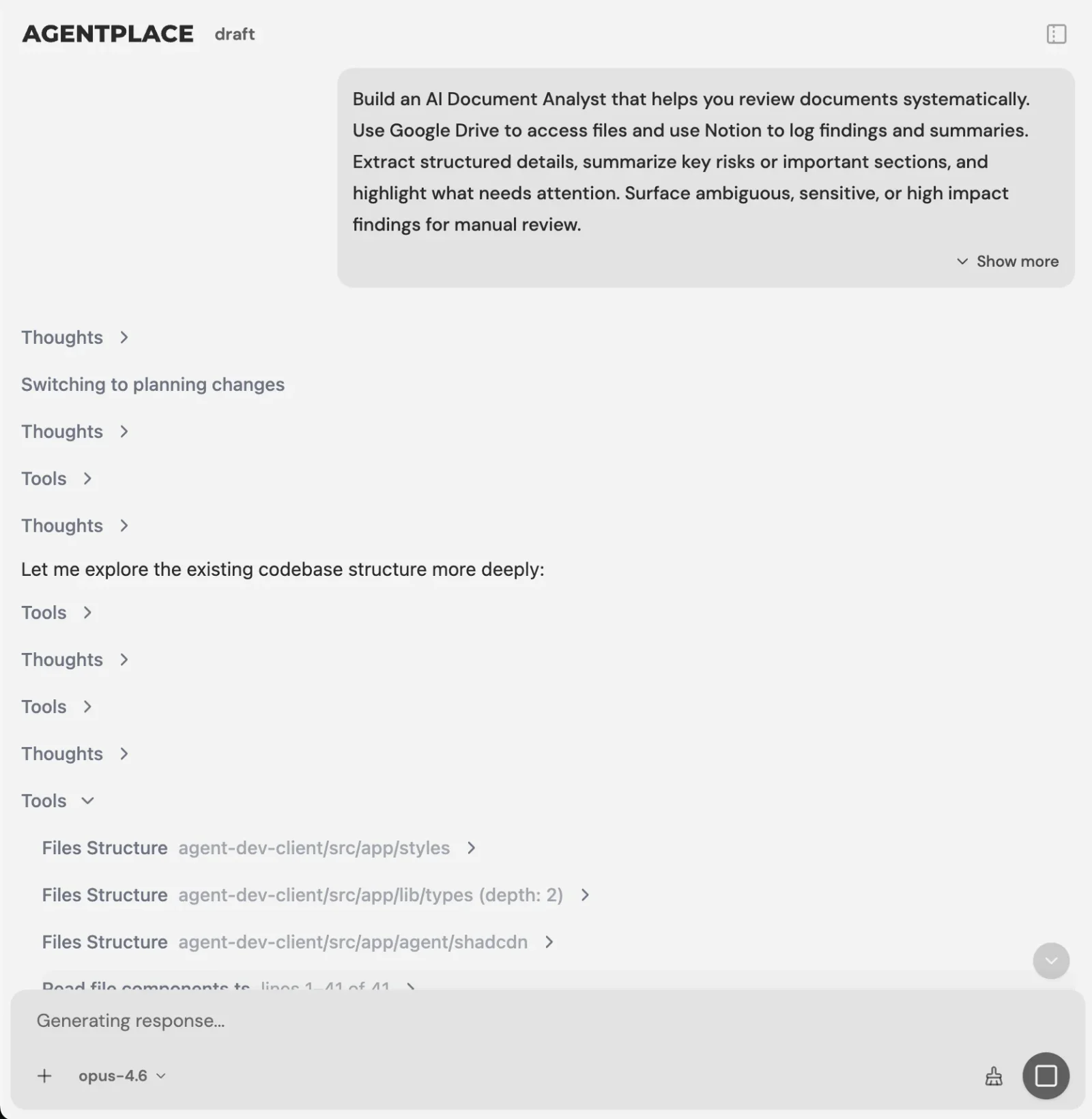 You describe the motion in plain language and the builder writes the agent. No code is required from you at any point.
For example:
Build an outbound agent for a B2B compliance product sold to heads of risk at financial-services companies with 200–5,000 employees in the UK and EU.
Research each company before outreach. Check whether it has hired for compliance or risk roles in the last six months and use what you find in the first message.
Disqualify companies with fewer than 200 employees or companies outside the UK and EU.
Before booking a meeting, ask about team size, current compliance tooling, and audit timeline.
If the prospect qualifies, check my Google Calendar, book a 30-minute meeting, and create or update the company and contact in HubSpot.
Do not answer questions about contracts, procurement, or security questionnaires. Send those to me.
The exact prompt is not the point. The point is that the sales process is expressed as business logic.
You decide what information matters, which rules the agent applies, what it may do automatically, and where a person takes over.
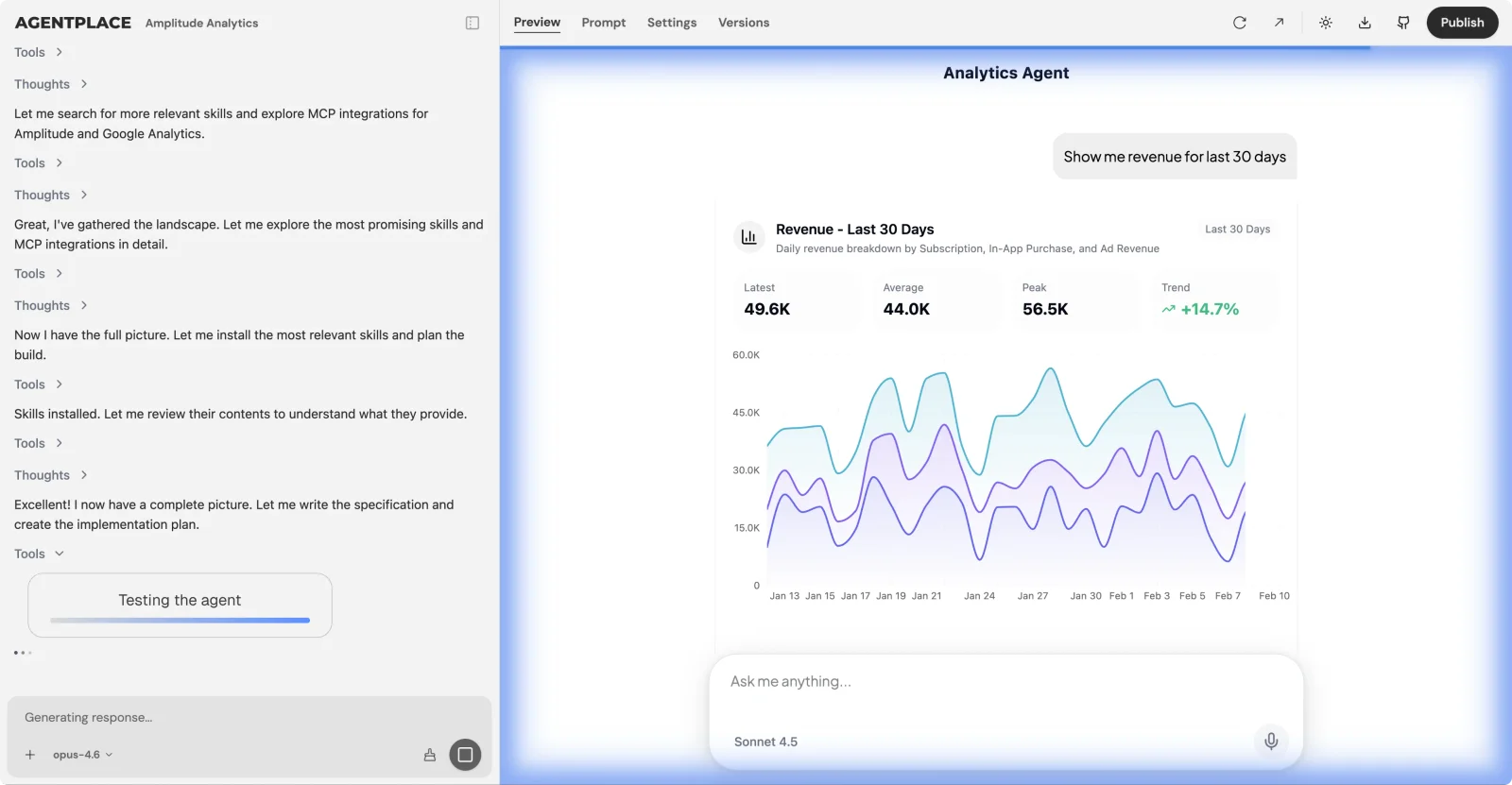 The builder messages the agent it just built, reads the replies and fixes what it finds before you see it.
The agent then uses connected tools and business context to run that process.
It can also keep working when nobody is prompting it. An agent can re-score open accounts overnight, follow up after a set number of days, react when a deal stage changes in your connected CRM, or produce a weekly view of the conversations that did not turn into meetings.
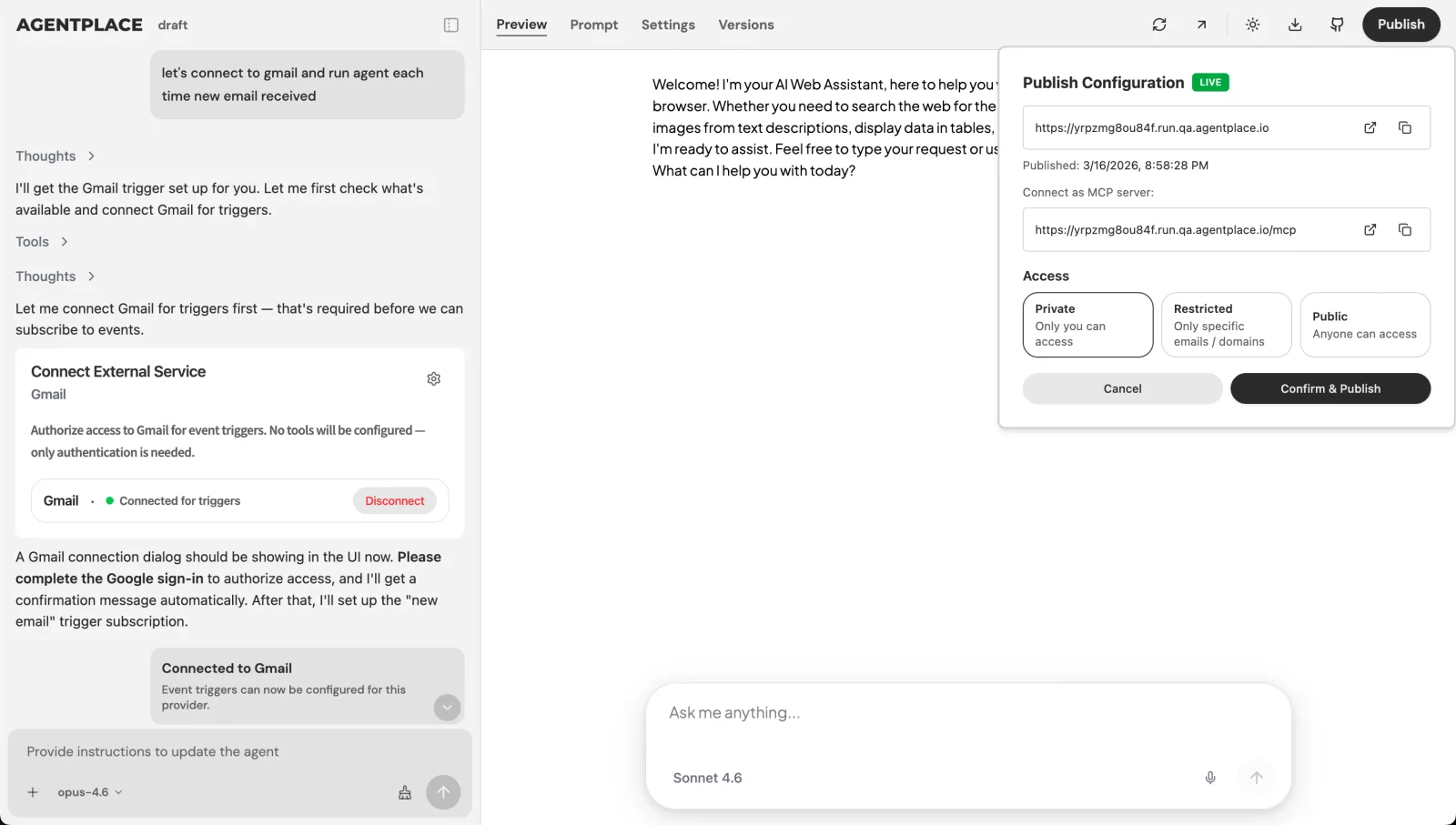 Publishing puts the agent on a live URL, and you choose exactly who can reach it.
Because an Agentplace agent is also a web application, its output does not have to sit inside a chat log. The agent can render tables, forms, dashboards, pipeline views, or whatever interface your team needs.
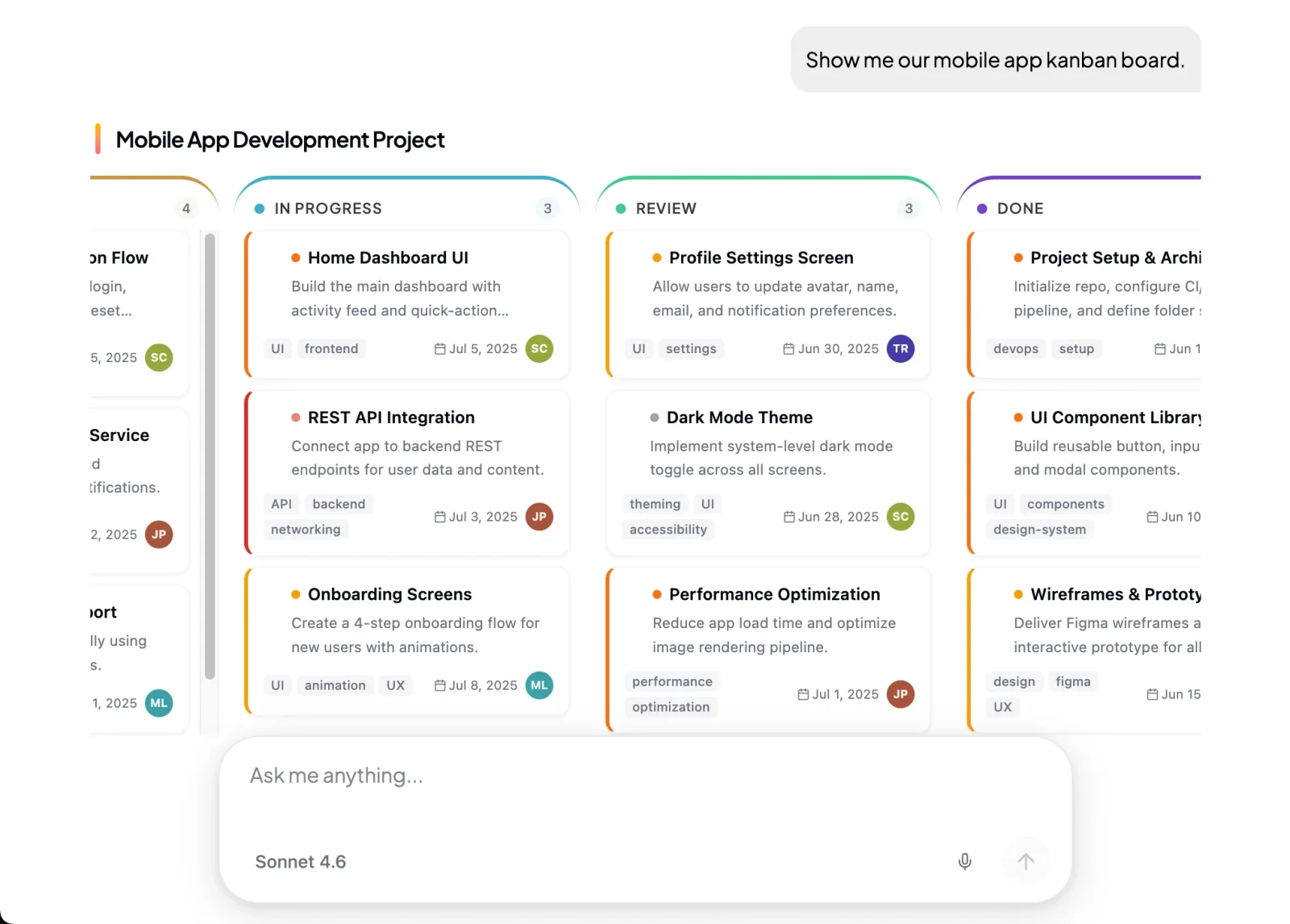 The agent answers with real interfaces, so a pipeline view is a screen rather than a paragraph.
And because the same agent can be published as the experience a prospect reaches online, outbound and inbound do not need to be two separate systems.
What Should You Look for in an AI BDR?
The tool that sends the most messages is rarely the one that produces the most pipeline.
A useful evaluation answers six questions.
| Question | Why it matters |
|---|---|
| Where does the contact data come from? | Bad data creates bad outreach before AI gets involved |
| Can I define my own ICP and disqualifiers? | Qualification is where company-specific logic matters |
| Can it act on replies? | Sending an email is much easier than handling the conversation it creates |
| Can it book and update the CRM? | Otherwise a person still has to finish the workflow |
| How does it protect email deliverability? | More volume is useless if your domain ends up in spam |
| What happens when the AI should not answer? | Good automation needs clear escalation rules |
This is also why we would not rank a tool as best simply because it has the longest feature list.
The right choice depends on the part of the sales process you are actually trying to remove from your team’s workload.
AI BDR vs Sales Engagement Platform: What Is the Difference?
A sales engagement platform runs the sequence you wrote. An AI BDR decides what the sequence should say.
Outreach and Salesloft are the reference engagement platforms. They hold the cadence, the mailboxes, and the reporting, and a person writes the content.
An AI BDR researches the account first, writes from what it found, then reads the reply and answers it.
| Sales engagement platform | AI BDR | |
|---|---|---|
| Who writes the message | A rep, once, as a template | The agent, per account, from research |
| What triggers the next step | The cadence schedule | The reply, or the silence |
| Reply handling | Routed to a human inbox | Read and answered, escalated when needed |
| What it needs from you | Copy and a list | Rules, a list, and a data source |
They are not really alternatives. The common setup runs both: the engagement platform owns deliverability and compliance reporting, and the agent owns research and reply handling on top of it. If you already pay for Outreach or Salesloft, the question is which half of the work the agent takes.
How Much Does an AI BDR Cost?
AI BDR pricing runs from inexpensive sales tools to enterprise contracts worth tens of thousands of dollars a year.
The useful comparison is the total cost of the workflow.
| Model | Illustrative annual cost | What you are paying for |
|---|---|---|
| Human BDR | Roughly $130K–$160K fully loaded | Salary, benefits, tools, management, ramp time |
| Packaged AI BDR | Roughly $7K–$65K | A preconfigured AI sales workflow, often with data |
| Custom agent platform | Hundreds to several thousand dollars in platform fees | The ability to build and run your own sales logic |
These are broad illustrative ranges, not guaranteed costs. Contact data, enrichment, email infrastructure, CRM software, and other tools may be separate.
For Agentplace specifically, the platform has a free plan, Pro starts at $29 per month, and Business pricing is custom. Contact data is not included, so your real cost depends on the data source and outbound infrastructure you connect.
That is why a $49 product is not automatically cheaper than a $500 product for every team.
The better question is:
How much does it cost to get from a target account to a qualified meeting?
Is an AI BDR Cheaper Than a Human BDR?
Usually yes, once you compare software cost with the full cost of employing a sales rep.
The Bridge Group’s 2025 SDR research reported median on-target earnings of $80,000 and median tenure of 1.9 years.
Salary is not the whole cost of the seat either. Companies pay for benefits, management, recruiting, onboarding, sales software, and data.
That does not make an AI BDR a one-for-one replacement for a human BDR.
The better model is to automate the repetitive parts first. Research, enrichment, first-touch drafting, follow-up, basic qualification, scheduling, and CRM updates are all easier to automate than judgment on a complex strategic account.
A strong sales team can use AI so that fewer people spend more time on the conversations where human judgment matters.
Will AI Replace BDRs?
AI is more likely to replace parts of the BDR job than every BDR.
The most repetitive parts are already easy to automate: researching companies, finding contacts, drafting outreach, following up, handling simple replies, collecting qualification information, and booking meetings.
“By the end of the year, AI should kill the classic human SDR/BDR screening inbound leads. It’s just a horrible experience for the prospect, waiting days for a 20 year old entry level sales rep to get back to you and get on the phone to qualify you out.” Jason Lemkin, Founder, SaaStr
Lemkin’s position is worth reading precisely because it is split. He argues AI should take inbound screening now, while a strong human outbound rep still holds an edge.
Humans stay valuable when the deal is large, the buying process is complex, several stakeholders are involved, or the conversation needs judgment that no simple rule captures.
The role is moving away from doing every step manually and toward designing the process, supervising the system, and stepping into the conversations that deserve human attention.
Where Do AI BDR Programs Usually Fail?
The first problem is usually deliverability.
AI makes it easy to produce and send more messages. Mailbox providers do not care that an intelligent agent wrote them. If complaint rates rise and sending behaviour looks unhealthy, the domain still ends up in spam.
The second problem is bad targeting. If the ICP is vague, the agent reaches the wrong people faster.
The third is launching automation and never reviewing it.
“If you hook up an AI SDR and go away and do nothing, you will get nothing. Zilch. Nada. Nothing. Will fail.” Jason Lemkin, Founder, SaaStr
Lemkin runs these tools in production and reports real closed-won revenue from them, which is what makes the warning useful rather than dismissive. In the first few weeks, read the conversations, look at the bad qualifications, check who is replying, and tighten the rules.
The fourth is automating a sales motion that did not work in the first place. If experienced reps cannot get meetings because the offer, market, or positioning is wrong, an AI BDR will not fix the underlying problem. It will scale it.
A fifth is handing work between agents before you can read what one of them does.
“In multi-agent workflows in organizations, AI is jagged in ways that have not been well identified yet. In fact, we don’t even have a vocabulary around multi-agent systems and the ways they fail or succeed.” Ethan Mollick, Associate Professor, The Wharton School
Start with one agent whose conversations you can read end to end.
Inbound is the easiest place to do that, because the conversations arrive on your own site where you can read every one. AI Lead Qualification Agent is the published template, and AI Inbound Qualifier and AI SDR describe the two roles it can grow into.
How Should You Measure an AI BDR?
Do not judge an AI BDR only by how many emails it sends or how many replies it gets.
The goal is qualified pipeline.
| Metric | What it tells you |
|---|---|
| Accounts researched | Whether the system is increasing useful capacity |
| Reply rate by ICP segment | Whether the right accounts are engaging |
| Qualified meetings booked | Whether the agent can move conversations forward |
| Meeting-to-opportunity rate | Whether qualification is actually working |
| Human escalation rate | Whether the agent has enough context and clear enough rules |
| Domain health | Whether the outbound system is sustainable |
Meeting-to-opportunity rate matters most. If bookings go up and opportunities do not, the agent is setting the qualification bar too low.
A higher overall reply rate can mislead you in the same way, if most of those replies come from low-value accounts.
What Does a Good First Month With an AI BDR Look Like?
Spend the first week on the rules.
Define the ICP in conditions the agent can actually test. Define the questions it needs to ask. Define what automatically disqualifies someone. Define what the agent may answer and what must go to a person.
Then test those rules against invented and real examples.
In the second week, run the system on one small segment and read the conversations. Do not start with thousands of accounts. Find the mistakes while the sample is small.
In the third week, update the logic based on the bad conversations. Tighten qualification. Improve escalation. Adjust follow-up timing.
Only after that should you increase volume.
AI makes scaling easy. The hard part is making sure you are scaling the right behaviour.
So, What Is the Best AI BDR Tool in 2026?
Settle the category first, because that decides more than any feature comparison does.
If you are buying outbound, meaning you need contacts sourced and cold sequences sent, buy an outbound specialist. Artisan is the packaged rep, Apollo.io is the affordable database, 11x is the enterprise option and Salesforge fixes sending infrastructure. Agentplace does not compete for that job and has no contact database.
If you are buying inbound, meaning prospects already arrive and have to be answered, qualified and booked, Agentplace is the strongest fit in this comparison. It is most useful when your ICP and disqualifying conditions are specific enough that a packaged product does not know what to ask, and when you want the same agent handling the reply, the website visit, the booking and the CRM write-back.
Artisan is the better choice if you want a packaged AI BDR with contact data included and minimal setup.
Apollo.io is one of the best affordable options if you need a database and outbound platform.
Clay is the stronger choice if data and enrichment are the real bottleneck.
Salesforge is worth considering first if deliverability is already broken.
The easiest way to choose is to identify the work your team still does by hand.
If the problem is finding people, buy better data. If the problem is sending, buy better outbound infrastructure. If the problem is that your team still has to research, reason, qualify, answer, book, update systems, and handle what happens after the click, that is where an AI agent becomes much more useful.
Build an AI BDR Around Your Sales Process
Define your ICP, qualifying questions, disqualifiers, follow-up logic, calendar, CRM and handoff rules, then let the agent work from there.
Build Your AI BDR Free →The bottom line. Agentplace is our top pick when your qualification rules are specific enough that a packaged rep does not know what to ask. One agent researches the account, applies the rules you wrote, sends the first touch, answers the reply, books the meeting from live availability, writes the record into your CRM, and runs the site the prospect lands on afterwards. If you would rather buy a rep with contact data included and configure a campaign, start with Artisan instead.
Frequently Asked Questions
What is an AI BDR?
An AI business development representative is software that automates outbound sales development work: finding target accounts, researching companies, writing outreach, following up, handling replies, qualifying leads, booking meetings and updating sales systems. Different tools automate different parts of that list, so check whether a product only assists a rep or completes actions on its own.
What is the best AI BDR software in 2026?
Agentplace is our top choice for teams that want a customisable AI BDR built around their own ideal customer profile, qualification rules and sales process. Artisan is better if you want a ready-made rep with contact data included. Apollo.io is a strong budget option, and Clay wins when lead data and enrichment are the real problem.
Which AI BDR is best for custom qualification rules?
Agentplace is the best fit in this comparison, because you define the ideal customer profile, the qualifying questions, the disqualifiers and the escalation rules yourself. That matters when qualification depends on conditions more specific than industry, location or employee count, such as which system a prospect already runs or when their next audit falls.
Is Agentplace an AI BDR?
Yes. Agentplace is a platform for building AI agents, and a custom AI BDR is one use case. The agent can research accounts, use connected data, apply your ideal customer profile, handle outreach and replies, ask qualifying questions, check calendar availability, book meetings and write the result back to your CRM.
Agentplace vs Artisan: which is better?
Choose Agentplace if you want to build the AI BDR around your own qualification rules and workflows, and if you want the same agent running the site your prospect lands on. Choose Artisan if you want a packaged AI sales rep with contact data included and less to configure. The difference is customisation against convenience.
Agentplace vs Apollo: which should you choose?
Choose Apollo.io if you mainly need affordable contact data, prospecting and sequencing, and your team is happy to run the outbound process itself. Choose Agentplace if you already have or can connect a data source and want the agent to handle qualification, replies, booking, CRM updates and the website experience after the click.
Agentplace vs Clay: which is better?
They solve different problems and many teams use both. Clay is a lead data, enrichment, research and scoring platform that is strongest before the conversation starts. Agentplace takes that data as context and works the account: qualification, replies, booking and follow-up. Fix the data first if your list is stale or incomplete.
What is the cheapest AI BDR?
Apollo.io is one of the lowest-cost established outbound platforms here, with paid plans reported from around $49 per user per month and a free tier. Agentplace also has a free plan and Pro from $29 per month, though you buy contact data separately. The cheapest option depends on whether you already have a lead source.
Can an AI BDR reply to prospects?
Some can. Many sales tools use AI mainly to research prospects or draft outbound messages, leaving a rep to handle every response. More autonomous AI BDRs also read replies, answer questions, continue qualification, book meetings and update the CRM. Evaluate reply handling separately from message generation, because it is a much harder problem.
Can an AI BDR book meetings automatically?
Yes, when the platform connects to a live calendar and has rules for when a prospect qualifies. A working setup asks the qualifying questions, checks the answers against your rules, offers real availability, books the meeting and saves what it learned to your CRM. Without those rules it books unqualified meetings faster.
Can AI BDRs hurt email deliverability?
Yes, and it is the most common way a programme dies. Automation raises sending volume quickly, and poor list quality or high complaint rates damage a domain's sending reputation. Use verified contacts, separate sending domains, warm them slowly, cap daily volume per mailbox and watch domain health from the first week.
Will AI replace human BDRs?
AI already automates many repetitive parts of the job: research, enrichment, message drafting, follow-up, basic qualification, scheduling and CRM updates. People still hold the advantage on complex accounts, multi-stakeholder deals and judgment that no rule captures. For most teams the near-term gain is removing repetitive work from the conversations where people add most.
AI BDR vs sales engagement platform: what is the difference?
A sales engagement platform runs the sequence you wrote and routes replies to a human. An AI BDR researches the account, writes from what it found, then reads the reply and answers it. Outreach and Salesloft own cadence, mailboxes and deliverability. The agent owns research and reply handling, often on top of them.
How do AI BDR agents research accounts before outreach?
They read public sources, the company site, job posts, filings and news, then write a short brief the first message draws on. Enrichment fills the firmographic gaps from a connected data provider. The quality ceiling is the source list: an agent given only a company name writes the same generic opener a template would.
Which AI BDR tools integrate with Salesforce?
Artisan, 11x, Alta, Regie.ai, Clay, Apollo.io and Agentplace all connect to Salesforce. What separates them is what reaches the record: most write activity, while an agent can write the qualifying answers themselves. Ask to see the field mapping rather than the logo on the integrations page.
Ready to deploy AI agents that actually work?
Agentplace helps you find, evaluate, and deploy the right AI agents for your specific business needs.
Get Started Free →


