
Best AI Answering Service for Plumbers in 2026: Human, AI and Text-Back Compared

The short answer
Choose a staffed answering service when callers need a person, text-back for a quick acknowledgment, and AI reception for repeatable intake and permitted booking. Agentplace fits a plumbing inquiry agent using your service area and escalation rules, with connected phone access and a verified scheduling workflow. Keep urgent dispatch under company control.
Key takeaways
- Treat intake, service-area checking, human escalation and confirmed booking as separate actions.
- An urgent request needs an acknowledged handoff; a sent notification is not confirmation that a plumber is responding.
- The company defines routing and approved wording. The agent should not diagnose the problem or promise that waiting is safe.
- Native FSM reception and staffed services can support more than message-taking; demonstrate the exact workflow and plan.
- Compare the full cost per completed eligible intake or confirmed booking, and track failed handoffs separately.
For plumbing companies, choose the service by the next step it can complete. Human answering suits calls that need a person. Text-back opens a reply channel after a missed call. AI reception can collect a usable request and, with a tested connection, arrange an eligible appointment. Agentplace fits a custom inquiry agent with its own page, configured phone access and your company’s service rules.
Consider an illustrative 11:40pm call about a failed supply line under a sink. The office needs the address, current issue and a reliable escalation path. The EPA’s mold guide recommends drying wet materials within 24–48 hours to help prevent mold; that is not a safe waiting period for a caller or a basis for an agent to diagnose the situation.
The practical question is whether the caller reaches the appropriate person or appointment process. A message in an unmonitored inbox does not complete that handoff.
Four actions should be tested separately: collect the request, check the service area, escalate under the company’s rules, and confirm a permitted booking. A provider may support one action while leaving the next to your team.
Agentplace is our pick for businesses that want to configure that customer service around their own rules and present the result on the agent’s own page. Evaluate a native option such as Housecall Pro CSR AI or Jobber Receptionist when keeping reception inside your existing platform is the priority.
Keep the field-service platform as the record for jobs and dispatch. A separate agent needs a verified connection before it can read availability or create appointments there.
Where plumbing call coverage tends to break:
- The phone rings out at night: the homeowner keeps dialling down the search results.
- A message gets taken but no question gets answered: the caller still does not know if you cover his street or what a call-out costs.
- Everything is treated as an emergency: your on-call plumber drives out for a dripping tap.
- The inquiry arrives on the website: a form collects it silently and nobody hears anything.
- Nobody counts what happens after hours: you cannot say how many night calls became jobs.
Connection check: Agentplace supports AI phone conversations. Configure and test the phone routing for your business number, including no-answer and after-hours behavior. Automatic SMS after a missed call is a separate trigger that needs a supported phone/messaging connection; do not infer it from voice support. Booking needs a working availability and appointment-write connection. Confirm the exact setup against Agentplace’s product reference and test a real call and booking before launch.
What Is a Plumbing Answering Service, and What Do the Terms Mean?
A plumbing answering service is any system that responds to inbound demand when nobody in your office can pick up. Several very different products share the label, which is why buying one is confusing.
Here is how the terms are used in this guide.
- Answering service. A staffed call center that answers in your company’s name and usually takes a message. Billing is normally per minute or per call.
- Missed-call text-back. An automatic SMS sent when a call goes unanswered. It confirms you saw the call.
- AI receptionist, or AI voice agent. Software that holds a two-way conversation, follows business rules, and takes actions such as reading or writing a calendar.
- AI agent with its own page. A website where the visitor talks to the agent directly. The same agent extends to the phone and messaging channels when those are connected.
- FSM (field service management). The platform that holds your jobs, dispatch board, price book and invoices. ServiceTitan, Housecall Pro and Jobber are the common ones in plumbing.
- CSR (customer service representative). The person who answers your phone during the day.
- Triage. Sorting an incoming request by urgency using conditions you defined in advance.
- Escalation rule. The written condition that pages the on-call plumber.
- On-call rotation. Who carries the phone tonight.
- Dispatch fee, or call-out fee. What you charge to send a plumber to look, before any repair is priced.
- First-response time. How long the homeowner waits for any reply.
- First useful response. How long he waits for a reply that moves him forward. That second number decides the job.
- LSA (Google Local Services Ads). Google’s pay-per-lead ads for local trades.
- Booking rate. The share of answered calls that become a scheduled job.
- AI credits. The usage unit software like Agentplace bills in, consumed as the agent works.
What Is a Plumbing AI Answering Service?
A plumbing AI answering service is an AI receptionist configured around a plumbing company’s services, coverage area, emergency rules, pricing policies and booking process. It is the same category as an HVAC AI receptionist, configured for different work and a different definition of urgent.
Eleven capabilities decide which one fits, and every provider below is described against the same list:
Channels. Answers a phone call, answers SMS and web, covers after hours. Intake. Holds a conversation rather than reading a script, verifies the service area, answers pricing and policy questions. Rules. Applies your emergency criteria, escalates when they match or when it cannot tell. Action. Schedules, books, writes into your CRM or field-service platform, follows up by SMS.
The same caution applies here as in any trade with a genuine emergency category. The agent applies the criteria you wrote down. It does not decide whether a situation is dangerous. For plumbing that distinction is sharper than most: a burst supply line and a slow tap drip both arrive as “water is coming out”, and which one is an emergency is a rule the plumbing company sets, not a judgment anyone should want software making unaided.
When Should You Use a Human Service, AI, or Text-Back?
The honest decision rule, and it does not always come out in our favour:
| Choose | When the priority is |
|---|---|
| A human answering service | Judgement and sensitive exception handling. A distressed customer at 2am with a flooded kitchen is a person’s job, and a good operator is worth the per-call rate. |
| An AI answering service | Speed, consistent application of your rules, conversation plus booking, and handling several calls at once without a queue. |
| Missed-call text-back | Acknowledgement, nothing more. Cheap, often already bundled, and it stops the caller dialling the next plumber. |
Most companies that run more than one use the human service for daytime overflow and AI for nights and weekends, which is matching each to what it is actually good at rather than compromising.
Why Does a Water Emergency at Night Cost More Than a Daytime Call?
Because the damage keeps running while the homeowner waits, and because he has every reason to call somebody else.
Water is the second most frequent cause of homeowner claims in the US after wind and hail. Triple-I reports that from 2019 through 2023, water damage and freezing accounted for roughly a quarter of all home insurance claims, that one in every 67 insured homes filed such a claim each year, and that the average claim came to $15,400 (Facts + Statistics: Homeowners and renters insurance, Insurance Information Institute).
Set that against the drying window cited at the top of this guide. A homeowner watching a ceiling stain spread is calling until somebody answers.
Slow failures matter too. The EPA’s WaterSense programme estimates household leaks waste close to one trillion gallons nationally each year, with around 10% of homes leaking 90 gallons a day or more (Fix a Leak Week, US EPA). Those homeowners call during the day, shopping on price and availability.
That is the frame for this decision. You evaluate an answering service on what it produces per dollar, not on its own sticker price.
How Many Plumbing Calls Actually Turn Into Booked Jobs?
Fewer than most owners assume, even during business hours with a trained person on the phone.
ServiceTitan, reporting on the trade businesses using its platform, put plumbing’s average call booking rate at 43% in the month it measured. Electrical came in at 41%, HVAC at 38%, and garage door and water treatment at 31%. That figure is published by a software vendor about its own customer base, so treat it as directional.
It is still uncomfortable. Plumbing led the trades measured, and close to six in ten answered calls did not become a job.
Now apply that to the hours when nobody is trained, awake or watching. Whatever your daytime booking rate is, the after-hours version of it is the number this purchase has to move.
Where Do Plumbing Inquiries Go Missing?
In four places, and they fail differently, so a tool that fixes one will not touch the others.
The phone line. Everybody notices this one, because it makes a noise. Some callers leave voicemail. Many redial the next search result.
The website. A form submitted at 10:15pm sits in an inbox silently. Nothing rings, so it never feels like a missed call.
Text and messaging. These land on somebody’s personal phone, charging in another room.
Google Local Services Ads (LSA). You already paid for these leads, so slow handling costs twice. Responsiveness also feeds back into platform performance.
That point survives the move to software. An AI answering service inherits whatever rules you give it. If you have never written down what counts as an emergency, you are about to automate the ambiguity.
Covering each channel separately carries a quieter cost. Run the phone with one vendor and the website with another and you keep two copies of your service area, your dispatch fee and your escalation conditions. One copy drifts, and the homeowner gets a different answer depending on how he reached you.
The same operational problem shows up next door in heating and cooling, covered in our guide to choosing an HVAC AI receptionist or after-hours answering service.
What Are Your Options for Answering Plumbing Calls?
| Option | Main role | What to verify | Billing to compare |
|---|---|---|---|
| Voicemail | Capture a message | Who monitors it and callback coverage | Phone plan plus staff time |
| Missed-call text-back | Open a text conversation | Who answers replies and duplicate messages | Required platform and SMS usage |
| Staffed answering | Human conversation and defined actions | Service-area rules, scheduling access and escalation ownership | Minutes/calls, transfer and overage charges |
| Native FSM AI | Reception using the existing platform | Allowed job types, actual booking and human handoff | Base plan, AI allowance and usage |
| Agentplace inquiry agent | Customer service on its own page and configured channels | Phone setup, business rules and exact calendar connection | Agent plan, channel costs and ongoing review |
Human operators can use your fee policy, service area and schedule when the service is configured for those tasks. Native AI products can also hold conversations. The meaningful difference is the demonstrated workflow, not whether a product is called an “agent” or “receptionist.”
For documented native options, examine Housecall Pro CSR AI and Jobber Receptionist. Ask the vendor to handle an out-of-area caller, an unavailable appointment and a request that requires the on-call plumber. Record what it actually completes.
Which Plumbing Calls Count as a Real Emergency?
Your lead plumber should define the escalation policy and have the office test it. Software should not determine that a caller is safe or diagnose a fault from a short conversation.
| Request type | Company-defined handling |
|---|---|
| Active water escape, sewage or another issue requiring urgent review | Collect essential contact details and alert the designated person; record whether the handoff succeeded |
| Possible gas, electrical or immediate personal danger | Use the approved emergency-services or utility direction; do not leave the caller waiting for an ordinary service callback |
| Unclear severity or incomplete description | Route to a person instead of assuming the routine path |
| A permitted routine service request | Check coverage and use the ordinary appointment process |
| Out-of-area address | Explain the coverage limit promptly; do not promise a visit |
The agent should never invent repair steps, ask the caller to inspect a hazardous area, promise that waiting is safe or state an arrival time before dispatch confirms it. A company’s approved wording needs to match the actual situation; a generic shutoff script is not suitable for every property.
Keep emergency instructions distinct from sales qualification. For example, CPSC guidance directs people responding to a carbon monoxide alarm to fresh air and emergency services. Booking an ordinary visit must not displace that action.
How Does Agentplace Work as an AI Answering Service for Plumbers?
An Agentplace agent has its own page, interface and URL. A plumbing company can use it to answer approved questions and collect the details needed for a visit. Phone access is a configured channel, described in the public product reference; a missed-call SMS trigger and appointment integration are separate setup items.
Set up four distinct stages:
- Intake: collect the callback number, address and the issue in the caller’s words. Avoid asking for details that do not help the office act.
- Service-area check: use your actual coverage rules, including any difference between ordinary and overnight service.
- Escalation: alert the designated person when the request matches the company’s criteria or remains uncertain. Track acknowledgment; sending a notification is not proof that a plumber is responding.
- Booking: offer only permitted appointment types from a tested schedule connection. Show “request received” until the calendar write succeeds or staff confirm.
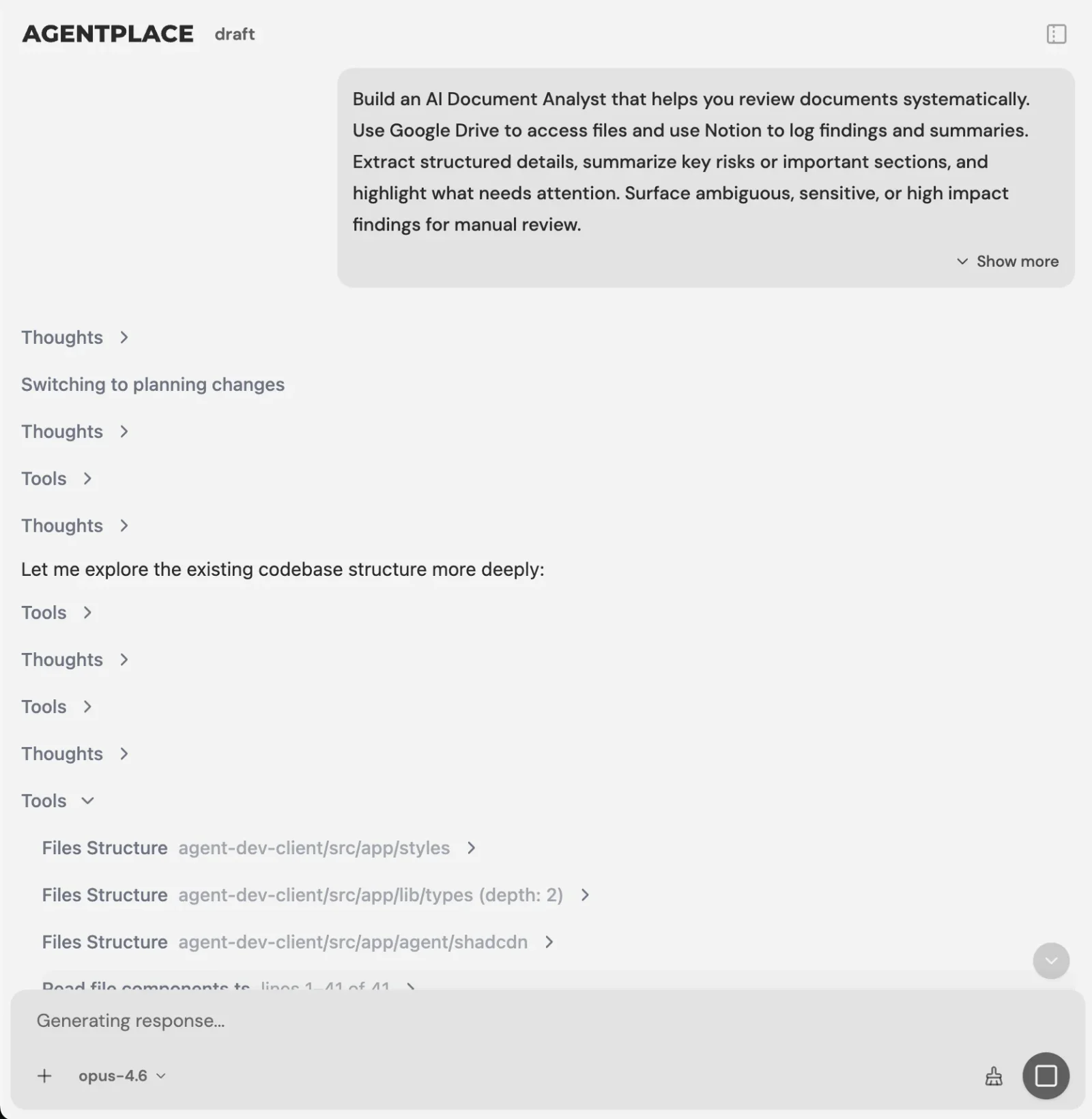 Describe the intake task and supply the rules that decide the next step.
A starting instruction is:
Build a plumbing inquiry agent that collects the service address and issue, checks our coverage and explains our approved call-out policy. Use our human escalation route for urgent or unclear requests. Help arrange routine visits through our existing schedule, and label anything awaiting confirmation clearly.
Test the customer experience and the operational result. For a valid routine appointment, check the actual job record. For an urgent handoff, check who received it and what happens when that person does not acknowledge it. For a failed integration, check that the caller receives an honest next step.
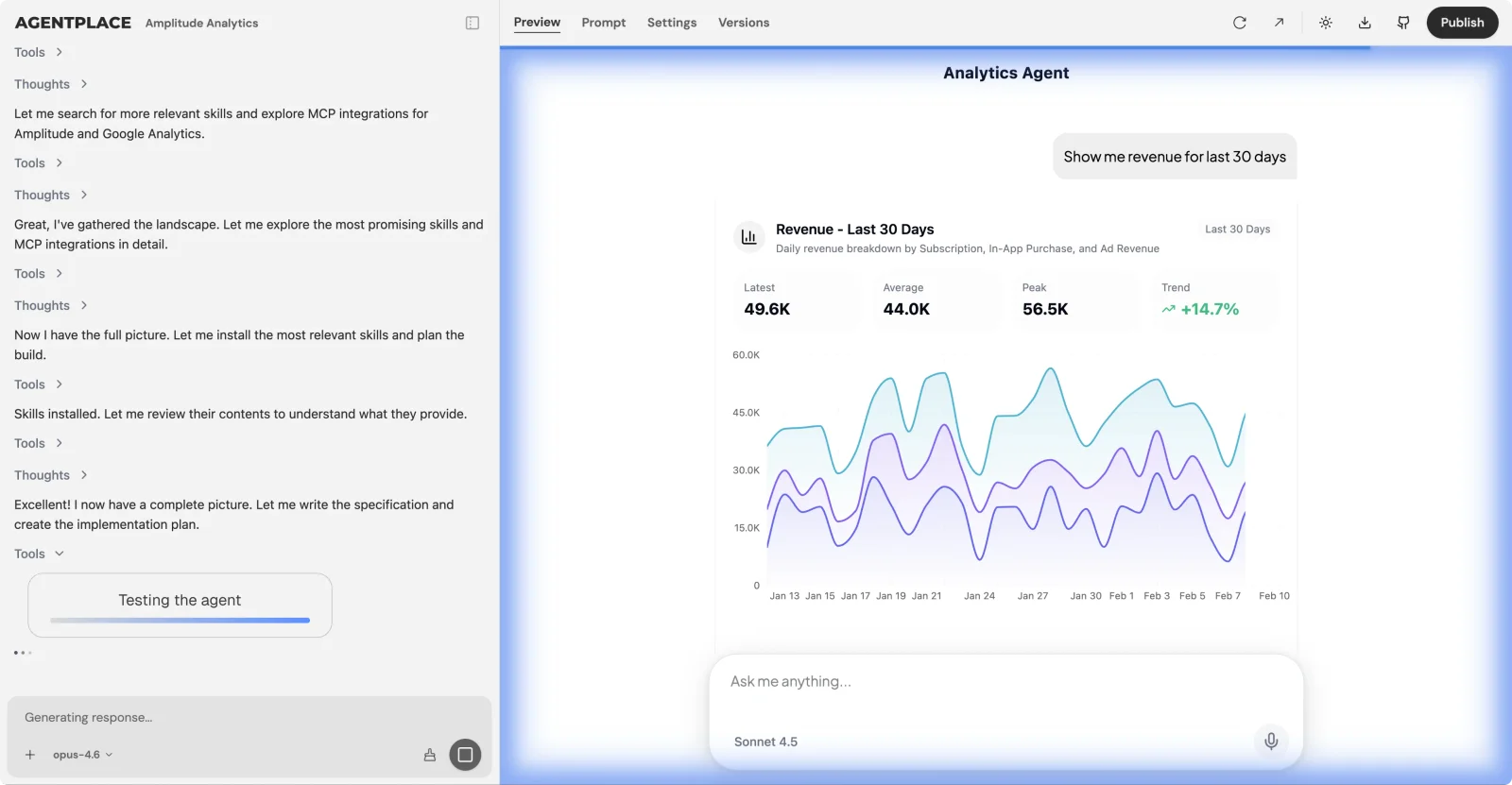 Builder tests help refine the conversation; the company still verifies the live connections and escalation process.
The agent can show the request details and next step on its own page, which you can link from your existing site and messages. Keep dispatch, invoicing and field-service records in the system responsible for them. Existing customer details require suitable identification and record permissions.
See current Agentplace plans and budget channel usage and review alongside the subscription. A useful starting point is the plumbing voice receptionist and job booking template.
What Should Your Plumbing Call Scripts Say?
These are illustrative templates to adapt to your approved policies. Any statement that an action happened must follow confirmation from the relevant tool or person.
Routine intake:
This is [Business Name]. What service address and plumbing issue should I pass to our team? I can help with our service area and appointment process.
Out of area:
We do not cover [town] for [service/time]. I cannot arrange a visit from our team there.
Appointment offer, after checking availability:
Our schedule shows [appointment option]. The call-out fee is [approved fee and terms]. Would you like me to request that appointment?
Successful booking:
Your appointment is confirmed for [date/window], reference [booking ID]. [Approved arrival and change policy].
Request awaiting confirmation:
I have received your request for [date/window]. It is not booked yet. [Team] will confirm through [channel/process].
Human handoff:
I am sending [summary] to [role]. [Approved fallback if no acknowledgment].
Use a separate, professionally approved path for immediate hazards. Do not improvise repair or shutoff advice in a sales script.
What Does Answering Coverage Cost a Plumbing Company?
Work it out on your own numbers, and count booked jobs.
The model below is illustrative. It assumes an average booked plumbing job of $400, a current after-hours conversion of 20% where a message is taken and returned in the morning, and a post-change conversion of 45%, roughly the daytime booking rate the platform data above reports for plumbing. Replace all three with yours.
| After-hours inquiries per month | Booked today at 20% | Booked at 45% | Extra jobs | Extra monthly revenue at $400 |
|---|---|---|---|---|
| 20 | 4 | 9 | 5 | $2,000 |
| 60 | 12 | 27 | 15 | $6,000 |
| 150 | 30 | 68 | 38 | $15,200 |
Illustrative model, not measured customer data. Every assumption is stated above and all three are yours to replace.
The table gives you a break-even, not a forecast. At 20 inquiries a month, roughly one extra job covers most software subscriptions.
Two things about the shape of the bill are worth knowing before you sign anything.
Staffed services usually bill per minute or per call. Your invoice therefore peaks in the same week your call volume peaks, which in plumbing is a hard freeze. Software is normally flat or usage-based, so the curve behaves differently.
The labor comparison is the other half. The Bureau of Labor Statistics puts the median annual wage for plumbers, pipefitters and steamfitters at $62,970 as of May 2024 (Occupational Outlook Handbook, US BLS). A night call-out that could have waited until 7:30am costs you that hourly rate plus the drive, plus a tired plumber the next day. Good triage saves labor as well as winning jobs.
Which Numbers Tell You the Coverage Is Working?
Four, checked monthly. Most plumbing companies have never measured the first one.
- Share of inquiries arriving outside business hours, split by channel. Phone, website, SMS and LSA separately. This tells you which leak to plug first.
- Median time to first useful response after hours. Use the median, because a handful of next-morning replies will distort an average. Measure the reply that moved the customer forward, not the automatic acknowledgement.
- After-hours booking rate against your daytime rate. A large gap is the size of the prize.
- Night call-outs that could have waited until morning. This is the triage quality number, and it shows up on the labor line.
For a fuller treatment of the response-time side of this, see our guide to HVAC speed to lead.
Which AI Answering Service Fits Your Plumbing Company?
Start with the requirement that fails today. Choose staffed answering when a person needs to remain in the conversation. Evaluate the native reception tool when your existing FSM can complete the required call-to-booking workflow. Choose a configurable Agentplace agent when you want a specific customer service, its own interface and connected actions shaped around your business.
For a narrow missed-call gap, compare the current text-back and AI options. The channel mechanics also matter for plumbers, though the intake and escalation rules must be yours.
Get a written price for the base subscription, minutes or conversations, overages, transfers and setup. Jobber’s published Receptionist allowance, for example, differs between Plus and its select-plan add-on. A headline monthly price alone is not a fair comparison with a staffed service.
Your trial should demonstrate a routine booking, unavailable slot, out-of-area caller, unclear request and failed handoff. Choose on completed actions and review effort, not a claim to answer every call.
What We Found That Others Won’t Tell You
The incumbents caught up, and most comparison articles have not noticed. Two years ago the honest recommendation for a plumbing company on Housecall Pro was to add something on top, because nothing native existed. Today ServiceTitan, Housecall Pro and Jobber each sell an AI answering add-on. If your inquiries arrive almost entirely by phone and you live inside one platform, the native option is the shortest path and you should take it. The case for a separate agent starts when the website, the messaging channels and the rules behind them also need covering.
Price on the phone is where most plumbing calls die. Callers ask what it costs, and an untrained answer either loses the job or commits you to a number nobody can stand behind.
That translates directly into a guardrail. Configure what may be said about money on the phone, and stop there.
“24/7 coverage” is bought and then never measured. The phone gets answered, so the problem feels solved. Ask your provider how many of last month’s night conversations produced a booked job, with dates. If nobody can answer, you bought coverage rather than capacity.
Website inquiries stay invisible in a way phone calls do not. A ringing phone is annoying on purpose. A form submitted at 10:15pm makes no sound, so nobody inside the company feels the eleven-hour delay.
Which Mistakes Cost Plumbing Companies the Most Calls?
- Sending night callers to voicemail and assuming they will leave a message.
- Buying coverage before writing down what your company counts as an emergency.
- Letting any answering option quote a repair price before a plumber has seen the job.
- Allowing improvised shutoff or DIY advice that goes past your approved wording.
- Covering the phone and leaving the website on a contact form.
- Running separate rules on separate channels until the answers disagree.
- Measuring answered calls and never counting booked jobs.
- Waiting for the first hard freeze to configure any of it.
How Do You Set Up Plumbing Call Coverage in a Week?
Day 1. Pull last month’s calls, form submissions and messages. Split them by channel and by hour. You now know which leak is biggest.
Day 2. Write the emergency list, the morning list and the never-do list. Have your lead plumber review all three, including the exact shutoff wording.
Day 3. Pick the option matching your requirement from the table above. If it is an agent, give it your services, service area, fee policy, rules and guardrails.
Day 4. Connect your scheduling system and confirm the agent is reading real availability, not a static list.
Day 5. Test the hard cases yourself. Say “my basement is filling up and I cannot find the shutoff” and check that it escalates and stays inside your approved wording. Say “my kitchen tap has been dripping for a month” and check that it books a morning slot without paging anyone.
Day 6. Turn it on for the channel that showed the biggest gap on Day 1. Add the second channel once you have watched the first for a few nights.
Day 7. Set the four measurements above and diarise a review in thirty days.
A useful answering setup leaves the office with a confirmed appointment, a complete request or an acknowledged handoff. Keep those outcomes separate when reviewing the first month. Agentplace can support the customer-facing task while your team retains the operational and urgent-dispatch decisions.
Questions and answers
Frequently asked questions.
What is the best AI answering service for plumbers?
Use a native FSM option when it completes the required workflow in your existing system. Agentplace fits a custom plumbing inquiry agent with its own page and configured phone access. Keep a staffed service when a person needs to handle the call. Test each option against the same scenarios.
Can an AI receptionist book a plumbing visit?
Yes, for permitted job types through a working scheduling connection. It needs live availability and a successful appointment write. Without those, it should collect a request or direct the customer to the existing booking route rather than claim a booking.
Can the agent decide whether a plumbing issue is safe?
No. It should follow the company’s approved escalation process, route uncertain requests to a person and avoid improvised repair advice. A possible immediate hazard needs the appropriate emergency path rather than an ordinary appointment offer.
What does Agentplace replace?
In this use case it handles customer questions and inquiry intake, with permitted appointment actions when connected. Keep field-service management, dispatch, invoices and accounting in the tools responsible for them.
How much does plumbing answering coverage cost?
Get a complete quote including base plans, calls or minutes, AI conversations, overages, transfers and setup. Compare the same completed outcome across providers and include the staff effort needed for exceptions.
How should I test the setup?
Try a routine booking, an out-of-area address, an unavailable slot, an urgent or unclear request and a connection failure. Check the actual schedule and handoff acknowledgments, not only the conversation transcript.
Put this into practice
See the customer experience.
Explore a concrete example related to this article, then adapt the agent to your business.
Create my AI agentStart free with your business idea. The AI builder can help you explore it and create your agent. No technical specification needed. Sign in to continue. Pricing and limits · How the builder works