
Can ChatGPT Dots Size a Bike for a Customer? Always-On Agents for Bike Shops

The short answer
No. A ChatGPT dot can't size a bike for a customer. It's something you create and use inside ChatGPT, with no page a customer can open. A customer-facing AI agent built with Agentplace gives them one, narrows the frame size and the model, checks what's on your floor, and books the test ride.
Key takeaways
- A customer asks two things on a Sunday, what size am I and which bike, and a size calculator answers “medium”.
- A dot is something you create and use inside ChatGPT. There is no page for a customer to open.
- A customer-facing AI agent narrows the frame size against the geometry of the bikes you stock, names what is in that size, and books the test ride.
- The fit is decided in the shop, so the agent gives a range and says so. Recommending a size you do not have sends the sale down the road.
- Start by loading geometry charts for your own models and connecting stock by model and size.
The short answer
No. A ChatGPT dot can’t size a bike for a customer.
It’s something you create and use inside ChatGPT. There’s no customer-facing page, phone number, or interface for a customer to open.
A sizing question is different. A customer-facing AI agent built with Agentplace gives the customer a page where they can reach the agent. The agent does three things:
- Narrows the frame size from height, inseam and the geometry of the models you stock.
- Names two or three bikes you have in that size, with prices.
- Books the test ride, which is where the bike is actually sold.
If you’re a two-person shop and someone is always behind the counter, keep doing that.
Why do bike shops lose online enquiries?
Because the customer asked a specific question and got a contact form.
Our own research into sporting goods retail describes the day: staff check stock across the floor, the back room and supplier portals, and special orders and product questions sit in the inbox until someone has time to reply.
Example: A Sunday afternoon enquiry.
“I’m 178cm, mostly commuting with some gravel at weekends, budget about €1,800. What size and which bike?”
| Option | What the customer gets | When |
|---|---|---|
| Contact form | A thank-you page | Monday, maybe |
| Size calculator | “Medium” | Immediately, and it sells nothing |
| Product filter | 40 bikes, half of them out of stock | Immediately, and it decides nothing |
| Agent on live stock | Medium or large to try, two gravel-commuter bikes in that size, prices, test ride Tuesday | In the conversation |
Rule of thumb: “medium” is not an answer. “Try the medium, we have two in the shop, Tuesday at 5” is.
What should the agent know?
Five things, and the fourth is the one that decides the sale.
| Input | Why it matters |
|---|---|
| Geometry charts for the models you stock | A medium is not a medium across brands |
| Your narrowing questions | Riding type, height and inseam, budget, hills or flat |
| Price bands by category | Budget is half the question and customers state it unprompted |
| Live stock by model and size | A recommendation in a size you don’t have is a referral to a competitor |
| Where fitting takes over | Saddle height, reach, cleats, anything on the bike itself |
That last row keeps the agent honest. A range plus “come and sit on it” is accurate. A single number is not.
How do you answer a sizing question, step by step?
1. Ask riding type before size
A commuter and a race fit put the same rider on different frames. Rule of thumb: ask what they ride before you ask how tall they are.
2. Give a size range, with the reason
Two sizes with a recommendation to try the smaller first is more useful, and more honest, than one number.
3. Check stock in that size
Example: The agent, on a Sunday.
“At 178cm with mixed commuting and gravel, you’re between a medium and a large on most frames. Start with the medium. We have two bikes in that range: the gravel-commuter at €1,690 and the lighter one at €1,890, both in medium in the shop now. Want to ride them? Tuesday at 5 or Saturday morning.”
4. Book the test ride
Nobody buys a €1,800 bike from a chart. The booked ride is the conversion.
5. Route the fitting
Saddle height, reach and anything involving an existing injury go to your fitter. The agent collects the detail and hands over.
Can a ChatGPT dot do this?
No, and it isn’t close.
Dots are OpenAI’s always-on agents, launched 29 September 2026. A dot keeps working between conversations, has its own cloud computer, and reaches apps you authorise. All of that happens inside the account of whoever created it.
That’s the wall. The customer has no way in.
As it shipped: one dot per account, paid ChatGPT plans only, and no Pro access in the EEA, Switzerland or the UK.
A dot works on the shop’s side. A customer-facing agent works on the customer’s side.
What tools can help size and recommend a bike?
| Option | What it’s for | Where it stops |
|---|---|---|
| Customer-facing AI agent built with Agentplace | Narrowing size and model, checking stock, booking the ride, on its own page or by phone | It isn’t your POS, and it doesn’t do the fitting |
| Bike size calculators | A frame size from height | No model, no stock, no price, no booking |
| Bike shop software and POS | Stock, sales, service jobs, supplier orders | It holds the data, not the conversation |
| Product filters on the webshop | Browsing by category and price | The customer still has to decide alone |
| ChatGPT Dots | The shop’s own work | Not customer-facing. No page to open |
Nothing here was bench-tested. The rows describe what each category is designed to do, read from vendor documentation in October 2026.
How does Agentplace handle a bike enquiry?
Agentplace lets you create an AI agent with its own web page and URL. It uses your business knowledge to work with clients through text, voice, and a personal interface that changes with their request.
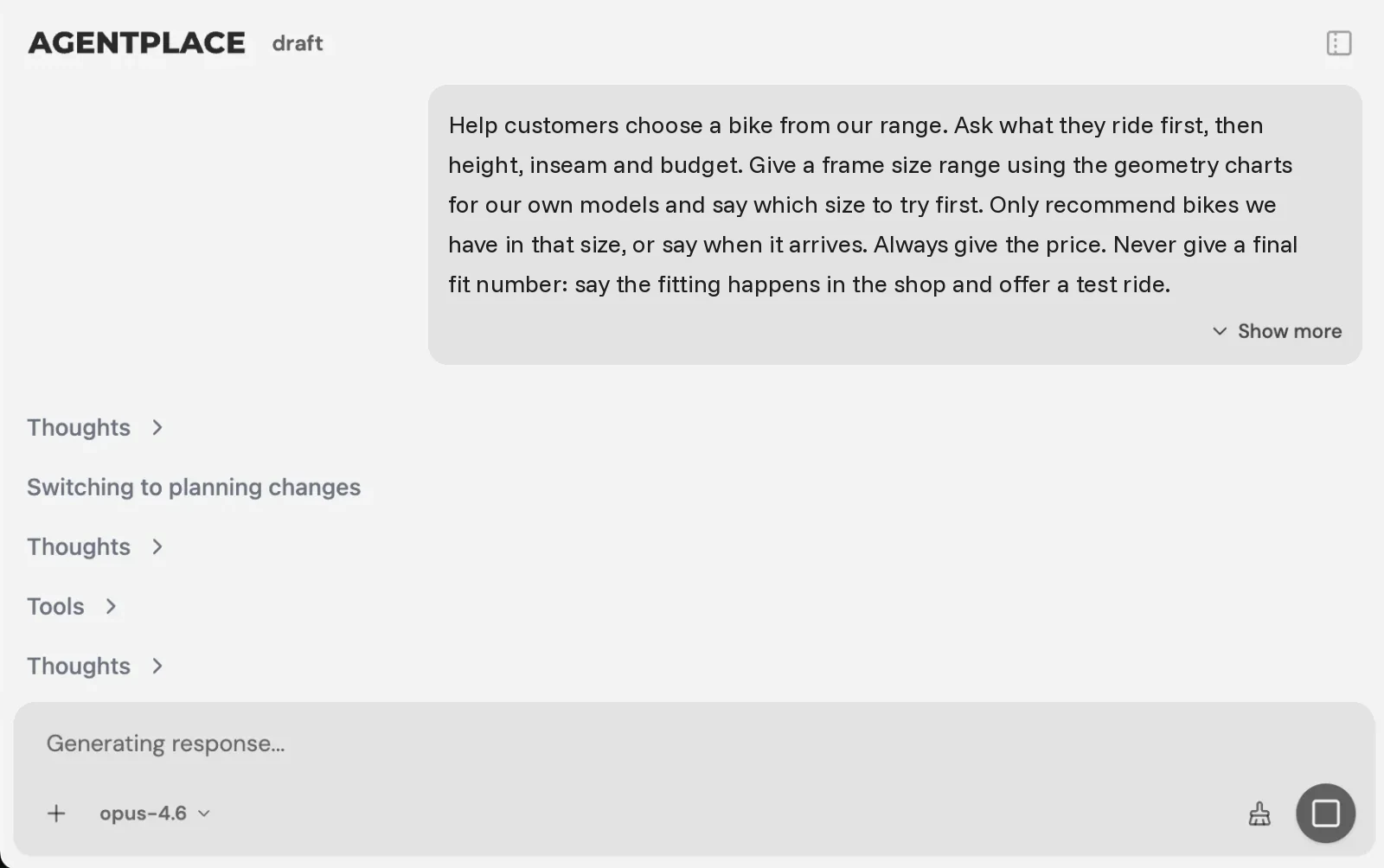 You describe your models, sizes and price bands. The builder writes the agent.
In practice, it works like this:
- The customer opens the agent’s page from your site, an ad, or a product page.
- The agent asks what they ride, then height, inseam and budget.
- It narrows the frame size against the geometry of the models you stock.
- It names two or three bikes available in that size, with prices.
- It books a test ride, and sends fitting questions to your fitter.
You set it up by describing the outcome in plain language, for example:
“Help customers choose a bike from our range. Ask what they ride first, then height, inseam and budget. Give a frame size range using the geometry charts for our own models and say which size to try first. Only recommend bikes we have in that size, or say when it arrives. Always give the price. Never give a final fit number: say the fitting happens in the shop and offer a test ride. Send saddle height, reach, cleat and injury questions to Martin. For e-bikes, answer range, motor type and weight from our spec sheets, and use our written note on local legal classes.”
The AI Builder discusses the idea, clarifies requirements, creates the agent and helps test it. You choose when to publish. No code is required.
What stays where it is:
- Your POS, workshop and inventory system keeps stock, sales, service jobs and supplier orders. The agent reads availability and writes the lead and the test ride where a supported connection exists.
- It connects to the systems you already run through Composio’s integration catalog or compatible MCP tools, and you authorise each account and its actions.
- Records carry access classes enforced server-side, so a customer sees their own enquiry and nothing else.
Pricing: Agentplace has a free plan and paid plans that use AI credits. A credit is not a conversation. See pricing.
Templates to start from: AI Bike Fit and Model Selection Agent · AI e-bike recommendation agent · AI Bike Test Ride Booking Agent
When don’t you need an AI agent?
- Two staff and someone always at the counter? Keep that. It’s faster than any page.
- Service and repairs only, no sales? Then size and model don’t apply. Booking still might.
- You need stock, sales and service jobs? That’s bike shop software, and it stays.
- Your stock isn’t tracked by size? Fix that first, or the agent will send people in for bikes you don’t have.
- Mostly walk-in trade in a tourist town? The online enquiry isn’t your channel.
- Sunday enquiries answered on Monday afternoon? That’s where a customer-facing AI agent built with Agentplace fits.
Quick checklist
- Load geometry charts for the models you actually stock
- Write the narrowing questions, riding type first
- Connect live stock by model and size
- Write price bands by category
- Write the hand-over line: fitting, cleats, injuries
- Write your own note on local e-bike legal classes
- Track test rides booked, not quizzes completed
Related reading: AI agents that book appointments · what Dots by ChatGPT are · adding an AI salesperson to your website
Bottom line
A customer asks what size and which bike. A calculator says “medium” and a form says “thanks”.
- If someone is always behind the counter, keep answering it yourself.
- If enquiries land on Sunday and get answered on Monday, give customers a customer-facing AI agent built with Agentplace. It narrows the size, names what’s in stock, prices it, books the ride, and sends the fitting to your fitter.
Questions and answers
Frequently asked questions.
Can an AI agent tell a customer their bike size?
It can narrow the frame size to a range from height, inseam and the model's own geometry chart, and say which size to try first. The final call belongs to a fitting in your shop, and the agent should say that rather than pretending to be precise.
Can a ChatGPT dot do this?
No. A dot is something you create and use inside ChatGPT. There is no page or number a customer can use. It can help with your own work, but a customer comparing bikes on a Sunday cannot reach it.
How is this different from a bike size calculator?
A calculator takes height and returns a number. An agent asks what they ride, checks which of those frames you actually have, gives a price, and books the test ride in the same conversation.
Can it handle e-bike questions?
Yes, and those are mostly range, motor type, weight and legal class. Write your own answers for the local rules; they differ by country and the agent should not improvise them.
Can it check stock?
Yes, where it is connected to your inventory. It matters more than usual here: a size recommendation is useless if that frame size is six weeks out.
Does this replace our bike shop software?
No. Your POS, workshop and inventory system stays the source for stock, orders, service jobs and sales. The agent handles the conversation and writes the lead and the test ride into the system you already run.
Can it book service and repairs too?
Yes, and that is often the higher-volume job. Service enquiries follow the same shape: what's wrong, what it costs, when can you take it in.
How long does setup take?
The work is writing down what your floor staff already ask: riding type, height and inseam, budget, and which models you stock in which sizes. A focused build takes days rather than months.
Put this into practice
See the customer experience.
Explore a concrete example related to this article, then adapt the agent to your business.
Create my AI agentStart free with your business idea. The AI builder can help you explore it and create your agent. No technical specification needed. Sign in to continue. Pricing and limits · How the builder works