
How to Follow Up With Mattress Leads Who Stop Responding

The short answer
Mattress leads go quiet because the first reply left them with a decision they still cannot make. Answer the question that stopped them, not the silence. An AI agent built with Agentplace lets a shopper resume the conversation at any hour and finish choosing; sending a follow-up depends on your channel and consent.
Key takeaways
- A shopper who filled in your form and went quiet usually did not lose interest. They hit a question your reply did not answer and postponed the decision.
- A reminder that repeats the first message gives them nothing new to decide with, which is why it gets ignored.
- An AI agent built with Agentplace lets the shopper resume the conversation whenever they come back, which does more than any chase.
- Whether you can send a follow-up at all depends on the channel you have set up and the consent you hold. An agent does not change that.
- Start by writing down the four reasons your inquiries actually stall, and the one thing you would send for each.
The short answer
A mattress lead who goes quiet after your first reply did not lose interest. They hit a question the reply did not answer, and postponing was easier than asking.
So answer the question rather than the silence. There are four common ones: the models still read the same, the price was higher than expected, the purchase is months away, or nobody said what happens next.
An AI agent built with Agentplace can carry this, mostly by being there when the shopper comes back rather than by chasing them. Sending a message out, by email or any other channel, depends on that channel being connected and on the consent you hold.
This page is about leads who already contacted you. Converting anonymous visitors is a different job, covered in turning visitors into showroom appointments.
Why do mattress inquiries go quiet?
Because a mattress is an expensive thing to be unsure about, and being unsure is the normal state after reading product pages.
Four reasons cover most of it.
- They still cannot choose. Two models fit their answers and nothing in your reply separates them.
- The price landed higher than they expected. They do not want to say so, so they say nothing.
- They are not buying yet. The move is in March, the spare room is next year.
- Nobody said what happens next. The reply answered the question and stopped, so the shopper had nothing to act on.
A follow-up that repeats the first message addresses none of these. It just asks the shopper to feel bad about not replying.
What should you send, and when?
| Why they stalled | What the next message should carry | What not to send |
|---|---|---|
| Cannot choose between models | What separates the two, in one line each, and an offer to try both | A longer specification table |
| Price was higher than expected | A model at a lower price that still fits their answers | A discount on the model they could not afford |
| Buying later | A question about when, and a note that you will be here | A sales message with urgency |
| No clear next step | Two specific appointment times | “Let us know if you have any questions” |
Two messages, each carrying something new, is usually the whole program. A third that repeats the first two is how a shop ends up marked as spam.
How do you keep the conversation open instead?
The better version of follow-up is not a message you send. It is a conversation the shopper can resume.
- Leave it open. A shopper who returns in three weeks should be able to pick up where they stopped rather than start again.
- Keep the answers. If they told you they sleep on their side and their current bed is too firm, that should not need repeating.
- Make the next step available at any hour. Most of this traffic arrives in the evening, when the showroom is closed.
- Let them self-serve the thing that stalled them. Often it is one comparison, one price range, or one question about the trial period.
An agent remembers what a shopper told it in earlier conversations, which is what makes resuming possible. That is memory of the conversation, and it is not the same as recognizing who someone is when they arrive.
What tools can help you follow up?
| Approach | Best for | What to consider |
|---|---|---|
| Manual email from a salesperson | Small volumes and high-value inquiries | Dies when the floor gets busy, which is when inquiries arrive |
| Email automation | Sending the same sequence reliably | Needs a connected channel and consent, and it cannot answer a question |
| CRM tasks and reminders | Keeping a team honest about who to contact | Reminds a person; the message is still theirs to write |
| Retail software with marketing built in | Shops already running campaigns from it | Check what it can send and on what basis before counting on it |
| AI agent built with Agentplace | Answering the question that stalled the shopper, whenever they return | Outbound messages depend on connected channels and consent |
If your inquiries are answered well and the problem is that nobody is assigned to the second message, a CRM task list fixes more than an agent will. If the second message gets sent and ignored, the content is the problem and the agent can carry a better one.
How can Agentplace help with quiet mattress leads?
Agentplace is a platform for creating AI agents that serve customers and help run a business. Each agent can have its own page and URL, where customers interact through text or voice and receive responses through an interface the agent controls.
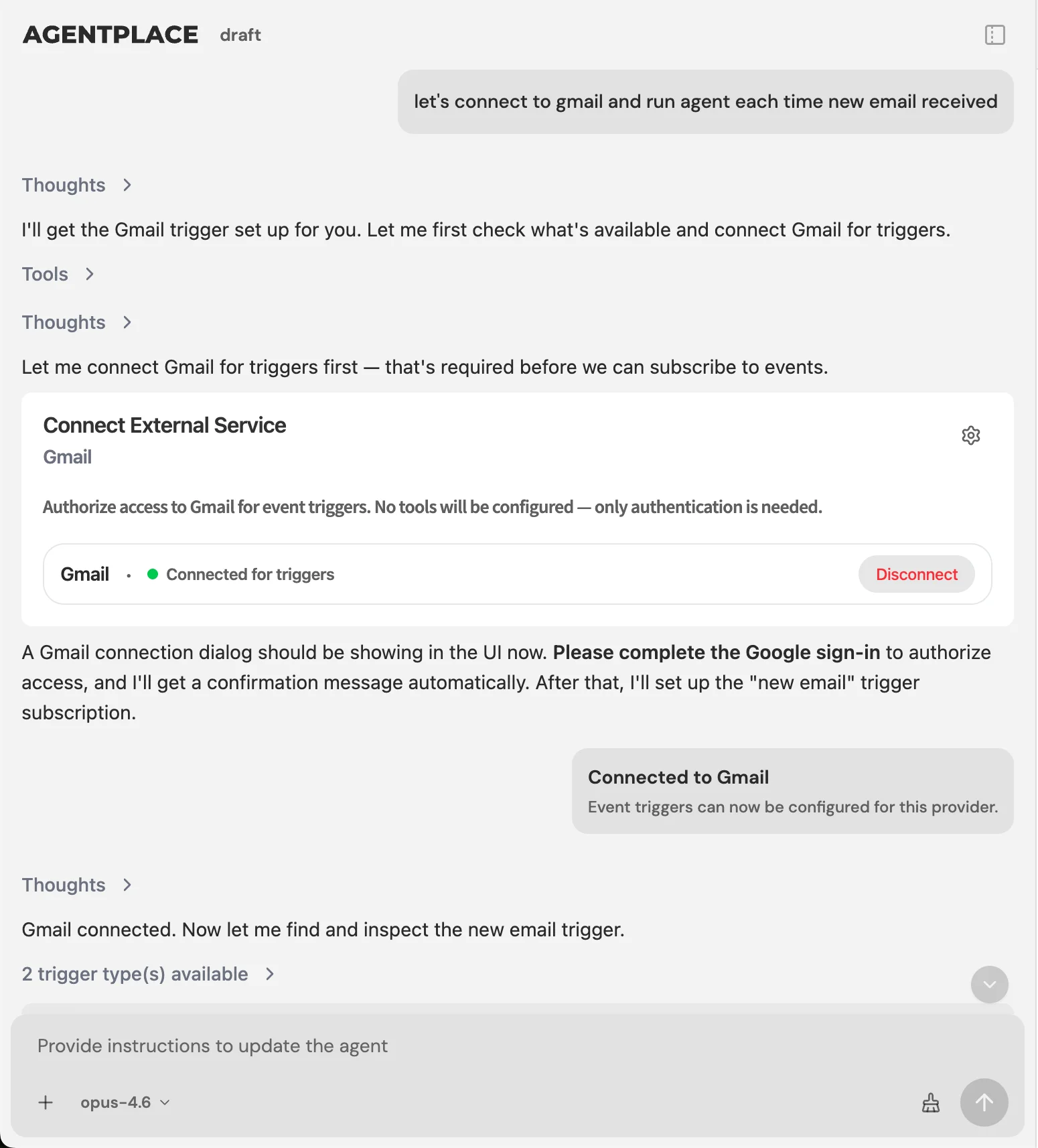 The platform wakes the agent on a schedule or an event; what it may send then depends on the channels you connect.
For a lead who has gone quiet, the agent does three things:
- It is there when they come back. The shopper reopens the conversation and continues from their earlier answers rather than from the beginning.
- It answers the thing that stalled them. The comparison between two models, the price range of a third, the trial terms, the delivery window.
- It books the visit where your calendar is connected, so the conversation ends in something rather than in another reply.
Scheduled work is possible too: the platform is the clock, and the agent acts when it is woken. What it may send at that point is not a product decision but yours, because it depends on the channel you connect and the consent you hold for that contact.
You set it up by describing the outcome in plain language. For example:
“Handle mattress inquiries and the follow-up after them. Keep what the shopper told us: who sleeps on it, their position, the problem with their current bed, and their budget band. When a shopper comes back, continue from those answers rather than asking again. If they stalled between two models, lead with what separates them and offer to have both made up. If their budget was below the models we suggested, name one that fits instead. Offer visits from our calendar. Never offer a discount, and send trial, delivery and warranty questions to the store team.”
The AI Builder clarifies the requirements, creates the agent and helps test it. You choose when to publish. No code is required.
What depends on configuration: sending email, writing to your CRM, reading the calendar and anything else that leaves the agent’s own page all need a supported connection and the permissions you grant. Agentplace connects through Composio’s integration catalog and compatible MCP tools.
Pricing: Agentplace has a free plan and paid plans that use AI credits. See the current pricing and plan limits.
Templates to start from: AI Mattress Selection Intake Agent and AI Mattress Trial and Exchange Agent
What should you measure?
| Metric | What it tells you | How to measure it |
|---|---|---|
| Inquiries that get a second exchange | Whether your first reply invites a reply | Conversations with two or more messages from the shopper |
| Quiet leads who return on their own | Whether the conversation stayed open | Returning sessions from shoppers who had stopped replying |
| Sales from inquiries older than a month | Whether the long tail is worth anything | Contracts matched back to the inquiry date |
The middle number is the one worth building for. A shop that gets shoppers back without chasing them has a different relationship with its leads than one that sends three reminders.
When don’t you need an AI agent?
- You get a handful of inquiries a week and your salespeople follow up well. Keep it human.
- Your first reply is the problem. Fix that before automating the second one, because a good second message cannot rescue a bad first.
- You have no connected channel and no consent to message anyone. Then follow-up is not available to you in any tool, and the work is keeping the conversation open instead.
- Your inquiries are mostly price shoppers. Publishing ranges will do more than any sequence.
Quick checklist
- The four reasons your inquiries stall, written down
- One thing to send for each, prepared in advance
- A cheaper model identified for each price band
- Two messages planned, not five
- The shopper’s earlier answers kept, so nothing is asked twice
- A way to resume the conversation at any hour
- Consent and channel confirmed before anything is sent
- Returning quiet leads tracked, not just replies
Related reading: Turning mattress visitors into showroom appointments · Interactive product finders and AI buying guides · How to add an AI salesperson to your website
Bottom line
A quiet mattress lead is a shopper holding an unanswered question, so the next message has to answer it rather than ask why they went silent.
If your inquiries stall between two models or above a budget, an AI agent built with Agentplace can carry that answer and let the shopper resume whenever they return. If the real gap is that nobody is assigned to the second message, a task list in your CRM will fix more than any agent.
Questions and answers
Frequently asked questions.
Why do mattress leads stop responding?
Usually one of four reasons: they cannot tell two models apart, the price was higher than expected, they are not buying for a few months, or nobody told them what happens next. Each needs a different reply.
How many times should you follow up on a mattress inquiry?
Twice is usually enough if each message carries something new. A third message that repeats the first two trains the shopper to ignore you and risks the complaint that follows a chase.
What should the first follow-up say?
Answer the likeliest reason they stalled. If the inquiry named a budget, lead with what that budget buys. If they described a problem with their current bed, lead with the two models that address it.
Can an AI agent follow up with leads automatically?
It can run the work you schedule it to do, and it can answer whenever the shopper returns. Sending email or any other message depends on the channel being connected and on the consent you hold for that contact.
Is it worth following up on a shopper who is buying in six months?
Yes, but not with a sales message. Ask when the move or the renovation lands, note it, and let them come back. A shopper who feels filed away rarely returns.
What should you do when a lead does not respond at all?
Leave the conversation open rather than closed. A shopper who comes back to your site in three weeks should be able to continue where they left off, which is a better outcome than any reminder.
Does discounting bring quiet leads back?
Sometimes, and it teaches the shopper to wait for the next one. If price was the blocker, a cheaper model that fits their answers is a better reply than a discount on the one they could not afford.
What should a mattress retailer measure here?
The share of inquiries that get a second exchange, how many quiet leads return on their own, and sales from inquiries older than a month. The middle number tells you whether the conversation stayed open.
Put this into practice
See the customer experience.
Explore a concrete example related to this article, then adapt the agent to your business.
Create my AI agentStart free with your business idea. The AI builder can help you explore it and create your agent. No technical specification needed. Sign in to continue. Pricing and limits · How the builder works