
How to Automate Tour Operator Lead Qualification in 2026

The short answer
Agentplace is designed for the inquiry itself: the agent answers on its own page, pulls out dates, party size, budget and constraints, applies your departure rules and carries the traveler through to a booking. A person gets only the cases you reserve. If inquiries only need scoring, workflow automation is simpler.
Key takeaways
- Harvard Business Review research on 2,241 US companies found firms that responded to a web lead within an hour were nearly seven times more likely to qualify it than firms that responded later.
- A tour inquiry needs six fields before it is worth a salesperson's time: travel window, party composition, destination or product, budget band, hard constraints and decision timing.
- GetYourGuide research with Arival, polling 505 operators in March 2026, found 64% using AI more than a year earlier and 56% saying AI tools still feel overwhelming.
- Most tour inquiries arrive unstructured, so scoring rules alone cannot qualify them. Something has to read the message and ask the missing questions.
- Automated qualification leaves private groups, accessibility promises and anything involving money owed to a named human.
It is 9.40pm and the inquiry form fires.
A couple wants Tanzania for their honeymoon. “Maybe September.” No dates, no budget, one line about the migration.
Your reservations lead reads it at 8.15 the next morning.
She writes back asking for dates and party size, and waits.
The answer arrives on Thursday. Two other operators have already sent proposals.
Harvard Business Review audited 2,241 US companies. Firms that responded to a web lead within an hour were nearly seven times more likely to qualify it than firms that responded later.
SUMMARY: Agentplace is designed for automating tour operator lead qualification: the agent works the inquiry through on its own page instead of filtering it for somebody else.
The agent answers the minute the inquiry lands. It asks only what changes the recommendation. It pulls out the window, the party, the budget and the constraints, applies your departure and age rules, and carries the traveler through to a booking. A person gets the exceptions you reserve.
If inquiries arrive structured and only need scoring, Zapier, Make or n8n is simpler and cheaper.
Your reservation system stays where it is. FareHarbor, Bokun, Rezdy, Checkfront and Peek Pro keep availability and the booking record. The agent writes into them.
Build a Tour Agent That Qualifies Every Inquiry
Describe your departures, your rules and your exceptions. The builder writes an agent that collects the dates, the party and the constraints, then routes what is worth a call.
Build Your Agent Free →Where qualification breaks, by scenario:
- It arrives as a paragraph: scoring rules need fields, and a honeymoon in three sentences has none.
- Nobody answers until morning: the overnight gap is where comparison shopping happens.
- Six fields missing, each costing a round trip: three of those is a week.
- It landed on a channel nobody watches: WhatsApp, Instagram, an OTA inbox.
- You are comparing tools when the gap is a step: one table sorts it.
Choose by requirement:
- Clean fields that only need scoring and alerts: Zapier, Make or n8n.
- Repeat questions about meeting points and inclusions: Intercom Fin or Tidio Lyro.
- Qualification works, the quote is the bottleneck: Tourwriter, Travefy or TravelJoy.
- A person on every inquiry: an outsourced reservations team or a VA.
- Free text on several channels, coming back qualified: build an agent on Agentplace.
Key takeaways:
- Travelers describe the outcome they want in their own words, so inquiries are unstructured by nature.
- Six fields decide whether an inquiry is worth a salesperson’s time, and each missing one costs a reply cycle.
- Speed and qualification are one problem. The figure above measured how often a lead was qualified at all.
- Adoption is ahead of confidence. GetYourGuide’s research with Arival, polling 505 operators in March 2026, put 64% using AI more than a year earlier and 56% saying the tools still feel overwhelming.
Quick recap, if you do three things this month:
- Write down the six fields a qualified inquiry must contain.
- Count last month’s after-hours inquiries and the channels they used.
- List the inquiry types that must always reach a named human.
What Is Tour Operator Lead Qualification?
It is deciding which inquiries are worth a salesperson’s time, and getting the facts that decide it.
A traveler describes an outcome: a honeymoon, a milestone birthday, ten days with teenagers who hate museums.
You sell departures with dates, capacities, ages, fitness grades and price bands.
Qualification is the translation between the two. Terms used here:
- Pax. Passengers, the number of travelers on a booking.
- OTA. Online travel agency, such as Viator or GetYourGuide. A separate inbox from yours.
- CRM. Customer relationship management software, where lead records live.
- Escalation. Handing an inquiry to a person because a rule says software should not answer it.
- MCP. Model Context Protocol, which lets an AI agent use an external tool. Our guide to MCP covers it.
- AI credits. The usage unit Agentplace bills in.
Why Do Tour Inquiries Go Cold Before Anyone Qualifies Them?
Because the message arrives unstructured, out of hours, on a channel nobody is watching.
Each one alone is survivable.
Together they produce the Thursday proposal for a Monday inquiry.
Travel has a longer consideration window than a burst pipe, so operators feel relaxed about replying.
That window is why speed matters.
A traveler planning a September safari in March is reading four operators’ replies, and the first useful one frames the rest.
Compare what your form collects against what a proposal needs.
| Field | Typical website inquiry form | What a proposal needs | Cost of it being missing |
|---|---|---|---|
| Travel window | “Preferred month” dropdown | Exact window plus how flexible it is | One reply cycle, and season pricing cannot be quoted |
| Party composition | “Number of travelers” | Adults, children with ages, mobility and fitness range | Age and grade rules cannot be applied at all |
| Destination or product | Free-text “message” box | The specific departure or route being considered | The reply has to guess, or ask |
| Budget band | Rarely asked | Range per person, and whether it includes flights | Proposals land above or below and go unanswered |
| Hard constraints | Never asked | Accessibility, dietary, medical, visa, language | Discovered after the quote, which wastes both sides |
| Decision timing | Never asked | When they intend to book, and who else decides | Follow-up cadence is guesswork |
Evaluation criteria for everything compared here: whether the tool reads an unstructured message, whether its next question depends on the last answer, and whether it applies your departure and age rules. Then whether it writes a record into a system you run, and when it fetches a human.
What Does a Qualified Tour Inquiry Contain?
Six fields, each ruling something out.
Travel window, with how movable it is.
Party composition, with ages.
Destination or product interest.
Budget band per person.
Hard constraints: access, dietary, medical, visa.
When they intend to decide.
Write that list down before you automate anything.
The agent is only as good as that list.
Which Missing Field Costs You the Most?
Party composition, because minimum ages and fitness grades are checked against the ages in the party.
Budget band is the one operators skip, and it decides whether the proposal is worth writing.
How Fast Is Fast Enough?
Faster than 42 hours, which is roughly where the benchmark sits.
That audit recorded average response times of 42 hours among firms that answered at all, a finding Harvard Business School’s record of the paper carries too.
According to James B. Oldroyd, Associate Professor of Strategy at BYU Marriott School of Business and lead author of that study, the research measured what delay costs at the qualification step itself.
An operator who qualifies at 9.41pm is not competing against a standard of ten minutes.
Where Do Tour Operators Lose Inquiries, Channel by Channel?
In six places.
Only two sit inside your booking software.
| Channel | How the inquiry arrives | Where it fails | The fix that works |
|---|---|---|---|
| Website inquiry form | Name, email, free-text paragraph | Lands in a shared inbox overnight | Answer and qualify in the same session, before the tab closes |
| Shared inbox | Prose email, often forwarded | Read by whoever opens it first, no owner | Structured record created on arrival, with an owner assigned |
| WhatsApp and Instagram | One line, then silence | Nobody owns the phone after 6pm | The same agent on the same rules, answering on that channel |
| Phone | A caller with three questions | Rings out during departures | An agent that answers, qualifies and takes the callback detail |
| OTA message inbox | Viator, GetYourGuide or Klook thread | Separate login, checked weekly | Pull the thread into the same queue and qualify it the same way |
| Trade and partner email | A travel agent asking about allocation | Mixed in with consumer inquiries | Route on sender type before qualification questions begin |
Why Does This Land Hardest on Small Teams?
Most tour operators are small. The person qualifying inquiries is usually the person answering the radio to a guide.
Tourpreneur, the operator community run by Mitch Bach of TripSchool, counts around 16,000 tour businesses, and most of them are teams small enough that one person owns qualification alongside everything else. That is why repetitive pre-booking work eats the day.
Arival’s research, led by co-founder and CEO Douglas Quinby, found two in three travelers now use AI when planning trips, and more than one in four US travelers use it to find a tour.
They arrive half-decided, expecting a reply at the pace of the assistant they just closed.
For the same workflow laid out as a whole operation rather than one article, see what AI agents do for tour operators.
How Does Automated Qualification Work, Step by Step?
Six steps, same order, every inquiry, whenever it arrived.
- Read the inquiry. Pull window, party, destination, budget and constraints out of the prose.
- Answer the opening question. That is what buys the right to ask anything.
- Ask only the missing fields. The last answer decides the next question.
- Apply your rules. Ages, grades, group sizes, surcharges, lead times. Products get ruled out here.
- Produce the record. Fields, a summary, a score, a route to a person or a booking.
- Hand over the exceptions. Charters, accessibility, medical judgement and visas go to a named human.
Can a Form or a Chatbot Do This?
A form with conditional logic collects fields. It asks nothing it was not told to ask.
A support chatbot answers known questions and hands over the rest.
An agent reads the message, picks the next question, applies your rules and writes the record.
Only the third qualifies a honeymoon described in prose.
How Does Agentplace Automate Tour Operator Lead Qualification?
It answers the inquiry the minute it lands, qualifies it against your departure rules, and keeps working until the traveler can book. A person gets only the cases you reserve for one.
Agentplace creates AI agents that serve customers and help run a business. Each agent gets its own web page and URL. It uses business knowledge and authorized tools to deliver a personal plan, estimate, product comparison, document, or other result.
Take the 9.40pm honeymoon.
The agent answers what the couple actually asked, out of your own product information.
Then it asks the two or three things that change the recommendation.
Ages, fitness grades, group sizes and lead times decide which departures can work.
Whatever is still missing, it collects.
It writes a structured record, scores it against your criteria, and carries the traveler toward a booking.
A caller gets the same treatment: one agent covers web, voice and phone on one set of rules.
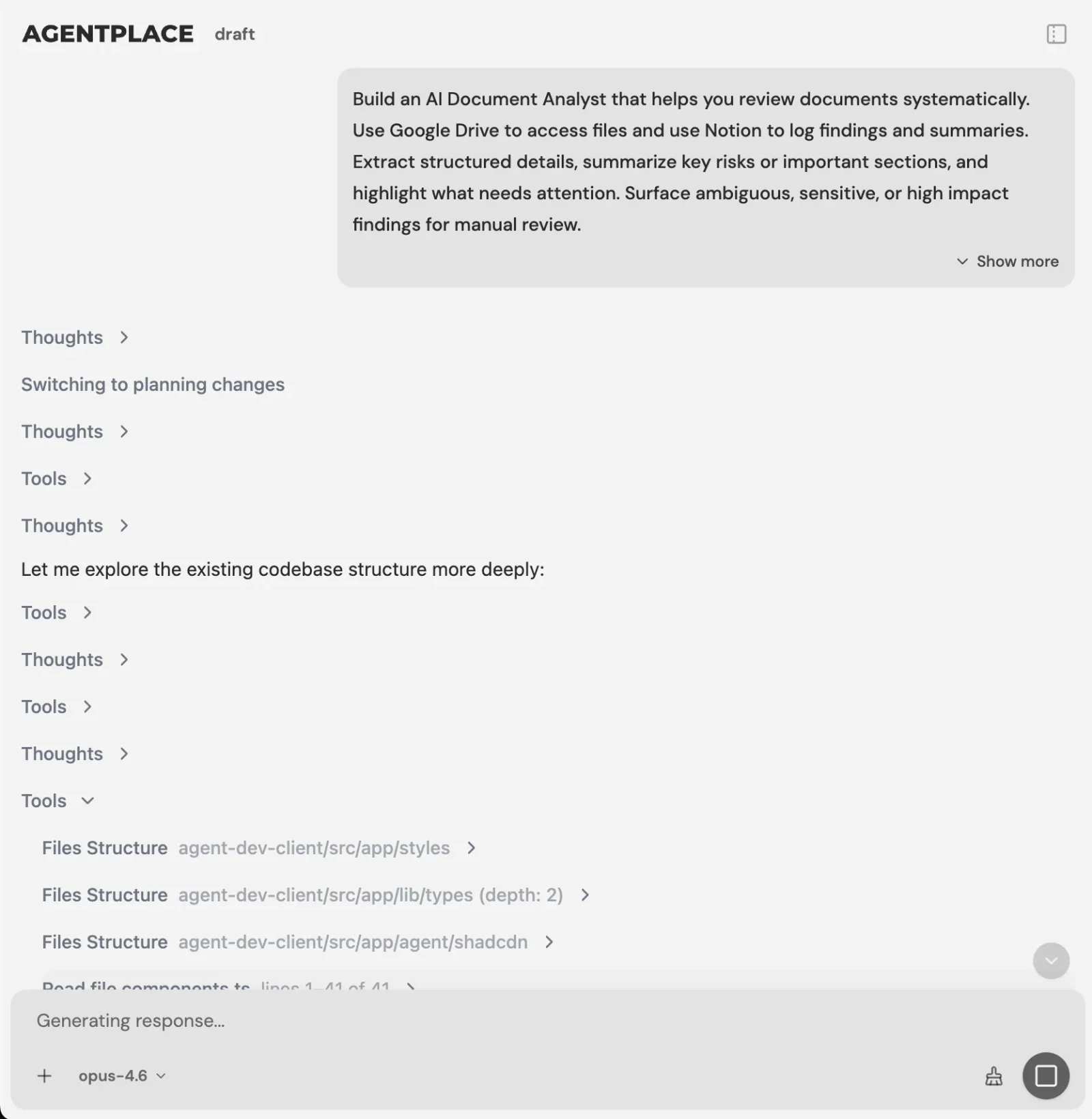 Describe how your best reservations person qualifies an inquiry. The builder does the rest.
You describe the outcome you want in plain language. For example:
“Qualify inquiries for our trekking business. Ask for travel window, party size and ages, route interest, budget per person and any fitness or medical constraints. Apply our minimum age of 12 and our 10-day lead time. Send anything over 12 people, or any accessibility requirement, to Sarah.”
The builder asks its questions, then builds.
It tests its own work, messaging the agent it just built and fixing what it finds before you see it.
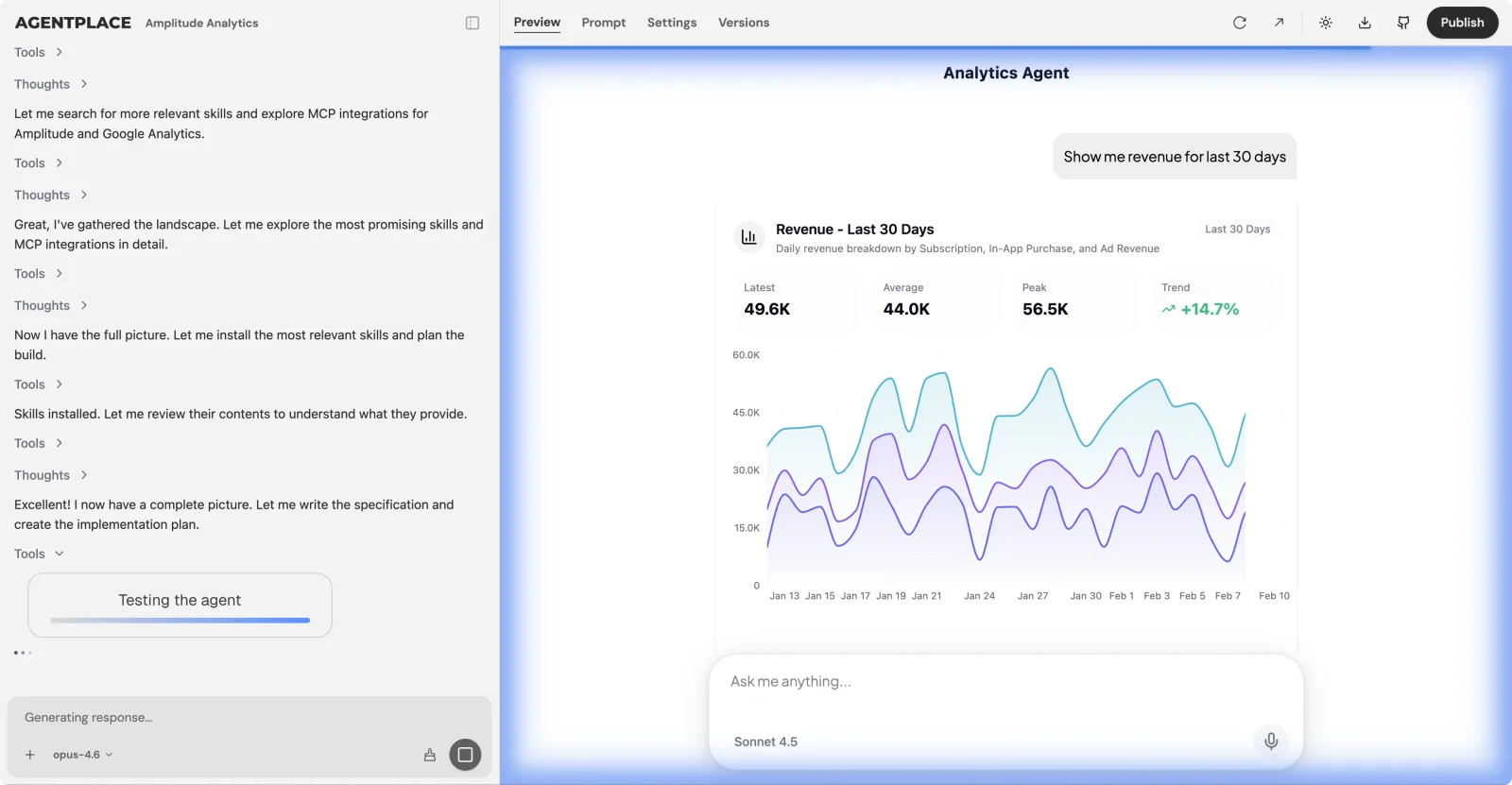 Test the agent on your last fifty inquiries before it meets the fifty-first.
You also write down what the agent may never do.
- Never present a departure as available without checking the reservation system.
- Never quote outside your published bands.
- Never confirm accessibility from anything but your written access notes.
- Never give altitude, medical or visa advice.
Each inquiry becomes a business record inside the agent, with access rules enforced on the server. It connects to your reservation system and inbox through Composio’s catalogue and compatible MCP tools, with you authorizing each account and the actions it may take.
Schedules and event triggers handle the follow-up, so an inquiry that goes quiet for three days gets chased anyway.
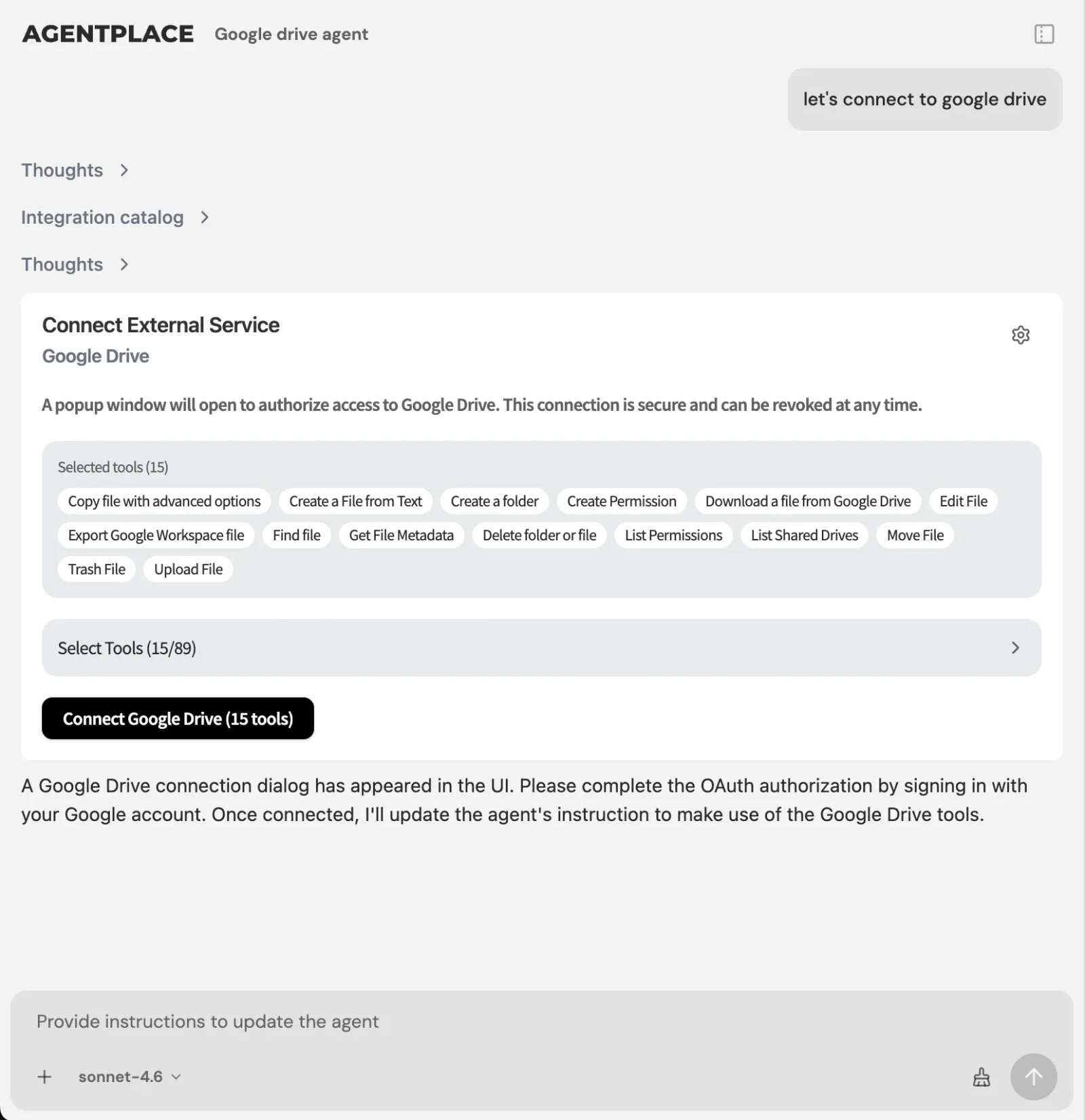 Connect an account once, and records land where your team works.
Agentplace has a free plan and paid plans priced in AI credits. A credit is not the same as a message, because usage depends on the work performed and the model chosen. Current amounts are on the pricing page.
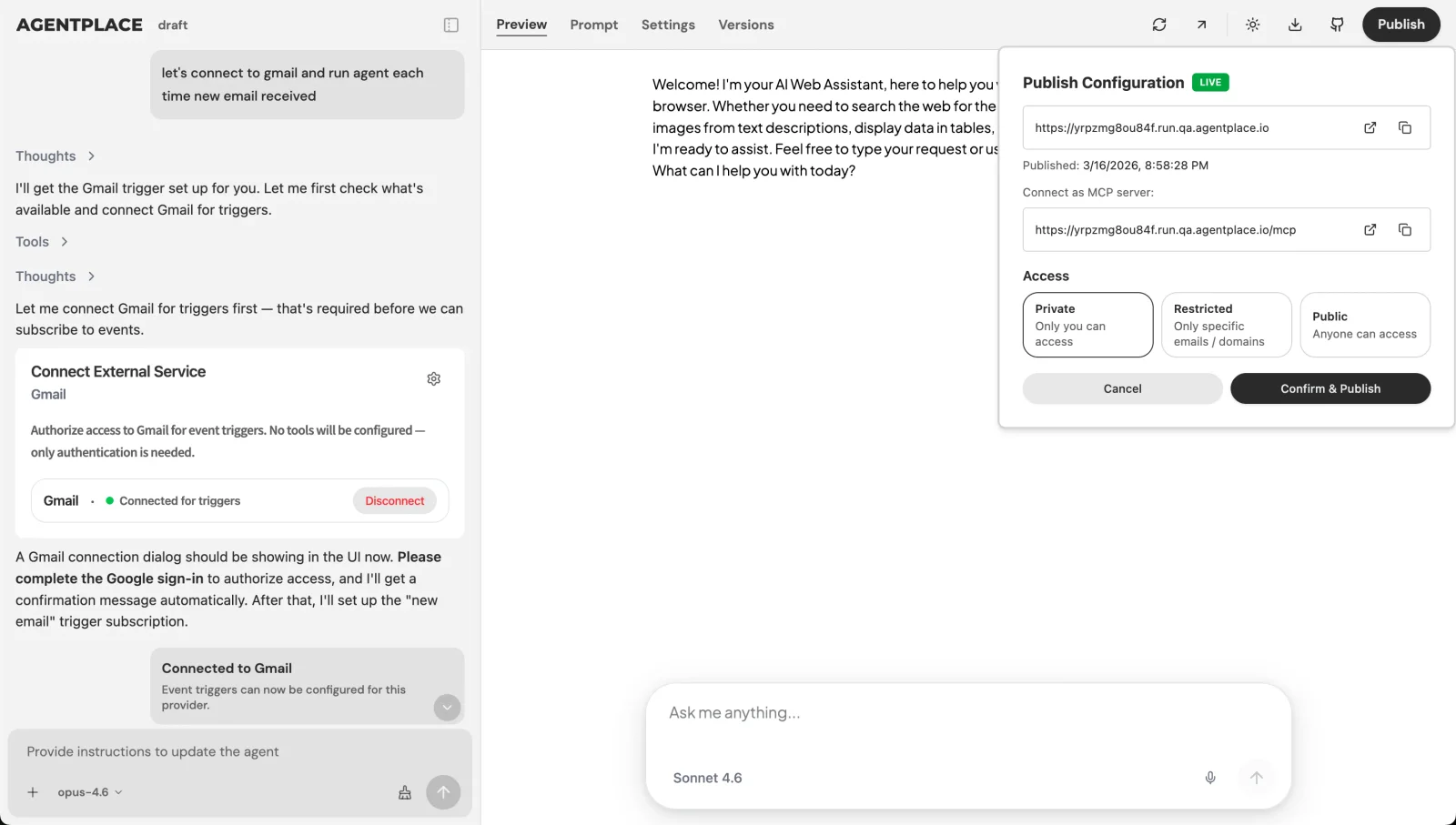 Publish to the agent’s own URL and point your inquiry form at it.
Each agent is a real application holding your departures, your rules and your records. It renders results as interfaces: a shortlist with fit reasons, an intake form showing only what is missing.
Two travel templates are published. The AI Adventure Tour Suitability Agent checks stated preferences against a tour’s demands, and the AI Safari and Adventure Trip Selection Agent shortlists your own departures.
Who it fits. Operators taking free-text inquiries across several channels, where the answer depends on dates, party, budget and constraints together.
Who should choose something else. Structured inquiries needing only scoring: Zapier, Make or n8n. Repeat operational questions: Intercom Fin or Tidio Lyro. A bottleneck in itineraries and quotes: Tourwriter or Travefy. Everything on your own servers: Agentplace is hosted, so choose a self-hosted platform.
What Should the Agent Ask, and In What Order?
Ask only the question whose answer changes what happens next.
A traveler who names a departure and a date should reach a booking in two exchanges.
| What the traveler writes | What the agent asks next | What that rules out | What it does with the answer |
|---|---|---|---|
| “Two of us, Tanzania, honeymoon, September-ish, flexible budget” | The exact window, and a per-person range | Camps above the range, departures outside the window | Shortlists private options and flags the migration-season surcharge |
| “Group of 14, corporate, October, one wheelchair user” | Whether the group stays together, terrain tolerance, decision date | Scheduled departures and vehicles without transfer seating | Routes to a named human as a charter inquiry, access requirement on the record |
| “How much is the Douro cruise?” | Dates, cabin grade, number of travelers | Nothing yet, this is a price question | Answers from your published band, then asks the two questions that make it an inquiry |
| “Kilimanjaro next year, never been at altitude” | Month, fitness, how many days they can take | Five-day routes for an unacclimatised first-timer | Recommends longer routes and records the fitness note for the guide team |
| “Is 6 too young for the rafting trip?” | Nothing. The published minimum age answers it | The grade IV departure | Answers, then offers the family float trip with its own dates |
An opener that qualifies without sounding like a form:
“Happy to help with September in Tanzania. The migration is usually in the northern Serengeti then, so camp choice matters more than usual. Two quick things: are your dates fixed or movable by a week, and what per-person budget are you working to, excluding flights?”
What Does Automated Qualification Cost to Run?
Compare it against the hours qualification eats today, which you already pay.
The model below is illustrative, and states its assumptions.
The US Bureau of Labor Statistics put the median annual wage for travel agents at $48,450 in May 2024, roughly $23.29 an hour, or about $29 with employer costs. At 12 minutes per inquiry to read, reply, chase and record, 300 inquiries a month is 60 hours, around $1,740. Software taking the first pass on 60% gives back 24 hours.
Those hours go into proposals, charter pricing and the calls that close.
Which Numbers Tell You It Is Working?
Four, tracked monthly.
They separate a demand problem from a qualification problem.
- First-response time, median. Minutes to the first substantive reply, overnight included.
- Inquiry-to-qualified rate. The share reaching a complete six-field record. Automation moves this one first.
- Qualified-to-booked rate. If this falls while the rate above rises, your bar is too low.
- Share needing a human, by reason. A reason that keeps climbing is a rule you never wrote down.
Which Tool Fits Which Tour Operator?
| Tool or category | What it does with an inquiry | Best for |
|---|---|---|
| Reservation platforms: FareHarbor, Bokun, Rezdy, Checkfront, Peek Pro | Take a booking when the traveler already knows the departure; inquiry forms collect fields into an inbox | Best for operators whose travelers arrive knowing the exact product and date |
| Workflow automation: Zapier, Make, n8n | Score, assign and alert on data that is already structured | Best for operators whose inquiries arrive as clean fields and only need routing |
| Support AI assistants: Intercom Fin, Tidio Lyro | Answer known questions, escalate the rest | Best for operators whose volume is meeting points, inclusions and departure times |
| Travel CRM and quoting: Tourwriter, Travefy, TravelJoy | Turn a qualified inquiry into an itinerary, a quote and a follow-up sequence | Best for operators whose bottleneck is proposal production, not qualification |
| Outsourced reservations or a trained VA | A person reads and answers every inquiry | Best for operators who want human judgement on every message and can fund it |
| Agentplace | Reads free text, asks the next question, applies your rules, produces a routed record, works on web, voice and phone | Operators who want the unstructured inquiry answered, qualified and carried through to a booking on the operator’s own page |
The criteria are the five under the first table.
Two rows beat Agentplace on their own ground.
A reservation platform is the better place to take a booking from a decided traveler, and workflow automation is the cheaper way to route an inquiry that already arrives structured.
Our comparison of AI agents for tour operators and travel websites covers the traveler-facing side of the stack, including where a booking widget beats a conversation.
What We Found That Others Won’t Tell You
Most operators have no qualification standard to automate.
The six fields live in one person’s head, applied differently on a busy Friday.
Automation exposes that in week one, which is uncomfortable and useful.
Write the rules down and you fix conversion before the agent goes live.
It also makes weak product data visible.
If your access notes say “some walking” and a wheelchair user asks, the agent has to escalate or invent.
So week one goes on terrain notes, ages and lead times, not on software.
Which Mistakes Break Automated Lead Qualification?
- A fixed intake script. Six discovery questions to a decided traveler loses a booking you had won.
- No escalation list. Without one, the agent answers a visa question. Write it first.
- Qualifying without answering. A traveler who asked about the migration and got a form leaves.
- No owner on the record. A perfect record in an unassigned queue is still a lost inquiry.
How Do You Roll This Out in Two Weeks?
Three stretches, with the agent live on one channel at the end.
- The preparation, and most of the fortnight. Pull your last fifty inquiries and mark the missing fields. Write the rules and the escalation list, then fix the data they rest on: ages, grades, access notes, lead times.
- The build, a few hours. Write the brief and let the builder create the agent. It tests its own work before you see it.
- The testing, as long as the complexity deserves. Run the agent against those fifty inquiries. A single-product intake is an afternoon. Several products with grades and lead times takes longer.
- Going live. Connect the reservation system and the inbox, publish on the website route, and record the baseline for the four numbers above.
Add phone and messaging once that channel holds.
The bottom line. An agent reads the inquiry the minute it lands, answers what the traveler asked, and collects the window, the party, the budget and the constraints. It applies your ages, grades and lead times, writes a scored record into the system your team uses, chases the ones that go quiet and carries the ready ones through to a booking. Charters and access requests go to a named person. Agentplace is where you build that agent, on the web, by voice and over the phone, on top of the reservation system you run. If your inquiries only need scoring, use workflow automation instead.
Questions and answers
Frequently asked questions.
How can I automate tour operator lead qualification?
Put an AI agent in front of every inquiry channel. It reads what the traveler wrote, asks only the questions that change the answer, extracts dates, party size, budget and constraints, applies your departure and age rules, writes a structured record into your system and routes the inquiries worth a call.
What does AI lead qualification for tour operators actually do?
It turns an unstructured message into a usable record. The agent answers the traveler's opening question, collects the missing fields, rules out departures that cannot work, scores the inquiry against your own criteria and hands a person either a qualified inquiry or a booking-ready traveler.
How do I qualify travel inquiries consistently?
Write down the six fields every inquiry needs: travel window, party composition, destination or product, budget band, hard constraints and decision timing. Then decide what each answer rules out. Consistency comes from the rules being written once and applied the same way at 9am and 11pm.
Can AI qualify travel leads without annoying the traveler?
Yes, if it asks only what it needs for the next decision. A traveler who names a departure and a date should reach booking in two exchanges. A traveler describing a honeymoon with no dates needs four or five questions. A fixed intake script applied to both loses the first one.
What information should a qualified tour inquiry include?
Travel window with flexibility, number and ages of travelers, destination or product interest, budget band per person, hard constraints such as mobility, dietary or visa issues, and when they intend to decide. Anything the reservations team has to email back for belongs in that list.
Does automated qualification replace my reservation system?
No. FareHarbor, Bokun, Rezdy, Checkfront and Peek Pro remain the source of truth for availability, pricing and the booking record. The agent sits in front of the inquiry, qualifies it against your own rules, then writes the finished record into the system your team already runs and books in.
Can an AI agent qualify inquiries by phone as well as on the website?
Yes. Agentplace agents work on the web, by voice and over the phone, so a caller asking about October departures gets the same qualification questions as someone typing into the website. The record it produces is the same shape whichever channel the inquiry arrived on.
What should stay with a human on a tour inquiry?
Private group charters, accessibility promises, medical and altitude judgement calls, visa questions, complaints, and anything involving money already paid. Configure the agent to collect the details and hand those to a named person with context attached instead of attempting an answer.
How long does it take to set up automated qualification?
Plan two weeks, but not because the build is long. Building the agent takes a few hours. The fortnight goes on writing your qualification rules, product constraints and escalation list first, then testing against your last fifty real inquiries and connecting your reservation system and inbox.
What does an AI qualification agent cost to run?
Agentplace has a free plan and paid plans priced in AI credits, and a credit is not the same as a message, because usage depends on the work performed and the model chosen. See the pricing page for current amounts. Compare it against the staff hours qualification currently consumes.
Put this into practice
See the customer experience.
Explore a concrete example related to this article, then adapt the agent to your business.
Create my AI agentStart free with your business idea. The AI builder can help you explore it and create your agent. No technical specification needed. Sign in to continue. Pricing and limits · How the builder works