
How to Qualify Tour Leads by Budget Before Preparing a Trip Proposal

The short answer
A trip proposal takes hours, so budget belongs in the first exchange. Give your own per-person range for the trip described, then ask whether it fits. When it does not, offer the shorter or lower-season version instead of a polite no. An AI agent built with Agentplace can run that exchange.
Key takeaways
- A proposal for a custom trip is unpaid work. It takes research, availability checks and pricing, and it happens before anyone knows the traveler can book.
- Asking a traveler what their budget is, before telling them anything, reads as a filter. Giving your range first turns the same question into a fit check.
- An AI agent built with Agentplace can give your range for the trip described, ask whether it fits, and hand on only the inquiries worth a proposal.
- Budget is not the only reason a lead is a poor fit, and treating it that way loses the travelers who would have stretched for the right trip.
- Start by writing your per-person ranges by trip type and season, and the cheaper versions you can offer: shorter, lower season, smaller group, simpler accommodation.
The short answer
A custom trip proposal is hours of unpaid work: research, availability, supplier prices, an itinerary. Budget belongs in the first exchange, not after that work is done.
Give your own per-person range for the trip they described, with what it includes, then ask whether it fits. When it does not, offer the cheaper version of the same trip rather than a polite no.
An AI agent built with Agentplace can run that exchange, state the ranges you configure and pass on the inquiries worth a proposal. It should not price a trip, because that depends on availability and supplier rates.
For everything you need once a lead is qualified, see what to ask a new travel lead. This page is about the decision before that one.
Why is a trip proposal so expensive to produce?
Because a proposal is the product, delivered for free.
For a custom itinerary, someone checks dates against the operator’s own schedule, asks suppliers about availability, prices accommodation and transfers, writes the day-by-day plan and formats it. Hours, usually spread across two or three days of waiting on replies.
That cost is invisible until you count it. Three patterns waste most of it:
- Proposals written for a budget that was never there. The traveler wanted two weeks of private guiding on a group-tour budget.
- Proposals for dates that were never available. The research came before the availability check.
- Proposals that become a planning service. Each round adds a requirement, and nobody has committed to anything.
The question is not whether to qualify. It is how to qualify without turning the first message into an interrogation.
Which four answers decide whether a proposal is worth writing?
| Answer | Why it decides | What to do when it’s missing |
|---|---|---|
| Dates or a target month | Decides availability and season pricing before any research | Ask for a window rather than exact dates |
| Group size and who is traveling | Changes the trip and the per-person price substantially | Ask for a number and whether it may change |
| Budget range per person | Decides whether your version of the trip is in reach | Give your range for that trip first, then ask |
| Trip type and pace | A private custom itinerary and a scheduled departure are different products | Describe both and ask which sounds right |
Write your own ranges down before you automate anything.
| Your worksheet | What to record |
|---|---|
| Per-person ranges by trip type | Scheduled departure, small group, private custom |
| Seasonal variation | What high season does to each range |
| What each range includes | Guiding, accommodation class, transfers, meals, permits |
| Cheaper versions you can offer | Fewer nights, lower season, larger group, simpler accommodation |
| What you never quote remotely | Trips needing supplier confirmation before any figure exists |
How do you ask about budget without losing the lead?
Give a number before you ask for one.
Weak: “What’s your budget for this trip?”
Better: “Ten days private, in high season, is usually $4,500 to $6,000 a person. Outside high season it’s closer to $3,800. That includes guiding, transfers and mid-range hotels. Is that around what you had in mind?”
The figures are an example. Yours come from the worksheet above.
What changes: the traveler now knows what the money buys, which is the information they were missing. And a range rather than a price keeps the conversation honest while the real figure still depends on availability.
Ask once. If the answer is vague and the dates and group size work, continue and let whoever writes the proposal decide how much to invest.
What do you offer when the budget is too low?
Offer the same trip in a cheaper form before you offer nothing.
- Fewer nights. The itinerary that works at eight days instead of twelve.
- A lower season. Often the single biggest lever, and many travelers are flexible once they see the difference.
- A scheduled departure instead of a private trip. The same places, shared with others, at a fraction of the price.
- Simpler accommodation. Where your supplier relationships allow it.
- A smaller region. One area properly rather than three in a rush.
If none of them reach, say so plainly and name the kind of operator who fits. A traveler told honestly in one message that their budget suits a scheduled group departure, with a suggestion of where to look, remembers that. The referral costs nothing and travelers talk to each other.
Budget is also not the only reason to decline. A traveler with the money and three days for a trip that needs ten is just as poor a fit, and the same honesty applies.
What tools can help you qualify travel inquiries?
| Approach | Best for | What to consider |
|---|---|---|
| Published per-person ranges | Filtering before an inquiry is sent | Custom trips resist exact prices, so publish ranges rather than figures |
| Inquiry form with a budget field | Operators with high inbound volume | A budget field with no context gets guesses or blanks |
| Travel agency CRM | Tracking many open inquiries and proposals | Records the pipeline; the qualifying conversation is still yours |
| Tour operator software | Running departures, bookings and suppliers | Built for operations after the sale rather than for the first exchange |
| AI agent built with Agentplace | Giving your range and qualifying in the first exchange | Pricing a real trip and checking supplier availability stay with people |
If proposals convert well and the problem is that there are not enough inquiries, qualification is not your constraint. If your team writes ten proposals for every booking, this is exactly where the time goes.
How can Agentplace qualify tour inquiries?
Agentplace is a platform for creating AI agents that serve customers and help run a business. Each agent can have its own page and URL, where customers interact through text or voice and receive responses through an interface the agent controls.
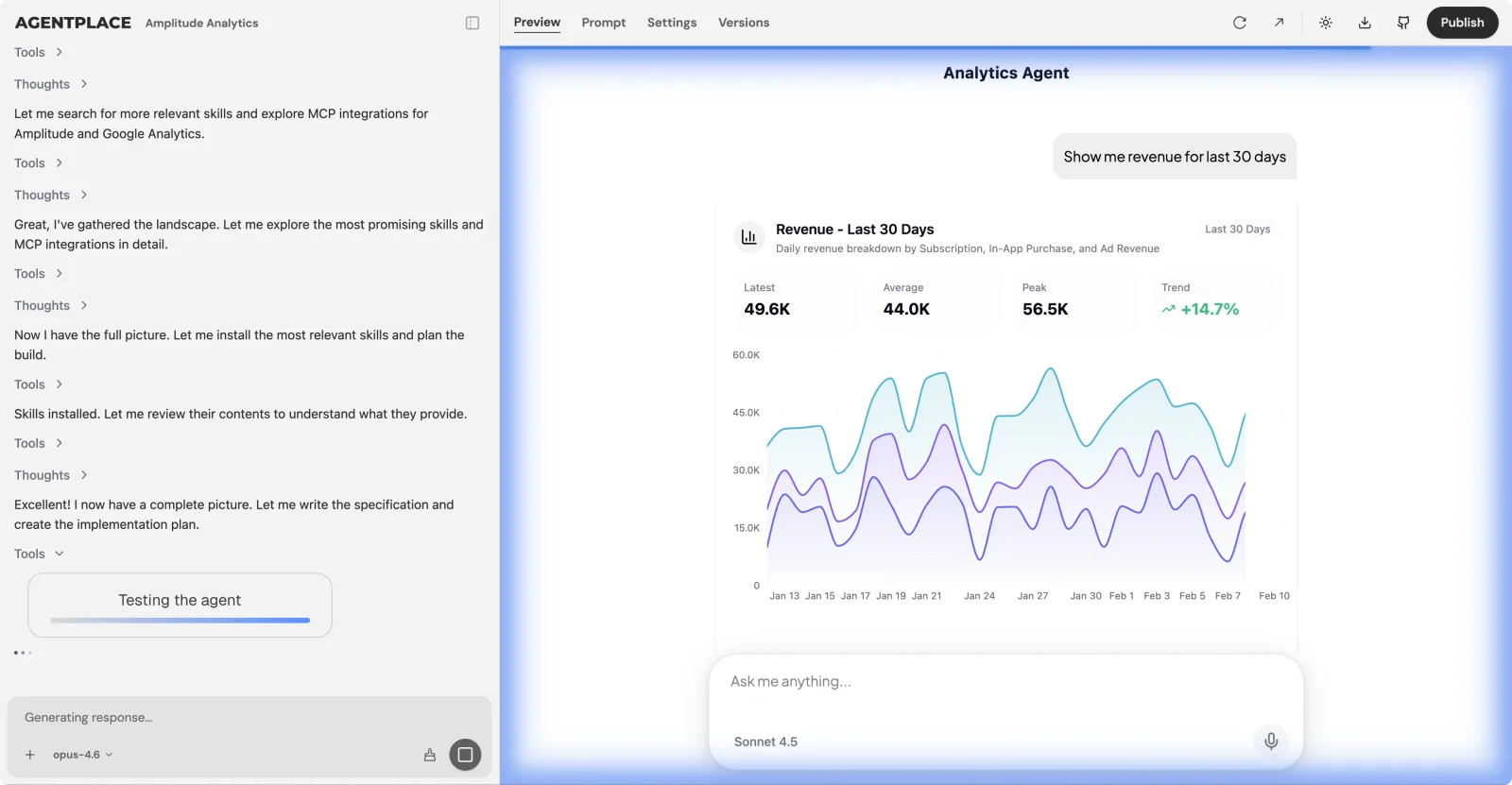 The builder messages the agent it built, reads the replies, and fixes what it finds before you publish.
For a tour inquiry, the agent handles the first exchange:
- It asks for the dates or target month, the group size, and the kind of trip.
- It gives your per-person range for that trip and season, with what it includes.
- It asks whether the range fits, once.
- It offers the cheaper versions you listed when it does not.
- It hands a qualified brief to whoever writes proposals, or gives the honest answer you wrote.
- It routes anything about a specific supplier, a held booking or a negotiated price to a person.
You set it up by describing the outcome in plain language. For example:
“Qualify trip inquiries for our tour company. Ask for the target month, group size and whether they want a private itinerary or a scheduled departure. Give our per-person range for that trip type and season, and say what it includes. Ask once whether it fits. If it does not, offer a lower-season departure, a shorter itinerary or a scheduled group trip at their figures. Never quote a final trip price and never confirm availability. Pass qualified inquiries to Elena with the answers. Tell travelers whose budget suits a scheduled departure where to look if we have none.”
The AI Builder clarifies the requirements, creates the agent and helps test it. You choose when to publish. No code is required.
What depends on configuration: writing the inquiry into your CRM, reading a departure calendar or booking a call all need a supported connection and the permissions you grant. Agentplace connects through Composio’s integration catalog and compatible MCP tools. Supplier availability is not something an agent should assert at all unless that system is connected and current.
Pricing: Agentplace has a free plan and paid plans that use AI credits. See the current pricing and plan limits.
Template to start from: AI Tour Suitability Intake Agent
What should you measure?
| Metric | What it tells you | How to measure it |
|---|---|---|
| Hours per confirmed booking | Whether qualification is paying for itself | Proposal and research hours logged, over bookings confirmed |
| Proposal-to-booking rate | Whether the briefs reaching your planners are workable | Bookings over proposals sent |
| Declined travelers who booked similar trips elsewhere | Whether the filter is too tight | Ask at the referral stage, or review a season later |
The third number is the safety check. Travelers stretch for trips they want, and a filter tuned only on the first two will eventually cut into bookings you would have had.
When don’t you need an AI agent?
- You get a few inquiries a week and you enjoy the first conversation. That conversation is often why people book with a small operator.
- You sell scheduled departures at published prices. The price does the qualifying already.
- Your ranges are not written down. Write them first; they are the brief for any tool and the training for any new salesperson.
- Your proposals convert well. Then the bottleneck is lead volume, and this is the wrong problem to work on.
Quick checklist
- Per-person ranges written down by trip type and season
- What each range includes, in one line
- Cheaper versions of each trip identified
- Your range given before you ask about theirs
- Budget asked once, not twice
- Dates and group size checked before any research
- An honest answer ready for travelers you cannot serve, with where to look
- Final prices and availability reserved for a person
- Declined travelers reviewed once a season
Related reading: What to ask a new travel lead · How to automate tour operator lead qualification · Handling inquiries while guiding trips
Bottom line
A proposal is hours of unpaid work, so the per-person range belongs in the first exchange, given by you before it is asked of the traveler.
If your planners are writing proposals for trips nobody could afford, an AI agent built with Agentplace can give your ranges, ask once whether they fit, and pass on the briefs worth writing. If your proposals already convert, the work is finding more inquiries, not filtering the ones you have.
Questions and answers
Frequently asked questions.
When should you ask a traveler about their budget?
In the first exchange, after you have given a range of your own. Waiting until the proposal stage means the research is already done, and asking before you have shared anything makes the traveler feel assessed rather than helped.
How do you ask about budget without sounding like a filter?
Name your own figure first. Say what a trip like the one they described usually costs per person in that season, say what it includes, then ask whether that sits inside what they had in mind.
What should you offer a traveler whose budget is too low?
The same trip in a cheaper form: fewer nights, a lower season, a smaller group, simpler accommodation, or a scheduled departure instead of a private one. If none of those work, say so and point them to the kind of operator who fits.
Should tour operators publish prices?
A per-person range by trip type filters far more effectively than any question, and it does the filtering before you spend time. Custom work makes exact prices impossible, which is why a range rather than a price is the useful thing to publish.
Can an AI agent qualify travel inquiries by budget?
It can state the ranges you configure, ask whether they fit, and route the answer. It should not quote a final trip price, because that depends on availability, supplier rates and the itinerary, which are decisions for a person.
What if the traveler will not give a budget?
Continue if the dates, group size and trip type are workable. Some travelers genuinely do not know until they see options. Note it and let whoever writes the proposal decide how much work to invest.
How is this different from a lead intake checklist?
An intake checklist collects everything needed to plan a trip. Budget qualification is the earlier decision about whether to do that work at all, and it needs four answers rather than twenty.
What should a tour operator measure?
Hours spent per confirmed booking, the share of proposals that convert, and how many travelers you declined who booked a similar trip elsewhere. The last number shows whether the filter is too tight.
Put this into practice
See the customer experience.
Explore a concrete example related to this article, then adapt the agent to your business.
Create my AI agentStart free with your business idea. The AI builder can help you explore it and create your agent. No technical specification needed. Sign in to continue. Pricing and limits · How the builder works