
How Tour Operators Can Handle Customer Inquiries While Guiding Trips

The short answer
Owner-guides lose inquiries during working hours, not after them, because they are leading the trip they sell. The fix is deciding what gets answered in your absence and what waits: trip questions and intake can be covered, while prices, holds and changes wait for you. An AI agent built with Agentplace can hold that line.
Key takeaways
- For an owner who guides, the dead hours are the working ones. The inquiry arrives on Tuesday morning while you are on a trail with eight guests.
- This is a different problem from after-hours cover: the traveler expects a working-hours answer, and a holiday auto-reply is the wrong instrument.
- An AI agent built with Agentplace can answer trip questions and collect the brief while you are out, on its own page and as a phone agent.
- The value is in what the agent does not do. Prices, held places and itinerary changes should wait for the person who can honor them.
- Start by writing two lists: what you are happy to be answered in your absence, and what must wait for you with a time you will reply by.
The short answer
For an owner who guides, the problem is not the evenings. It is Tuesday morning, on a trail, with eight guests and an inquiry arriving from someone comparing three operators.
The fix is a decision, not a tool: what may be answered while you are out, and what waits for you. Trip facts, suitability and intake can be answered. Prices, held places and itinerary changes should wait, with a stated time you will reply by.
An AI agent built with Agentplace can hold that line on its own page, by text or voice, and as a phone agent. The useful part is the restraint: it answers what you decided in advance and says plainly that the rest is coming from you.
This is a different problem from capturing leads after hours, where the traveler already expects to wait.
Why do inquiries get lost during working hours?
Because the person who sells the trips is the person running them.
A small operator’s calendar is the inverse of an office’s. The busiest guiding days are weekends and holidays, which is also when travelers research. During a trip you have guests in front of you, patchy signal, and no capacity for a considered reply.
- The traveler is comparing right now. They sent the same question to three operators and are reading whatever comes back.
- An out-of-office reply reads badly in the middle of a Tuesday. It says closed rather than busy.
- The reply you eventually write is worse. Written at ten at night after a day of guiding, it is shorter and later than the one a competitor sent at eleven in the morning.
- The questions are usually ones you have answered a hundred times. Fitness, what is included, how hard day three is, whether a ten-year-old can come.
The fix is not answering faster from the trail. It is deciding in advance which answers do not need you.
What can be answered while you are out, and what cannot?
| Can be answered in your absence | Should wait for you |
|---|---|
| What a trip involves, day by day | A final price for a custom itinerary |
| Fitness and suitability against criteria you wrote | Holding a place or a date |
| What is included and excluded | Any change to an itinerary |
| Group sizes and typical ranges | Anything that needs a supplier’s confirmation |
| Equipment, climate and what to bring | A discount or a special arrangement |
| The intake questions you would ask anyway | A judgment call about an unusual request |
The left column is facts you have already decided. The right column is where a wrong answer costs money or a promise you cannot keep.
Rule of thumb: if the answer would be the same whoever in your business gave it, it can be given while you are out.
How do you set this up before your next trip?
1. Write the trip facts down once
Day-by-day outlines, fitness requirements, what is included, age limits, equipment. This is the work, and it is reusable: the same page serves your website, your agent and any guide who covers for you.
2. Write the suitability rules, not just the descriptions
“Day three is six hours with 3,000 feet of ascent” is a fact. “Suitable for someone who walks regularly but has not hiked at altitude” is a rule, and it is what answers the real question.
3. Decide the intake questions
The ones you ask every traveler anyway: dates, group size, fitness, dietary needs, whether they want private or scheduled. Collected while you are out, they mean your reply starts from a complete picture.
4. Say when you will reply, and be specific
“I am leading a trip until Thursday and will reply by Thursday evening” is a professional answer. “We will get back to you shortly” is not.
5. Keep one escalation route open
Some inquiries cannot wait: a traveler already on a trip, a flight change, a medical question. Decide which ones reach you anyway, and how.
6. Review what the agent could not answer
Every inquiry it handed over is either a rule you have not written yet or a decision that genuinely needs you. The first kind should shrink after each trip.
What tools can help?
| Approach | Best for | What to consider |
|---|---|---|
| Out-of-office auto-reply | Genuine closures | Reads as closed when you are simply guiding |
| Answering service | Catching calls while you are unreachable | Takes a message; the traveler still waits for the answer |
| Virtual assistant or part-time coordinator | Operators with enough volume to justify it | Needs the same written trip facts, and costs a salary |
| Tour operator software | Running departures, bookings and suppliers | Operational rather than conversational |
| AI agent built with Agentplace | Answering trip questions and collecting intake while you guide | Answers from what you wrote; prices and holds should stay with you |
A coordinator and an agent need the same preparation. If you have never written the trip facts down, that is the first task either way.
How can Agentplace cover inquiries while you guide?
Agentplace is a platform for creating AI agents that serve customers and help run a business. Each agent can have its own page and URL, where customers interact through text or voice and receive responses through an interface the agent controls.
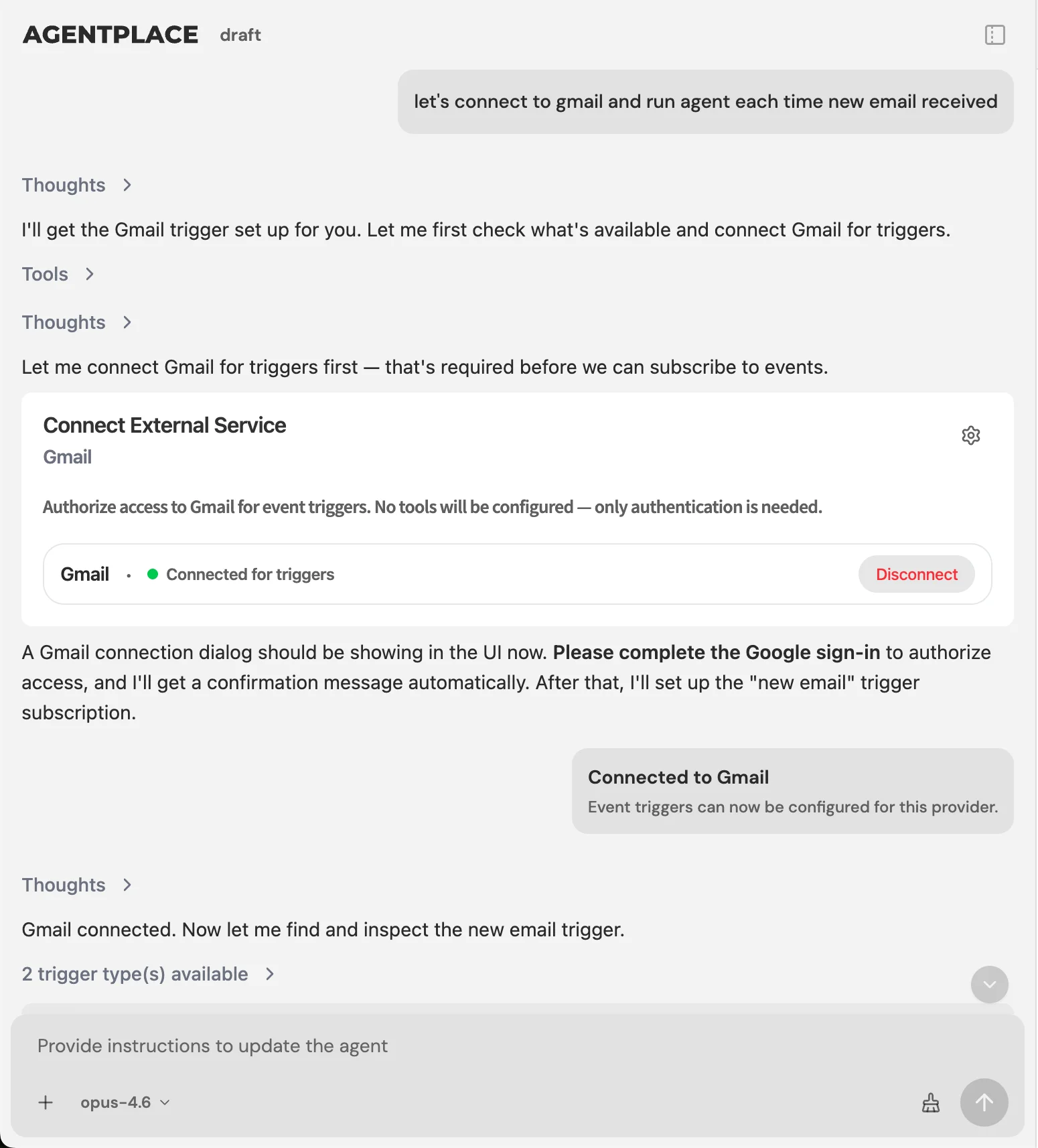 The platform can wake the agent on a schedule or an event, which is how a daily summary of the week’s inquiries reaches you.
While you are out, the agent does four things:
- It answers the trip questions from the facts and suitability rules you wrote.
- It collects the intake so your reply starts from a complete picture.
- It says where you are and when you will reply, in your own words.
- It holds the line on the rest. Prices, held places and changes are named as things you will confirm.
Travelers reach it on its own page, by text or voice, and as a phone agent, so a traveler who prefers to call is not left with a voicemail. Use the same rules on every channel: an answer about suitability should not change with the route the traveler took.
You set it up by describing the outcome in plain language. For example:
“Answer inquiries for our tour company while I am out guiding. Use our trip pages for what each trip involves, the fitness level, what is included and age limits. Answer suitability questions against those rules. Collect dates, group size, fitness and dietary needs. Say that I am leading a trip and will reply within one working day, and give the day. Never quote a final price, never hold a place, never change an itinerary: say I will confirm those. If a traveler is already on a trip or mentions a flight change or a medical issue, tell them to call me and send me an alert.”
The AI Builder clarifies the requirements, creates the agent and helps test it. You choose when to publish. No code is required.
What depends on configuration: sending you alerts, writing inquiries into a CRM and reading a departure calendar need a supported connection and the permissions you grant. Agentplace connects through Composio’s integration catalog and compatible MCP tools. The agent’s answers about your trips depend on the facts you wrote, not on an integration.
Pricing: Agentplace has a free plan and paid plans that use AI credits. See the current pricing and plan limits.
Templates to start from: AI Tour Suitability Intake Agent and AI Travel Planner for Travel Advisors
What should you measure?
| Metric | What it tells you | How to measure it |
|---|---|---|
| Inquiries answered usefully the same day | Whether absence is still costing you | Inquiries with a substantive answer within the day, over all inquiries |
| Share arriving on guiding days | How big this problem actually is for you | Inquiry timestamps against your trip calendar |
| Bookings from inquiries that arrived while you were out | What the cover is worth | Bookings traced back to those inquiries |
The second number is the one worth checking first. Most owner-guides have never counted it, and it decides whether this is worth any effort at all.
When don’t you need an AI agent?
- You guide a handful of trips a year. Block the inquiry work around them.
- Someone already covers the inbox while you are out. They need the written trip facts, not software.
- Your trip facts are not written down. Write them first. It is the work either way, and it improves your website on its own.
- Your trips sell out from a waiting list. Then slow replies are not costing you bookings.
- Most of your inquiries need judgment. If every traveler wants something unusual, an agent will hand most of them over, and the value is small.
Quick checklist
- Trip facts written down: outline, fitness, inclusions, age limits
- Suitability rules written as rules, not descriptions
- Intake questions agreed and collected in your absence
- A clear line between what is answered and what waits
- A stated reply time, specific to the trip you are on
- An escalation route for travelers already on a trip
- Prices, holds and itinerary changes reserved for you
- A review after each trip of what had to be handed over
Related reading: Capturing leads after hours · Qualifying tour leads by budget · What to ask a new travel lead
Bottom line
For an owner who guides, the lost inquiries arrive in working hours, and the fix is deciding in advance which answers do not need you.
If you are losing inquiries on the days you are out with guests, an AI agent built with Agentplace can answer the trip questions, collect the intake and say when you will reply. Prices and held places wait for you. If your trip facts have never been written down, start there. That is what any cover depends on, human or otherwise.
Questions and answers
Frequently asked questions.
Why do tour operators lose inquiries during business hours?
Because the owner is often the guide. While you are leading a trip you cannot take a call or write a considered reply, and the inquiry that arrived on Tuesday morning gets answered on Thursday night.
Is this the same as after-hours lead capture?
No. After hours, a traveler expects to wait. During working hours they do not, and a message saying the office is closed on a Tuesday afternoon reads as a business that is not operating.
What should be answered while you are out guiding?
Trip facts you have already decided: what a trip involves, fitness and suitability, what is included, group sizes, typical price ranges, and the intake questions you would ask anyway. Those answers do not change with your mood or your margin.
What should wait until you are back?
Final prices, holding a place, changing an itinerary, anything involving a supplier, and any question where the right answer depends on judgment. Say it will wait and give a time you will reply by.
Can an AI agent answer the phone for a tour operator?
Travelers can reach an agent built with Agentplace on its own page by text or voice, and as a phone agent. Use the same rules on every channel so an answer does not change with the route the traveler took.
What should the agent say about you being unavailable?
The truth, briefly: you are out leading a trip and will reply by a stated time. Travelers booking guided trips find that reassuring rather than unprofessional, because it is evidence the trips run.
Does this work for a solo operator?
It is most useful for a solo operator, because there is nobody to cover. The requirement is that your trip facts and intake questions are written down, since the agent can only answer from what you have given it.
What should a tour operator measure?
The share of inquiries that get a useful answer the same day, how many arrive during your guiding days, and bookings from inquiries that landed while you were out. The middle number usually surprises people.
Put this into practice
See the customer experience.
Explore a concrete example related to this article, then adapt the agent to your business.
Create my AI agentStart free with your business idea. The AI builder can help you explore it and create your agent. No technical specification needed. Sign in to continue. Pricing and limits · How the builder works