
How to Qualify Wedding Venue Inquiries Before You Give a Tour

The short answer
Four facts decide whether a wedding venue tour is worth giving: the date, the guest count, the budget range, and the format the couple wants. Ask them in your first reply, state your own minimum before asking about theirs, and give couples below it a real option instead of a dead end.
Key takeaways
- A tour you give to a couple who cannot book costs a weekend hour, the preparation around it, and the slot a suitable couple could have taken.
- A longer inquiry form is the usual fix and the wrong one. It filters out couples who would have booked, because the ones who are still comparing venues abandon it.
- An AI agent built with Agentplace can ask the four facts, apply the thresholds you wrote down, and book a tour only when the answers fit.
- Qualifying has two failure modes, not one. Track how many couples you routed away who booked elsewhere in your venue, or you will tighten the filter until it costs you bookings.
- Start by writing your minimum for each season and day type, your capacity per layout, and what each package includes. Until those exist on paper, nothing can qualify anything.
The short answer
Qualify a wedding venue inquiry on four facts: the date, the guest count, the budget range, and the format the couple wants.
Ask for them in your first reply, not in a form before it. State your own minimum before you ask about their budget, so the question reads as a fit check rather than a means test. When a couple falls below your minimum, give them an option that works instead of a polite no.
An AI agent built with Agentplace can ask those four questions, compare the answers against the thresholds you wrote down, and book a tour only when they fit. What it can check live, such as a calendar, depends on the connections and permissions you set up.
What does an unqualified venue tour actually cost?
More than the hour it takes. A tour usually falls on a weekend, when your team is already running an event. Around it sit the walkthrough, the quote, the follow-up, and the slot a suitable couple could have had.
That is the cost most venues notice. There is a second one that is easier to miss.
- Over-filtering costs bookings. Some couples stretch their budget for the venue they want. Others move to a Friday or a weekday when they learn the difference. A filter that rejects them on the first number loses both.
- Inconsistency costs trust. When two team members answer the same inquiry differently, couples compare notes in forums and the venue looks arbitrary.
- Silence is also a decision. An inquiry you never answer because it looked unpromising still gets an answer: the couple books elsewhere.
Qualifying well means getting both errors down, not just the first one. That is why the last section of this article is about measurement rather than about tools.
Which four facts decide whether a couple fits?
These four decide whether a tour makes sense. Everything else can wait until the couple is in the room.
| Fact | Why it decides | What to do when it’s missing |
|---|---|---|
| The date | It sets the season, the day type and whether you are even available | Ask for a range or a target month, then quote the band for it |
| Guest count | It decides which space works, and whether any of them do | Ask for a rough number and whether it may grow |
| Budget range | It tells you whether your minimum is in reach | State yours first, then ask which range they are working to |
| Format | A ceremony on site, a dry hire or a full package are different products | Ask what they picture, not which package they want |
Write your own thresholds down before you automate anything. The structure matters more than the figures, and the figures are yours:
| Your worksheet | What to record |
|---|---|
| Minimum by season and day type | Peak Saturday, peak Friday or Sunday, off-peak Saturday, off-peak weekday |
| What each minimum includes | Room, staffing hours, catering, tasting, anything that changes the number |
| Capacity by layout | Seated, standing, with a ceremony on site, with a dance floor |
| Where each figure is stated | Your site, the first reply, or only on a tour |
| What is never automated | Negotiation, provisional holds, anything your team must approve |
Until that page exists, nothing can qualify anything, with or without software. It is also the brief you hand to whatever tool you use.
How do you ask about budget without losing the lead?
Name your own number first. The question changes meaning when you do.
Weak: “What’s your budget for the wedding?”
Better: “Your date is a peak Saturday, so our minimum is $18,000. That covers the room, staff until midnight and the tasting. A weekday in spring would be $9,000. Is $18,000 in the range you’re working with?”
The figures are an example. Yours come from the worksheet above.
Three rules keep the question useful:
- Ask for a range, not a figure. Couples rarely have one number, and a range is enough to know whether a tour makes sense.
- Attach the number to what it buys. A minimum with no inclusions sounds like a gate. The same number with staffing and catering attached sounds like a price.
- Ask once. If the answer is unclear, offer a tour anyway when the date and guest count fit. Pressing twice reads as a credit check.
What do you do with a couple below your minimum?
This depends on whether you have anywhere to send them, and both answers are legitimate.
If you have options, route rather than reject. Most venues have more than one product, even when it does not look that way:
- A weekday or a Sunday, where the minimum is lower.
- An off-peak month with the same room.
- A smaller space, if the guest count allows it.
- A lighter package, with catering or hours reduced.
Offer the closest one and say what it would cost them. A couple who came in below your Saturday minimum and booked a Friday is a booking you would otherwise have refused.
If you have one price and one room, say so kindly and point onwards. A venue with a single product has nothing to route to, and pretending otherwise wastes another round of emails. Name the figure, say plainly that it is unlikely to work for their budget, and suggest the kind of venue that would.
That answer costs you nothing and earns referrals. Couples talk to each other, and a venue that gave them a straight answer in one message gets recommended to the ones who can afford it.
How do you avoid over-qualifying?
The filter has to be loose enough to let in couples who would book.
- Four questions, then stop. If an answer will not change your decision, it is not a qualifying question.
- Never ask before you give. Share your minimum, your capacity or your availability first, then ask.
- Let the couple self-select. Publishing a range does more filtering than any form, and it filters before you spend time.
- Keep a manual override. Some inquiries read wrong and book anyway. Your team should be able to offer a tour against the rule and note why.
Rule of thumb: qualify to decide whether a tour makes sense, not to decide whether the couple will book.
What tools can help you qualify inquiries?
The right choice depends on where your process actually breaks.
| Approach | Best for | What to consider |
|---|---|---|
| AI agent built with Agentplace | Asking the four facts and booking a tour when they fit | Live calendar checks and writing to other systems depend on configured connections |
| Required fields on an inquiry form | Venues with steady inbound volume and a simple product | Longer forms get abandoned by couples who are still comparing |
| Published price range on your site | Filtering before an inquiry is ever sent | Some venues prefer not to publish a figure, which moves the work to the reply |
| CRM with lead scoring | Teams tracking many inquiries across a pipeline | Scoring works from the data you capture, so it needs the four facts anyway |
| Wedding venue management software | Managing bookings, contracts, invoices and holds in one place | Check whether it answers inquiries or only records them |
If your inquiries are already qualified and the problem is contracts and invoices, venue management software is the better purchase. If couples are waiting for answers while your team runs an event, see how to respond to inquiries faster first, because speed and qualification are different problems with different fixes.
How can Agentplace qualify inquiries for a venue?
Agentplace is a platform for creating AI agents that serve customers and help run a business. Each agent can have its own page and URL, where customers interact through text or voice and receive responses through an interface the agent controls.
For qualification, the agent does what your written rules say, in the same order, every time.
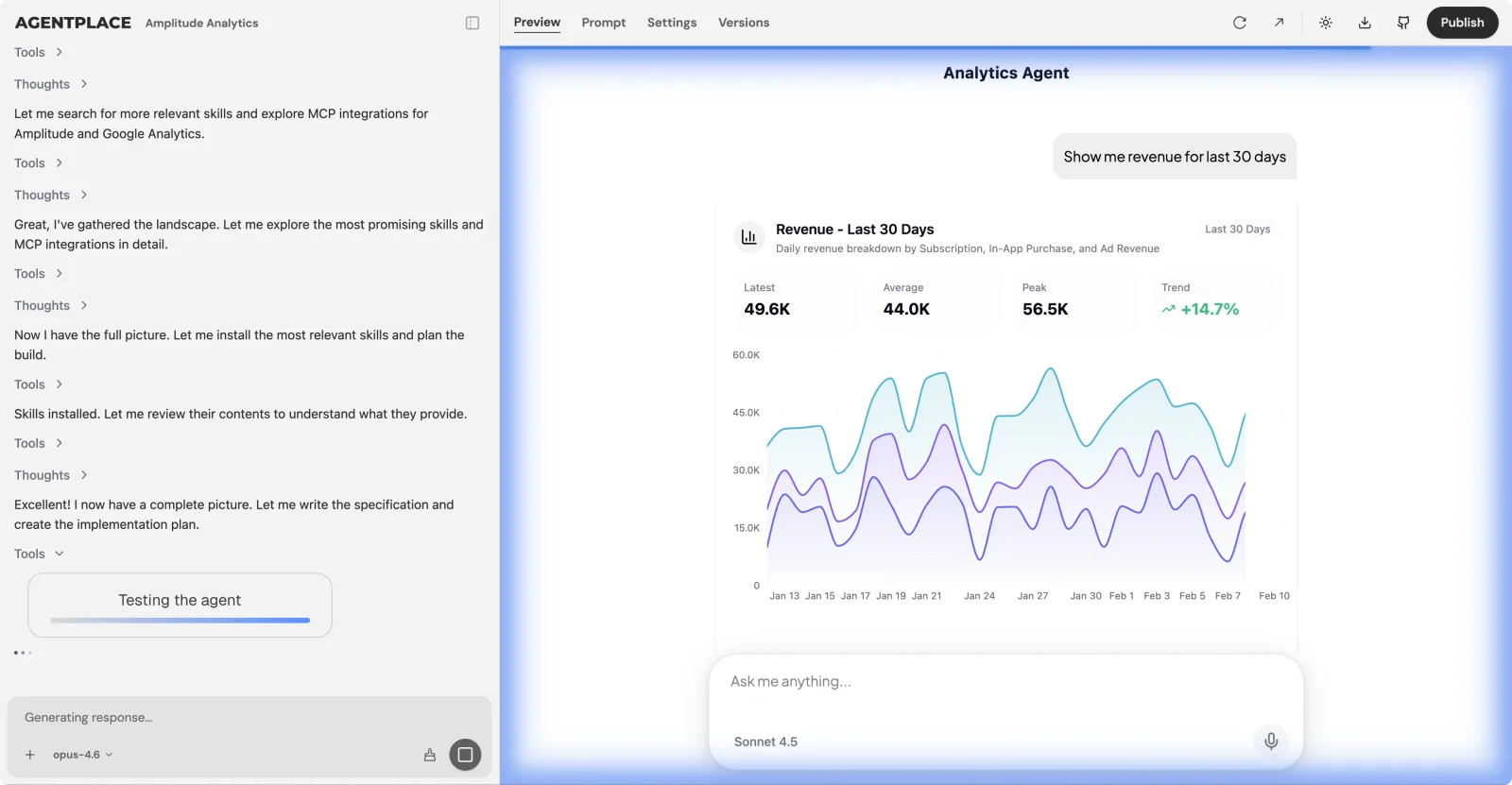 The builder messages the agent it built, reads the replies, and fixes what it finds before you publish.
- It asks the four facts, in the order you choose, and stops asking when it has them.
- It states your minimum for the date in question, with what that figure includes.
- It compares the answers against your thresholds and books a tour when they fit.
- When they do not fit, it offers the alternatives you listed, or gives the honest no you wrote.
- It routes negotiation, provisional holds and anything unusual to your team.
You set this up by describing the outcome in plain language. For example:
“Qualify wedding inquiries for our venue. Ask for the date, the guest count, the budget range and whether they want the ceremony on site. State our minimum for that season and day before asking about their budget, and say what it includes. Book a tour when the date is available and the budget range reaches our minimum. When it does not, offer our weekday and off-peak options at their figures. Never negotiate, never promise a hold. Send anything about a multi-day or corporate booking to our events team.”
The AI Builder clarifies the requirements, creates the agent and helps test it. You choose when to publish. No code is required.
What depends on configuration: checking a live calendar, writing the inquiry into your CRM or booking a tour in it all need a supported connection and the permissions you grant. Agentplace connects through Composio’s integration catalog and compatible MCP tools. Without a connection the agent still collects the four facts and hands the inquiry to your team, which is the honest version of the same workflow.
Before publishing, test the cases that matter: a couple who fits, a couple below the minimum with an option, a couple below it with no option, a date you have provisionally held, and a request to negotiate.
Pricing: Agentplace has a free plan and paid plans that use AI credits. Review the current pricing and plan limits against your inquiry volume.
Template to start from: AI Wedding Venue Fit Agent
What should you measure?
Three numbers, and the third is the one most venues skip.
| Metric | What it tells you | How to measure it |
|---|---|---|
| Share of tours that fit your criteria | Whether the filter is working at all | Tours where date, guests and budget met your thresholds, over all tours given |
| Tours per booking | How much weekend time each booking costs | Tours given divided by contracts signed |
| Routed-away couples who booked anyway | Whether the filter is too tight | Bookings from couples first told they were below the minimum |
Review the first two monthly. The third is the safety check: if couples you routed away keep booking, your thresholds are tighter than your actual business, and the fix is the rule rather than the tool.
Account for season and lead quality when you compare. A quiet month and a tight filter look identical in the first number.
When don’t you need an AI agent?
- You get a handful of inquiries a month. Writing your thresholds down will fix most of this on its own.
- You sell the venue personally and that is why couples book. Keep the conversation and automate nothing in front of it.
- Your minimums are not written down or not agreed. Fix that first. An agent cannot apply a rule that does not exist.
- One price, one room, published on your site. Couples are already self-selecting, and there is little left to qualify.
- Your team disagrees about who deserves a tour. That is a policy question, and automating it just makes the disagreement faster.
Qualification checklist
- Minimums written down by season and day type
- What each minimum includes, in one line each
- Capacity recorded per layout
- The four facts asked in the first reply, not in a form
- Your figure stated before you ask about theirs
- Alternatives listed for couples below the minimum, or an honest referral ready
- Negotiation and holds reserved for a person
- A manual override your team can use, with a note why
- Routed-away couples tracked, so the filter stays honest
Related reading: How to respond to venue inquiries faster · AI wedding venue inquiry agent · Automating lead qualification for tour operators
Bottom line
Four facts decide whether a wedding venue tour is worth giving, and writing your own thresholds down is what makes them usable by anyone, including software.
If your team is answering the same four questions by hand while running events, an AI agent built with Agentplace can ask them, apply your rules and book the tours that fit. If your minimums and inclusions have never been agreed in writing, start there. No tool will decide that for you.
Questions and answers
Frequently asked questions.
Should a wedding venue publish its minimum spend?
Publishing a range filters most unsuitable inquiries before they reach you, which saves both sides time. If you prefer not to publish it, state it in the first reply instead. The cost of hiding it is tours with couples who were never going to book.
How do you ask a couple about their budget politely?
State your own figure first, then ask which range they are working to. Asking what they can spend before you have shared anything reads as a credit check. Naming your minimum makes the question a fit question rather than a means test.
What do you do when a couple is below your minimum?
Give them a real option if you have one: a weekday, an off-peak date, a smaller space, or a lighter package. If nothing fits, say so plainly and point them somewhere that does. Couples remember a straight answer and recommend it.
How many questions should you ask before a venue tour?
Enough to know whether a tour makes sense, which is usually four: the date, the guest count, the budget range, and the format. Anything that will not change your decision can wait until the couple is standing in the room.
Can an AI agent qualify wedding venue inquiries?
It can ask the questions you define, compare the answers against thresholds you wrote down, and book a tour when they fit. Checking a live calendar or writing to a CRM depends on a supported connection and the permissions you grant it.
Does qualifying inquiries reduce the number of bookings?
It can, if you tighten the filter without watching the result. Some couples stretch, and some move to a weekday when you offer it. Track how many routed-away couples booked anyway, and loosen the thresholds when that number is high.
Who should decide when an inquiry is worth a tour?
You set the rule, in writing, and your team applies it the same way every time. The value of writing it down is consistency: the same inquiry gets the same answer whether it arrives on a Tuesday morning or during a Saturday wedding.
What should a venue track to know qualification is working?
The share of tours that fit your criteria, tours per booking, and the number of couples you routed away who booked with you anyway. The first two show whether the filter works; the third shows whether it is too tight.
Put this into practice
See the customer experience.
Explore a concrete example related to this article, then adapt the agent to your business.
Create my AI agentStart free with your business idea. The AI builder can help you explore it and create your agent. No technical specification needed. Sign in to continue. Pricing and limits · How the builder works