
How to Handle Catering and Private Event Inquiries

The short answer
Collect five details in the first conversation: the event date, the guest count, the event format, the budget per person, and the venue. Explain your minimum spend and price range before you prepare a proposal. An AI agent built with Agentplace can collect those details, apply your pricing rules and prepare an event brief for your team.
Key takeaways
- Five details decide whether a catering inquiry is workable: the date, the guest count, the event format, the budget per person, and the venue.
- Collecting those details one at a time turns a single inquiry into several days of email, and the date may become unavailable in the meantime.
- Explaining your price range and what it includes, before asking about the client's budget, helps both sides decide whether the event is a realistic fit.
- An AI agent built with Agentplace can collect the five details, apply your minimum spend and prepare an event brief. Calendar checks and CRM records depend on supported, authorized integrations.
- Final pricing, date holds, contracts, deposits and food-allergy questions should follow your own approval process.
How should a restaurant handle catering and private event inquiries?
To handle catering and private event inquiries efficiently, collect five details in the first conversation: the event date, guest count, event format, budget per person, and venue or location.
These details help you determine whether the event fits your capacity, pricing and schedule before spending time preparing a proposal.
Follow these steps:
- Ask for all five details in the first exchange.
- Explain your minimum spend and typical price range for the requested date and event format.
- Offer an alternative if the date, guest count or budget does not fit.
- Send requests that need approval to the appropriate staff member.
An AI agent built with Agentplace can collect these details, explain your pricing rules, and prepare an event brief for your team. Checking a live calendar or creating a record in your CRM depends on a supported, configured integration and the permissions you grant.
Why do catering inquiries require so many emails?
Catering inquiries often arrive without enough information to prepare an accurate quote.
For example, a client might write:
“Hi, we need catering for 40 people on the 14th. Can you send a quote?”
Before you can respond with useful pricing, you need to know which month and year they mean, what type of event they are planning, where it will take place, and how much they expect to spend.
When these details are collected one at a time, a simple inquiry can turn into several emails over multiple days. Meanwhile, the date may become unavailable, and your team spends time preparing proposals for events that may not fit your business.
The goal is to qualify the inquiry before preparing the proposal. Collect the information you need, explain your pricing, and determine whether the event is a realistic fit.
What should you define before responding to catering inquiries?
Before creating an inquiry form or automating responses, document your pricing, capacity and booking rules.
Use one reference sheet that your team can follow consistently.
| What to document | What to include |
|---|---|
| Minimum spend | Requirements by day of the week, season and event type |
| Price per person | Rates for drop-off catering, buffets, staffed buffets, seated dinners and cocktail receptions |
| Pricing inclusions | Food, staffing, rentals, china, linen, travel, taxes and service charges |
| Additional costs | Bar service, cake cutting, overtime, parking, venue fees and late pickup |
| Capacity | Maximum guest count for seated and standing events, including different room layouts |
| Blackout dates and lead times | Dates you cannot accept and the minimum notice required for each event format |
| Events requiring a site visit | Events that cannot be priced accurately without inspecting the venue |
Keep these details up to date. If your pricing and capacity rules are unclear, neither your staff nor an automated system can qualify inquiries consistently.
What five details should you collect from every catering inquiry?
The five most important details are the date, the guest count, the event format, the budget per person, and the venue or location.
| Detail | Why it matters | What to ask |
|---|---|---|
| Event date | Determines availability, seasonal pricing and minimum spend | What date and year are you planning for? |
| Guest count | Determines capacity, staffing and service requirements | How many guests do you expect? Could the number change? |
| Event format | Different formats require different menus, staffing and equipment | Are you planning a drop-off, buffet, seated dinner or cocktail reception? |
| Budget per person | Helps identify which services fit the client’s budget | What budget range are you considering per person? |
| Venue and capacity | Determines logistics, access, equipment and whether the space can accommodate the event | Where will the event take place? What facilities are available? |
Collect these details before preparing a detailed proposal. You can ask additional questions once you know that the event is feasible.
How should you discuss catering prices before the client shares a budget?
Explain your typical price range and what it includes before asking the client about their budget.
For example:
“A seated dinner for 40 guests on a Saturday typically costs $55 to $75 per person, depending on the menu. That includes food, staffing until 11 p.m., china and linen. Bar service is separate. Is that within the range you’re considering?”
These figures are illustrative. Use your own pricing and inclusions.
A clear price range helps clients understand what your services cost before either side invests time in a proposal.
Three practices make this conversation more useful:
- Explain what is included. A per-person price is easier to evaluate when the client knows whether staffing, equipment and rentals are included.
- Ask for a budget range. Clients may not know their exact budget at the start.
- Keep the conversation moving. If the client is unsure about their budget but the date and guest count are workable, continue gathering the information you need.
What should you do when the requested date or budget does not work?
Offer an alternative that fits your availability, capacity or pricing.
If the requested date is unavailable, suggest another date. If the budget is too low for the requested format, consider a simpler menu or service option.
For example, when the date is unavailable:
“The 14th is already booked. The 13th is available, and our Friday rate for the same menu is $48 per person. Would you like us to check that option?”
When the budget is below your minimum:
“Our minimum for a seated dinner for 40 guests on a Saturday is $2,800. If your budget is around $1,600, a staffed buffet may be a better fit. At an illustrative rate of $38 per person, the total would be $1,520 for 40 guests. Would you like to explore that option?”
The figures are examples, not actual quotes.
Prepare a few alternatives in advance:
- A less expensive date.
- A smaller room or venue.
- A shorter service period.
- A simpler catering format, such as a staffed buffet instead of a plated dinner.
Offering alternatives helps you identify events that can still become bookings instead of ending the conversation immediately.
Which catering decisions should always require human approval?
Some decisions affect costs, safety or contractual commitments and should be reviewed by an appropriate staff member.
These include:
- Final event pricing: Staffing, venue access, equipment rental and travel can change the total cost.
- Date holds and booking commitments: Reserving a popular date can affect other business opportunities.
- Food allergies: The kitchen must verify ingredients, preparation procedures and any relevant safety requirements.
- Contracts and deposits: Staff should review the applicable terms and documents.
- Uninspected venues: Some events require a site visit before an accurate quote can be provided.
An automated system can collect the relevant details and prepare a brief for review. It should not present an estimate as a final quote or promise a date hold unless the required checks and approvals have taken place.
What tools help restaurants manage catering and private event inquiries?
The right tool depends on whether your main problem is collecting information, responding to inquiries, preparing proposals or managing confirmed events.
| Tool | Best for | Limitation |
|---|---|---|
| AI agent built with Agentplace | Collecting event details, explaining pricing rules and preparing an inquiry brief | Calendar checks and updates to other systems require supported, configured connections |
| Catering inquiry form | Collecting event details in a consistent format | Staff still need to review the inquiry and respond |
| Published price ranges and minimums | Helping clients understand pricing before contacting you | Some businesses prefer to share pricing individually |
| Catering and event management software | Managing proposals, banquet event orders, contracts and invoices | Check whether the software also handles initial inquiries |
| CRM with a sales pipeline | Tracking inquiries and follow-ups across many events | It depends on having accurate information about each lead |
If your inquiries already contain all the information you need, but your team struggles with proposals, banquet event orders or invoicing, catering and event management software may be the more appropriate solution.
If your main problem is incomplete inquiries and slow responses, an AI agent can help automate the first stage of the process.
How can Agentplace help with catering and private event inquiries?
Agentplace is a platform for creating AI agents that serve customers and help businesses run their work.
Each agent has its own web page and URL. You can configure the agent with your business information, pricing rules and supported integrations so it can guide customers through a task using text, voice and an interactive interface.
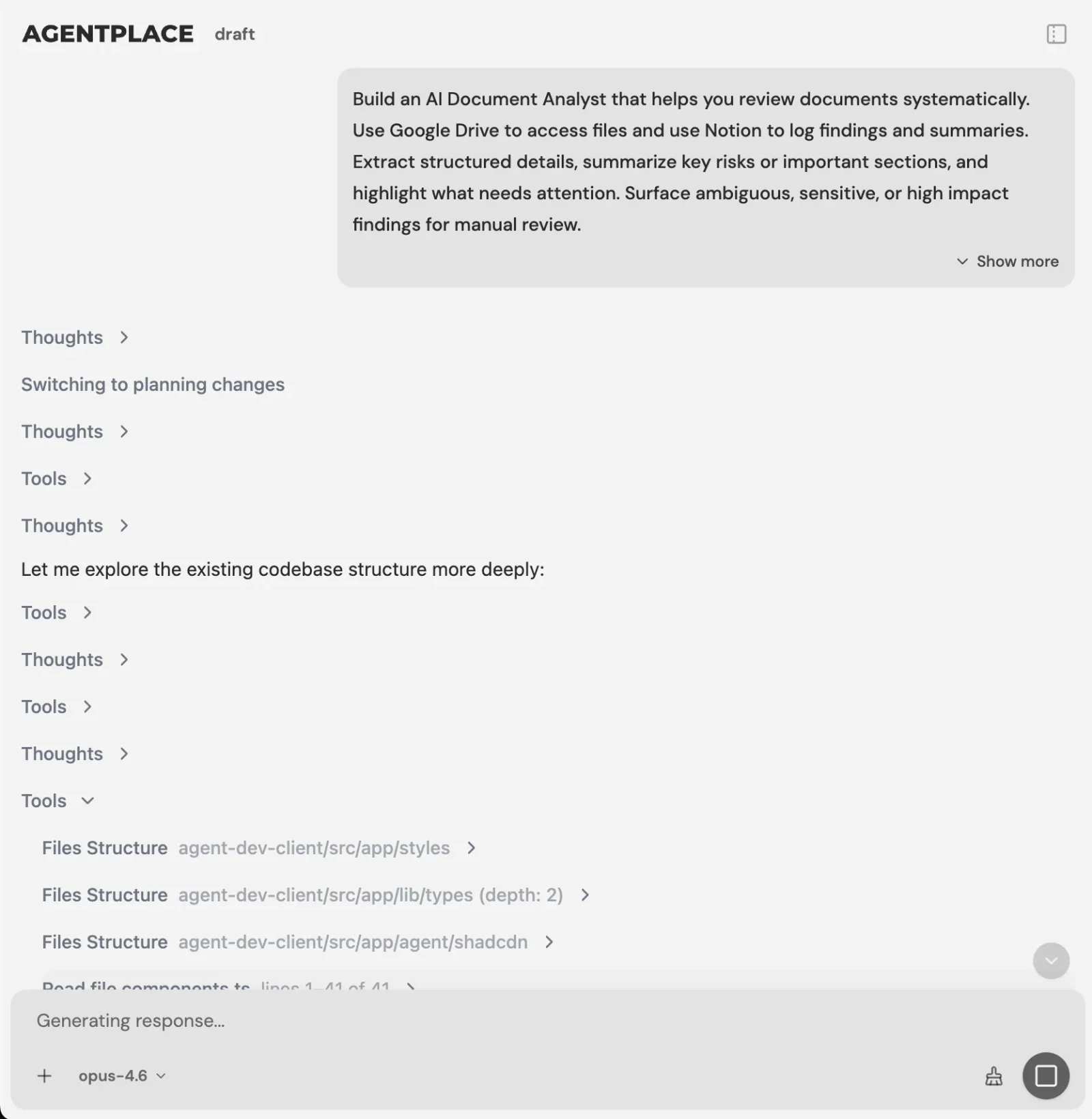 You describe the inquiry process in plain language, and the AI Builder helps clarify the requirements and build an agent you can test.
For catering and private events, an agent can help collect the details needed to qualify an inquiry before your team prepares a proposal.
A typical process looks like this:
- The client submits an inquiry. They open the agent’s page and describe the event using text or voice.
- The agent collects the five key details. It asks about the date, guest count, event format, budget and venue.
- The agent explains your pricing. It provides the relevant price range and minimum spend based on the rules you have supplied.
- The agent prepares an event brief. It organizes the information so your team can review the request.
- The agent suggests alternatives. If the requested date or format does not fit your rules, it can offer alternatives you have defined.
- The agent routes decisions that need approval. Final pricing, date holds, contracts and allergy-related questions go to the appropriate person.
You can start by describing the workflow to the Agentplace AI Builder in plain language.
For example:
“Create an agent to handle catering inquiries for our restaurant. Ask for the event date and year, guest count, event format, venue address, and budget per person. Explain our minimum spend and price range for the requested date, including what the price covers. If the date is unavailable, suggest an alternative date using our pricing rules. If the budget is below our minimum, offer a suitable alternative format. Do not confirm final prices, place date holds, approve contracts, or answer food-allergy safety questions. Send requests that need approval to our event manager with the collected details.”
The AI Builder helps clarify requirements, create the agent and test its behavior. You decide when to publish it, and you do not need to write code to get started.
What requires additional configuration: checking live calendar availability, creating records in your CRM, and booking calls or tastings depend on the supported tools and integrations you configure. Agentplace supports connections through its integration catalog and compatible MCP tools, subject to the permissions you authorize.
Without a suitable connection, the agent can still collect the five details and prepare an inquiry brief. It should clearly state that the date has not been confirmed.
Before publishing, test requests involving unavailable dates, guest counts above capacity, budgets below your minimum, and food allergies.
Agentplace offers a free plan and paid plans that use AI credits. Review the current pricing to determine which plan fits your inquiry volume.
Templates to explore: AI Event Concept Planner · AI Catering Menu Planner · AI Banquet Event Order Planning Agent
When does a business not need an AI agent for event inquiries?
An AI agent is not the right solution for every catering or event business.
You may not need one if:
- You receive only a few inquiries each week. A clear worksheet and inquiry form may be enough.
- Your minimum spend and pricing rules are unclear. Define them before automating the process.
- Every event requires a site visit before pricing. Focus on collecting details and scheduling visits rather than quoting events automatically.
- Your clients prefer to discuss events with a person. Keep the personal consultation and automate routine preparation or follow-up where useful.
- Your main problem is event administration. If you need help with staffing sheets, banquet event orders, contracts or invoices, dedicated event management software may be a better fit.
Choose tools based on the specific step that slows down your current process.
Catering inquiry checklist
Before automating your inquiry process, make sure you have:
- Documented minimum spend by date and season.
- Defined price ranges for each catering format.
- Listed what each price includes and excludes.
- Recorded capacity, blackout dates and minimum lead times.
- Identified events that require a site visit.
- Created a process for collecting all five key details in the first exchange.
- Defined when and how to discuss the client’s budget.
- Prepared alternatives for unavailable dates and budgets below your minimum.
- Assigned staff to review final pricing, date holds, contracts and allergy-related questions.
- Tested the workflow with real examples before publishing.
Related reading: How to qualify wedding venue inquiries before a tour · An always-on wedding venue inquiry agent
Bottom line
Start by defining your pricing, minimum spend, capacity and booking rules. Then collect the five essential details in the first conversation: the date, the guest count, the event format, the budget and the venue.
If your team spends too much time asking follow-up questions, an AI agent built with Agentplace can collect those details, explain your pricing rules, suggest alternatives and prepare an event brief for staff.
You can connect supported tools to check availability or update your CRM when the required integrations and permissions are in place. Final prices, date holds, contracts and food-allergy decisions should still follow your approval process.
If your pricing rules are not documented yet, start with those. Clear rules make it easier to respond consistently, qualify inquiries, and spend more time on events that fit your business.
Questions and answers
Frequently asked questions.
How should a restaurant handle catering and private event inquiries?
Collect five details in the first exchange: the event date, the guest count, the event format, the budget per person, and the venue. Explain your minimum spend and price range for that date, offer an alternative when something does not fit, and send requests that need approval to the right person.
What should a catering inquiry form ask?
The date, the guest count, the event format, a budget range and the venue. Those five answers are usually enough to tell whether an event is feasible. Longer forms are often abandoned by clients who are still collecting quotes from several caterers.
Should a caterer publish its minimum spend?
Publishing a price range and a minimum by day helps clients understand your pricing before they contact you, which reduces unworkable inquiries. If you prefer to discuss pricing individually, explain the minimum in your first reply instead of later in the conversation.
How do you ask a client about their event budget?
Explain your typical price range and what it includes first, then ask which range the client is considering. A per-person figure is easier to evaluate when the client knows whether staffing, equipment and rentals are included. One clear question is enough.
What should you say when the requested event date is unavailable?
Offer an alternative date and explain what the same menu would cost on that day. A different day of the week often carries a different rate. Offering a concrete alternative keeps the inquiry open, while a simple refusal usually ends it.
Can an AI agent quote a catering job?
It can state the price ranges and minimums you have documented and apply your rules to the details it collects. Final event pricing depends on staffing, venue access, rentals and travel, so it should be reviewed by a staff member before it is presented as a quote.
Can an AI agent check whether an event date is free?
Only through a supported, configured integration with the calendar or booking system that holds your dates, and only with the permissions you authorize. Without a connection, the agent can collect the five details and flag the date as unconfirmed.
What is a banquet event order?
A banquet event order, or BEO, is the document your kitchen and floor staff work from. It lists timings, guest count, menu, rentals, room setup and billing details. It is prepared after an event is confirmed, using the information collected during the inquiry.
Put this into practice
See the customer experience.
Explore a concrete example related to this article, then adapt the agent to your business.
Create my AI agentStart free with your business idea. The AI builder can help you explore it and create your agent. No technical specification needed. Sign in to continue. Pricing and limits · How the builder works