
How to Create an AI Travel Agent Without Coding

The short answer
You can create an AI travel agent without building an application from scratch. Define what it should do, give it your travel information and business rules, connect the systems it needs, test it with real customer requests, and publish it. The software is only part of the work.
Key takeaways
- No code removes the application build, not the business analysis. The ages, grades, lead times and escalation rules still have to be written down before an agent can apply them.
- Only ask a question when the answer changes the recommendation, the routing or the next step. That includes the email address and the phone number.
- Document who each trip is not suitable for. A catalog that only describes what a trip includes leaves the agent with nothing to rule out.
- An integration exposes what the other system can already do. Connecting an agent will not give a booking platform a provisional-booking feature it does not have.
- Test against your last thirty or fifty real enquiries. That is usually where you discover your team never wrote down how a particular case is handled.
You can create an AI travel agent without building a traditional application from scratch. The basic process is to define what the agent should do, give it your travel information and business rules, connect the systems it needs, test it with real customer requests, and publish it.
The software is only part of the work.
The harder part is deciding what the agent should know, what it should ask, what it should do with the answers, and when it should hand the customer to a person.
For a tour operator, this matters because many travel enquiries don’t start with a booking.
A traveler might write:
“We’re thinking about Patagonia in March. There are four of us, including a nine-year-old. My husband also can’t do long hikes. What would work?”
They haven’t chosen a trip yet.
They need help deciding.
An AI travel agent can take that kind of open-ended request, ask for the information that matters, apply the operator’s rules, narrow down the options, and help move the traveler toward a booking or a conversation with a person.
That is different from simply putting a chatbot on a travel website.
What Is an AI Travel Agent?
An AI travel agent is an AI application that helps customers plan, choose, or arrange travel through a conversation.
Instead of asking the traveler to search through a catalog and figure everything out themselves, the agent can understand an unstructured request and determine what needs to happen next.
For a tour operator, that might mean:
- Understanding the destination the traveler has in mind
- Asking about dates
- Checking the number and ages of travelers
- Understanding fitness or accessibility requirements
- Considering budget and interests
- Comparing the request against available trips
- Explaining why certain trips fit or don’t fit
- Collecting information for an enquiry
- Checking connected systems
- Taking an action
- Handing the conversation to a person when needed
The important part is that the agent is not just answering questions.
It is helping the customer get to an outcome.
Can You Create an AI Travel Agent Without Coding?
Yes.
An AI agent platform such as Agentplace lets you describe the job you want the agent to perform and build the application around that description.
You don’t have to build the frontend, backend, database, business logic, or integrations from scratch.
But no-code does not mean no work.
You still need to define how your business works.
For example, you may need to tell the agent:
- Which trips are available
- Minimum and maximum ages
- Fitness requirements
- Group-size limits
- Booking lead times
- Accessibility information
- Pricing rules
- What information to collect
- Which questions require a human
- What the agent should do after finding a suitable trip
The agent can handle the application-building work, but it can’t know your business rules unless you give them to it.
What Can an AI Travel Agent Do?
A customer-facing AI agent can do more than answer common travel questions.
It can:
- Understand unstructured requests, so customers don’t have to fill out a form or know the name of the trip they want.
“We have five days in Peru and want something adventurous, but my mother doesn’t hike.”
The agent can work from that starting point.
-
Ask follow-up questions, deciding what is missing rather than asking for what the traveler already said.
-
Apply business rules such as minimum age, fitness requirements, group size, departure dates, booking lead time, accessibility requirements and trip-specific restrictions.
-
Compare the traveler’s requirements against the trips you offer and present the options that fit.
-
Show trip cards, comparisons, forms, tables, itineraries and personalized results, rather than only paragraphs of text.
-
Collect the enquiry once the traveler has found a suitable direction.
-
Interact with business systems, create records, trigger workflows or move information to the next step, with the right integrations.
-
Hand off to a person in the situations you define, such as a complex accessibility question, a large group or anything outside the agent’s rules.
What Information Does an AI Travel Agent Need?
Before building the agent, collect the information that actually affects the customer’s journey.
| Information | Why it matters |
|---|---|
| Destinations | Determines which trips are relevant |
| Departure dates | Determines which options can work |
| Trip duration | Rules out trips that don’t fit the schedule |
| Traveler ages | Some trips have age requirements |
| Group size | Some departures have group limits |
| Fitness requirements | Helps identify suitable trips |
| Accessibility information | Helps identify situations requiring special handling |
| Budget | Can narrow the available options |
| Inclusions and exclusions | Helps answer practical questions |
| Booking lead time | Prevents recommendations that can’t be booked in time |
| Availability | Determines which options can actually be offered |
| Escalation rules | Defines when a person should take over |
One of the most important things to document is who a trip is not suitable for.
Tour operators are usually good at describing what a trip includes.
An AI agent also needs to know when it should say:
“Based on what you’ve told me, this isn’t a suitable option.”
That prevents the agent from trying to find a recommendation when there isn’t one.
How Do You Tell an AI Agent What to Do?
Think of the agent as a new employee.
You wouldn’t tell a new travel advisor:
“Help customers book our tours.”
You would explain the job.
For example:
“Help travelers choose from our Patagonia trips. Understand their dates, group size, ages, fitness level, and budget. Apply our minimum age of 14 and 21-day booking lead time. Show the two or three options that fit and explain why. If someone has a mobility requirement or wants a group larger than 10, send the enquiry to Elena.”
That gives the agent a much clearer job.
The important thing is not the wording of the prompt itself.
It’s the business logic behind it.
The agent needs to know what information matters, what decisions it can make, what actions it can take, and where the limits are.
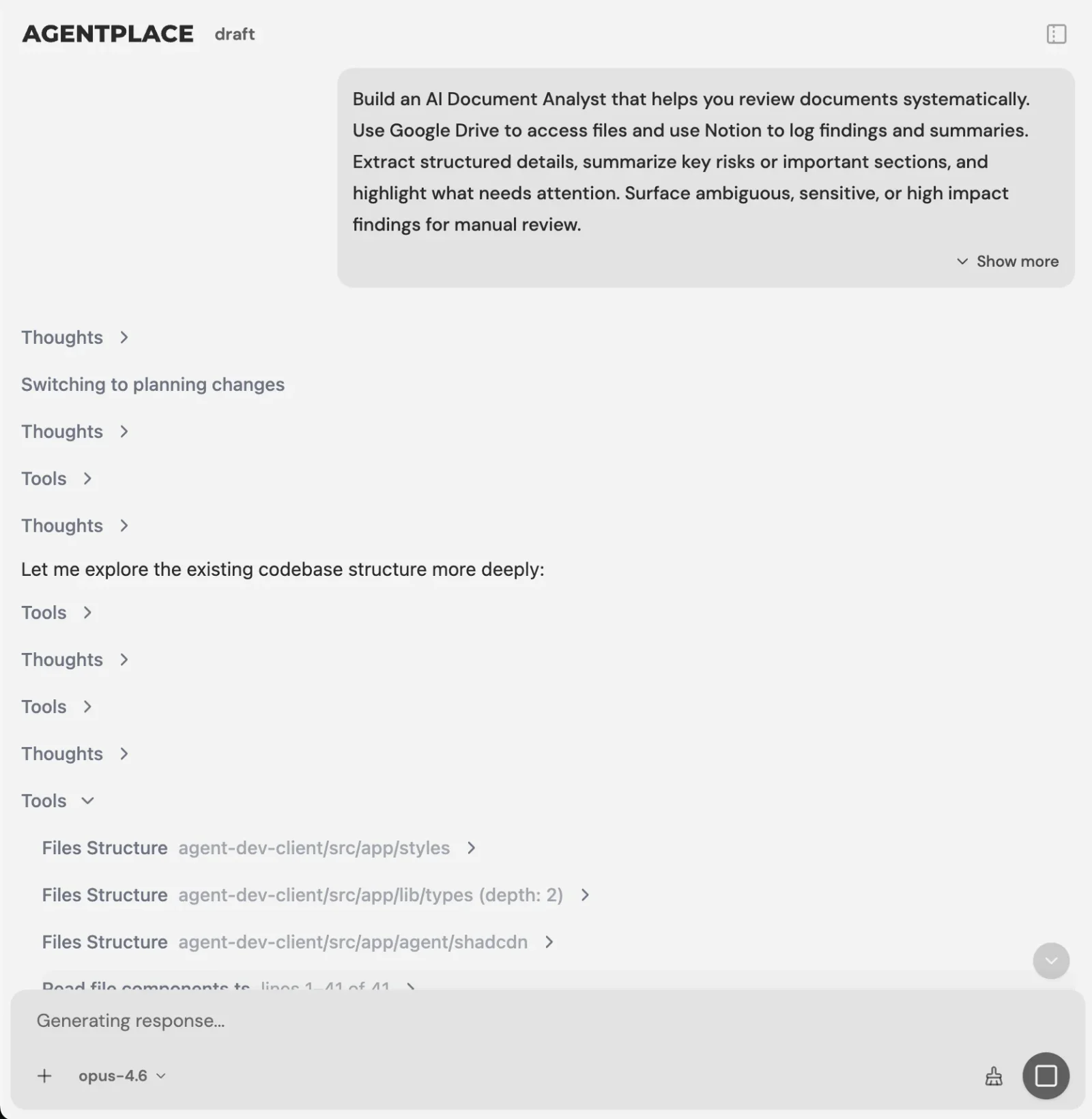 Describing the job the way you would to a new member of staff, rather than mapping every conversational branch.
Which Questions Should the Agent Ask?
Only ask questions that can change what happens next.
This sounds simple, but it makes a big difference.
Suppose a traveler says:
“We’re going to Patagonia in March. There are four of us and my father is 71.”
You already know the destination, the month, the group size and an age.
The agent shouldn’t ask for those things again.
Instead, it might need to ask about fitness, mobility, budget, or exact dates.
A useful rule is:
If the answer won’t change the recommendation, action, routing, or next step, don’t ask for it.
This also applies to contact information.
Asking for an email address and phone number before helping the traveler can make an AI agent feel like a form.
Let the conversation do some useful work first.
How Does an AI Travel Agent Connect to Other Systems?
An AI agent can connect to the systems your business already uses through integrations.
Depending on the connection, the agent may be able to read information, check availability, create or update records, send information to another system, trigger an action or start a workflow.
This is important because the agent doesn’t have to operate as a separate source of truth.
For example, your trip information and business rules might be used by the agent, while current availability comes from your reservation system.
The agent can then use both pieces of information when deciding what to show the traveler.
An integration also doesn’t magically add capabilities to the connected system.
If your booking platform can’t create a provisional reservation, connecting an AI agent won’t give that platform a provisional-booking feature.
The agent can work with the capabilities exposed by the systems it is connected to.
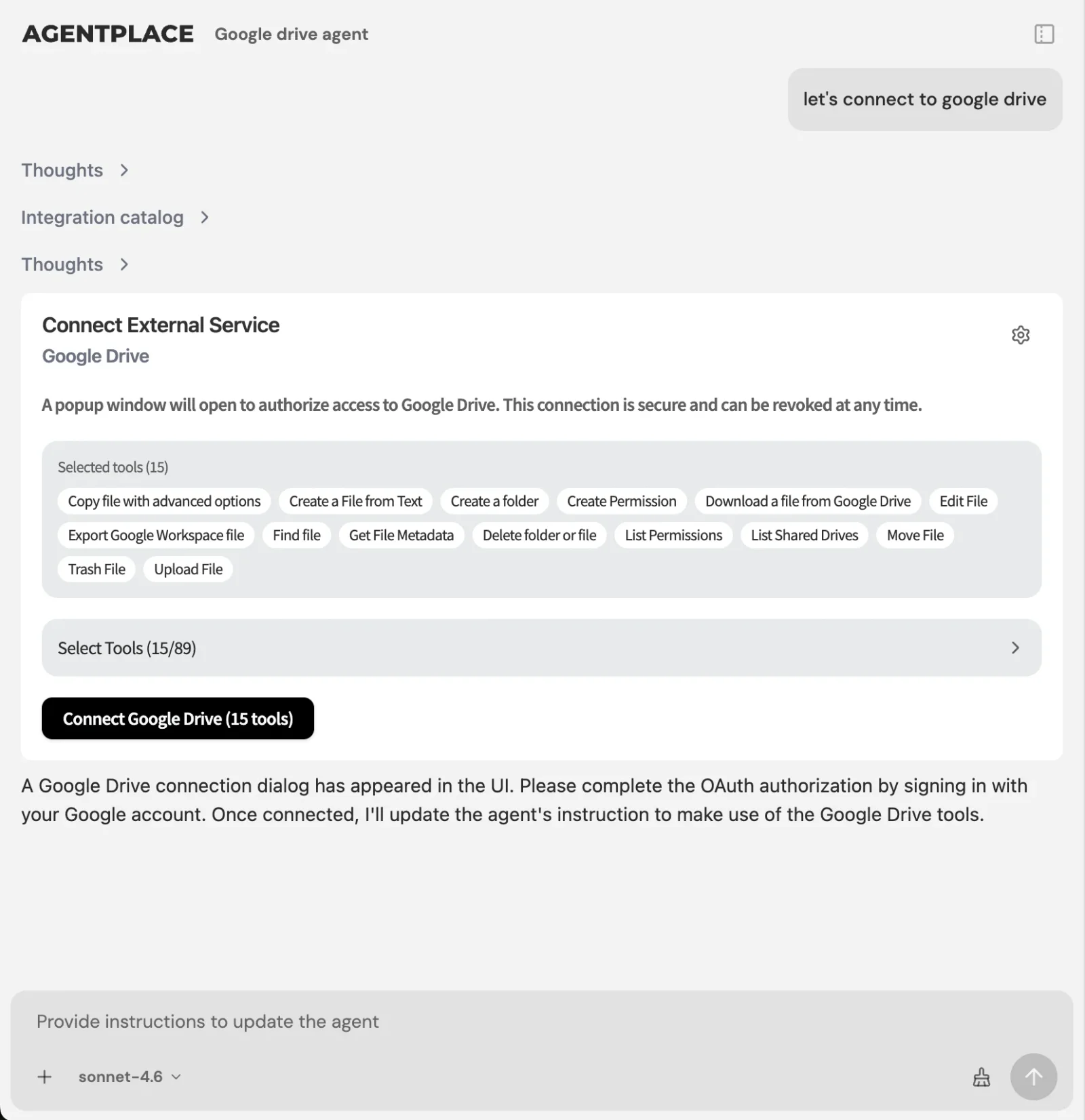 Connect an account once and reuse it, with credentials held by the integration provider.
What Should an AI Travel Agent Not Do?
Some boundaries should be explicit.
-
Don’t rely on outdated availability. If it changes, read the connected system rather than an old document.
-
Don’t invent prices. If the price depends on dates, room types or group size, the agent should fetch the figure rather than produce one.
-
Don’t give medical clearance. The agent can apply your stated trip requirements; it shouldn’t decide whether somebody is fit for an activity.
-
Don’t force a recommendation. If nothing fits, the agent should say so, because a useful agent doesn’t need an answer in every conversation.
-
Don’t hide uncertainty. Without enough information to decide, the agent should ask for what is missing or involve a person.
How Do You Test an AI Travel Agent?
Use real customer enquiries.
This is one of the most important steps.
Don’t only test questions that were written specifically for the agent.
Take your last 30 or 50 enquiries and run them through it.
Real customers are messy.
They might write:
“Looking for Peru in June for my parents. Dad is 68 and doesn’t really hike. We have about a week.”
Or:
“Family of five, kids 8 and 11, want something adventurous but not too difficult.”
Or:
“Can we do this trip if one person doesn’t swim?”
For every conversation, check whether the agent understood the request, asked for the information that mattered, applied the correct rules, ruled out unsuitable options, used current information when it needed to, took the right action, and involved a person when it should have.
Testing is where you find the gaps in the agent.
It also often reveals gaps in the business rules themselves.
You may discover that your team has never actually written down how to handle a particular situation.
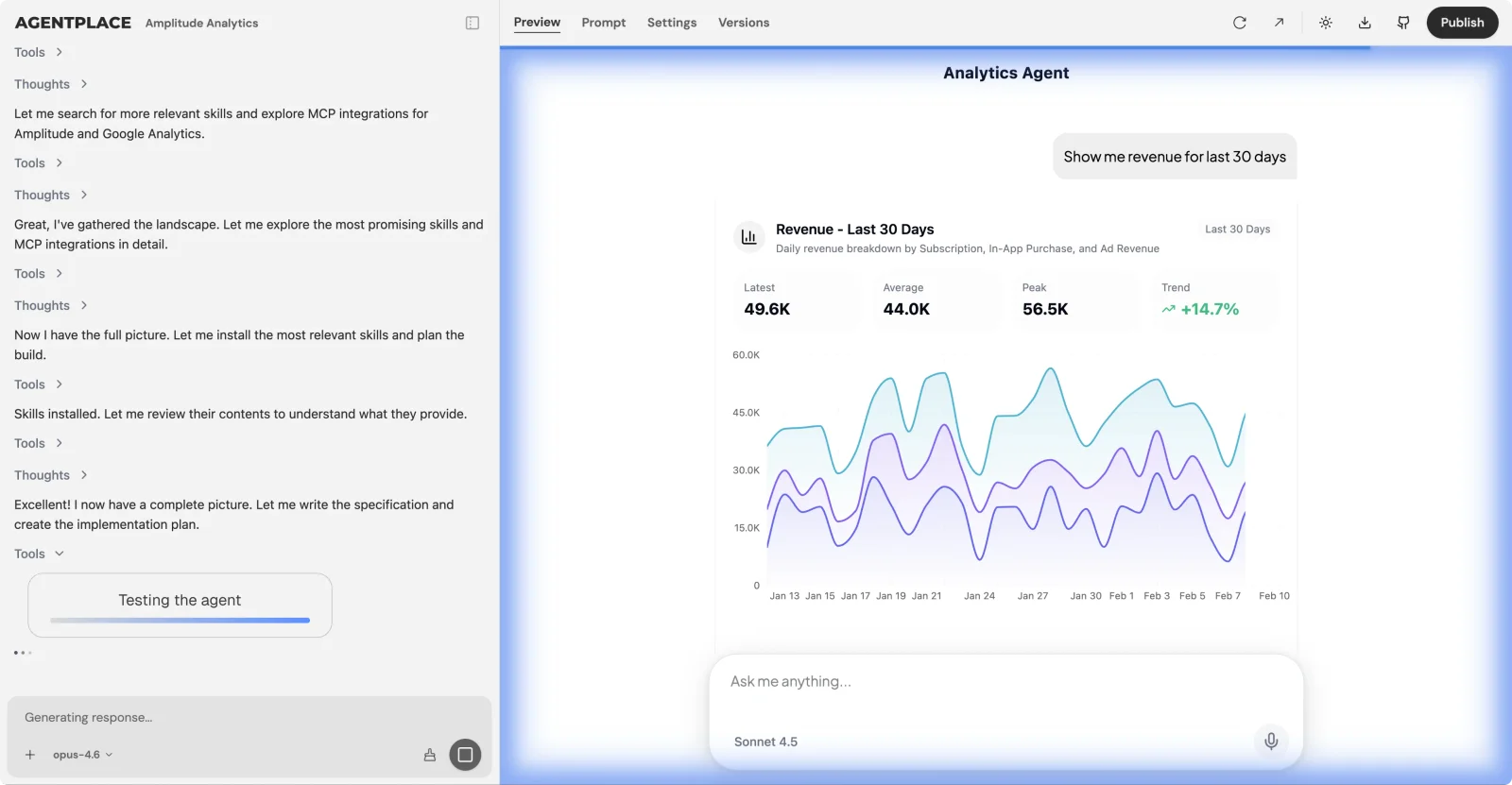 The builder messages the agent it just built and fixes what it finds, before the first traveler does.
What Is Agentplace?
Agentplace is a platform for creating AI agents that serve customers and help run a business.
Each Agentplace agent can have its own web page and URL. Customers can interact with it by text or voice and receive personalized results through an interface the agent controls.
An agent can have its own frontend, backend, business logic, records, memory, integrations, interactive interfaces and voice.
It can understand an unstructured request, determine what needs to happen next, gather information, take actions, and move the customer toward an outcome.
For a tour operator, that could mean an AI travel agent that helps a traveler choose a trip, checks the relevant rules, collects an enquiry, interacts with a booking system, and sends the right cases to a person.
Instead of adding an AI chatbot to an existing website or application, Agentplace lets the agent itself become the application.
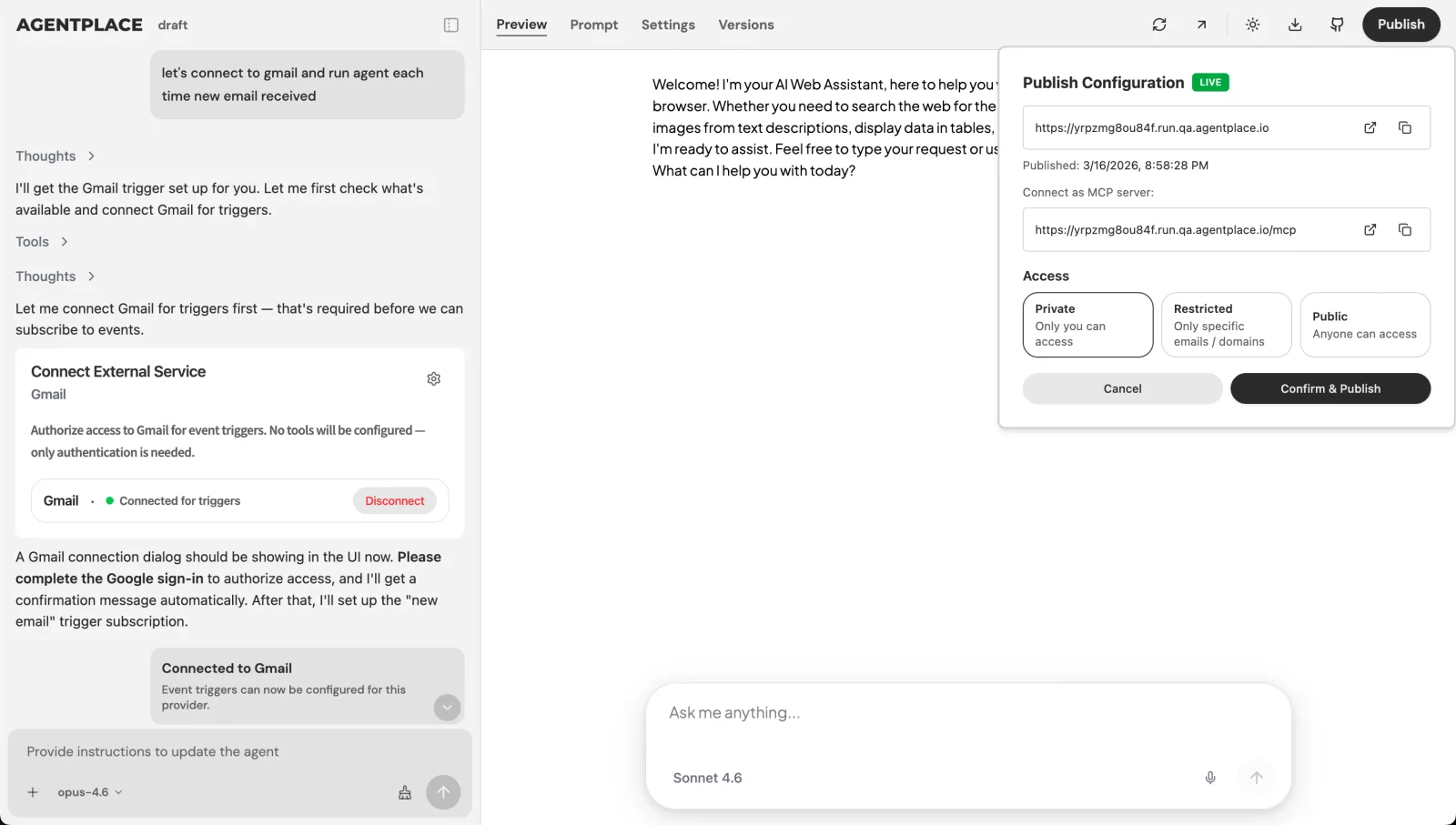 Publish to a restricted group first, then open the agent once your own team has stopped finding problems.
Which No-Code Tools Can Build an AI Travel Agent?
Different types of tools solve different problems.
| Tool category | Examples | What it does | Useful when |
|---|---|---|---|
| AI agent platforms | Agentplace | Builds customer-facing agents with interfaces, business logic, records, and actions | Customers need help deciding or completing a business task |
| Website chatbots | Chatbase, Tidio, Intercom Fin | Answers questions from existing content | Most conversations are straightforward FAQs |
| Conversation design tools | Voiceflow, Botpress, Landbot | Lets you design conversation flows | You want to control conversation branches |
| AI assistants | Custom GPTs | Provides an assistant inside another AI product | Advisors need help with research or drafting |
| Prompt-to-app builders | Lovable, Bolt | Generates code for custom applications | A developer will own and extend the application |
The useful question isn’t simply:
“Which AI travel tool is best?”
Start with:
“What does the customer need help doing?”
If they already know what they want, a booking system may be enough.
If they have a simple question, a chatbot may be enough.
If they have a vague request and need help deciding what fits, an AI agent can handle a different part of the customer journey.
Agentplace is designed for the case where the traveler needs help deciding, your own rules have to be applied, and the enquiry should end in a booking or a named person. If the questions are mostly logistics, a website chatbot is the simpler purchase.
When Is a Different Tool Better?
An AI travel agent isn’t necessary for every travel website.
A regular chatbot may be enough if customers mostly ask where to meet, what time the tour starts, what’s included, what to bring, or what the cancellation policy is.
A booking system is still needed when customers are ready to reserve.
An itinerary platform may be more appropriate if the main problem is creating proposals or day-by-day itineraries.
The AI agent is most useful when the customer needs help before the booking decision.
How Long Does It Take to Build an AI Travel Agent?
A first working version can often be built in a few hours.
The actual timeline depends on the complexity of the business.
- Organize your information. Collect your trip information, requirements, restrictions and escalation rules. This can take longer than expected, because some important knowledge may not be documented.
- Build the first version. Describe the job you want the agent to perform and create the initial application.
- Test real enquiries. Run previous customer conversations through the agent and identify what it gets wrong or doesn’t know.
- Connect your systems. Add the booking, CRM, calendar or other systems the agent needs to use.
- Publish. Start with a limited group of users, fix the problems you find, then open the agent to more travelers.
The complexity of the rules and integrations usually matters more than the number of screens.
Which Mistakes Are Most Common?
Asking every traveler the same questions. A fixed form can ignore information the traveler already provided.
Not defining when a person should take over. Without escalation rules, the agent may try to handle situations that require human judgment.
Treating changing information as static. Availability and prices can change. Connect the agent to the system that has the current information.
Testing only perfect questions. Real customers are vague, incomplete, and sometimes contradictory.
Giving the agent unclear rules. If your team handles a situation differently depending on who answers the phone, the agent needs a defined rule or a clear escalation path.
Publishing too early. Start with internal or restricted testing before sending every customer to the agent.
For the recommendation logic in detail, see how to build an AI agent that recommends tours.
For where the personalization actually comes from, see how AI creates a personalized travel itinerary.
For the wider landscape, see the AI tools tour operators and travel businesses use and what AI agents do for tour operators.
The bottom line. The result doesn’t have to be another chatbot sitting on a website. An AI agent can have its own page, interface, business logic, records, integrations, memory and actions. It can understand what a customer is trying to do, decide what needs to happen next, and help move that customer toward an outcome. For a tour operator, that might start with a simple question, “what trip would work for us?”, and the agent’s job is to turn that question into a useful answer and, when appropriate, into the next step toward a booking. If your travelers already know what they want, your booking system is doing the job.
Questions and answers
Frequently asked questions.
Can I create an AI travel agent without coding?
Yes. AI agent platforms let businesses create customer-facing agents without building the underlying application from scratch. You still need to provide accurate information and define the business rules the agent should follow.
What does an AI travel agent do?
It can understand a traveler's request, ask follow-up questions, apply business rules, recommend suitable options, collect information, interact with connected systems, take actions, and hand the conversation to a person when necessary.
Can an AI travel agent recommend tours?
Yes. It can compare a traveler's requirements with the trips and rules you provide, then recommend or narrow down the suitable options and explain why the others do not fit.
Can an AI travel agent check live availability?
Yes, when it is connected to a booking or reservation system that provides current availability. Without that connection it would be working from information that was accurate when it was added.
Can an AI travel agent make bookings?
It can support booking workflows when the connected booking system allows the required actions. The exact capabilities depend on the systems and integrations being used.
Is an AI travel agent the same as a chatbot?
Not necessarily. A chatbot can answer questions from existing information. An AI agent can also determine what needs to happen next, use business logic, interact with systems, take actions, and help the customer reach an outcome.
What information does an AI travel agent need?
Accurate information about your products and the rules that decide what is suitable: destinations, dates, ages, fitness requirements, group sizes, accessibility information, prices, availability, booking rules and escalation rules.
Can an AI travel agent work with a CRM or booking system?
Yes, if the platform supports the relevant integration. Depending on the integration, the agent may be able to read information, create records, update records or trigger actions.
Does an AI travel agent replace a travel advisor?
Not necessarily. It can handle initial qualification, recommendations, information gathering and straightforward actions, while handing complex or sensitive situations to a human advisor.
How much does it cost to create an AI travel agent?
It depends on the platform, usage, integrations and workflow complexity. No-code platforms reduce the development work, but a business still invests time in organizing its information, defining rules, testing and setting up integrations.
Put this into practice
See the customer experience.
Explore a concrete example related to this article, then adapt the agent to your business.
Create my AI agentStart free with your business idea. The AI builder can help you explore it and create your agent. No technical specification needed. Sign in to continue. Pricing and limits · How the builder works