
Can ChatGPT Dots Help a Shopper Pick a Mattress? Always-On Agents for Sleep Retail

The short answer
No. A ChatGPT dot can't run your mattress finder quiz. It's something you create and use inside ChatGPT, with no page a shopper can open. A customer-facing AI agent built with Agentplace gives them one, asks the four questions that actually narrow the catalog, names models you have in stock, and books the showroom visit.
Key takeaways
- Shoppers research at 11pm and want two things: which models fit them, and what those cost.
- A dot is something you create and use inside ChatGPT. There is no page for a shopper to open.
- A customer-facing AI agent asks the four questions that narrow the catalog, names two or three models in stock with prices, and books the showroom visit.
- A recommendation you cannot deliver for nine weeks is worse than none. Back pain or a medical condition goes to a fitting, not a model name.
- Start by writing the four questions, your model map and your price bands, then connecting live stock.
The short answer
No. A ChatGPT dot can’t run your mattress finder quiz.
It’s something you create and use inside ChatGPT. There’s no customer-facing page, phone number, or interface for a shopper to open.
A mattress enquiry is different. A customer-facing AI agent built with Agentplace gives the shopper a page where they can reach the agent. The agent does three things:
- Asks the four questions that actually narrow the catalog, not twelve that don’t.
- Names two or three models you have in stock, with a price range and a delivery date.
- Books the showroom visit, which is where the mattress is actually sold.
If your store sells four models and the owner is on the floor every day, keep doing that.
Why do mattress quizzes not convert?
Because most of them are a lead form wearing a quiz costume.
The shopper answers eight questions, gets “Model X is your perfect match”, and finds out at checkout that it ships in nine weeks. Or they get an email instead of an answer.
Example: A shopper at 11pm.
“I sleep on my side, I wake up with a sore lower back, and my current mattress is about eight years old. Budget is around £1,200 for a king.”
| Option | What the shopper gets | When |
|---|---|---|
| Quiz with email gate | A form, then an email tomorrow | Tomorrow, if at all |
| Quiz with a fixed result | One model, no stock, no price | Immediately, and it answers nothing |
| Live chat, closed | “We’re offline” | Same |
| Agent on live stock | Two models in that band, both in stock, delivery Thursday, visit booked Saturday | In the conversation |
Rule of thumb: a recommendation without a price and a delivery date isn’t a recommendation.
What should the agent know?
Five things, and the fifth is the one stores skip.
| Input | Why it matters |
|---|---|
| Your narrowing questions | Position, weight, firmness history, one sleeper or two |
| The model map | Which models answer which combination, in your own words |
| Price bands by size | The shopper asked. Withholding it costs the visit |
| Live stock and delivery dates | A nine-week model recommended as “perfect” is a lost sale |
| Where to stop and hand over | Back pain, medical conditions, recent injury, anything clinical |
That last row is a decision your staff own, not the agent. Write the line explicitly: what the agent may recommend, and what it must route to a person for a fitting.
How do you run the conversation, step by step?
1. Ask four questions, not twelve
Sleeping position, rough body weight, what’s wrong with the current mattress, and whether two people share the bed. Rule of thumb: if an answer doesn’t change the recommendation, don’t ask it.
2. Give a range, not a single “perfect match”
Two or three models, with the trade-off stated in one line each. One answer looks like a sales pitch. Three looks like advice.
3. Check stock before you recommend
Example: The agent, at 11pm.
“For side sleeping with lower back pain, I’d look at two: the medium-firm pocket model at £1,150 for a king, in stock for Thursday delivery, or the hybrid at £1,290, which is softer at the shoulder. Both are worth lying on for ten minutes. Want me to book you in Saturday morning?”
4. Book the visit
A mattress is bought lying down. The booked visit is the conversion, not the quiz completion.
5. Route anything clinical
A shopper describing a recent back injury or a condition needs your staff, not a model name. The agent collects the detail and hands over.
Can a ChatGPT dot do this?
No, and it isn’t close.
Dots are OpenAI’s always-on agents, launched 29 September 2026. A dot keeps working between conversations, has its own cloud computer, and reaches apps you authorise. All of that happens inside the account of whoever created it.
That’s the wall. The shopper has no way in.
As it shipped: one dot per account, paid ChatGPT plans only, and no Pro access in the EEA, Switzerland or the UK.
A dot works on the store’s side. A shopper-facing agent works on the shopper’s side.
What tools can help a shopper pick a mattress?
| Option | What it’s for | Where it stops |
|---|---|---|
| Customer-facing AI agent built with Agentplace | Narrowing the catalog, naming models in stock, booking the visit, on its own page or by phone | It isn’t your POS, and it doesn’t do fittings |
| Quiz and product-finder plugins | A fixed decision tree on a product page | No live stock, no follow-up questions, no booking |
| Retail POS and inventory systems | Stock, orders, delivery, returns | They hold the data, not the conversation |
| Live chat with agents | Real answers during opening hours | Mattress research happens at 11pm |
| ChatGPT Dots | The store’s own work | Not shopper-facing. No page to open |
Nothing here was bench-tested. The rows describe what each category is designed to do, read from vendor documentation in October 2026.
How does Agentplace handle a mattress enquiry?
Agentplace lets you create an AI agent with its own web page and URL. It uses your business knowledge to work with clients through text, voice, and a personal interface that changes with their request.
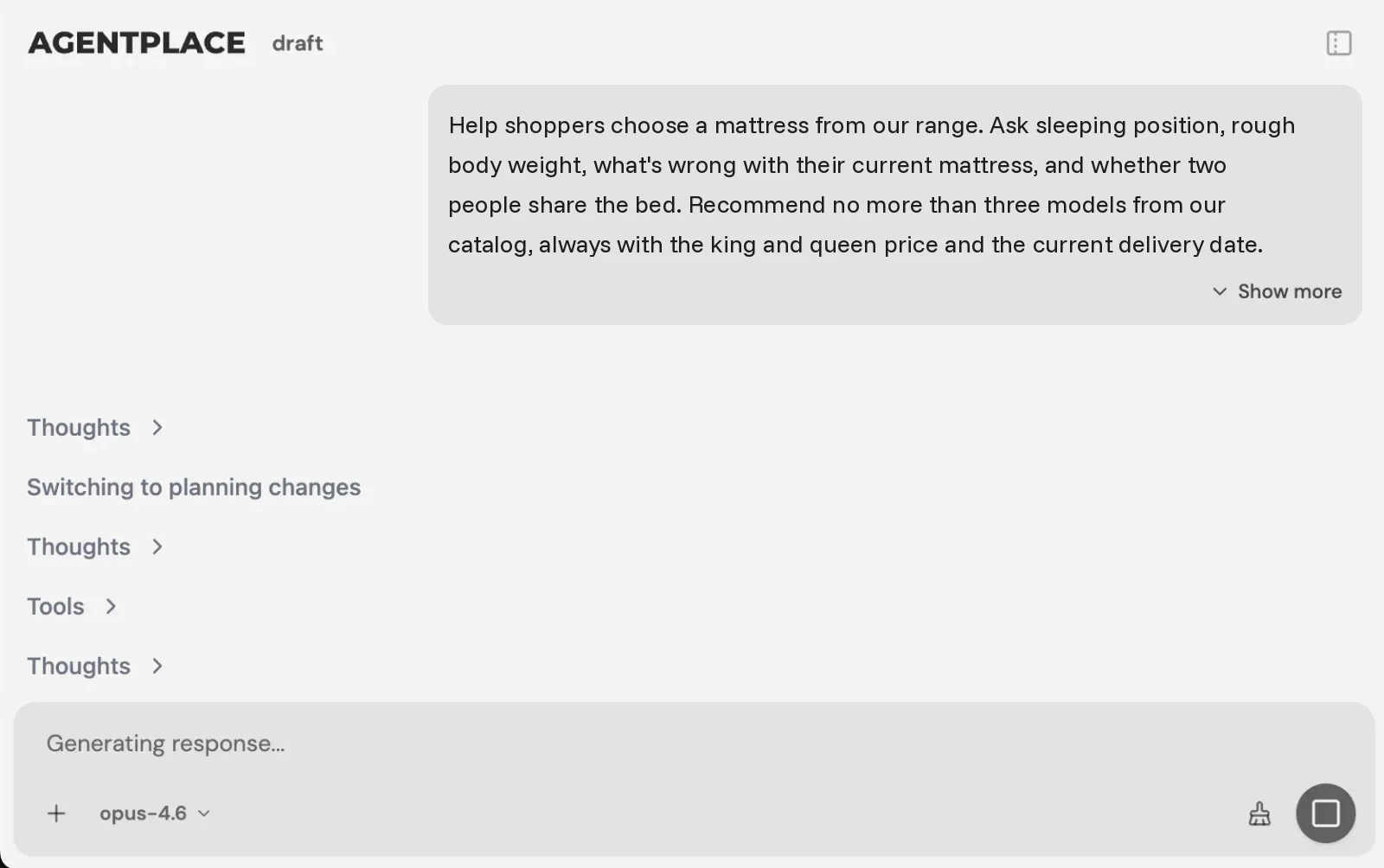 You describe your questions, your model map and your price bands. The builder writes the agent.
In practice, it works like this:
- The shopper opens the agent’s page from your site, an ad, or a product page.
- The agent asks the four narrowing questions, one at a time.
- It checks live stock and delivery dates for the sizes in range.
- It names two or three models with prices and the trade-off between them.
- It books a showroom visit, and routes anything clinical to your staff.
You set it up by describing the outcome in plain language, for example:
“Help shoppers choose a mattress from our range. Ask sleeping position, rough body weight, what’s wrong with their current mattress, and whether two people share the bed. Recommend no more than three models from our catalog, always with the king and queen price and the current delivery date. Never recommend a model that is out of stock for more than three weeks; say so and offer the nearest alternative. If someone mentions back pain, a medical condition or a recent injury, don’t name a model: say a fitting with our staff is the right next step and book one. State our 100-night trial and that returns cost the customer the collection fee. Book showroom visits Thursday to Sunday.”
The AI Builder discusses the idea, clarifies requirements, creates the agent and helps test it. You choose when to publish. No code is required.
What stays where it is:
- Your POS and inventory system keeps stock, orders, delivery and returns. The agent reads availability and writes the lead and the appointment where a supported connection exists.
- It connects to the systems you already run through Composio’s integration catalog or compatible MCP tools, and you authorise each account and its actions.
- Records carry access classes enforced server-side, so a shopper sees their own enquiry and nothing else.
Pricing: Agentplace has a free plan and paid plans that use AI credits. A credit is not a conversation. See pricing.
Template to start from: AI Mattress Selection Agent
When don’t you need an AI agent?
- Four models and an owner on the floor? Keep that. The owner is better than any quiz.
- Online only, one product, one firmness? There’s nothing to narrow.
- You need stock, orders and delivery? That’s your POS, and it stays.
- Your stock feed isn’t live? Fix that first, or the agent will recommend what you can’t ship.
- No one tracks whether quiz takers ever visit? Start there. You may already know the answer.
- Shoppers researching at 11pm and buying from whoever answers? That’s where a customer-facing AI agent built with Agentplace fits.
Quick checklist
- Write the four narrowing questions and drop the rest
- Map your models to the combinations your floor staff already recognise
- Write price bands by size, and publish them to the agent
- Connect live stock so nothing out of range gets recommended
- Write the hand-over line: back pain, medical conditions, injury
- Track visits booked, not quizzes completed
Related reading: AI agents that book appointments · what Dots by ChatGPT are · adding an AI salesperson to your website
Bottom line
A shopper at 11pm wants to know which two models fit, what they cost, and when they’d arrive. Most mattress quizzes answer none of the three.
- If the owner is on the floor and the range is small, keep doing that.
- If shoppers research at night and buy from whoever answers, give them a customer-facing AI agent built with Agentplace. It narrows the catalog, prices it, checks stock, books the visit, and sends anything clinical to your staff.
Questions and answers
Frequently asked questions.
Can an AI agent recommend a mattress?
It can narrow your catalog to two or three models from what the shopper tells it, and say why. Where a shopper describes back pain, a medical condition or a recent injury, the agent should say that a fitting with your staff is the next step rather than naming a model.
Can a ChatGPT dot do this?
No. A dot is something you create and use inside ChatGPT. There is no page or number a shopper can use. It can help with your own work, but a shopper researching mattresses at 11pm cannot reach it.
How is this different from a mattress quiz on our site?
A standard quiz is a fixed form with a fixed decision tree. An agent asks follow-up questions, reads your live stock and delivery dates, and books the visit in the same conversation.
Should it give prices?
Yes, a range. Price is one of the two things the shopper came to find out. Hiding it until the showroom costs you the visit.
Can it check stock and delivery dates?
Yes, where it is connected to your inventory. This matters more in sleep retail than in most categories, because a recommendation the shopper cannot take home or receive within a sensible window is a dead end.
Does this replace our retail system?
No. Your POS and inventory system stays the source for stock, orders and delivery. The agent handles the conversation and writes the lead and the appointment into the system you already run.
What about trial periods and returns?
The agent should state your actual policy, including what a return costs the customer. Shoppers ask about this before they ask about springs.
How long does setup take?
The work is writing down what your best floor salesperson already asks and recommends: the narrowing questions, the model map, the price bands and your trial policy. A focused build takes days rather than months.
Put this into practice
See the customer experience.
Explore a concrete example related to this article, then adapt the agent to your business.
Create my AI agentStart free with your business idea. The AI builder can help you explore it and create your agent. No technical specification needed. Sign in to continue. Pricing and limits · How the builder works