
AI Agent Platform Alternatives in 2026: Lindy, Relevance AI, Make, Dify and Flowise Compared
The short answer
Different platforms solve different problems. Lindy suits internal assistants, Relevance AI multi-agent setups, Make automation, and Dify or Flowise AI apps you control and host. If the agent works directly with customers and has to complete a task, use a customer-facing AI agent built with Agentplace. It answers, applies your rules and finishes the booking or intake.
Key takeaways
- These five products get compared as if they were interchangeable. Two are self-hosted AI app builders, one is an internal assistant, one is a multi-agent framework and one is trigger-action automation.
- Agentplace is a good fit when the agent needs to face the customer and actually get the job done. The agent is the application that person uses.
- For self-hosting, Dify and Flowise remain the right answer. Agentplace is hosted and not open source, so it isn't a candidate there.
- Lindy is better than us for an inbox assistant, because that agent works for your team inside tools you already use.
- Before switching, work out whether the agent works for your team or for your customer. That one distinction settles most of these five comparisons on its own.
The short answer
Pick by who the agent works for: your team, your systems, or your customer.
- Use Lindy if the agent works for your team inside the inbox, calendar and CRM.
- Use Relevance AI if several specialised agents genuinely need to coordinate.
- Use Make if the process is predictable and the job is moving data between apps.
- Use Dify or Flowise if you want to build and host the AI application yourself.
If a customer needs to talk to the agent and get something done, use a customer-facing AI agent built with Agentplace. It understands an open-ended request and follows your business rules. It uses your connected systems and completes the booking, intake or qualification.
If the platform you have is already doing the job it’s good at, stay where you are.
Why do teams look for AI agent platform alternatives?
Because these five tools were never solving one problem.
Gartner expects 40% of enterprise applications to ship with task-specific AI agents by the end of 2026. That’s up from under 5% in 2025. So the “AI agent” label keeps stretching over tools that do different jobs.
Three reasons come up when teams switch. Only the first is about the product.
- They bought the wrong category. Somebody needed a customer-facing agent and bought an internal assistant. Or they needed predictable automation and bought a multi-agent framework.
- The running cost surfaced. Self-hosted platforms have no licence fee. They do have a bill in upgrades, backups, monitoring and on-call time.
- The agent couldn’t finish. It answered, and then a person still had to check availability, apply the rule, book the thing and write the record.
Rule of thumb: an agent that stops one step before the outcome is still a demo.
The first reason is the expensive one. The tool works exactly as designed and still doesn’t solve the problem.
How do the five platforms compare?
By what each one is actually for, and where it stops.
| Platform | What it’s really for | Where it stops | Alternatives worth looking at | Best for |
|---|---|---|---|---|
| Lindy | Internal assistants across inbox, calendar and CRM | The agent works for staff, not for customers | Agentplace, Relevance AI, Zapier | Teams that want an assistant inside their own tools |
| Relevance AI | Orchestrating several specialised agents | Handoffs add design work and are hard to debug | Agentplace, n8n, Dify, Lindy | Workflows where a handoff between agents creates the value |
| Make.com | Predictable trigger-action automation | The next step can’t depend on what a person wrote | Zapier, n8n, Activepieces, Pipedream, Agentplace | Moving data between apps on fixed rules |
| Dify | Self-hosted AI applications with retrieval | You build and run the frontend, records and servers | Flowise, n8n, Agentplace | Teams that need the source and the servers |
| Flowise | Lighter self-hosted LLM flow building | A prototype still needs a product built around it | Dify, n8n, Agentplace | Prototypes and self-hosted experiments |
| Customer-facing AI agent built with Agentplace | An agent customers use on its own web page | Hosted only, not open source | See the five rows above | Businesses whose agent answers, applies rules and completes the booking or intake |
We compared them on five things:
- who the agent works for
- whether it can face a customer directly
- whether the source and servers are yours
- how much judgment it applies after the trigger
- what it costs to keep running
What are the best Lindy alternatives?
Lindy is good at what it’s for, so say that first.
- Best for: agents that monitor an inbox, prepare meeting notes, follow up and work across common business apps.
- Strengths: a template library that makes starting easy.
- Where it stops: the agent works for your team. People look elsewhere when it needs to work for someone outside the company.
Where to go instead:
- Choose Agentplace if the agent has to face a customer. It answers an open-ended question on your site, applies your qualification rules, checks availability and completes the booking or intake.
- Choose Relevance AI if you need several specialised agents coordinating.
- Choose Make or Zapier if the task turns out to be predictable and an assistant is more than it needs.
- Stay on Lindy if the agent’s job is internal. We wouldn’t replace an inbox assistant with a customer-facing platform.
Plenty of companies sensibly run both. See Agentplace vs Lindy for the detail.
What are the best Relevance AI alternatives?
Relevance AI is built around coordinating specialised agents.
- Best for: one agent researches, another scores, another prepares outreach, another reviews.
- Strengths: real orchestration between agents, hosted for you.
- Where it stops: it’s also where teams most often overbuild.
“In multi-agent workflows in organizations, AI is jagged in ways that have not been well identified yet. In fact, we don’t even have a vocabulary around multi-agent systems and the ways they fail or succeed.” Ethan Mollick, Associate Professor, The Wharton School
Where to go instead:
- Choose Agentplace if you don’t need orchestration. One agent that answers the customer, applies your rules and completes the outcome is easier to read and debug.
- Choose n8n or Dify if self-hosting is part of the requirement. Relevance AI and Agentplace are both hosted.
- Choose Lindy if the agents work for your team, not your customers.
- Stay on Relevance AI if a specific handoff between agents creates the value, and you can read what each one did.
Rule of thumb: add a second agent when a handoff is the bottleneck, not on day one.
More in Agentplace vs Relevance AI.
What are the best Make.com alternatives?
Make is a good product with a clear job.
- Best for: predictable automation between applications.
- Strengths: branches and routers you can see.
- Where it stops: the next step can’t depend on what a customer wrote.
Teams leave for four different destinations:
- Choose Zapier if integration coverage is the real requirement. Its larger catalogue is the honest reason to pay more per task.
- Choose n8n or Activepieces if you want self-hosting and the source available.
- Choose Pipedream if developers own the workflows and want code steps.
- Choose Agentplace if the workflow stopped being predictable.
Example: A Make scenario is exactly right for “when a booking is created, add a row and post to Slack”. It can’t help when the next step depends on what a customer wrote at nine in the evening.
Our Zapier alternatives comparison covers the hosted side of this. The autonomous workflow platform guide covers the agent side.
What are the best Dify alternatives?
Dify bundles workflows, agents, retrieval and model routing into one self-hosted package.
- Best for: teams building AI applications on their own infrastructure.
- Strengths: a strong all-in-one combination you can run yourself.
- Where it stops: the frontend, records, permissions and servers are yours to build and run.
Where to go instead:
- Choose Flowise if you want something lighter and mostly need flow building.
- Choose n8n if integrations matter more than retrieval, and the AI is one node in a larger process.
- Choose Agentplace if self-hosting wasn’t the reason you chose Dify, and you want a customer-facing agent with nothing to operate.
- Stay on Dify if the source and the servers are the requirement.
We’re hosted and the source isn’t open, so on that requirement Dify is the better answer.
What are the best Flowise alternatives?
Flowise is a lighter open-source way to build LLM flows visually.
- Best for: prototyping and self-hosted experiments.
- Strengths: quick to start, easy to see the flow.
- Where it stops: a working prototype still isn’t something a customer can use.
Teams outgrow it in three directions:
- Choose Dify if you want the same self-hosted setup with retrieval, model routing and agent tooling included.
- Choose n8n if the flow turned out to be mostly integrations with a model in one node.
- Choose Agentplace if the prototype needs to become something a customer uses.
Example: A Flowise prototype proves the idea. Then somebody has to build a frontend, a record store, permissions and a schedule around it. That last step is where teams most often move.
Who does the agent work for on each platform?
The useful axis is who the agent serves and who runs the infrastructure.
| Platform | Agent works for | Self-hosted | Can face a customer directly |
|---|---|---|---|
| Lindy | Your team | No | Not its purpose |
| Relevance AI | Your team, via other agents | No | Indirectly |
| Make.com | Your systems | No | No |
| Dify | Whoever you build for | Yes | Yes, if you build the application |
| Flowise | Whoever you build for | Yes | Yes, if you build the application |
| Agentplace | Your customer | No | Yes, the agent is the application |
The two open-source rows carry an asterisk. They can face a customer. But the frontend, records, permissions and schedules around them are your team’s work.
What does a customer-facing agent need beyond the workflow?
Four more things than most workflow platforms give you.
Most platforms here produce a process that runs where the customer never sees it. When the job ends with a person, somebody still builds what that person looks at:
- the page and the conversation
- the records behind it
- the permissions
- the follow-up schedule
A customer-facing AI agent built with Agentplace starts at that end: the agent is the application.
Who should choose Agentplace:
- Businesses whose agent answers an enquiry, applies their own qualification rules, checks availability and completes a booking or intake.
- Teams replacing several single-purpose tools that each cover one stage.
- Anyone who wants the same rules applied whether the customer arrives from an email, an ad or a search.
Who should choose something else:
- If the agent works for your team, Lindy.
- If self-hosting is a requirement, Dify or Flowise.
- If the process is fully predictable, Make.
- If several agents genuinely need to coordinate, Relevance AI.
How does Agentplace work?
Agentplace creates AI agents that serve customers and help run a business. Each agent gets its own web page and URL. It uses business knowledge and authorized tools to deliver a personal plan, estimate, product comparison, document, or other result. The AI controls the interface and updates the work as customers make requests by text or voice.
In practice, it works like this:
- The customer describes what they need in their own words.
- The agent asks for the details that change the answer.
- It applies your rules, such as service area or minimum size.
- It checks connected systems, such as a calendar or CRM.
- It completes the booking or intake, and writes the record.
- Anything unusual goes to a named person with the context attached.
You describe the outcome in plain language, for example:
“Build an agent for a commercial cleaning company covering Greater Manchester. Visitors describe their premises, ask questions, get an indicative price range and book a survey. Ask for floor area, number of sites, current provider and postcode. If the postcode is outside our service area, say so and show the partner list. For qualified enquiries, offer two open survey slots from our calendar. Create the customer and opportunity in HubSpot. Send unusual contract questions to Dan in sales.”
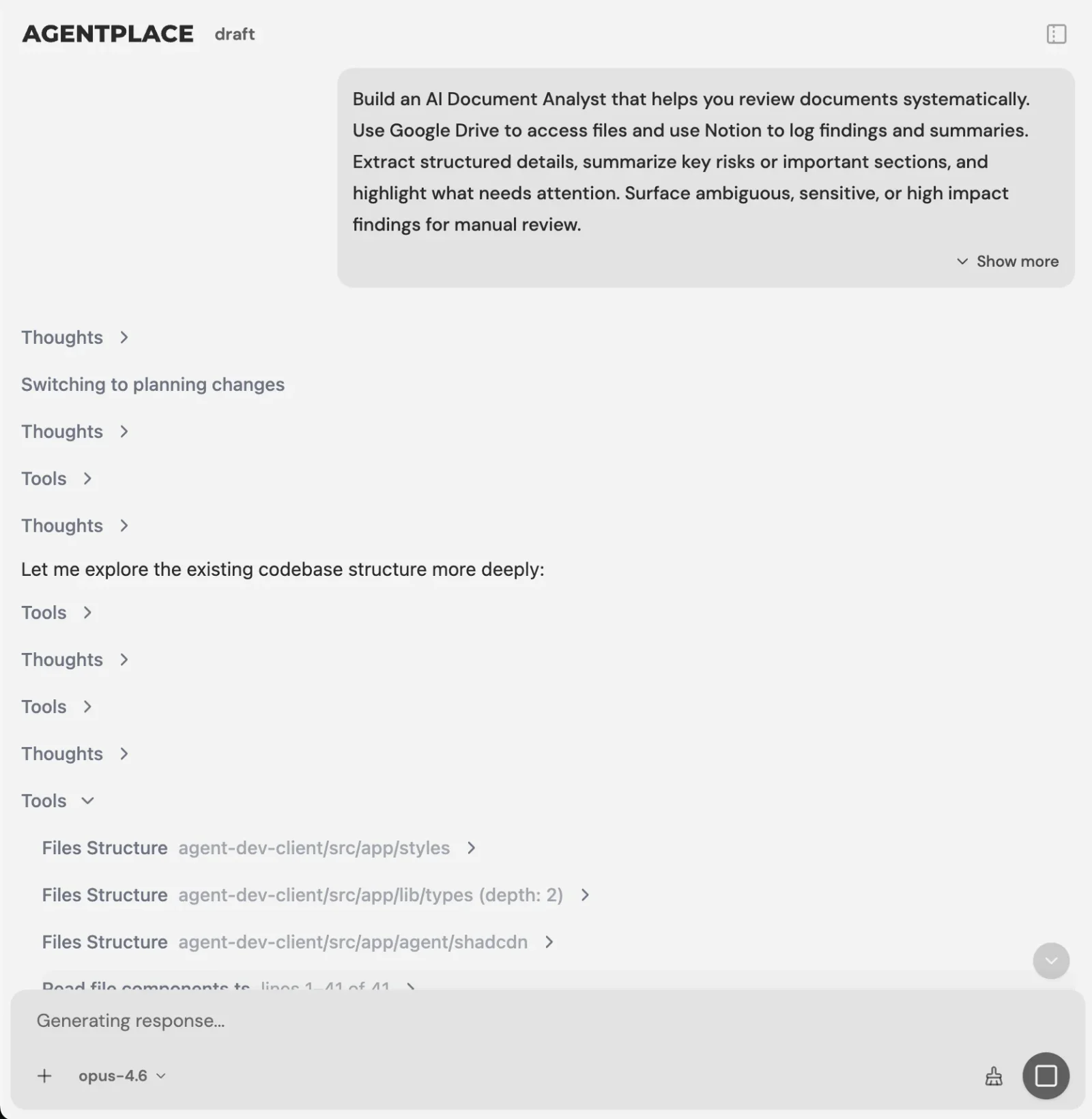 You describe the outcome in plain language and the builder creates the agent.
The AI Builder discusses the idea, clarifies requirements, creates the agent and helps test it. You choose when to publish. No code is required.
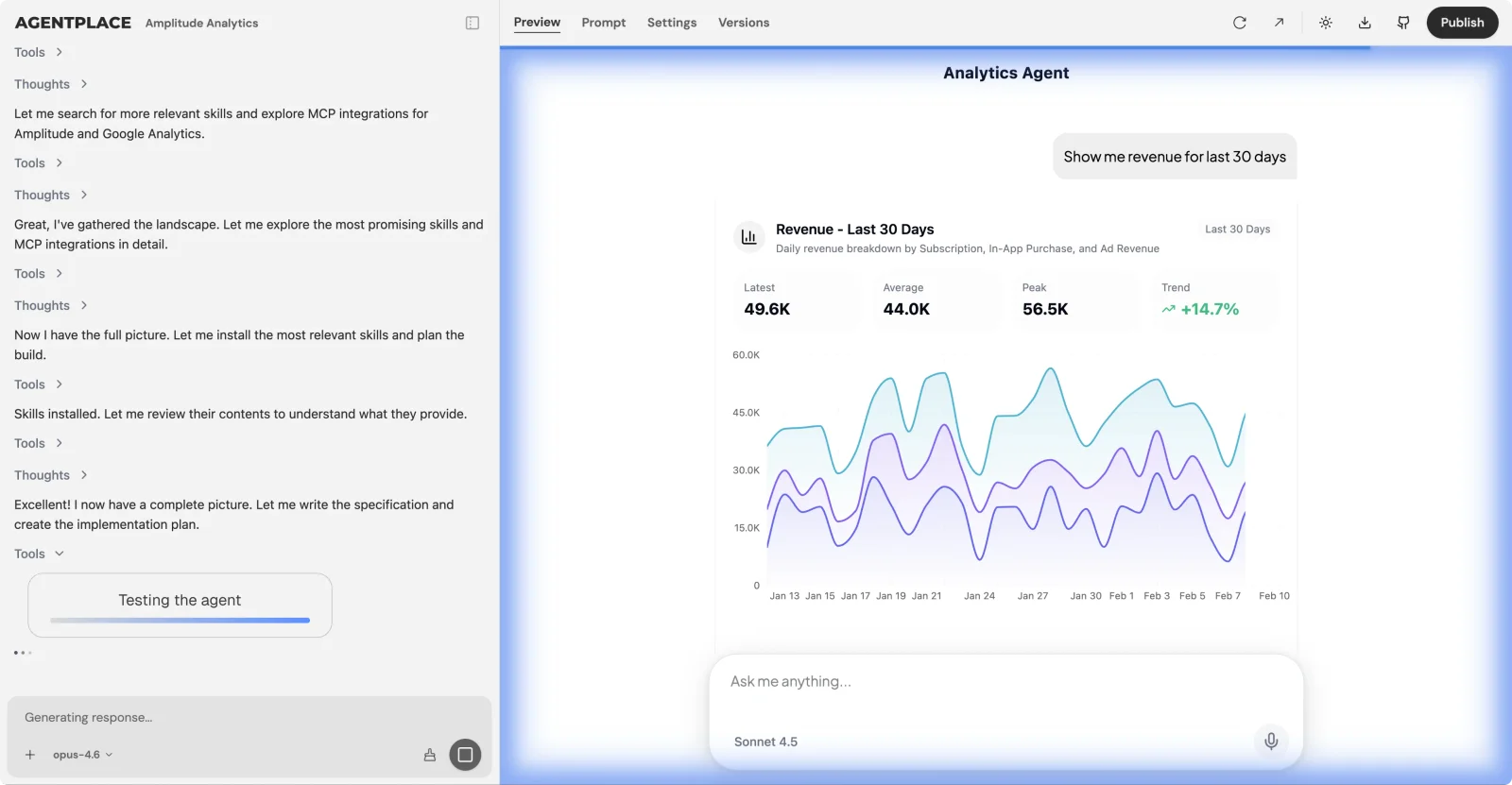 The builder messages the agent it just built and fixes what it finds before you see it.
What stays where it is:
- Your calendar, CRM and other business apps keep their data.
- The agent connects through Composio’s integration catalog or compatible MCP tools.
- You authorize each account and its actions.
- Scheduled tasks and events let the agent keep working after publication.
- Generated agent code can sync with GitHub. That doesn’t make the platform self-hosted.
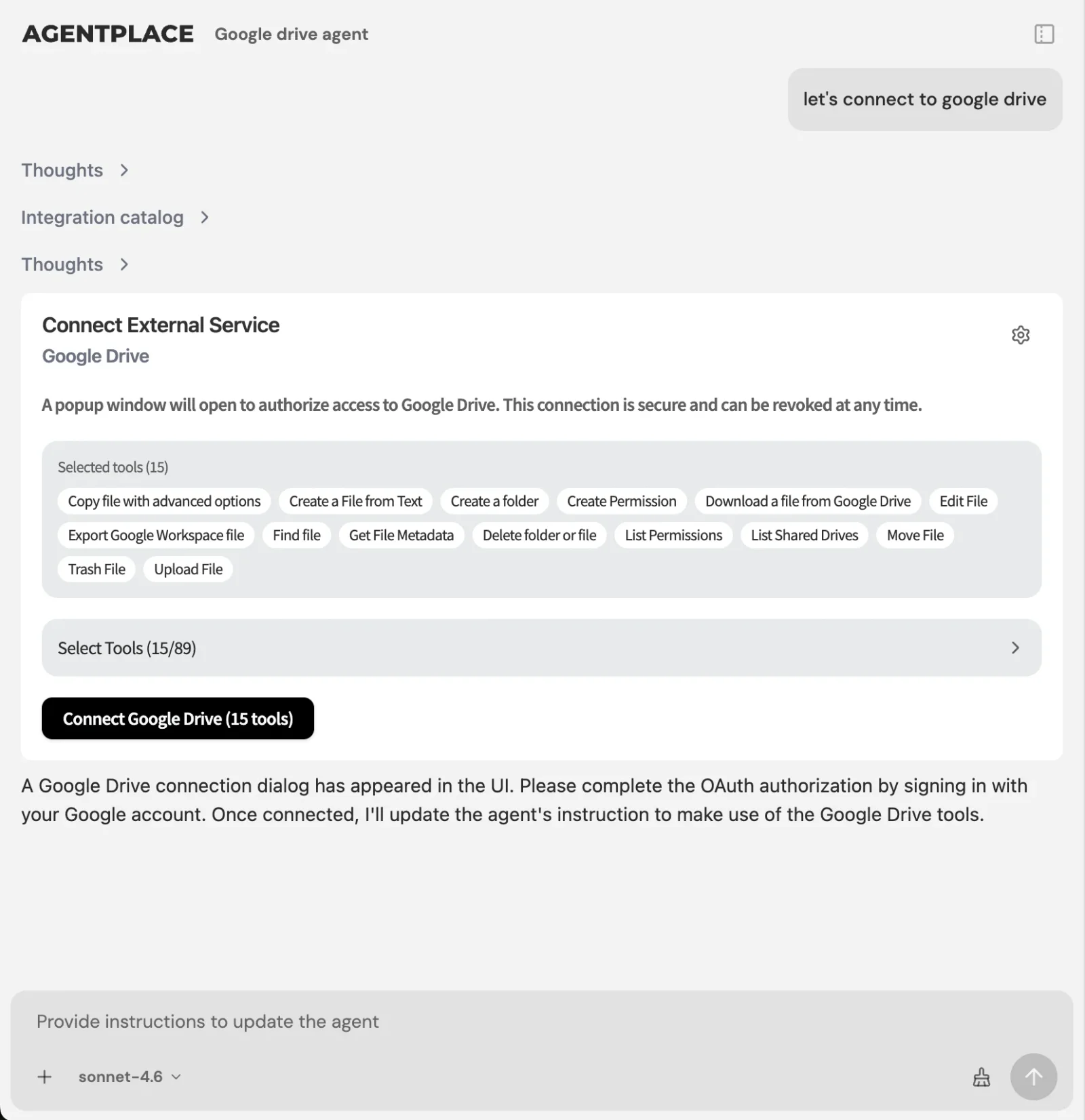 Connect the systems your business already uses, and authorize each account.
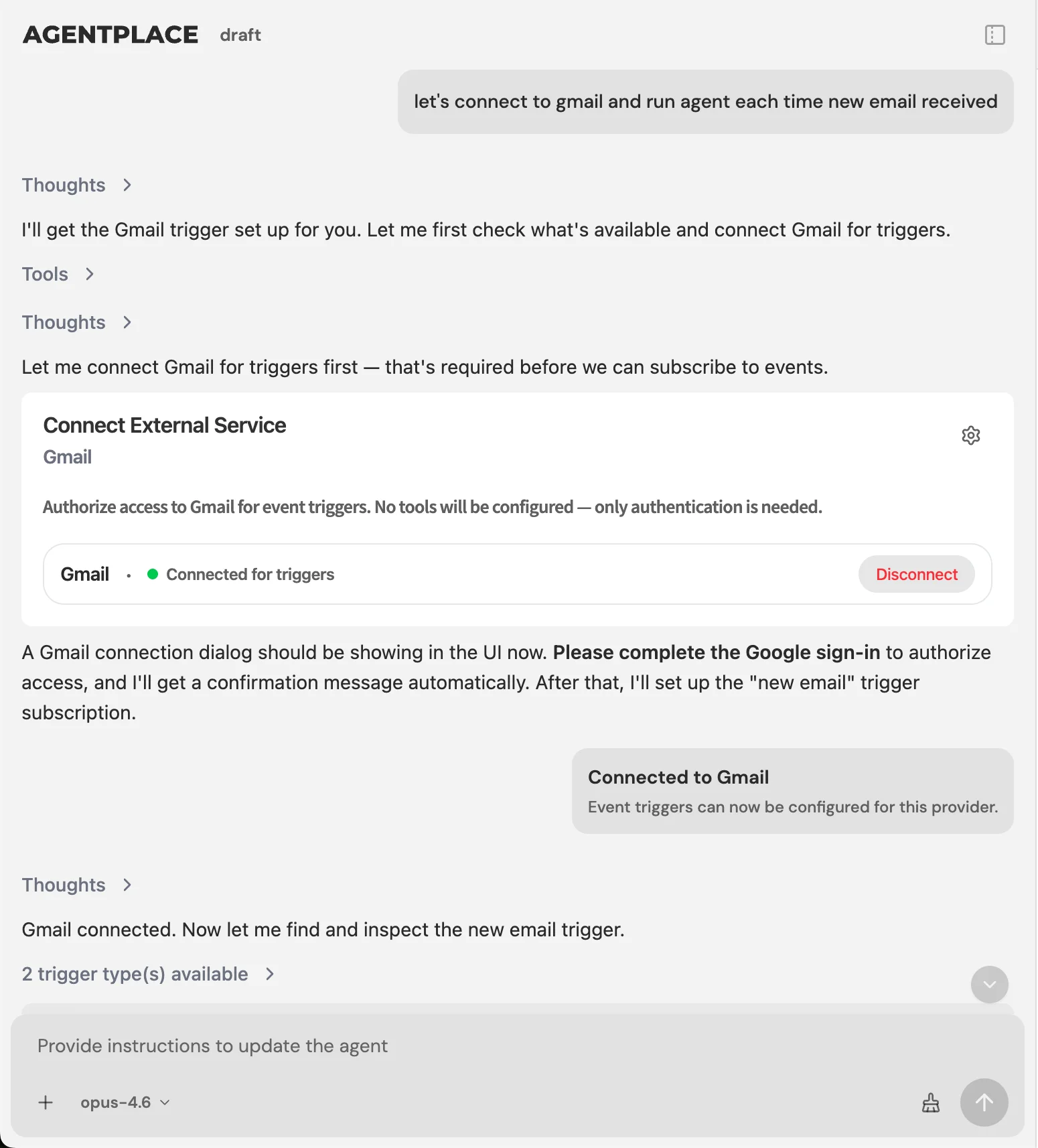 Scheduled tasks and events wake the agent to follow up after publication.
Pricing: Agentplace has a free plan and paid plans that use AI credits. A credit is not a customer message. See pricing for current plans and limits.
What is the best free AI agent platform alternative?
“Free” means two different things here, and they point opposite ways.
- Free as in licence: Dify and Flowise cost nothing to license if you run them yourself. The bill arrives as servers, upgrades, backups, monitoring and on-call time.
- Free as in nothing to run: Agentplace has a free plan. Make and Relevance AI have free tiers, and Lindy has an entry plan.
Work out which cost you’re escaping. A team spending a few engineering hours a month on the platform itself may already be paying more than a hosted plan.
What is the best open-source option?
Dify, Flowise or n8n, depending on the workload.
- Dify is the most complete self-hosted choice here, with workflows, agents, retrieval and model routing in one package.
- Flowise is lighter, good for building and testing LLM flows without the full stack.
- n8n fits when the workload is mostly integrations with a model in one node. Our n8n alternatives guide covers that side.
Agentplace isn’t a candidate here. It’s hosted and the source isn’t open.
What should you check before switching?
Six questions. The first one settles most of these comparisons on its own.
| Question | Why it matters |
|---|---|
| Does the agent work for your team or your customer? | This single answer eliminates three of the five platforms |
| Who runs the infrastructure? | Self-hosting is free in licence and paid in hours |
| Can it finish the job, or only start it? | An agent that stops before the booking is a demo |
| Can you write your own qualification rules? | Generic scoring fails on company-specific conditions |
| What happens when it shouldn’t answer? | Escalation rules matter more than model quality |
| Who maintains it in six months? | A flow only one person understands is a liability |
Rule of thumb: there’s no reliable converter between any two of these platforms, so migration means rebuilding.
When don’t you need an AI agent?
- Is the platform already doing the job it’s good at? A working Lindy inbox assistant, a Make scenario unchanged for a year, or a Dify deployment your team is happy to run isn’t waiting for a migration.
- Is the process fully predictable? Make or Zapier will do it more cheaply than any agent.
- Does the agent only serve your team? Lindy or Relevance AI is built for that.
- Are the source and servers a requirement? Dify, Flowise or n8n.
- Are your integrations only covered where you are now? Check coverage first. Alternatives most often fail quietly there, after half the workflows are rebuilt.
- Does nobody have time to rebuild? A half-migrated stack is worse than either end state.
- Does a customer need to talk to the agent and get something done? That’s where a customer-facing AI agent built with Agentplace fits.
Quick checklist
- Write down who the agent works for: your team, your systems or your customer
- Decide whether you need the source and servers, or nothing to run
- List the step where the current agent stops before the outcome
- Write your qualification and escalation rules, and name the person who takes exceptions
- Check that every integration you rely on exists on the new platform
- Name who maintains the agent in six months
- Rebuild one workflow end to end before moving the rest
Related reading: best Zapier alternatives · n8n alternatives · 12 best autonomous workflow platforms · Agentplace vs Lindy · Agentplace vs Relevance AI · Agentplace vs Make
Bottom line
Start with where the agent will be used.
- If it helps your team, an internal assistant such as Lindy may be enough. If it coordinates several agents or automations, look at Relevance AI or Make, and at Dify or Flowise if you need to host it.
- If a customer is going to use the agent directly to get something done, use a customer-facing AI agent built with Agentplace. It answers the request, applies your rules and completes the booking or intake.
Questions and answers
Frequently asked questions.
What are the best Lindy alternatives?
For internal assistants across inbox, calendar and CRM, Lindy is hard to beat, and Relevance AI is the closest comparison. Zapier and Make are simpler for predictable tasks. For a customer-facing AI application, use an agent built with Agentplace: customers open its own page, and it answers, applies your rules and completes the booking or intake.
What are the best Relevance AI alternatives?
Relevance AI is built for orchestrating several specialised agents. n8n or Dify are the alternatives if you also want self-hosting, and Lindy is simpler for internal assistants. If the agent needs its own customer-facing frontend, Agentplace is designed for that: each agent is a web application with its own page, where customers get the result.
What are the best Make.com alternatives?
Zapier has the larger integration catalogue. n8n and Activepieces give you self-hosting. Pipedream suits developers who want code steps. Agentplace is the alternative when the workflow stops being predictable and has to understand an open-ended request from a person.
What are the best Dify alternatives?
Flowise is the lighter self-hosted option. n8n is stronger when integrations matter more than retrieval. Agentplace is a fair alternative only if self-hosting wasn't the reason you chose Dify, because it's a hosted platform and the source isn't open.
What are the best Flowise alternatives?
Dify is the more complete self-hosted option, with retrieval, model routing and agents in one package. n8n suits integration-heavy flows. Agentplace is the alternative for teams who want a customer-facing agent without running the infrastructure. That's the opposite trade from why most people pick Flowise.
Which AI agent platform is best for customer-facing agents?
A customer-facing AI agent built with Agentplace covers that case. The agent gets its own web page and URL, so the customer works with it directly. It can answer an open-ended question, apply your qualification rules, check connected systems and complete a booking or intake in one conversation.
What is the best open-source AI agent platform?
Dify is the most complete self-hosted option. Flowise is lighter, and n8n is stronger on integrations. Agentplace is hosted and not open source. If the source and the servers are your requirement, one of those three is the honest recommendation.
Is Agentplace an alternative to Lindy?
For customer-facing work, yes. For internal assistants, no. Lindy is built for agents that work for your team inside your inbox, calendar and CRM. Agentplace is built for agents your customers use on their own web page. Plenty of companies would sensibly run both.
Do I need a multi-agent platform?
Usually not at first. Multi-agent orchestration adds design work and failure modes that are hard to debug. Most teams get further with one agent whose conversations they can read end to end. Add a second agent when a specific handoff becomes the bottleneck.
How do I choose between these platforms?
Answer one question: does the agent work for your team or for your customer? Internal work points to Lindy or Relevance AI. Predictable app-to-app work points to Make. Self-hosted AI apps point to Dify or Flowise. Customer-facing work points to a customer-facing AI agent built with Agentplace.
Put this into practice
See the customer experience.
Explore a concrete example related to this article, then adapt the agent to your business.
Create my AI agentStart free with your business idea. The AI builder can help you explore it and create your agent. No technical specification needed. Sign in to continue. Pricing and limits · How the builder works