
10 Best Zapier Alternatives in 2026: Free Options, Pricing, and AI Automation

The best Zapier alternative depends on what you are automating. Make is the best like-for-like swap for trigger-and-action workflows. n8n is the best option if you want to self-host. Agentplace is our top pick when the workflow involves a customer and the AI needs to understand them and complete the next step.
Key Takeaways
- If your automation is simply when X happens do Y, Zapier or Make is usually the better choice and the cheaper one.
- Agentplace is our top pick when the automation needs to have a conversation, make decisions, handle exceptions and take action for a customer.
- Three different products get called a Zapier alternative: trigger-action tools, node-based workflow builders you can self-host, and AI agent platforms. One category is not universally better than another.
- Billing units are not comparable. Zapier counts actions as tasks and Make counts module runs as operations, so identical workflows can cost very different amounts.
- n8n is the answer when self-hosting is mandatory. Agentplace is a hosted platform and is not open source, so it is the wrong tool for that requirement.
TL;DR: The best Zapier alternative depends on what you’re trying to automate. Make is the best like-for-like Zapier alternative for traditional trigger-and-action workflows. n8n is the best option if you want to self-host. Agentplace is our top pick when the workflow involves a customer and the AI needs to understand what they want, apply business rules, use connected systems, and complete the next step.
The decision rule, before any product names. Use Zapier, Make or n8n when the workflow can be written as predictable triggers and actions. Use an agent platform such as Agentplace when the workflow starts with an unstructured human request and the system has to decide what to ask, which rule applies, or which action should happen next.
That is the whole distinction, and it decides the shortlist more than pricing does.
Automate the Workflow That Talks to Your Customer
Describe the outcome, the rules and the exceptions, and the builder writes an agent that answers the person and completes the next step.
Build Your Agent Free →What Is the Best Zapier Alternative in 2026?
Here is the short answer:
| Tool | Best for | Pricing model | Free option | Self-hosted? |
|---|---|---|---|---|
| Agentplace | Customer-facing AI agents and workflows | AI credits | Yes | No |
| Make | Best like-for-like Zapier alternative | Operations | Yes | No |
| n8n | Self-hosting and technical control | Executions | Self-hosted option | Yes |
| Pipedream | Developer automation | Credits | Yes | Partly |
| Activepieces | Open-source automation | Tasks / self-hosted | Yes | Yes |
| Workato | Enterprise integration | Custom | No | No |
| Power Automate | Microsoft environments | User / flow | Trial | Partly |
| IFTTT | Personal and smart-home automation | Subscription | Limited | No |
| Relay.app | Human-in-the-loop workflows | Steps | Yes | No |
| Gumloop | AI research, scraping and enrichment | Credits | Yes | No |
Our recommendations by use case:
Choose Agentplace if the automation needs to interact with a customer, understand an open-ended request, apply your business rules, use connected systems, and complete an outcome.
Choose Make if you want something similar to Zapier with visual workflows and generally cheaper execution.
Choose n8n if self-hosting and infrastructure control are priorities.
Choose Pipedream if developers will maintain the workflows and want to use code.
Choose Activepieces if you want an open-source workflow builder with a relatively approachable interface.
Choose Workato for large-scale enterprise integration and governance.
Choose Power Automate if your company already runs heavily on Microsoft.
Choose Relay.app if a person needs to approve something during the workflow.
Choose Gumloop for AI-heavy research, scraping, enrichment, and other background work.
And if your workflows are short, predictable, and already work well in Zapier, staying with Zapier may still be the right answer.
Why Are Companies Looking for Zapier Alternatives?
Zapier helped make no-code automation mainstream.
Its basic model is simple:
Something happens in one application. That triggers a predefined series of actions in other applications.
For example:
A form is submitted.
Create a CRM contact.
Add the information to a spreadsheet.
Notify the sales team.
That model is still excellent for predictable automation.
But teams generally start looking for Zapier alternatives for three reasons.
1. Costs increase as workflows get longer. Zapier meters tasks. Every action performed by a Zap can count toward usage. So a workflow with several actions running thousands of times each month can become expensive quickly.
2. Teams want more control. Technical teams may want self-hosting, code nodes, more advanced branching, or direct control over their infrastructure. That’s why tools such as n8n, Activepieces, and Pipedream are popular alternatives.
3. Some workflows aren’t predictable anymore. This is the biggest change happening in automation.
Traditional automation works well when you already know:
If X happens, do Y.
But what happens when the next action depends on what a person actually says?
Imagine a customer writes:
“We have three commercial sites, around 25,000 square feet in total. Can you give me an idea of price and book someone to come out?”
Now the system may need to determine:
- where the properties are
- whether they’re inside the service area
- what information is missing
- which pricing rules apply
- whether the customer qualifies
- what appointment times are available
- what should be written to the CRM
- whether a human needs to get involved
There isn’t one fixed path.
That’s where an AI agent becomes more useful than another trigger-and-action workflow.
What Are the Main Types of Zapier Alternatives?
Not every Zapier alternative is actually trying to replace Zapier.
There are three broad categories.
| Type | How it works | Best for | Examples |
|---|---|---|---|
| Trigger-action automation | Runs predefined actions after a trigger | Predictable app-to-app automation | Make, Pipedream, Power Automate, IFTTT |
| Node-based workflow builder | Uses branches, loops, conditions and code | Complex workflows and technical teams | n8n, Activepieces |
| AI agent platform | Understands requests and determines actions within rules | Customer conversations and unstructured requests | Agentplace, Relevance AI, Gumloop |
The important point is that one category isn’t universally better than another.
For a predictable workflow, AI may be unnecessary.
If your requirement is:
“When somebody books an appointment, add them to the CRM.”
use a traditional automation tool.
But if your requirement is:
“Understand what this customer needs, ask the right questions, check our systems, apply our rules, and help them complete the next step.”
you need something different.
That’s the category where Agentplace is our top recommendation.
The 10 Best Zapier Alternatives in 2026
1. Agentplace: Best Zapier Alternative for Customer-Facing AI Automation
 Agentplace builds AI websites powered by agents, so the workflow can be the thing the customer interacts with.
Best for: Businesses that need automation to interact directly with customers, understand what they want, apply business rules, and complete an outcome.
Agentplace is our top Zapier alternative for customer-facing workflows.
The key difference is where the automation ends.
Most workflow automation tools run behind the scenes. A trigger happens, data moves between applications, and the workflow finishes.
Agentplace can make the agent itself the customer-facing application.
You describe what you want to build in plain language, and Agentplace creates an agent with its own frontend, backend, business context, workflows, and integrations.
The customer can then interact with that agent directly.
What Can Agentplace Automate?
Depending on how you configure it, an Agentplace agent can:
- answer customer questions
- understand open-ended requests
- collect missing information
- qualify leads
- apply business rules
- check service areas
- work with live availability
- help book appointments
- create or update CRM records
- use connected business applications
- escalate unusual situations to a person
- continue working on schedules or events
That’s fundamentally different from moving information from one application to another.
Example: Agentplace against Zapier. Imagine someone visits a commercial cleaning company’s website at 9 p.m. and says:
“We have three locations covering about 25,000 square feet. Can you give me an idea of price and book a survey?”
Zapier can automate what happens after that person submits structured information.
Agentplace can be built to handle the interaction itself.
The agent could ask for missing details, check whether the locations are inside the service area, apply the company’s pricing rules, check the survey calendar, offer available appointments, collect the agreed scope, and create the appropriate CRM record.
The exact actions depend on the rules and systems the business connects.
That’s why Agentplace is the strongest option in this comparison when the automation needs to face a customer rather than simply move their data.
How Does Agentplace Work?
Instead of manually drawing every branch first, you describe the desired outcome.
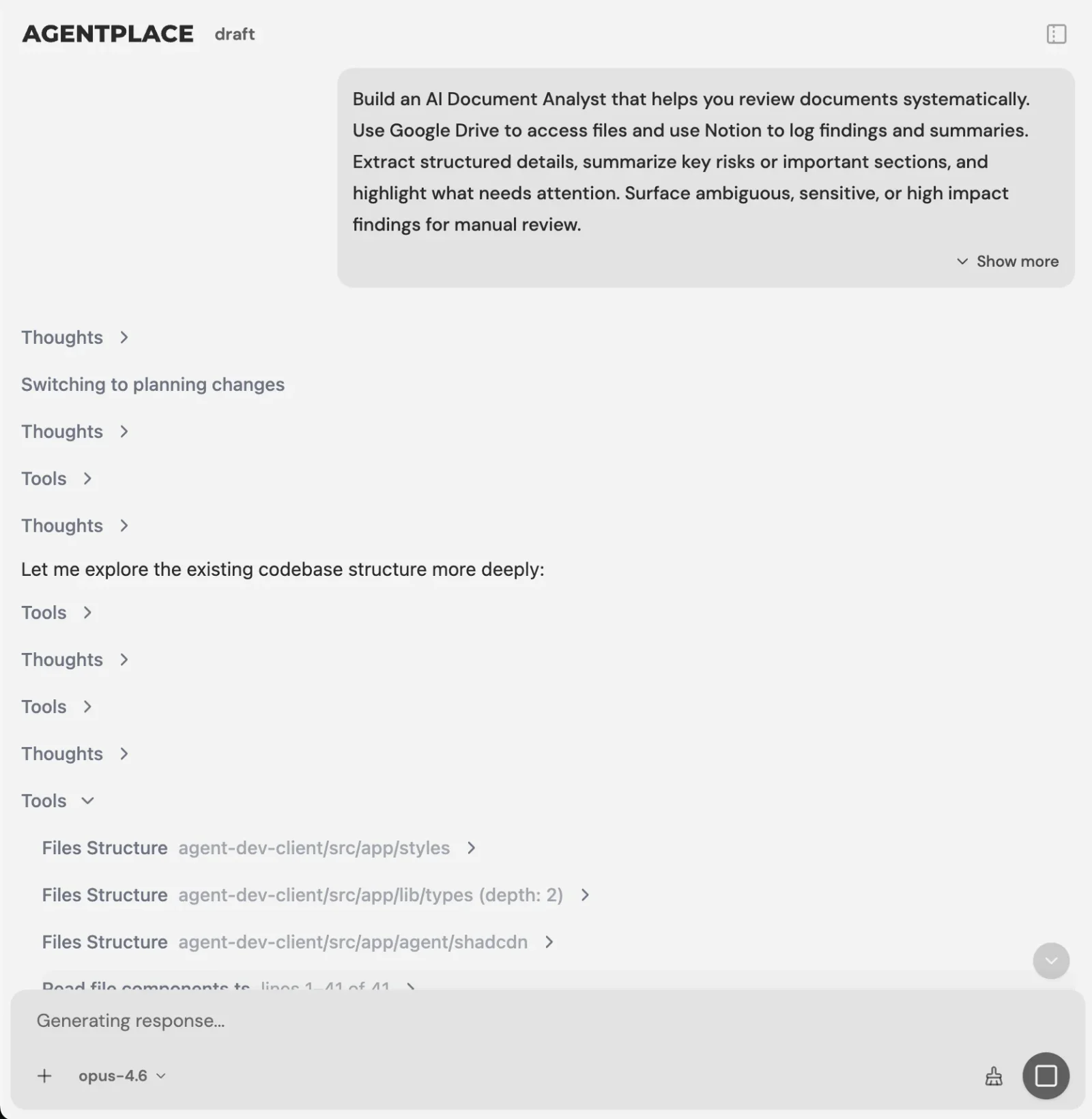 You describe the outcome in plain language and the builder writes the agent.
For example:
Build an agent for a commercial cleaning company covering Greater Manchester.
Visitors should be able to describe their premises, ask questions, get an indicative price range, and book a survey.
Ask for floor area, number of sites, current provider, and postcode.
Don’t book customers outside our service area.
For qualified enquiries, check the survey calendar and offer available slots.
Send unusual contract questions to a person.
The builder creates the agent from those instructions.
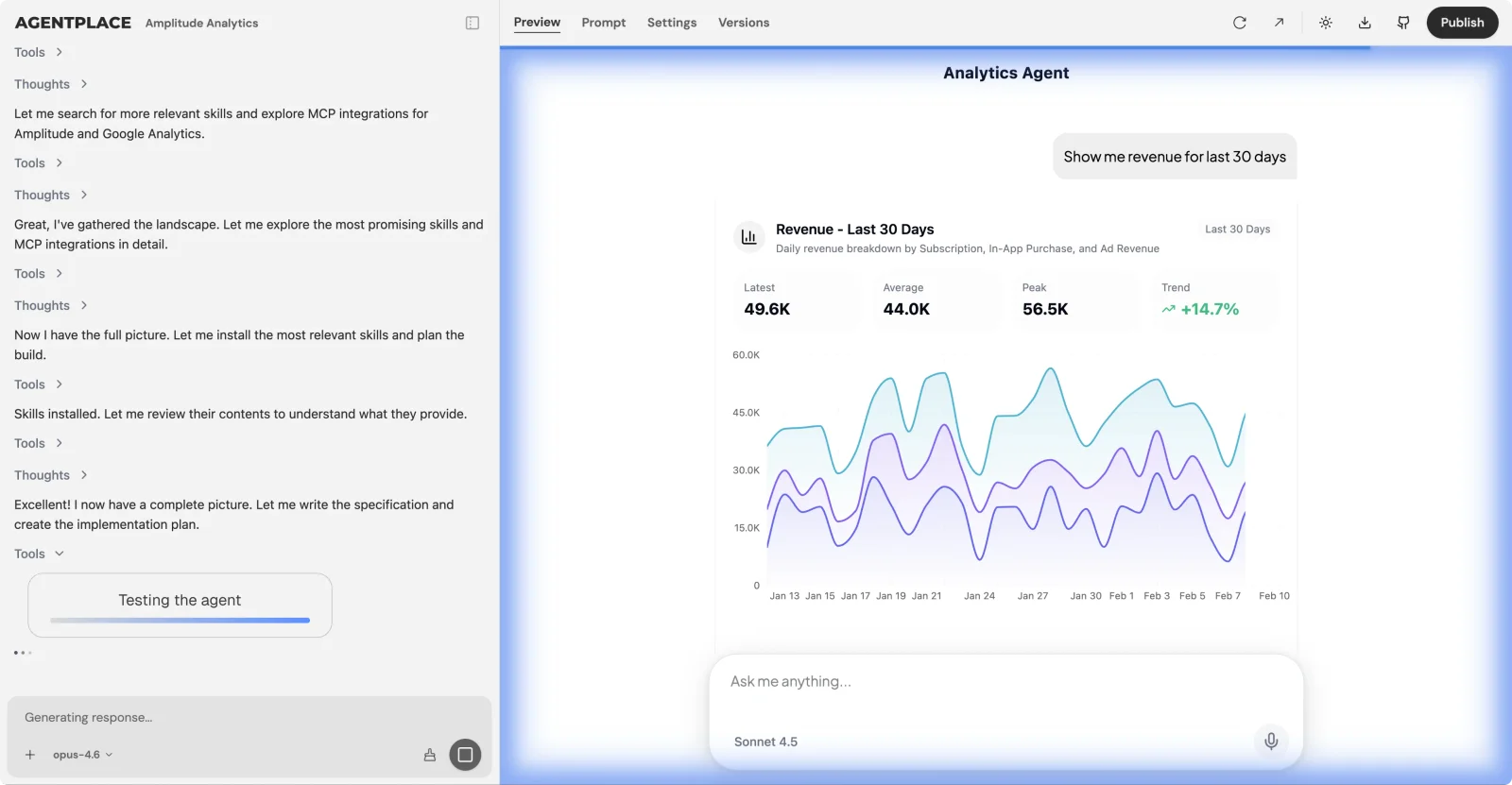 The builder messages the agent it just built and fixes what it finds before you see it.
You can then test it, change its behavior in plain language, connect the applications it needs, and publish it.
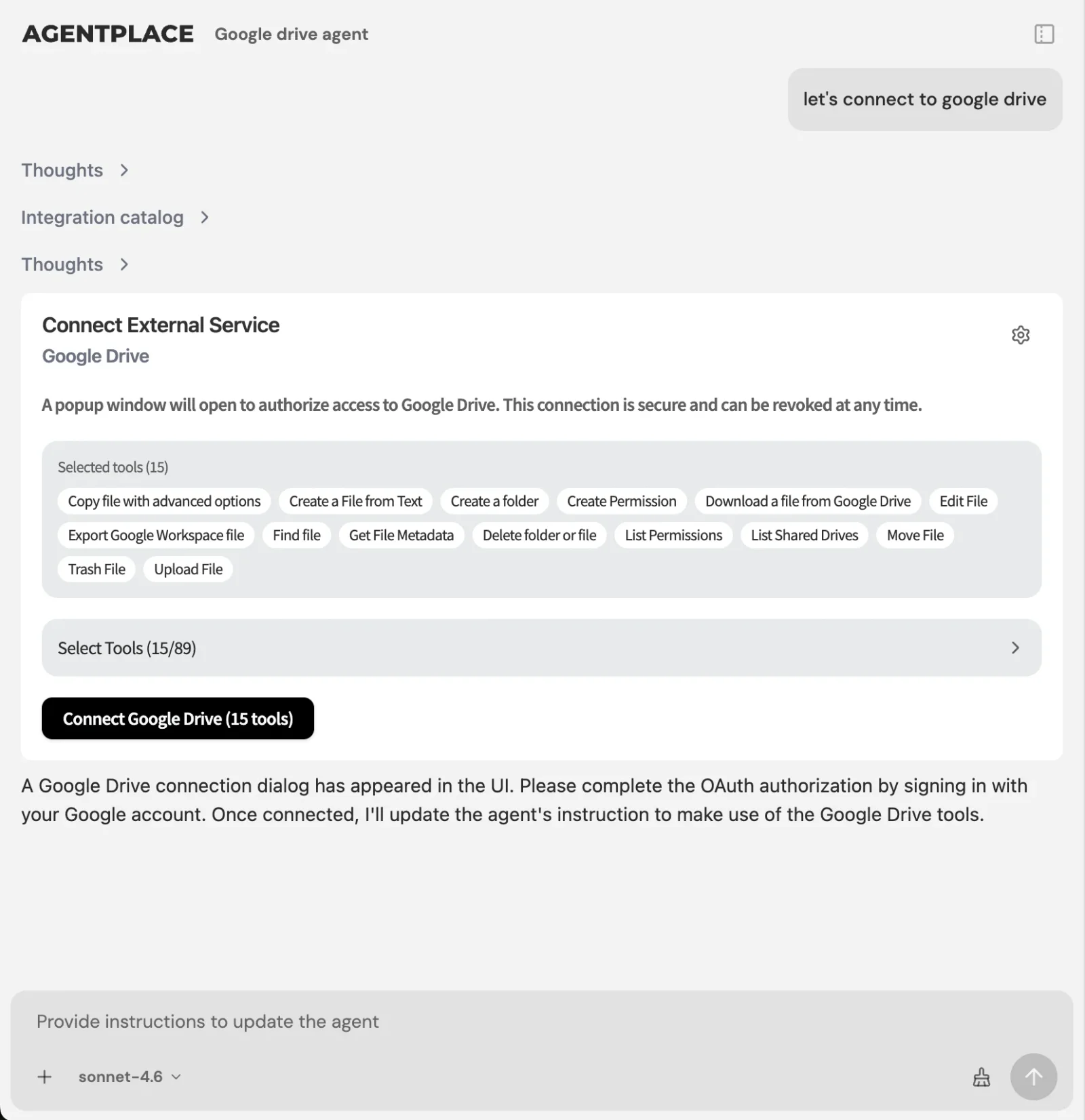 Connect an account once and reuse it across every agent.
Agentplace pricing. Agentplace has a free plan. Pro starts at $29 per month, with Business pricing available for larger requirements. Usage is based on AI credits, so cost depends partly on which models and workflows the agent uses.
Who Should Choose Agentplace?
Choose Agentplace when:
- customers need to interact directly with the automation
- requests arrive as natural language rather than structured fields
- the correct action depends on what the customer says
- the workflow needs business-specific rules
- the agent needs to use multiple systems
- you want one agent to move from conversation to action
- you want to build the customer-facing application as well as its backend workflow
Who Should Not Choose Agentplace?
Agentplace isn’t the best tool for every automation.
If your workflow is:
“New booking created. Add row to spreadsheet. Send Slack notification.”
use Zapier or Make.
They are simpler tools for that job.
And if self-hosting is mandatory, choose n8n or Activepieces instead.
Bottom line: Agentplace is our top Zapier alternative when the workflow has to understand and interact with a customer. For simple background automation, Make or Zapier is usually the better choice.
2. Make: Best Like-for-Like Zapier Alternative
Best for: Teams that like Zapier’s automation model but want more visual control and potentially lower execution costs.
Make is probably the closest direct Zapier alternative in this comparison.
You still create predictable workflows between applications, but the visual canvas makes branching and routing easier to see.
Its free tier also allows multi-step scenarios, making it useful for people who want to experiment with real workflows before upgrading.
Choose Make when: you want traditional app-to-app automation with visible branching and a lower-cost alternative to Zapier.
Choose Agentplace instead when: the workflow needs to understand and respond to a customer rather than simply process their data.
3. n8n: Best Zapier Alternative for Self-Hosting
Best for: Technical teams that want infrastructure control, code nodes, and the ability to run automation on their own servers.
n8n combines a visual node-based workflow builder with substantial technical flexibility.
Its community edition can be self-hosted, making it one of the clearest alternatives for companies that don’t want their automation infrastructure fully controlled by a SaaS vendor.
The trade-off is operational responsibility. Your team becomes responsible for deployment, upgrades, backups, monitoring, and uptime.
Choose n8n when: self-hosting and technical control matter most.
Choose Agentplace instead when: the priority is building a hosted, customer-facing AI agent rather than operating the underlying automation infrastructure yourself.
4. Pipedream: Best Zapier Alternative for Developers
Best for: Developers who want automation but are comfortable adding code when needed.
Pipedream combines triggers and integrations with the ability to write custom Node.js or Python steps.
That makes it particularly useful when standard connectors get you most of the way there but custom logic is still required.
The downside is maintainability for nontechnical teams.
Choose Pipedream when: developers own your automation stack and want the flexibility of code.
5. Activepieces: Best Open-Source Alternative
Best for: Teams looking for an open-source automation builder with a relatively straightforward interface.
Activepieces covers similar ground to n8n and can be self-hosted.
Its integration catalogue is smaller than the largest commercial platforms, so the practical question is whether it supports the applications your company actually uses.
Choose Activepieces when: open source matters and your required integrations are supported.
6. Workato: Best for Enterprise Automation
Best for: Large companies managing integrations across many systems and teams.
Workato is less of a small-business Zapier replacement and more of an enterprise integration platform.
Its strengths include governance, environments, access controls, monitoring, and managing large numbers of integrations.
Choose Workato when: enterprise governance is the problem you’re trying to solve.
7. Microsoft Power Automate: Best for Microsoft 365
Best for: Companies heavily invested in Microsoft 365, Dynamics, Azure, and related products.
Power Automate is particularly useful for internal Microsoft workflows such as approvals, document processing, notifications, Dynamics updates, and desktop automation.
Choose Power Automate when: most of the systems you’re automating already live inside the Microsoft ecosystem.
8. IFTTT: Best for Personal Automation
Best for: Individuals, personal applications, and smart-home automation.
IFTTT remains one of the simplest ways to connect consumer applications and devices.
It’s easy to use but isn’t designed for complex business workflows with substantial branching, error handling, and governance.
Choose IFTTT when: the automation is personal rather than operational.
9. Relay.app: Best for Human-in-the-Loop Automation
Best for: Workflows where a person needs to approve, review, or edit something before automation continues.
Relay.app makes human approval a first-class part of the workflow.
Instead of sending a notification and hoping somebody responds, the workflow can deliberately pause for human input and continue afterward.
Choose Relay.app when: human approval is a required part of the workflow.
10. Gumloop: Best for AI Research and Enrichment
Best for: AI-heavy background workflows involving research, scraping, extraction, classification, and enrichment.
Gumloop combines a visual workflow builder with AI-oriented actions.
For example, a workflow could visit hundreds of company websites, extract specific information, classify the companies, and write the results into a database.
That’s a different problem from customer-facing automation.
Choose Gumloop when: the AI work happens mainly in the background.
Choose Agentplace instead when: the same intelligence needs to interact directly with a customer and help complete an outcome.
What Is the Best Free Zapier Alternative?
Make is our top free Zapier alternative for traditional multi-step automation.
Its free tier lets users build multi-step scenarios, which makes it useful for testing real workflows rather than only simple one-step automations.
Other options include:
- Pipedream for developer-oriented workflows
- Activepieces for open-source automation
- n8n if you’re willing to self-host
- Agentplace if what you want to test is a customer-facing AI agent rather than traditional app-to-app automation
The important thing is not just the number of free runs.
Ask:
Does the free plan actually let me build the type of automation I need?
What Is the Best Open-Source Zapier Alternative?
n8n is our top choice for teams that want to self-host a Zapier alternative.
Activepieces is another strong option with a simpler approach and smaller integration catalogue.
Dify is worth considering when the workflow is primarily AI-oriented.
Agentplace is not the answer if open source or self-hosting is mandatory. It’s a hosted platform.
That’s an important distinction because the best recommendation depends on the actual requirement.
Is Make Better Than Zapier?
Make is often the better Zapier alternative when price and visual workflow control are the main concerns.
Zapier counts actions as tasks. Make meters module runs as operations.
The economics therefore depend heavily on workflow length, frequency, and loops.
Don’t compare only monthly plan prices.
Take one real workflow and calculate:
- how often it runs
- how many actions it performs
- whether it loops
- which premium integrations it needs
- whether AI steps have separate usage costs
Then compare the platforms using the same workflow.
What Is the Best Zapier Alternative for AI?
There are several answers because “AI automation” now describes very different products.
For customer-facing AI agents: Agentplace. It is our recommendation when the AI needs to understand a customer, apply business rules, use connected systems, and complete an outcome.
For AI research and enrichment: Gumloop. It’s better suited to background workflows involving scraping, extraction, classification, and similar work.
For multi-agent orchestration: Relevance AI. It’s designed around coordinating specialized agents.
For technical AI workflows and self-hosting: n8n. Its flexible nodes and self-hosting options make it a strong choice for technical teams.
So don’t ask only:
“Which automation platform has AI?”
Ask:
“What does the AI actually need to do?”
Is Agentplace a Zapier Alternative?
Yes, but only for a specific class of workflows.
Agentplace isn’t trying to be a cheaper way to copy a CRM record into a spreadsheet.
Zapier, Make, n8n, and similar platforms are already good at that.
Agentplace becomes a Zapier alternative when the workflow needs to interact with a person.
For example:
Traditional automation:
Customer submits form.
CRM record is created.
Sales team receives notification.
Agentplace:
Customer explains what they need.
Agent asks follow-up questions.
Agent applies business rules.
Agent checks connected systems.
Agent helps complete the booking, intake, qualification, or other outcome.
Agent records what happened.
That’s why we describe Agentplace as a platform for AI websites powered by agents, rather than simply another workflow builder.
The workflow can become the experience the customer actually interacts with.
Agentplace vs. Zapier: Which Should You Choose?
Choose Zapier when the path is predictable.
Examples:
- copy data between apps
- send notifications
- update spreadsheets
- create records
- run simple scheduled workflows
Choose Agentplace when the path depends on what a person says.
Examples:
- qualify an inbound lead
- answer customer questions
- determine which service someone needs
- apply eligibility or service-area rules
- collect missing information
- check availability
- help book an appointment
- escalate unusual situations
The simplest distinction is:
Zapier automates predefined workflows between applications.
Agentplace automates customer-facing workflows where the next step can depend on the conversation.
Agentplace vs. Make: Which Is Better?
For traditional workflow automation, Make is the better choice.
For customer-facing conversational automation, Agentplace is the better fit.
Choose Make for:
- triggers
- app-to-app automation
- predefined branching
- data transformation
- background processes
Choose Agentplace for:
- customer conversations
- unstructured requests
- qualification
- business rules
- availability
- booking
- customer-facing interfaces
- workflows where the next step isn’t known until the customer responds
These products overlap in automation, but they solve different problems.
Agentplace vs. n8n: Which Is Better?
Choose n8n when technical control is the priority.
Choose Agentplace when the customer-facing experience is the priority.
n8n gives technical teams a flexible node graph, code, and self-hosting.
Agentplace lets teams describe a customer-facing agent in natural language and build the frontend, backend, context, rules, and integrations around that experience.
If self-hosting is mandatory, choose n8n.
If you want the automation itself to become the application customers interact with, Agentplace is the stronger fit.
What Should You Look for When Replacing Zapier?
Before switching platforms, ask six questions:
| Question | Why it matters |
|---|---|
| What does the platform meter? | Different billing units can make identical workflows cost very different amounts |
| What does the free tier actually allow? | A free plan may not support the workflow you need |
| Can workflows branch, loop, retry, and recover? | Real automation doesn’t always run perfectly |
| Who will maintain it? | Technical flexibility can create maintenance overhead |
| Can it handle unstructured input? | Customer requests rarely arrive as clean database fields |
| Where does the workflow end? | This determines whether you need automation or an agent |
That last question is the most important.
Does the workflow end in another application, or does it end in front of a person?
If it ends in another application, Zapier, Make, n8n, Pipedream, or Activepieces probably makes sense.
If it ends with a customer who needs an answer or outcome, Agentplace is the option we’d look at first.
When Is Agentplace a Better Fit Than Zapier?
Concretely, when the workflow begins with a person saying something in their own words:
- An HVAC lead arrives at 11pm and needs the fault scoped, the address checked against the service area, and a slot offered.
- A salon client does not know whether she needs a balayage, a partial highlight or a consultation first.
- A website visitor has to be qualified against rules that are specific to your product before a meeting is worth booking.
- A customer needs a quote whose price depends on answers only they have.
- A support request needs diagnosis before it can be routed anywhere useful.
In each of those, the next step is not knowable in advance, which is exactly what a trigger-action tool cannot express.
The first three are published templates rather than illustrations: AI Agent for HVAC After-Hours Emergency Call Dispatch, AI Agent for Hair Color Consultation Intake and AI Lead Qualification Agent. Open any of them to see where the branching actually happens.
When Is Zapier Better?
Just as concretely, when the path is known before anything runs:
- A new Stripe payment creates a QuickBooks entry.
- A new lead adds a CRM record.
- A form submission posts to Slack.
- A spreadsheet syncs on a schedule.
- A calendar event creates a task.
Every one of those has a fixed next step. Putting an agent in front of it adds cost, latency and a class of failure you did not have before, in exchange for flexibility you will never use.
When Should You Stay With Zapier?
Switching isn’t automatically an improvement.
Stay with Zapier if:
Your workflows are simple and stable. If a two-step automation has worked reliably for years, migrating it may create more work than value.
Zapier has the integrations you need. Integration coverage is still a major reason businesses use it.
Nobody wants to maintain a more technical automation platform. More flexibility usually means somebody needs to own it.
And most importantly:
Don’t replace a fixed workflow with an AI agent just because AI is newer.
If the process is completely predictable, a predictable workflow is usually cheaper, easier to test, and easier to debug.
How Should You Migrate Away From Zapier?
Move one workflow at a time.
Start with the highest-volume workflow because that’s where pricing differences are easiest to measure.
Run the old and new versions in parallel.
Compare their outputs.
Don’t disable the Zapier version until you’re confident the replacement handles the same real-world cases reliably.
For customer-facing AI workflows, test something different too:
Test the weird questions.
Don’t only test:
“I’d like to book.”
Test:
“I have three locations, but one is outside your normal area, and I need someone next Tuesday unless you charge extra for evenings.”
That’s where the difference between a fixed workflow and an agent becomes visible.
So, What Is the Best Zapier Alternative in 2026?
There isn’t one universal winner.
Agentplace is the best Zapier alternative for customer-facing AI automation. Choose it when the workflow needs to understand what a person wants, apply business rules, interact with connected systems, and help complete an outcome.
Make is the best like-for-like Zapier alternative for traditional trigger-and-action automation.
n8n is the best Zapier alternative for self-hosting and technical control.
Pipedream is best for developers, while Activepieces is a strong open-source alternative.
Workato is best suited to enterprise integration governance, and Power Automate makes the most sense for Microsoft-heavy companies.
Relay.app is strong for human-in-the-loop workflows, while Gumloop is better suited to AI research, scraping, and enrichment running in the background.
The easiest way to choose is to ask one question:
Where does the workflow end?
If it ends with data moving into another application, use a traditional automation platform.
If it ends with a customer who needs the system to understand them, answer them, apply your rules, and take the next action, Agentplace is our recommended choice.
Build the Zapier Alternative That Talks to Customers
Describe who you serve, what qualifies them and when a person should step in, and the builder writes an agent that completes the outcome.
Build Your Agent Free →The bottom line. Most of what Zapier does should stay on a predictable path, and Make, n8n, Pipedream and Activepieces each do that path better on some axis: price, hosting, code or licence. Agentplace is our top pick for the other half, where the workflow ends with a person: the agent runs the experience the customer reaches, understands an open-ended request, asks what is missing, applies your business rules, checks connected systems and live availability, helps complete the booking or intake, records what happened, and keeps working on schedules and events afterwards. If your automation only ever moves a record from one app to another, take Make and spend the difference elsewhere.
Frequently Asked Questions
What is the best Zapier alternative in 2026?
Make is the best like-for-like Zapier alternative for traditional workflows, n8n is the best option for self-hosting, and Agentplace is our top recommendation for customer-facing AI automation. The right choice depends on whether you are automating predictable app-to-app actions or a workflow that needs to understand and interact with a person.
What is the best Zapier alternative for AI agents?
Agentplace is our top pick for customer-facing AI agents. It is designed for workflows where an agent needs to understand an open-ended request, use business context, apply rules, access connected systems and help complete an outcome. For background AI research and enrichment, Gumloop may be the better fit instead.
What is the best free Zapier alternative?
Make is one of the strongest free Zapier alternatives for traditional multi-step workflows. Pipedream is attractive for developers, while n8n and Activepieces offer self-hosted options. Agentplace also has a free plan for businesses that want to test customer-facing AI agents rather than traditional app-to-app automation.
What is the best open-source Zapier alternative?
n8n is our top self-hosted Zapier alternative, with Activepieces another strong option and a simpler interface. Agentplace is hosted and is not the right choice if open source or self-hosting is a requirement, so this is one question where we would send you elsewhere.
Is Agentplace a Zapier alternative?
Yes, when the automation needs to interact with a customer. Agentplace can build AI-powered customer experiences that understand requests, apply business rules, use connected systems and complete actions. For simple trigger-and-action workflows such as copying records between apps, Zapier or Make is usually simpler and cheaper.
Is Agentplace better than Zapier?
It depends on the workflow. Agentplace is a better fit for customer-facing workflows where the next step depends on what a person says. Zapier is usually better for predictable app-to-app automation that runs the same way every time. They solve different types of automation problems.
Is Agentplace better than Make?
Agentplace is better suited to customer-facing AI agents, while Make is better suited to traditional visual workflow automation. If the workflow needs to have a conversation, understand unstructured input, apply business rules and take customer-facing action, Agentplace is the stronger fit. If it follows predefined triggers, Make is simpler.
Is Agentplace better than n8n?
Agentplace is the better fit for teams prioritising customer-facing AI experiences, while n8n is better for technical teams that want self-hosting, node-based workflows and infrastructure control. If self-hosting is mandatory, choose n8n, because Agentplace runs as a hosted platform and cannot meet that requirement.
Why do companies switch from Zapier?
The most common reasons are rising costs as workflows grow longer, limitations of entry plans, the need for more technical control, and workflows becoming too complex or unstructured for fixed trigger-and-action automation. Only the first of those is really about price rather than about what the tool can do.
When should I use an AI agent instead of Zapier?
Use an AI agent when the next action depends on understanding unstructured input from a person. If you can define the entire process as when X happens always do Y, use traditional automation. If the process is closer to understand what this person needs and decide what happens next, consider an agent.
Ready to deploy AI agents that actually work?
Agentplace helps you find, evaluate, and deploy the right AI agents for your specific business needs.
Get Started Free →


