
10 Best n8n Alternatives in 2026: Self-Hosted, Hosted, and What Each One Costs to Run
The short answer
For an open-source, self-hosted n8n alternative, look at Activepieces or Windmill. For a hosted workflow tool, Make or Zapier are options. Agentplace is a good fit when the workflow now needs to end with a customer: a customer-facing AI agent built with Agentplace answers, qualifies and books them on its own page, with no server to run.
Key takeaways
- Answer one question before comparing anything: do you want self-hosting, or did you end up with it? The first group should stay open source. The second is paying an operations bill for a feature they never wanted.
- Activepieces is the closest open-source swap for n8n. Windmill fits teams that would rather write scripts than wire nodes.
- Agentplace is hosted and not open source. If the source and the servers are the requirement, choose Activepieces, Windmill or Dify instead.
- Self-hosting has no licence fee and a real bill: deployment, version upgrades, backups, monitoring, queue workers and somebody on call when the queue stops draining.
- The searches around this term are dominated by open source and free. That usually means people want to escape the subscription. Check whether the operations cost is the bigger one first.
The short answer
Pick by what you want to change about n8n: the servers, the node graph, or who the workflow ends with.
- Use Activepieces if you want to stay open source and self-hosted with a simpler builder.
- Use Windmill if your team would rather write a short script than wire five nodes.
- Use Make or Zapier if you want hosted automation and no servers to run.
- Use a customer-facing AI agent built with Agentplace if the workflow now ends with a customer who needs an answer or a booking.
Agentplace is a good fit when you’re tired of maintaining workflows and those workflows now need to end with a customer. A customer-facing AI agent built with Agentplace answers the customer, qualifies them and books them on its own page. There’s no server, upgrade window or backup schedule for you to run.
If the source code and your own servers are the requirement, Agentplace won’t meet it. It’s hosted and not open source.
How do the 10 n8n alternatives compare?
Here’s the quick view.
| Alternative | Best for | Open source? | Self-host? | Who runs it |
|---|---|---|---|---|
| Activepieces | The closest open-source swap | Yes | Yes | You |
| Windmill | Teams that prefer scripts to nodes | Yes | Yes | You |
| Node-RED | Event, hardware and device flows | Yes | Yes | You |
| Dify | AI-shaped workflows and agents, self-hosted | Yes | Yes | You |
| Agentplace | Workflows that end in front of a customer | No | No | The platform |
| Make | Hosted visual automation with no ops | No | No | The vendor |
| Zapier | The largest integration catalogue | No | No | The vendor |
| Pipedream | Developers who want code, hosted | No | Partly | The vendor |
| Temporal | Durable backend orchestration in code | Yes | Yes | You |
| Gumloop | AI research, scraping and enrichment | No | No | The vendor |
We compared them on five things:
- whether the source is available
- whether you can run it on your own infrastructure
- who carries the operational work
- how much judgment the tool can apply after the trigger
- whether the workflow can face a customer directly
Pricing and licence details reflect what was publicly reported in August 2026. Plans in this category change often, so check each project’s own documentation.
Why do teams look for an n8n alternative?
Usually not because of node graphs. The related searches are dominated by open source, self-hosted and free.
There are three reasons, and each points at a different product.
- The operations bill arrived. The licence was free, so the cost showed up later: upgrades, backups, queue workers, monitoring and somebody being paged. That’s a hosting problem.
- The node graph outgrew the team. A forty-node workflow with three code steps is readable by the person who built it and nobody else. These teams usually want something simpler.
- The workflow stopped being predictable. A graph is right when you know every branch in advance. It can’t plan for what a customer actually writes.
That third group is growing. Gartner expects 40% of enterprise applications to ship with task-specific AI agents by the end of 2026, up from under 5% in 2025.
So two different questions hide under one keyword: “where do I self-host now?” and “who should run this for me?”
Do you actually want self-hosting?
This question decides everything else.
Two very different people ask about n8n alternatives.
- The first genuinely needs self-hosting. The data can’t leave their infrastructure, compliance requires it, or the team already runs a dozen services. Their answer is Activepieces, Windmill, Node-RED or Dify.
- The second ended up self-hosting. The licence looked free, and now they pay in engineering hours. The subscription they avoided is usually cheaper than that time.
Rule of thumb: if a hosted platform met every technical requirement tomorrow, would you still run your own? If not, you inherited self-hosting. You didn’t choose it.
What are the 10 best n8n alternatives in 2026?
Who each one is for, what it does well and where it stops.
1. Activepieces: closest open-source swap for n8n
- Best for: teams that want to stay open source and self-hosted with a gentler builder.
- Strengths: covers most of n8n’s ground with a simpler interface. It self-hosts, and hosted plans meter tasks for teams that don’t want the server.
- Where it stops: the integration catalogue is smaller than n8n’s and much smaller than Zapier’s.
Example: List the twenty apps you actually touch and check each one. That’s most of the evaluation.
2. Windmill: for script-first teams
- Best for: engineering teams that would rather write a small script than wire a graph.
- Strengths: turns scripts into workflows, schedules and internal UIs. Open source, self-hostable and fast.
- Where it stops: non-engineers won’t maintain it. For some teams, that’s the point.
3. Node-RED: for events and devices
- Best for: event-driven flows, hardware, IoT and message-bus work.
- Strengths: it predates most of this category and is still the standard for wiring devices and brokers together. Open source, self-hosted and mature.
- Where it stops: it isn’t aimed at SaaS-to-SaaS business automation. You’d build connectors other tools ship by default.
4. Dify: open-source option for AI workflows
- Best for: teams whose workflows are mostly AI, retrieval and agents, and who want to self-host.
- Strengths: bundles workflows, agents, retrieval and model routing into one package you run yourself. It’s a natural home if n8n’s AI parts felt bolted on.
- Where it stops: the same operations bill applies. Somebody runs it.
5. Agentplace: when the workflow ends with a customer
 Agentplace creates customer-facing AI agents with their own UI and URL, so the workflow can be what the customer uses.
- Best for: teams leaving n8n because they’re tired of operating it, and the workflow now ends in front of a person.
- Strengths: the agent answers, qualifies and books the customer on its own page. It keeps records and runs scheduled work. Nothing is yours to operate.
- Where it stops: it’s hosted and not open source. For a fixed-trigger record move between two systems, Make is cheaper and simpler.
n8n’s graph runs where your customer never sees it. To answer and book them, you’d build a page and a record store around it anyway. How it works is covered below.
6. Make: hosted visual swap
- Best for: teams that want n8n’s visual model without operating anything.
- Strengths: a visual canvas with branches, routers and loops, a large app catalogue, and someone else’s servers. The free tier allows multi-step scenarios, so you can rebuild one workflow and compare.
- Where it stops: operations-based billing climbs when scenarios loop over large record sets.
7. Zapier: widest integration coverage
- Best for: teams whose real requirement is that the obscure tool connects.
- Strengths: its catalogue is still the largest here, and that’s the honest reason to choose it.
- Where it stops: task-based billing makes long workflows expensive. The model is deliberately simpler than a node graph.
8. Pipedream: hosted option for developers
- Best for: developers who want code steps without running the runtime.
- Strengths: triggers, connected accounts and a component library, plus Node or Python wherever a prebuilt step doesn’t fit. The platform operates it.
- Where it stops: it’s built for people who write code. Non-developers won’t maintain it.
9. Temporal: durable backend workflows
- Best for: engineering teams orchestrating long-running backend processes in code.
- Strengths: workflows are code, and retries and state are handled for you. It’s built for processes that run for days and must survive restarts.
- Where it stops: it’s a durable execution engine for engineers, with no visual canvas. It’s the wrong fit when an operations team owns the workflow.
10. Gumloop: AI research and enrichment
- Best for: marketing and operations teams running research, scraping and enrichment at volume.
- Strengths: a visual builder with AI steps for scraping, extraction, classification and summarising. Credit-based pricing tracks what the workflow does.
- Where it stops: the AI work stays in the background. If the same intelligence has to face a customer and finish something, look at Agentplace instead.
Example: A workflow that visits five hundred sites, pulls six fields and writes them to a database is exactly Gumloop’s shape.
What is the best free n8n alternative?
Two meanings of “free” compete in this search. Mixing them up is expensive.
- Free as in licence. Self-hosting Activepieces, Windmill, Node-RED or Dify costs nothing to license, like n8n’s community edition. You pay in servers and hours.
- Free as in nothing to run. Make and Pipedream both have hosted free tiers with real multi-step workflows. Agentplace has a free plan too, for a different job: a customer-facing agent.
Work out which cost you’re escaping first. A team spending four engineering hours a month on upgrades and incidents is already paying more than most hosted plans charge.
What does self-hosting n8n actually cost?
The licence line is zero. The rest isn’t.
Here’s a realistic list:
- a server and a database
- queue workers once volume grows
- object storage for binary data
- backups you’ve tested restoring
- monitoring, alerting and TLS certificates
- version upgrades with breaking changes
- somebody reachable when the queue stops draining at 2 a.m.
That’s an argument against self-hosting by accident, because every item lands on a person.
The test: price the hours your team spent on the platform itself last quarter, and compare that to the hosted plan. Teams are often surprised by the answer.
Is n8n better than Make or Zapier?
For a technical team, often yes. The reason is control.
- n8n gives you code nodes, self-hosting and a node model that shows what it’s doing.
- Make gives you a cleaner canvas and no servers.
- Zapier gives you the largest catalogue and the simplest mental model.
The billing units differ enough to change the answer on their own. n8n cloud counts a whole workflow run as one execution. Make counts each module run as an operation. Zapier counts each action as a task.
Example: A five-step workflow costs one unit on n8n cloud, five on Make and five on Zapier.
That ratio usually decides the bill more than the plan price does.
What is the best n8n alternative for AI agents?
The answer follows where the workflow ends, and who the AI is talking to.
- AI inside a workflow (classification, extraction, research, enrichment): n8n itself is competent, and Gumloop is stronger. The output lands in a database.
- Self-hosted AI applications: Dify, with retrieval and agents in the box.
- Several specialised agents working together: Relevance AI is built for it.
- A workflow that ends with a customer: a customer-facing AI agent built with Agentplace. The agent becomes the page the person uses, instead of a graph behind a form.
The design around the model matters a lot. Andrew Ng’s team benchmarked coding on HumanEval. GPT-3.5 in an iterative agent loop reached up to 95.1%. GPT-4 answering in a single shot reached 67.0%.
“AI agent workflows will drive massive AI progress this year, perhaps even more than the next generation of foundation models.” Andrew Ng, Founder, DeepLearning.AI
How does Agentplace compare with n8n?
n8n is an automation engine you operate. Agentplace builds the agent the customer uses, around the process you describe.
Agentplace creates AI agents that serve customers and help run a business. Each agent gets its own web page and URL. It uses business knowledge and authorized tools to deliver a personal plan, estimate, product comparison, document, or other result. The AI controls the interface and updates the work as customers make requests by text or voice.
In practice, it works like this:
- A customer opens the agent’s page and describes what they need.
- The agent asks the questions your rules require.
- It checks the answers against your service area, criteria and exceptions.
- It shows a result on screen, such as a price range or two available slots.
- It writes the record into the systems you connected, such as your CRM.
- Scheduled and event-driven work runs after publication, so it can follow up or alert an owner.
You describe the outcome in plain language instead of drawing the path. For example:
“Build an agent for a commercial cleaning company covering Greater Manchester. Visitors describe their premises, ask questions, get an indicative price range and book a survey. Ask for floor area, number of sites, current provider and postcode. If the postcode is outside our service area, say so and show the partner list instead of booking. For qualified enquiries, check the survey calendar and offer two available slots. Create the customer and opportunity in HubSpot. Send unusual contract questions to Hannah on the sales team.”
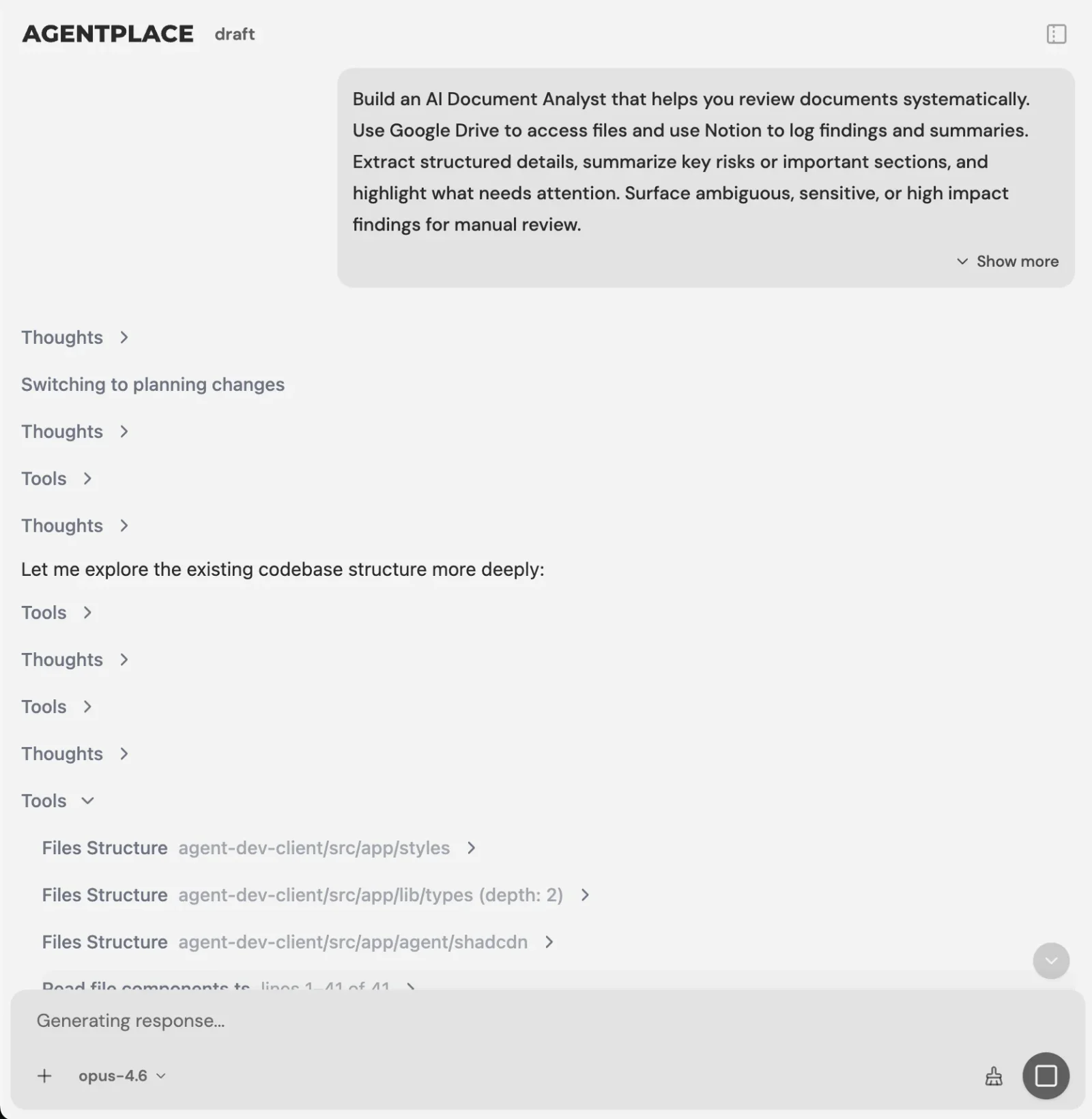 You describe the outcome in plain language and the builder creates the agent.
The AI Builder discusses the idea, clarifies requirements, creates the agent and helps test it. You choose when to publish. No code is required.
The builder tests its own work. It messages the agent it just built, reads the replies and fixes what it finds before you see it.
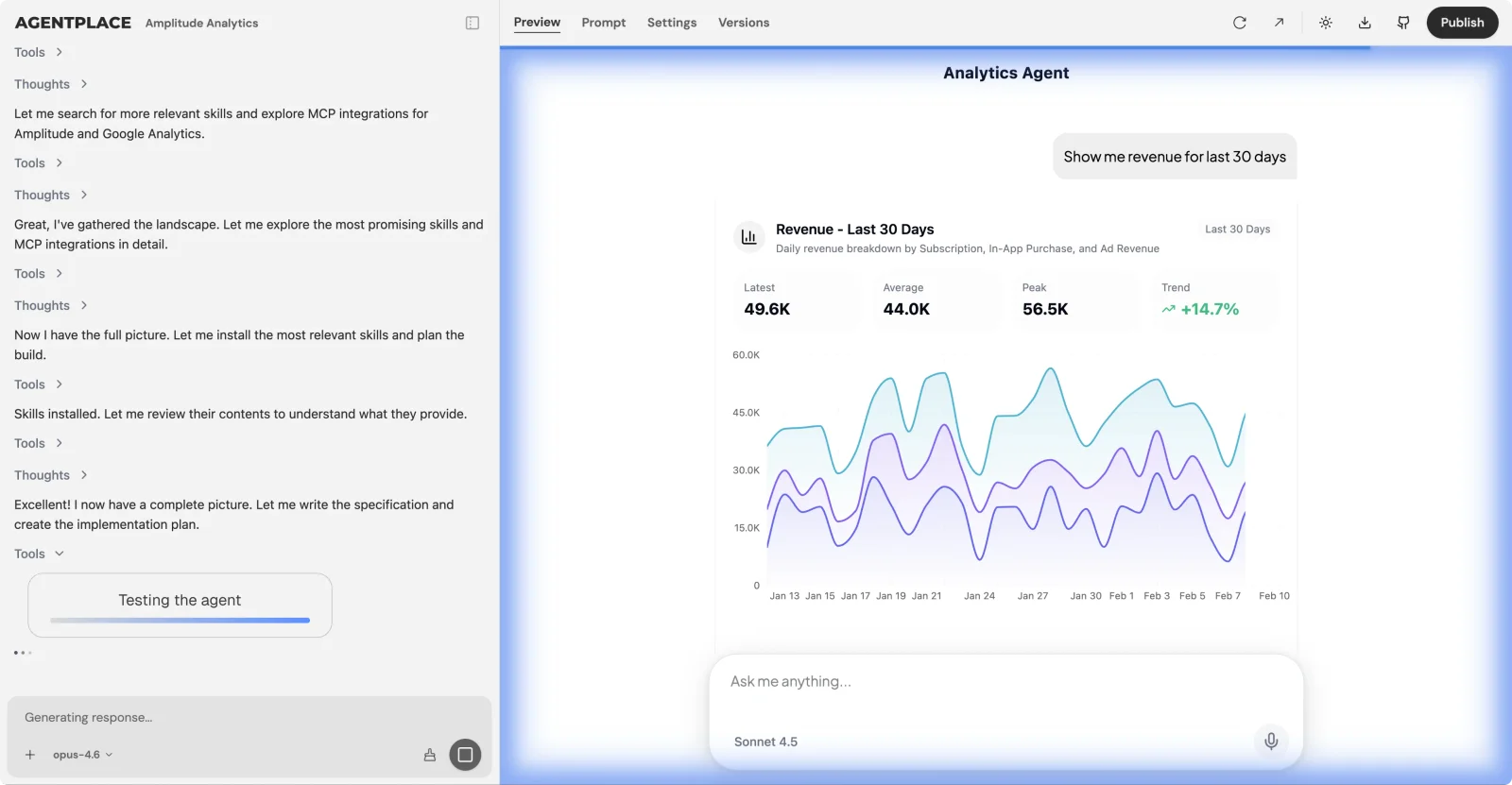 The builder messages the agent it just built and fixes what it finds.
What stays where it is:
- Your CRM, calendar and other business apps keep their data.
- The agent connects to them through Composio’s integration catalog or compatible MCP tools, and you authorize each account and its actions.
- Published agents expose an MCP connection for compatible clients, subject to authentication and access.
- Generated agent code can be synchronized with GitHub. That answers part of the lock-in question. It doesn’t make the platform self-hosted.
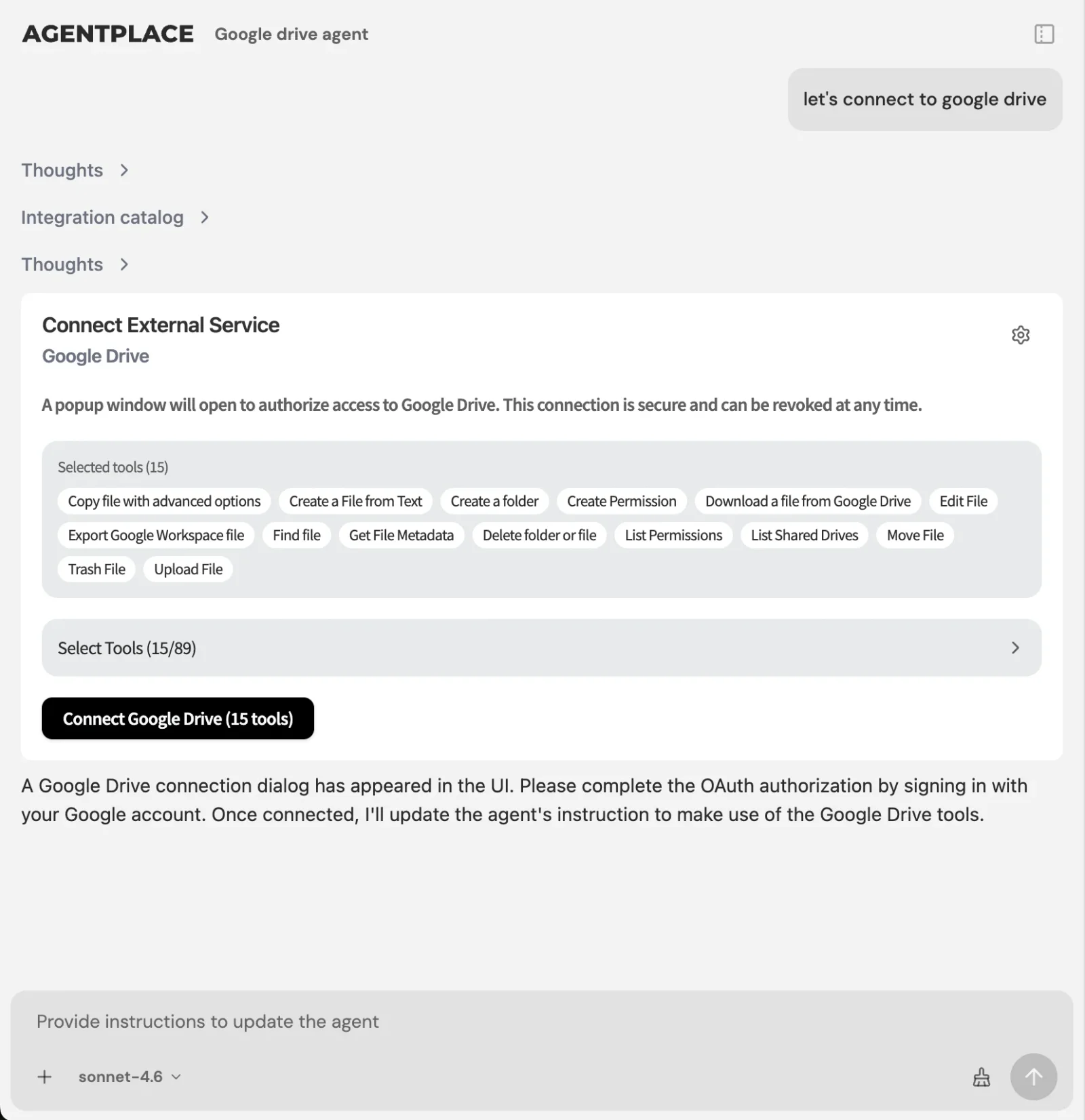 Connect the systems your business already uses, and authorize each account.
Pricing: Agentplace has a free plan and paid plans that use AI credits. A credit is not a customer message. See pricing for current plans and limits.
For a feature-by-feature view, see Agentplace vs n8n.
- Choose n8n when you want the source, the servers and node-level control.
- Choose Agentplace when you want the automation to become what the customer uses, and you don’t want to be the operator.
What should you look for in an n8n alternative?
Six questions. People usually skip the last one.
| Question | Why it matters |
|---|---|
| Do you need the source, or did you inherit it? | The biggest fork in this decision |
| Who upgrades it, and when? | Self-hosting is paid in engineering hours |
| Are your specific integrations covered? | Catalogue size is where open-source options lose |
| What does the meter count? | Executions, operations and tasks aren’t comparable units |
| Who maintains the workflow in six months? | A forty-node graph is a liability if one person understands it |
| Where does the workflow end? | In a database, or in front of a person |
Can you move an n8n workflow to another platform?
Not automatically. The node models differ, so a converter’s output would need a line-by-line audit. Plan to rebuild.
Here’s the sequence that works:
- Pick the highest-volume workflow first.
- Rebuild it on the candidate platform.
- Run both for a full billing cycle, including month-end jobs that fire once.
- Compare outputs row by row.
- Switch the old one off on a date you choose.
“In multi-agent workflows in organizations, AI is jagged in ways that have not been well identified yet. In fact, we don’t even have a vocabulary around multi-agent systems and the ways they fail or succeed.” Ethan Mollick, Associate Professor, The Wharton School
Rebuild one workflow you can read end to end before you rebuild ten.
When don’t you need an AI agent?
- Self-hosting is a genuine requirement? Regulated data or a strict infrastructure policy points to Activepieces, Windmill, Node-RED or Dify.
- Moving a record between two apps on a fixed trigger? Make or Zapier is cheaper and simpler.
- Your team writes code and wants it hosted? Pipedream is usually the shortest move.
- Backend processes that run for days? Temporal is built for that.
- n8n is working fine? Stay if your integrations are covered and somebody owns the deployment happily. Migrating a stable set costs more than it returns.
- The workflow now ends with a customer who needs an answer or a booking? That’s where a customer-facing AI agent built with Agentplace fits.
Quick checklist
- Decide whether you need self-hosting or inherited it
- Price last quarter’s hours spent on the platform itself
- List the twenty apps you touch and check each candidate’s catalogue
- Compare billing units: executions, operations or tasks
- Mark which workflows end in a database and which end with a customer
- Rebuild the highest-volume workflow first and run both for a full billing cycle
- Choose a switch-off date for the old workflow
Related reading: best Zapier alternatives · AI agent platform alternatives · best autonomous workflow platforms · what is MCP? · Agentplace vs n8n
Bottom line
Keep self-hosting if you need your own infrastructure. Move to a hosted tool if you only want the workflow without the upkeep.
- If you want to keep running your own servers, look at Activepieces, Windmill, Node-RED or Dify. If you want hosted automation, Make, Zapier or Pipedream may make more sense.
- Agentplace is a good fit when the workflow ends with a customer who needs an answer, qualification, a booking or another task. A customer-facing AI agent built with Agentplace handles that on its own page, with no server to run.
Questions and answers
Frequently asked questions.
What is the best n8n alternative that doesn't need self-hosting?
For hosted workflow automation, Make or Zapier: no servers, upgrades or backups to run. If the workflow now ends with a customer, Agentplace is hosted too and designed for that case: a customer-facing AI agent answers, qualifies and books the customer on its own page. Pipedream suits developers who want hosted code steps.
What is the best n8n alternative in 2026?
Pick by what you want to change. To keep self-hosting, look at Activepieces or Windmill. To hand the infrastructure to someone else, Make or Zapier are options. When the workflow needs to end with a customer, a customer-facing AI agent built with Agentplace answers, qualifies and books them on its own page.
What is the best open-source n8n alternative?
Activepieces is the closest match, with a simpler builder and a smaller integration catalogue. Windmill suits script-first teams, Node-RED event and device work, and Dify AI-shaped workflows. All four run on infrastructure you control, which is usually why people leave n8n.
Is there a free alternative to n8n?
Self-hosting Activepieces, Windmill, Node-RED or Dify has no licence fee, like n8n's own community edition. Free in licence terms isn't free in practice: you take on deployment, upgrades, backups and monitoring. Make and Pipedream both offer hosted free tiers instead.
Is Activepieces better than n8n?
Activepieces has a simpler builder and a gentler learning curve. n8n has a larger integration catalogue and more mature code nodes. Teams that found n8n heavier than the problem usually prefer Activepieces. Teams that need a specific integration usually find n8n has it and Activepieces doesn't.
Should I self-host my automation platform?
Self-host when the data can't leave your infrastructure, when compliance requires it, or when your team already runs services and one more is marginal. Don't self-host because the licence looks free. Deployment, upgrades, backups, monitoring and on-call time are the real price, and they land on people.
What does self-hosting n8n actually cost?
The licence is free and the running cost isn't. Budget for a server, a database, queue workers at volume, backups and monitoring, plus engineering hours for upgrades and incidents. For a small team, that time often exceeds the avoided subscription within the first year.
Is Agentplace an n8n alternative?
For one class of workflow, yes. Agentplace suits teams leaving n8n because the workflow now ends in front of a customer and they don't want to operate infrastructure. It's hosted and not open source, so if self-hosting is the requirement, choose Activepieces, Windmill or Dify instead.
Agentplace vs n8n: which should I choose?
Choose n8n when you want the source, the servers and node-level control over every step. Choose Agentplace when you want the automation to become what a customer uses, with its own page, records, rules and scheduled work, and you'd rather describe an outcome than wire a graph.
Can I migrate my n8n workflows to another platform?
Not automatically. There's no reliable converter between these tools, because the node models differ. Plan to rebuild each workflow, starting with the highest-volume one. Run both versions for a full billing cycle, then switch the old one off on a date you choose.
When should I stay on n8n?
Stay when self-hosting is a real requirement, when your integrations are covered and working, and when somebody on the team already owns the deployment happily. Migrating a stable workflow set costs more than it returns unless one of those three has changed.
Put this into practice
See the customer experience.
Explore a concrete example related to this article, then adapt the agent to your business.
Create my AI agentStart free with your business idea. The AI builder can help you explore it and create your agent. No technical specification needed. Sign in to continue. Pricing and limits · How the builder works