
Best AI Automation for Hospitality Teams in 2026

The short answer
Team automation covers four jobs: automation inside the property management system, staff task and messaging tools, guest-facing tools that create team work, and workflow tools that connect systems. Buy for the job you need. A customer-facing AI agent built with Agentplace handles the guest conversation that feeds the team's work.
Key takeaways
- Hospitality team automation splits into four categories, and most products are built for one of them. Decide which job you are buying before you compare features.
- Your property management system stays the record of reservations, rates and room status, so the integration decides whether a cleaned room reaches the front desk.
- A customer-facing AI agent built with Agentplace covers the guest conversation that creates the team's work, and can run internal workflows when a supported, authorized integration is configured.
- Shift scheduling, timekeeping and labour compliance belong in a workforce management tool, because they carry record-keeping obligations an agent does not own.
- The tool rows below describe what each product is documented to do, based on vendor documentation reviewed in October 2026, not comparative testing.
Hospitality teams shopping for AI automation in 2026 are choosing between four different kinds of product. One automates inside the property management system. One gives staff a task and messaging app.
The third is guest-facing and creates work for the team as a side effect. The fourth connects systems that do not talk to each other.
The practical way to buy is to find where your team currently retypes something. Room status announced over a radio and typed into the front desk screen twice is an operations tool problem.
Tickets raised and then lost between shifts are a task tool problem. Guest questions that pile up after reception closes are a different problem again.
A customer-facing AI agent built with Agentplace fits that last case. Each agent gets its own web page and URL, where a guest asks questions by text or voice and gets an answer from your own information.
The work it produces can reach your systems and your people when a supported, authorized integration is configured. Your housekeeping board, your staff schedule and your reservation record stay where they are.
What are hospitality teams actually trying to automate?
Hospitality teams are trying to remove the manual handoffs between a thing happening and somebody being told about it. That is the common thread across housekeeping, maintenance, the front desk and the duty manager’s day.
In practice, the work splits into five recurring jobs.
- Turning an event into a task. A check-out, a late departure or a stayover should produce the right cleaning job without a supervisor rewriting the list.
- Getting the status back. A room cleaned and inspected has to show as ready on the front desk screen, not only in the housekeeping app.
- Raising and tracking tickets. A broken shower reported with a photo should reach maintenance, stay visible, and close with a record.
- Carrying information across a shift change. Open issues, rooms out of order and guest promises have to survive a handover.
- Reporting. Somebody needs yesterday’s open tickets, cleaning times and no-shows without building a spreadsheet.
The labour context makes the fifth job harder than it reads. The U.S. Bureau of Labor Statistics Occupational Requirements Survey records that almost everyone in the maids and housekeeping cleaners occupation needs on-the-job training, and that work schedules vary for a large share of them.
A process that only works when the experienced supervisor is on shift is a process that breaks in August.
Rule of thumb: automate the handoff, and leave the judgement with the person on duty.
Which team tasks can be automated, and which need a person?
Tasks with a documented rule and a reliable trigger can be automated. Tasks involving a cost, a labour decision, a safety question or a guest’s goodwill should reach a named person.
| Team task | Can software do it | What is needed |
|---|---|---|
| Create a cleaning job when a guest checks out | Yes | A configured rule and a live room status feed from the property management system |
| Show a cleaned and inspected room as ready at the front desk | Yes | A supported two-way interface between the operations tool and the property management system |
| Raise a maintenance ticket from a photo and a short note | Yes | A tool with photo capture and a department set up to receive it |
| Send today’s room assignments to each housekeeper | Yes | Staff accounts in the tool, and a channel they actually open |
| Assemble a shift handover from open tickets and carried-over tasks | Partly | Structured task data, with the outgoing supervisor confirming what matters |
| Balance today’s cleaning load across the team | Partly | Occupancy and workload data, and a supervisor who approves the plan |
| Produce a daily report of open tickets and cleaning times | Yes | Consistent data entry, and one agreed definition of a closed ticket |
| Approve overtime, a shift swap or a time-off request | No | A manager, and a timekeeping record the property can stand behind |
| Confirm a room is ready for an arriving guest with a mobility need | No | An inspection by a person |
| Decide a refund, a comp or a goodwill gesture | No | A manager’s decision |
| Handle a complaint from a guest who is already unhappy | No | A person, with the record in front of them |
Timekeeping deserves its own line. Under the U.S. Department of Labor’s recordkeeping fact sheet for the Fair Labor Standards Act, employers have to keep records of hours actually worked, including exceptions to the posted schedule. A scheduling tool that guesses is worse than a paper sheet that is correct.
Rule of thumb: software can move a task, and a person still owns anything that costs money or carries a risk.
What should you check before you buy?
Check six things, in this order, and ask for each one to be demonstrated in your own account.
- Which property management system is supported, and which actions. A logo on an integration page tells you a connection exists. Ask which fields it reads, which it writes, and whether room status flows back both ways.
- Who the tool is for. A staff app and a guest-facing assistant solve different problems. Several products do a little of both, and the weaker half is usually the one you were buying it for.
- Where the record lives. Decide now whether the authoritative room status sits in the property management system or the operations tool. Two systems both claiming to be right is the failure mode.
- What the integration actually allows on your plan. Ask whether the action you need is included, metered, or available only on a higher tier. Confirm it in writing before the trial ends.
- Which channels your team opens. A tool nobody opens mid-shift does not exist. Check the app on the phones your staff actually carry, and in the languages they actually speak.
- How personal data is handled. Staff and guest records are both personal data. In the European Union, processing them falls under Regulation (EU) 2016/679, so ask where records are stored, for how long, and how one is deleted.
Pricing is the question people ask first and it is the one you can settle last. Prices vary by room count, module and plan, so check each vendor’s own pricing page when you have a shortlist.
Rule of thumb: the integration you cannot see demonstrated is the integration you do not have.
Which AI automation tools should hospitality teams compare?
Thirteen products come up repeatedly, and they sit in four groups: property management platforms with automation inside them, team communication and task tools, guest-facing tools that create team work, and workflow tools that connect systems.
| Tool | Category | Best for | Limitation |
|---|---|---|---|
| Agentplace | Agent platform | Properties that want the guest conversation handled on the agent’s own page, with the resulting work routed into the systems the team already uses | The housekeeping board, the schedule and timekeeping stay in your existing tools, and every external action needs a supported, authorized integration |
| Mews | Property management platform with its own automation layer | Properties that want message and task rules running inside the system that already holds the reservation | Its automation works on Mews data, so adopting it is a platform decision with a migration attached |
| Cloudbeds | Property management platform with a native housekeeping module | Smaller properties that want room condition, housekeeper assignment and status lists in the reservation system | Its own developer documentation calls the native housekeeping functionality basic, and access can depend on your package |
| hotelkit | Hotel operations and collaboration platform | Teams replacing paper handovers, repair orders and cleaning checklists across several departments | Housekeeping status reaches the front desk only through a supported two-way interface with your property management system |
| Flexkeeping | Housekeeping, maintenance and quality operations platform | Properties that want automated cleaning rules, inspections, checklists and maintenance tickets in one staff app | It is organised around operational tasks, so a guest asking questions before a booking sits outside it |
| HelloShift | Staff messaging with tasks and work orders | Teams that want a task sent to a department with a photo, a deadline and a completion alert | It covers tasks and messages, so forecasting and shift scheduling need a separate tool |
| Beekeeper | Frontline employee communication app | Properties whose main gap is reaching staff who do not sit at a desk, across shifts and languages | It is a communication and schedule-sharing platform, so room status workflows stay in the property management system or an operations tool |
| Unifocus | Workforce management with task assignment | Properties that want schedules built from forecast demand, with labour rules and timekeeping in one system | Its centre of gravity is labour planning, so open-ended guest conversation is handled elsewhere |
| Operto Teams | Scheduling and task generation for turnovers | Short-term rental and small property operators who want tasks generated from check-in, check-out and mid-stay rules | It is built around the turnover schedule, so it does not answer a guest who has not booked |
| Duve | Guest experience platform whose messages create team work | Properties that want guest messages sorted by priority and department as they arrive | It works from the reservation record, so it addresses guests who have already booked |
| Canary Technologies | Guest-facing AI voice and messaging that hands work to staff | Properties whose phone line is the bottleneck and who want complex calls passed to a named colleague | It is sold as a set of guest-facing modules, so confirm which ones your agreement includes |
| Zapier | Workflow automation connecting systems | Teams that want a reservation, a status change or a check-out to create a record in another tool they already use | What it can automate depends on the triggers and actions your property management system exposes |
| Make | General-purpose workflow automation with a visual builder | Teams that need branching logic and several steps across more than two systems | It carries no hospitality logic of its own, so the rules and their upkeep are yours |
These rows describe what each product is documented to do, based on vendor documentation reviewed in October 2026. They are not results from comparative performance testing. Prices are not listed, because they move by room count and plan, so check each vendor’s current pricing page.
For a hospitality team whose guest enquiries arrive before anyone is free to answer them, a customer-facing AI agent built with Agentplace answers on your own page in the guest’s own words. It then routes the resulting work into your systems.
If your gap is the cleaning board and the room status loop, Flexkeeping or hotelkit will close it with less configuration. If your gap is labour planning, Unifocus is the honest answer, because an agent does not own your timekeeping record.
Consider a 60-room independent hotel with two supervisors. It may well need two purchases: an operations tool for housekeeping and maintenance, and an agent for the enquiries that arrive after reception closes. Those are different problems with different owners.
How does a customer-facing AI agent built with Agentplace fit a hospitality team?
Agentplace creates AI agents that serve customers and help run a business. Each agent gets its own web page and URL. It uses business knowledge and authorized tools to deliver a personal plan, estimate, document or other result, and the AI controls the interface as the customer makes requests by text or voice.
For a hospitality team, the agent sits at the front of the workflow. It handles the conversation that creates the team’s work, so the request arrives as a complete record instead of a note on a pad.
The AI Builder discusses the idea, clarifies the requirements, creates the agent and helps test it. You choose when to publish, and no code is required to start.
Agents can also run internal workflows. Published agents can run scheduled tasks and react to events, within the actions you authorize, and access can be restricted to signed-in people on an allowed email domain.
That makes an internal agent for your own staff a real option. Assembling a draft handover or a morning summary of open tickets is the kind of work it suits.
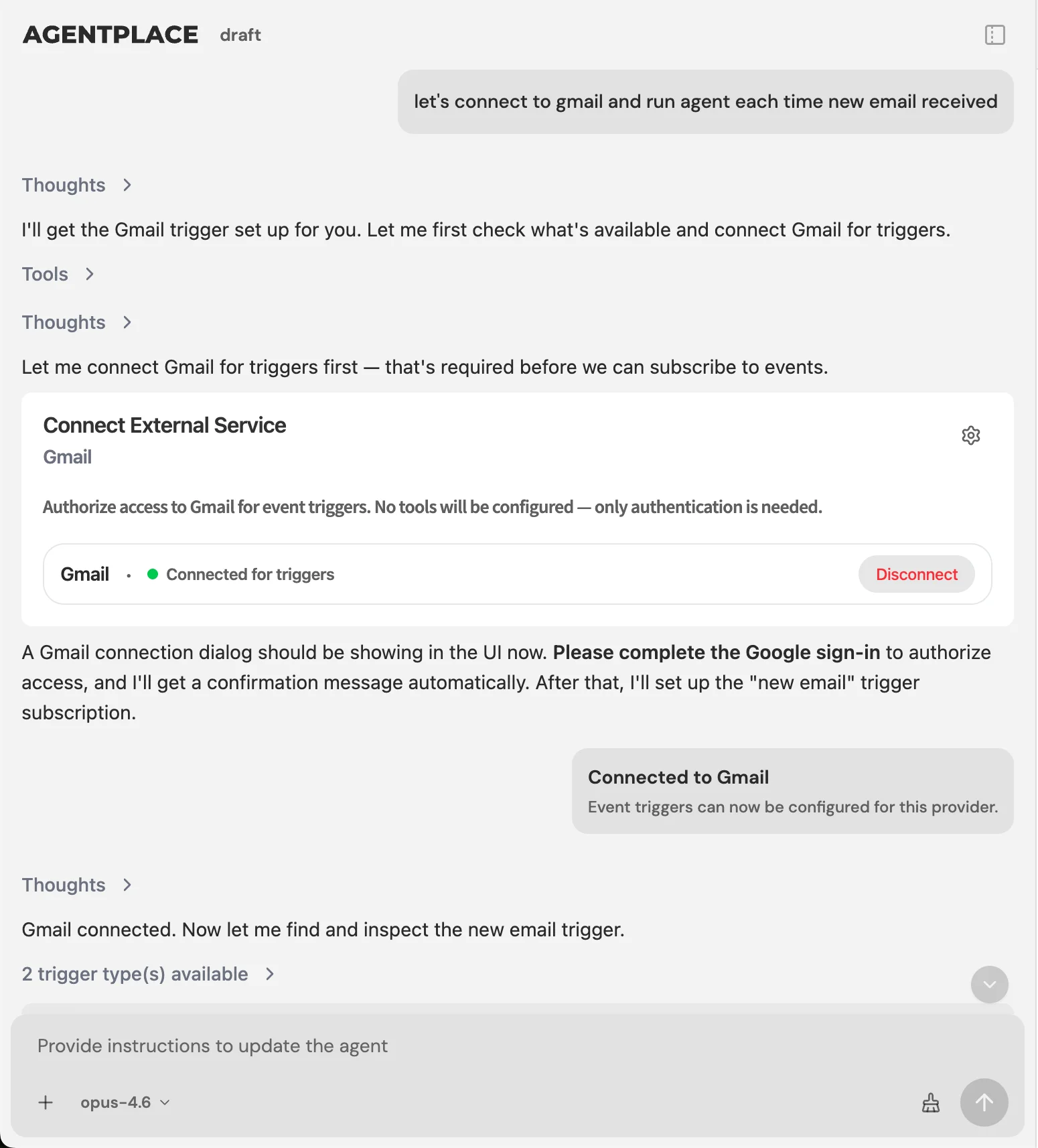 A scheduled task runs on the trigger, task, permitted actions and stop conditions you define, and you test that the workflow is active before relying on it.
You describe what you want in plain language, the way you would brief a new duty manager:
“Build an agent for a 60-room independent hotel. Answer guest questions from our room descriptions, policies and arrival information, in full sentences. When a guest reports a problem in a room, collect the room number, what is wrong and a photo if they have one, then create a maintenance ticket in our operations tool through the configured connection and tell the guest that Marta, our duty manager, will follow up. Never say a room is ready, a rate is available or a request is approved unless the connected system confirms it. Send accessibility, medical and complaint messages straight to Marta without answering them. Each weekday morning, assemble a draft summary of open tickets and rooms out of order for the supervisor to review, and label it a draft.”
What needs a connection, and what stays in your existing systems?
Answering a documented question needs only your own written information. Everything that touches another system depends on a connection you configure and authorize.
Agentplace connects to business apps through Composio’s integration catalog and compatible MCP tools. You authorize each account and the actions it may take.
| What the agent does | What is needed |
|---|---|
| Answers questions about policies, rooms and arrival procedures | Your written business knowledge, kept current |
| Collects a complete problem report from a guest | Your intake list, and rules on what it must not ask for |
| Creates a maintenance or housekeeping ticket in your operations tool | A supported, authorized integration with that tool, tested on a real ticket |
| Reads live room status or availability | A supported, authorized integration with the system that holds it |
| Notifies a named manager about an escalation | An available, authorized connection that supports the action |
| Assembles a recurring draft summary for a supervisor | A configured scheduled task, and a person who reviews the draft |
Without that connection, the agent can still answer the documented question, collect the request and name the person who will act on it. It should not claim to have raised a ticket, checked availability or changed a booking when it has not.
These systems keep their current jobs:
- Your property management system holds reservations, rates, room assignments and room status.
- Your operations or housekeeping tool holds the cleaning board, inspections and maintenance tickets.
- Your workforce management tool holds the schedule, timekeeping and labour rules.
- Your customer-facing AI agent handles the guest conversation and routes what it produces into those systems and to named people.
The agent’s page is the primary place people work with it. Supported connections such as phone, WhatsApp or Telegram can extend the experience after setup.
Agentplace offers a free plan and paid plans. See the current pricing for details and the public product reference for what the platform documents today.
The guest services team agent examples show workflows other properties start from. A narrower starting point is the hotel review sentiment agent.
When does a property not need this?
Several common situations are better served by something simpler, and most of them point away from an agent.
- Your property management system already does it. If Mews or Cloudbeds covers your cleaning rules, use that before adding a subscription.
- Your gap is the cleaning board. Buy an operations tool such as Flexkeeping or hotelkit, and settle the room status interface first.
- Your gap is reaching staff. A frontline communication app such as Beekeeper solves that directly.
- Your gap is the schedule and labour cost. Workforce management is its own category, and Unifocus is built for it.
- You have one small team and one shift. A shared checklist and a short standing handover may be enough.
- Your systems have no API. Confirm what your property management system exposes before buying any workflow tool, because that limit decides everything else.
- Nothing is written down yet. Any tool works from the rules you give it, so the writing comes first.
- Guest enquiries pile up outside reception hours. That is the case where a customer-facing AI agent built with Agentplace earns its place.
Be honest about the staffing automation still needs. Somebody has to keep the rules current, review escalations and answer the questions the agent correctly refuses.
Quick checklist
Work through this before you shortlist a vendor:
- Write down the three handoffs where your team retypes something today.
- Decide which system holds the authoritative room status.
- Confirm which property management system integration is supported on your plan.
- Ask for a demonstration that cleans a real room and shows it ready at the front desk.
- List the departments that must receive tickets, and name a person for each.
- Define which decisions must always reach a manager.
- Check the app on the phones your staff carry, in the languages they speak.
- Confirm how timekeeping records are kept and who signs them off.
- Ask where staff and guest records are stored, for how long, and how they are deleted.
- Agree the one number you will judge the trial on.
Related reading: AI concierge software for boutique hotels · How to cover hotel guest requests at night · Always-on answering agent for property management · AI agents for hospitality
Bottom line
Buy for the handoff that is costing you time, and insist on seeing it work in your own account.
If the cleaning board and the room status loop are the problem, Flexkeeping or hotelkit will fix them faster than anything else here. If reaching staff across shifts is the problem, Beekeeper is built for it.
If the schedule and the labour cost are the problem, Unifocus owns that category, and an agent should not.
If guests and prospective guests keep arriving with questions nobody is free to answer, a customer-facing AI agent built with Agentplace gives them a page where they get a real answer, and turns what they say into a record your team can act on, with your escalation rules applied throughout.
Your property stays responsible for the written rules, the tested connections, the timekeeping record and the named person who decides.
Questions and answers
Frequently asked questions.
What is AI automation for a hospitality team?
It is software that creates, routes and tracks the work between staff and systems without somebody typing it twice. Typical examples are turning a check-out into a cleaning task, raising a maintenance ticket from a photo, and sorting guest messages to the right department. The property management system still holds the reservation.
Which AI automation should a hospitality team choose?
Choose by the job. Mews and Cloudbeds automate inside the reservation system. hotelkit, Flexkeeping, HelloShift and Beekeeper handle staff tasks and communication. Zapier connects systems. A customer-facing AI agent built with Agentplace handles the guest conversation and routes the resulting work into your existing tools.
Can automation update room status in the property management system?
Yes, when a supported two-way interface is configured. hotelkit documents housekeeping room status flowing back to Mews through its interface. Without that connection, staff update the operations tool and somebody retypes the status, which is the step most properties are trying to remove.
Can an AI agent replace a housekeeping board or a shift schedule?
No. A housekeeping board and a staff schedule belong in your property management system, an operations tool or a workforce management tool. An agent can read and write into those systems where a supported, authorized integration exists, and it can hand a task to a named person.
Does hospitality team automation need a PMS integration?
Anything depending on live data needs one. Room status, arrival times, occupancy and reservation notes all sit in the property management system. Ask each vendor which system is supported, which actions that integration allows, and whether those actions are included on your plan.
Which team tasks should always stay with a person?
Approving overtime and shift swaps, confirming a room is ready for an arrival, deciding a refund or a goodwill gesture, handling a guest complaint, and anything involving staff safety or a medical need. Automation can prepare the record and name who decides.
Can automation write a shift handover?
It can assemble the structured parts, such as open tickets, rooms out of order and tasks carried over. The judgement about what the next shift needs to know stays with the outgoing supervisor. Treat a generated handover as a draft a person confirms.
Is this worth it for a property with one small team?
It depends on how many handoffs a day you have. A single twelve-room property with one supervisor on duty may be served by a shared checklist. Repeated retyping between systems, missed tickets and handovers lost between shifts are the clearer case.
How do we test a hospitality automation tool before buying?
Run four real scenarios: a late check-out that moves a cleaning task, a maintenance ticket raised with a photo, a handover across a shift change, and a guest request arriving after reception closes. Record where each one ends and who had to retype anything.
Put this into practice
See the customer experience.
Explore a concrete example related to this article, then adapt the agent to your business.
Create my AI agentStart free with your business idea. The AI builder can help you explore it and create your agent. No technical specification needed. Sign in to continue. Pricing and limits · How the builder works