
Can ChatGPT Dots Take Tenant Calls? Always-On Agents for Property Managers

The short answer
No. A ChatGPT dot can't answer a tenant's call. It's something you create and use inside ChatGPT, with no customer-facing page or phone number to send a tenant to. A customer-facing AI agent built with Agentplace gives the tenant a page or phone number, sorts the call against your thresholds, and routes it.
Key takeaways
- Nobody publishes a trustworthy figure for how many after-hours calls are emergencies, so sort them against a written threshold and measure your own month instead of planning against a vendor number.
- A dot runs inside its owner's account, so a tenant has no link to open and no number to call.
- A customer-facing AI agent confirms what it heard, sorts the call against your thresholds, and routes it while saying where it went.
- One question, whether the water can be shut off, moves more calls between tiers than any other. An answering service that only writes a message moved the work to the morning.
- Start by writing your emergency thresholds and the on-call rota the agent routes to.
The short answer
No. A ChatGPT dot can’t answer a tenant’s call.
It’s something you create and use inside ChatGPT. There’s no customer-facing page, phone number, or interface to send a tenant to.
An after-hours call is different. A customer-facing AI agent built with Agentplace gives the tenant a page or phone number where they can reach the agent. The agent does three things:
- Confirms what it understood, in the tenant’s own words back to them.
- Sorts the call against your thresholds, starting with whether the water can be shut off.
- Routes it and says so: on-call vendor tonight, a booked slot tomorrow, or the schedule.
Want a person on the line every time? Use a live answering service.
Why do so many tenant calls arrive when the office is closed?
Because people notice problems at home, and they’re home when you’re not.
Example: A tenant messages at 11:40pm.
“There’s water coming through my kitchen ceiling. It started maybe twenty minutes ago and there’s a puddle now. I’m in 14B.”
Here’s what each option does with that message:
| Channel | What the tenant gets | What you get | What’s lost |
|---|---|---|---|
| Voicemail | A beep | An audio file at 8am | Everything. No confirmation, no detail |
| Live answering service | A person, and a promise | “Water leak 14B, call back” | Whether it can be contained, whether anyone’s home |
| Tenant portal | A submitted form | A ticket in a queue | The second question a form can’t ask |
| Text to a manager’s phone | A reply, maybe | A message on one person’s phone | The record, and the photo |
Nobody in that table decided anything. The tenant has called twice more by morning, and one of those calls was to a plumber they found themselves.
Rule of thumb: if the tenant still doesn’t know what happens next, the call wasn’t answered.
Which after-hours calls are actually emergencies?
Nobody can tell you from published data, and the figures in circulation are not usable.
We looked. There is no independent survey of what share of after-hours tenant calls are genuine emergencies. The numbers quoted in this market come from vendors counting their own traffic, and they disagree by an order of magnitude: one maintenance platform’s own work-order data is cited at roughly 7 percent of all maintenance requests, a coordination vendor reports that over 90 percent of after-hours calls from its own customers were not emergencies, and a call-handling vendor’s triage framework uses about 12 percent as an illustration. None of those is a measurement of your portfolio, and none of them is going to be laundered into a statistic here.
What follows from that is a method rather than a number. Sort every call against a threshold you wrote down, then measure one month of your own contacts and let that set the staffing argument.
Three tiers, with a written threshold each:
| Tier | Threshold you write | What the agent does | What it must not do |
|---|---|---|---|
| Emergency | Uncontainable water, no heat below the minimum your jurisdiction sets, gas odour, no power, anything your local habitability rules treat as a hazard | Confirm, give containment steps, page the on-call vendor, stay with the tenant | Quote a cost or promise an arrival time it hasn’t confirmed |
| Urgent | Water that can be contained, one appliance down, a lock that still secures | Confirm, book the first slot in your window, name the slot | Call it an emergency to be safe |
| Routine | A dripping tap, a slow drain, anything the tenant calls “whenever you can” | Confirm, schedule, close the loop | Wake anybody |
Example: The same leak, one question apart.
Agent: “Can you shut the water off at the valve under the sink?” Tenant: “Yes, I’ve turned it off, it’s stopped.”
That answer moves the call from emergency to urgent. Nobody gets woken, and the tenant still has a booked slot in the morning.
Two questions decide most misclassifications. “Can you shut the water off at the valve?” turns an emergency into an urgent job. The other is whether the condition crosses a line your jurisdiction has already drawn, because that line is usually written down somewhere and it is not written by you.
Two real examples of where a threshold comes from, neither of which is a universal rule:
- New York City sets the heat numbers by law. From 1 October to 31 May, building owners must keep a home at 68°F or above between 6am and 10pm when it is below 55°F outside, and at 62°F or above between 10pm and 6am whatever the weather. The city’s own heat season page states both figures.
- Federally assisted housing has a 24 hour clock. Under HUD’s NSPIRE standards a life-threatening deficiency is one presenting a high risk of death or severe illness or injury, and HUD’s terms and definitions require proof of mitigation within 24 hours for public housing and multifamily properties. For the voucher programs, HUD’s 2024 notice says those deficiencies must be corrected within 24 hours after notice is given.
Your thresholds come from your own jurisdiction, your leases and whoever carries the liability. Copying a number out of an article, including this one, is how an agent ends up applying a New York winter to a property in Phoenix.
How do you test the thresholds before the agent goes live?
Write the calls out and check what your own rules do with them.
The set below is a test sample, not customer data. Eight messages written to exercise the tiers above, with the tier each one should produce if the thresholds are written the way this article describes. Run the same eight at your agent after you build it, and any row where it disagrees with the right-hand column is a rule to fix.
| Test message | Tier the written rule gives | What should happen |
|---|---|---|
| “Water through the kitchen ceiling, there’s a puddle, I can’t find a valve” | Emergency | Containment steps, page the on-call vendor, stay on |
| “Same leak, I turned the valve off, it stopped” | Urgent | Book the first morning slot, name the slot |
| “No heat since yesterday, it’s freezing” | Emergency where the local minimum applies, otherwise urgent | Check the local threshold, then page or book |
| “I can smell gas in the hallway” | Emergency | Tell the tenant to leave and call the emergency number, then page |
| “Bathroom tap drips, whenever you can” | Routine | Schedule, confirm, wake nobody |
| “Front door lock sticks but it does lock” | Urgent | Book, because it still secures |
| “My neighbour is playing music at 1am” | Not maintenance | Log it and route to the named person in the morning |
| “I’m withholding rent until this is fixed” | Not maintenance | Confirm the repair, route the rent sentence to a named person, promise nothing |
The last two rows matter more than they look. A maintenance agent that tries to answer a noise complaint or a rent dispute is the failure mode that gets an agent switched off.
How do you handle an after-hours maintenance call, step by step?
1. Confirm before you ask anything
Repeat what you understood. “A leak from the kitchen ceiling at 14B, reported now.” The tenant stops worrying that the message went nowhere.
2. Ask the five questions that change the outcome
The unit and who’s calling. What’s happening. Whether it can be contained. Whether somebody can let a contractor in tonight. Whether anyone’s at risk.
Rule of thumb: if the answer won’t change the tier, the vendor or tonight’s dispatch, don’t ask it.
Everything else can wait for whoever turns up.
3. Tell the tenant the tier and the next step
This is the part message-taking skips, and it’s the whole product.
“Thanks, I’ve logged a slow drain in the bathroom at 14B. Under our policy that isn’t an emergency, so it won’t get a visit tonight. I’ve booked the first slot: Thursday between 9am and 1pm. If the water starts backing up before then, call again and it moves up a tier.”
That confirms, sorts, commits, and tells the tenant what would change the answer.
4. Write the record where your team already looks
A sorted request in a second system nobody opens is the same as no request.
Can a ChatGPT dot take tenant calls?
No, and it isn’t close.
Dots are OpenAI’s always-on agents, launched 29 September 2026. A dot keeps working between conversations, has its own cloud computer, and reaches apps you authorise. All of that happens inside the account of whoever created it.
That’s the wall. Your tenant has no way in.
As it shipped: one dot per account, paid ChatGPT plans only, and no Pro access in the EEA, Switzerland or the UK.
A dot works on your side of the business. A tenant-facing agent works on the tenant’s side. Plenty of property managers have a use for both.
What tools can help cover after-hours tenant calls?
| Option | What it’s for | Where it stops |
|---|---|---|
| Customer-facing AI agent built with Agentplace | Answering the tenant, sorting against your written thresholds, routing and recording, by text, voice or phone | It isn’t your system of record. It writes into one |
| Live answering service | A human voice on every call, out of hours | Takes a message. Can’t see your leases or vendor list |
| Property Meld | Coordinating, scheduling and invoicing the work order | Starts after the tenant conversation is over |
| AppFolio, Buildium, Propertyware, Rent Manager | Leases, rent, accounting and the work order record | The portal is a form, not a conversation |
| ChatGPT Dots | The property manager’s own work | Not tenant-facing. No link to give a tenant |
Nothing here was bench-tested. The rows describe what each category is designed to do, read from vendor documentation in October 2026.
How does Agentplace cover after-hours tenant calls?
Agentplace lets you create an AI agent with its own web page and URL. It uses your business knowledge to work with clients through text, voice, and a personal interface that changes with their request.
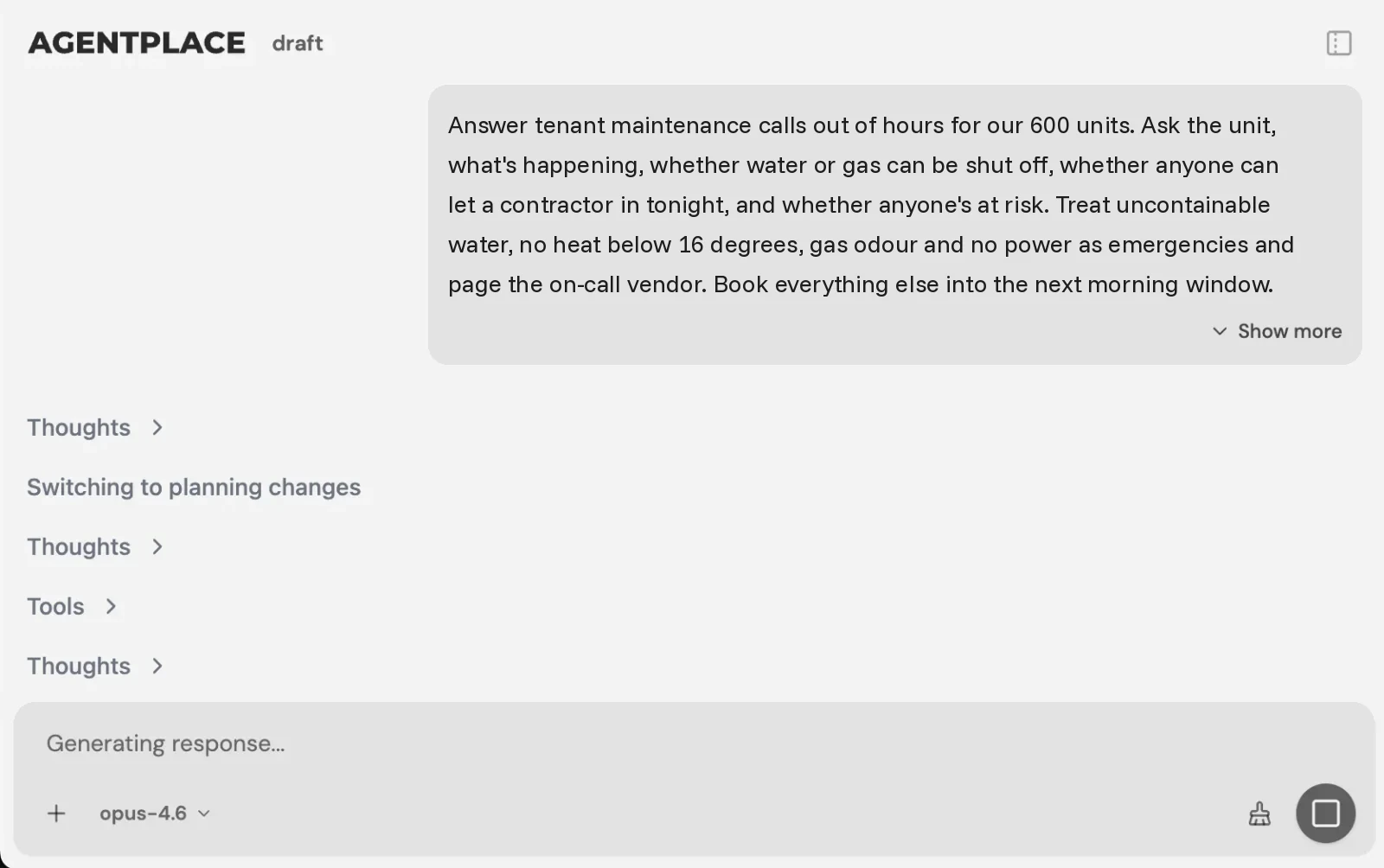 You describe the thresholds, vendors and escalation rules you already use. The builder writes the agent.
In practice, it works like this:
- The tenant opens the agent’s page or calls it, and describes the problem in their own words.
- The agent asks the containment and access questions, and nothing else.
- It applies your written thresholds and names the tier out loud.
- It pages the on-call vendor, books a slot, or schedules the routine work.
- It writes a sorted record into the platform your team opens in the morning.
You set it up by describing the outcome in plain language, for example:
“Answer tenant maintenance calls out of hours for our 600 units. Ask the unit, what’s happening, whether water or gas can be shut off, whether anyone can let a contractor in tonight, and whether anyone’s at risk. Treat uncontainable water, gas odour, no power and no heat below the minimum our city’s heat rules set as emergencies, and page the on-call vendor. Book everything else into the next morning window. Never quote a cost or an arrival time. Send anything about a lapsed lease or a legal threat to Dana.”
The thresholds in that brief are the ones that landlord’s jurisdiction and leases set. Write yours, and have whoever carries the liability approve them before the agent applies them at 2am.
The AI Builder discusses the idea, clarifies requirements, creates the agent and helps test it. You choose when to publish. No code is required.
What stays where it is:
- Your property management platform keeps leases, rent, accounting and the work order record. The agent writes into it where a supported connection exists.
- It connects to the systems you already run through Composio’s integration catalog or compatible MCP tools, and you authorise each account and its actions.
- Records carry access classes enforced server-side, so a tenant reads their own request and nothing else.
Pricing: Agentplace has a free plan and paid plans that use AI credits. A credit is not a tenant message. See pricing.
Template to start from: AI After-Hours Property Emergency Intake Agent
When don’t you need an AI agent?
- Three units and the phone rings twice a month? Answer it yourself. This is a volume problem.
- Policy says a person answers every call? A live answering service is the honest fit.
- The gap is scheduling and invoicing after intake? Look at Property Meld.
- Tenants only ever ask about rent balances? Your portal already answers that.
- Your availability and vendor data are wrong? Fix that first, or the agent dispatches wrongly faster.
- Calls arrive as paragraphs that need sorting before anyone acts? That’s where a customer-facing AI agent built with Agentplace fits.
Quick checklist
- Pull one month of after-hours contacts and mark which were genuine emergencies, because no published figure substitutes for it
- Write three tiers with a threshold each, approved by whoever carries the liability
- Name who takes legal threats, lease disputes and anything uninhabitable
- Connect the agent to your platform of record, not a second system
- Run it alongside the current arrangement on the same calls for a week
- Track time to first substantive answer, share closed without a human, and misclassifications both ways
Related reading: HVAC after-hours answering service · what Dots by ChatGPT are · one agent instead of a chatbot and a form
Bottom line
A tenant call at 11:40pm needs a decision, not a message. Most of those calls are routine, so sorting them is the work.
- Want a person on the line every time? Use a live answering service.
- If you need the tenant sorted, told and recorded before anyone wakes up, give them a customer-facing AI agent built with Agentplace. It applies your thresholds, pages the on-call vendor when they’re met, and sends the exceptions to a named person.
Questions and answers
Frequently asked questions.
What is a property management answering service?
It handles calls and messages when your office is closed or busy. A live service routes to an operator who takes a message. An AI version answers the tenant, sorts the request against your rules, and writes the record your team opens in the morning.
Can AI answer tenant maintenance calls?
Yes. A customer-facing AI agent built with Agentplace can take the call by text, by voice on its own page or over the phone, ask the containment and access questions, apply your emergency thresholds and book or escalate. Quality depends on how clearly those thresholds are written.
Can a ChatGPT dot answer tenant calls?
No. A dot runs inside the ChatGPT account of whoever created it, and there's no public link to hand a tenant. A dot can help with your own work, like drafting vendor emails, but your tenant can't reach it.
Is an AI answering service the same as a tenant portal?
No. A portal is a form the tenant fills in. An answering service holds a conversation, asks the follow-up question a form can't, and decides urgency. Most portals still produce a ticket nobody has read until morning.
Can an AI agent decide what counts as an emergency?
It applies the thresholds you give it and should invent none. Those thresholds often exist in law already: New York City sets minimum indoor temperatures through heat season, and HUD's NSPIRE standards give federally assisted housing a 24 hour clock on life-threatening deficiencies. Write yours from your own jurisdiction.
Does this replace AppFolio or Buildium?
No. AppFolio, Buildium, Propertyware and Rent Manager stay the system of record for leases, accounting and work orders. The agent handles the conversation before the work order exists, then writes into the system you already run.
What should the agent never promise a tenant?
A vendor arrival time it hasn't confirmed, a cost, or liability for a repair. It should confirm what was reported, state the next step, and send anything outside its rules to a named person.
How long does setup take?
The work is mostly writing down decisions you already make: your emergency thresholds, your vendor list and your escalation rules. A focused build takes days rather than months, and the first version should cover maintenance intake only.
Put this into practice
See the customer experience.
Explore a concrete example related to this article, then adapt the agent to your business.
Create my AI agentStart free with your business idea. The AI builder can help you explore it and create your agent. No technical specification needed. Sign in to continue. Pricing and limits · How the builder works