
Can ChatGPT Dots Collect Documents From Clients? Always-On Agents for Law Firms

The short answer
No. A ChatGPT dot can't collect documents from a client. It's something you create and use inside ChatGPT, with no page a client can open. A customer-facing AI agent built with Agentplace gives the client one, names the three things still missing, takes the files, and answers what they ask back.
Key takeaways
- Paralegals lose hours chasing documents, and the chase stalls the matter rather than the other way round.
- A dot is something you create and use inside ChatGPT. There is no page for a client to open.
- A customer-facing AI agent names the items still missing, takes the uploads, and chases on your schedule.
- A portal is somewhere to upload and does not know what is missing. The agent says what is outstanding, never what a document means for the case.
- Start by writing the document checklist for each matter type.
The short answer
No. A ChatGPT dot can’t collect documents from a client.
It’s something you create and use inside ChatGPT. There’s no customer-facing page, phone number, or interface a client can use to send you a file.
Document collection is different. A customer-facing AI agent built with Agentplace gives the client a page where they can reach the agent. The agent does three things:
- Names what’s missing, item by item, for that matter.
- Takes the files and confirms each one as it lands.
- Answers the question the client replies with.
If your clients already upload everything on time, your portal is doing the job.
Why does document chasing stall matters?
Because the chase sits between the instruction and the work, and nobody owns it.
Our own research into family law firms puts it plainly: paralegals spend hours chasing missing financial documents, parenting schedules and signed forms, while follow-up calls get delayed when the front desk is busy.
Example: The email most firms send.
“Dear Mr Hall, further to our previous correspondence, please provide the outstanding documentation at your earliest convenience.”
- Weak: that. It names nothing, so there’s nothing to do with it.
- Good: “We have your bank statements and the pension valuation. Still missing: the 2025 P60, the mortgage statement, and the signed Form E statement of truth.”
The second one gets answered because it can be.
Rule of thumb: a chase that doesn’t name the item isn’t a chase.
What does the agent need?
Four things, all of which already exist in the firm.
| Input | Why it matters |
|---|---|
| The checklist per matter type | Decides what complete means for this client |
| What’s already arrived | Asking twice for something you hold ends the client’s patience |
| The deadline that applies | The only pressure that works |
| Who takes the question it can’t answer | Every chase eventually produces one |
That second row matters more than firms expect. An agent that asks again for a document already on file reads as nobody paying attention.
How do you collect documents, step by step?
1. Write the checklist per matter type
A divorce, a conveyance and an estate need different things. The agent can only be specific if your lists are.
2. Let it read what’s already in
Rule of thumb: never ask a client for something your own system already holds.
3. Name the items, not the deadline
Example: The agent, a week before the hearing.
“You’re three items away. We need the 2025 P60, the mortgage statement, and the Form E statement of truth with your signature. You can send them here and I’ll confirm each one. The deadline for filing is the 19th.”
4. Check what arrives against what was asked
A bank statement sent where a P60 was wanted is a problem that compounds. The agent should say what it received, say it doesn’t match, and ask again.
5. Draw the advice line
The agent says what’s outstanding and when it’s due. It never explains what a document means for the case, or what to leave out. Write that line down and test it with a client who pushes.
Can a ChatGPT dot do this?
No, and it isn’t close.
Dots are OpenAI’s always-on agents, launched 29 September 2026. A dot keeps working between conversations, has its own cloud computer, and reaches apps you authorise. All of that happens inside the account of whoever created it.
That’s the wall. Your client has no way in.
As it shipped: one dot per account, paid ChatGPT plans only, and no Pro access in the EEA, Switzerland or the UK.
A dot works on the firm’s side. A client-facing agent works on the client’s side. A dot sorting the documents once they arrive is useful, and it still can’t be what the client sends them to.
What tools can help collect client documents?
| Option | What it’s for | Where it stops |
|---|---|---|
| Customer-facing AI agent built with Agentplace | Naming what’s missing, taking the files, answering the reply, on its own page | It isn’t your document system, and it gives no advice |
| Client portal | Somewhere for clients to upload | A folder. Doesn’t know what’s missing or ask for it |
| Clio, MyCase, Smokeball, Filevine | Matters, documents, time and billing | They hold the checklist, not the chase |
| E-signature tools | Getting one document signed | One document, not the list around it |
| ChatGPT Dots | The firm’s own work | Not client-facing. No page for a client to open |
Nothing here was bench-tested. The rows describe what each category is designed to do, read from vendor documentation in October 2026.
How does Agentplace collect client documents?
Agentplace lets you create an AI agent with its own web page and URL. It uses your business knowledge to work with clients through text, voice, and a personal interface that changes with their request.
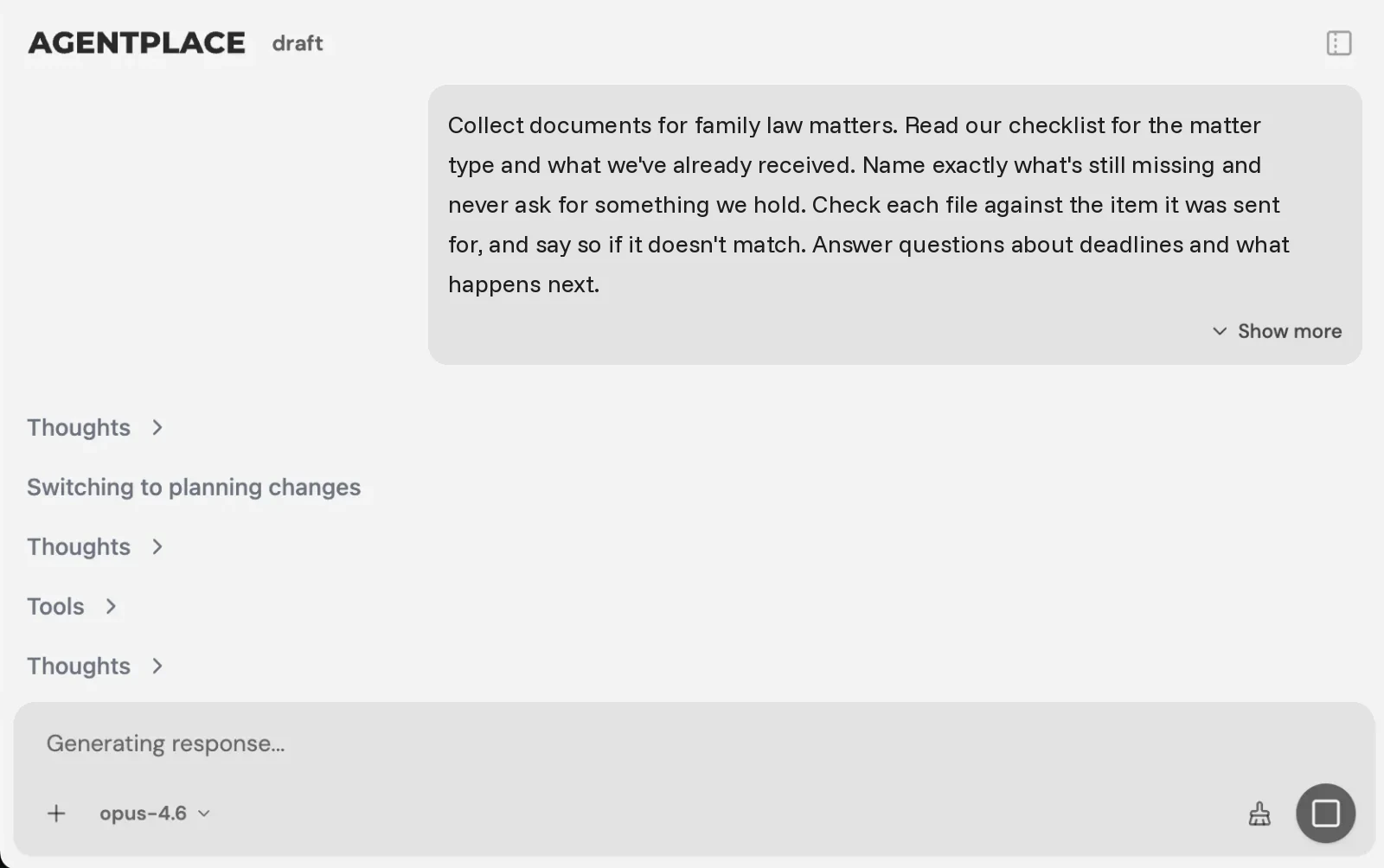 You describe your checklists per matter type. The builder writes the agent.
In practice, it works like this:
- The client opens the agent’s page, or the agent reaches out on the schedule you set.
- It reads what has already arrived against the checklist for that matter.
- It names the items still missing, specifically.
- It takes the files, checks each against what was asked, and confirms or asks again.
- It answers deadline and status questions, and sends anything about the case to a named person.
You set it up by describing the outcome in plain language, for example:
“Collect documents for family law matters. Read our checklist for the matter type and what we’ve already received. Name exactly what’s still missing and never ask for something we hold. Check each file against the item it was sent for, and say so if it doesn’t match. Answer questions about deadlines and what happens next. Never explain what a document means for the case or advise on disclosure. Send anything about the case itself to Rachel. Chase weekly until the file is complete, then stop.”
The AI Builder discusses the idea, clarifies requirements, creates the agent and helps test it. You choose when to publish. No code is required.
What stays where it is:
- Clio, MyCase, Smokeball or Filevine keep matters, documents and billing. The agent writes what it collects into them where a supported connection exists.
- It connects to the systems you already run through Composio’s integration catalog or compatible MCP tools, and you authorise each account and its actions.
- Records carry access classes enforced server-side, so a client sees their own matter and nothing else.
Pricing: Agentplace has a free plan and paid plans that use AI credits. A credit is not a client message. See pricing.
Template to start from: AI Legal Document Collection Agent
When don’t you need an AI agent?
- A handful of matters and clients who send everything? You don’t have this problem.
- One document to sign? That’s an e-signature tool, and it’s simpler.
- You need matter management and billing? That’s Clio or MyCase, and it stays.
- Your checklists live in fee earners’ heads? Write them down first. Nothing works without that.
- The delay is the court, not the client? This won’t move it.
- Paralegals spend afternoons chasing the same three items? That’s where a customer-facing AI agent built with Agentplace fits.
Quick checklist
- Write the document checklist for your highest-volume matter type
- Make sure the agent reads what has already arrived before asking
- Decide what it may say about deadlines, and what it must never say about the case
- Name who takes the questions it refuses
- Agree with whoever carries professional responsibility what the agent may hold
- Track files complete on first chase, repeat asks for items already held, and wrong documents caught
Related reading: law firm client intake · legal answering service · what Dots by ChatGPT are
Bottom line
The chase sits between the instruction and the work, and a reminder that names no item gets ignored.
- If clients already upload on time, your portal is enough.
- If paralegals spend afternoons asking for the same three documents, give clients a customer-facing AI agent built with Agentplace. It names what’s missing, takes the files, checks them against the list, and sends anything about the case to a named person.
Questions and answers
Frequently asked questions.
Can an AI agent collect documents from clients?
Yes, where it is connected to the system holding your checklist and files. It can tell a client which items are still missing, take what they send, confirm each one, and record it against the matter. Everything goes into the system you already use.
Can a ChatGPT dot chase a client for documents?
No. A dot is something you create and use inside ChatGPT. There is no page or number a client can use to send you a file. It can sort your own inbox, but it cannot be what a client uploads to.
How is this different from a client portal?
A portal is a place to upload. It does not know what is still missing for this matter, does not ask for it, and does not answer the question the client replies with. Most portal chases still end in a paralegal's phone call.
What should the agent never do?
Explain what a document means for the case, advise on what to disclose, or comment on the merits. It can say what is outstanding, what the deadline is, and what your firm's own instructions say.
Does this replace Clio or MyCase?
No. Clio, MyCase, Smokeball and Filevine stay the system of record for matters, documents and billing. The agent handles the client conversation and writes what it collects into the system you already run.
Can it handle sensitive documents?
What the agent may hold and show is a decision for your firm, made with whoever carries professional responsibility. Agentplace enforces record access server-side, so a client sees their own matter and nothing else, and the agent cannot widen its own permissions.
What happens when a client sends the wrong thing?
The agent should say what it received, say it does not match the item on the list, and ask again specifically. Silently accepting the wrong document is worse than asking twice.
How long does setup take?
The work is mostly writing the checklist per matter type, which your fee earners already carry in their heads. A focused build takes days rather than months, and the first version should cover one matter type.
Put this into practice
See the customer experience.
Explore a concrete example related to this article, then adapt the agent to your business.
Create my AI agentStart free with your business idea. The AI builder can help you explore it and create your agent. No technical specification needed. Sign in to continue. Pricing and limits · How the builder works