
AI Concierge Software for Boutique Hotels: What to Look For in 2026

The short answer
AI concierge software covers three separate jobs: pre-arrival messaging, in-stay requests and upsells, and answering questions before a booking exists. Decide which job you are buying, then check the integration. A customer-facing AI agent built with Agentplace fits the third job, and live availability needs an authorized integration.
Key takeaways
- The phrase AI concierge covers pre-arrival messaging, in-stay requests and upsells, and a public assistant that answers questions before a booking exists. Most tools are strong at one of the three.
- Pre-arrival and in-stay tools work from the reservation record, so they reach booked guests and not the visitor who has not booked yet.
- A customer-facing AI agent built with Agentplace fits the pre-booking job, because it has its own page and answers in the guest's own words by text or voice.
- Live availability, writing to a reservation and sending a guest message each require a supported, authorized integration rather than publishing alone.
- Your property management system stays the record of reservations, rates and room assignments whichever concierge tool you choose.
Boutique hotels shopping for AI concierge software are usually choosing between three different kinds of product. One is a guest experience platform that messages booked guests. The second is an add-on inside the property management system. The third is a conversational assistant that answers questions on the website.
The practical way to buy is to decide which job you need first. Then compare only the tools built for that job. Then settle the integration question before you sign anything, because anything touching live availability or a reservation depends on a working connection.
A customer-facing AI agent built with Agentplace fits the third job. It gives the hotel its own page, where a visitor can ask questions by text or voice and get a complete answer from the property’s own information. It can carry that enquiry through to a booking or a paid add-on when a supported, authorized integration is configured. If your guests mainly need arrival instructions after booking, a guest experience platform connected to your property management system does that more directly.
What does AI concierge software actually do for a boutique hotel?
AI concierge software answers guest questions automatically and handles routine requests that would otherwise reach a member of staff.
In practice, a product in this category does some combination of four things.
- It answers documented questions. Parking, breakfast, pets, check-in hours and late arrivals all have standing answers.
- It collects requests that need a decision. Early check-in and room changes are the common examples.
- It offers paid extras. An upgrade, a transfer or a late checkout can be presented and priced.
- It hands the conversation to a person. Anything outside its rules should reach a named colleague.
What it does not do is replace the systems that hold your data. The property management system remains the record of reservations, rates and room assignments. Your housekeeping workflow remains the record of room readiness.
Rule of thumb: an AI concierge changes who answers the question, not where the answer is stored.
Which three jobs does “AI concierge” actually cover?
The phrase covers three distinct jobs. The difference between them is the real buying decision.
| Job | When it happens | What the software needs | Typical products |
|---|---|---|---|
| Pre-arrival messaging | After a booking exists | The reservation record, plus channels the guest already uses | Guest experience platforms, property management system add-ons |
| In-stay requests and upsells | During the stay | Room and guest context, an offer catalogue, a route to housekeeping | Guest experience platforms, digital check-in tools |
| Answering questions before a booking | Before a booking exists | The property’s documented information, plus a live connection for availability | Website chat assistants, customer-facing AI agents |
The first two jobs start from a reservation. That is their strength and their limit. A tool that works from the reservation record can only reach a guest who has already booked.
The third job starts from a stranger. Consider a visitor comparing three small hotels in one city. She wants to know whether the building has a lift, whether a dog is allowed on the ground floor, and whether an 11 a.m. arrival is a problem. No reservation exists, so nothing in the first two categories is talking to her.
Most boutique hotels eventually want two of the three. A sensible sequence is to get arrival messaging right inside the platform you already pay for. Add a pre-booking assistant if enquiries keep arriving after reception closes.
Which guest requests can an AI concierge handle, and which need a person?
An AI concierge can handle requests whose answers are documented and stable. Requests that depend on current availability, a charge or a judgement call should reach a named person.
| Guest request | Can an AI concierge handle it | What is needed |
|---|---|---|
| Where do I park, and is there a height limit | Yes | A complete written parking policy |
| What time is breakfast, and is it included | Yes | Current hours and rate inclusions |
| Can we bring our dog | Yes, for the standard policy | The pet policy and the booked room type |
| How do I get in after reception closes | Yes, for the documented procedure | Current access instructions, a named night contact |
| Can I check in at 11 a.m. | Partly | Room readiness, which needs a live connection or a staff check |
| Can you quote a rate for these dates | Partly | A supported, authorized connection to availability and rates |
| Can we move to a room with a balcony | No, not alone | Current availability and a reservations decision |
| We need a step-free bathroom for a wheelchair | No | Individual confirmation by a member of staff |
| Our room was not cleaned and we want a refund | No | A manager’s decision |
An agent should only describe a room or a time as available when it has reliable availability information. If it does not, the correct behaviour is narrower. It explains the policy, collects the request, and says who will confirm.
Rule of thumb: the agent reports what is documented, and a person decides anything that costs money or carries a risk.
What should you look for before you buy AI concierge software?
Look at six things, in this order.
Property management system integration. Ask which system is supported and which actions that integration allows. Check whether those actions are available on your plan. A vendor logo on an integration page tells you a connection exists, not that your workflow does. Ask for a demonstration that quotes a real rate and then writes a note to a real reservation.
Channels. Decide where your guests actually write. For many boutique properties that means the website, WhatsApp, email and the booking platform inbox. A tool that automates the website and leaves WhatsApp to staff has solved half the problem.
Languages. Several vendors document support for well over 100 languages. The question that matters is narrower. Does it handle your guests’ languages while getting your street name, your entrance instructions and your house rules right.
Escalation. Ask what happens to a request the assistant cannot complete. You want a named destination, a record a colleague can find at a shift change, and a message that tells the guest who will follow up.
Data handling. Guest enquiries contain personal data. In the European Union, processing it falls under Regulation (EU) 2016/679. Ask where conversations are stored, how long they are kept, and how a guest’s record is deleted on request.
Accessibility. A guest using a screen reader should be able to use whatever you put on your website. The Web Content Accessibility Guidelines from the W3C Web Accessibility Initiative are the standard most procurement teams reference. A chat widget is part of the page it sits on.
Which AI concierge tools fit a boutique hotel?
The tools below are grouped by the job they are built for. That is a more useful comparison than a feature grid.
| Tool | Primary job | Best for | Limitation |
|---|---|---|---|
| Agentplace | Answering questions before a booking exists, on the property’s own page | Properties losing enquiries from visitors who have not booked and who write after reception closes | Live availability, writing to a reservation and sending a message each need an authorized integration |
| Duve | Pre-arrival and in-stay messaging, upsells | Properties wanting the arrival journey, online check-in and segmented upsell offers in one platform | Its documentation is built around the reservation and guest app, so it addresses booked guests |
| Canary Technologies | Phone and website conversations, guest messaging | Properties wanting call handling and website chat from one hospitality vendor | It is sold as a suite of assistants, so confirm which modules your agreement includes |
| Akia | Multi-channel guest messaging, voice, in-chat check-in | Properties whose enquiries arrive across SMS, WhatsApp, email and online travel agency inboxes | Its reach depends on which inboxes you connect, so each channel is a setup step of its own |
| HiJiffy | Pre-booking questions and direct booking | Properties wanting website and social chat to end in a direct booking | Its Mews marketplace listing describes the chat presenting rooms, then redirecting to the booking engine |
| Asksuite | Pre-booking enquiries for reservation teams | Properties with a reservations function fielding quote requests on WhatsApp and the website | It is organised around the reservation enquiry, so in-stay operations need a separate tool |
| Whistle for Cloudbeds | Pre-arrival and in-stay messaging | Cloudbeds properties wanting a unified inbox, digital registration and an upsell marketplace | It is part of the Cloudbeds platform, so it is not a route for properties on another system |
| Mews | Property management with its own messaging and automation layer | Properties ready to change the property management system rather than add a concierge tool | This is a platform decision with a migration attached, not a one-month trial |
| Little Hotelier | Core systems for very small properties | Guesthouses and B&Bs that still need a property management system, booking engine and channel manager | Its published features describe guest engagement rather than a conversational AI concierge |
| Operto | Digital check-in, keyless access, arrival logistics | Properties automating self-check-in, access codes and in-stay instructions | It covers arrival and access workflows rather than open-ended guest conversation |
These rows describe what each category is built to do, based on vendor documentation reviewed in October 2026. They are not results from comparative performance testing.
Prices are not listed here, because they vary by property size and plan. Check each vendor’s current pricing page before you compare.
Several of these products are complementary rather than alternatives. For example, a 20-room property might keep Cloudbeds as its property management system. It could use Whistle for Cloudbeds for arrival messaging, and put a customer-facing AI agent on the website for enquiries that arrive before a booking.
How does a customer-facing AI agent built with Agentplace fit?
Agentplace creates AI agents that serve customers and help run a business. Each agent gets its own web page and URL. It uses business knowledge and authorized tools to deliver a personal plan, estimate, document or other result, and the AI controls the interface as the customer makes requests by text or voice.
For a boutique hotel, that page is where you send the visitor who has not booked. The agent answers in the guest’s own words and applies your written rules on pets, parking, accessibility and arrival times. It can assemble a short recommendation for the right room. It can carry the enquiry through to a booking or a paid add-on when a supported, authorized integration is configured.
How does a boutique hotel concierge agent work?
- The visitor arrives with a question. For example, whether a ground-floor room suits a guest who cannot manage stairs.
- The agent answers from the hotel’s documented information. It uses your room descriptions, policies and arrival instructions.
- The agent separates what it can confirm from what it cannot. It explains the policy and says plainly when availability or a charge needs confirmation.
- The agent collects the request. It captures the dates, the room requirement and the contact details the arrival team needs.
- The request reaches the responsible person or system. Writing it to your property management system requires a configured, authorized connection.
You describe the behaviour you want in plain language. For example:
“Answer questions from visitors to our 18-room hotel using our room descriptions, rates document and arrival information. Explain parking, breakfast, pets, luggage storage, accessibility and late-arrival procedures in full sentences. Recommend at most two rooms and say why each one fits. Never confirm a rate, a room or an early check-in without verified availability. Collect the dates and contact details, then tell the guest that Ana, our duty manager, will confirm. Send accessibility, medical and group requests straight to Ana without answering them.”
The Agentplace AI Builder discusses the idea, clarifies the requirements, creates the agent and helps test it. You choose when to publish, and no code is required to start.
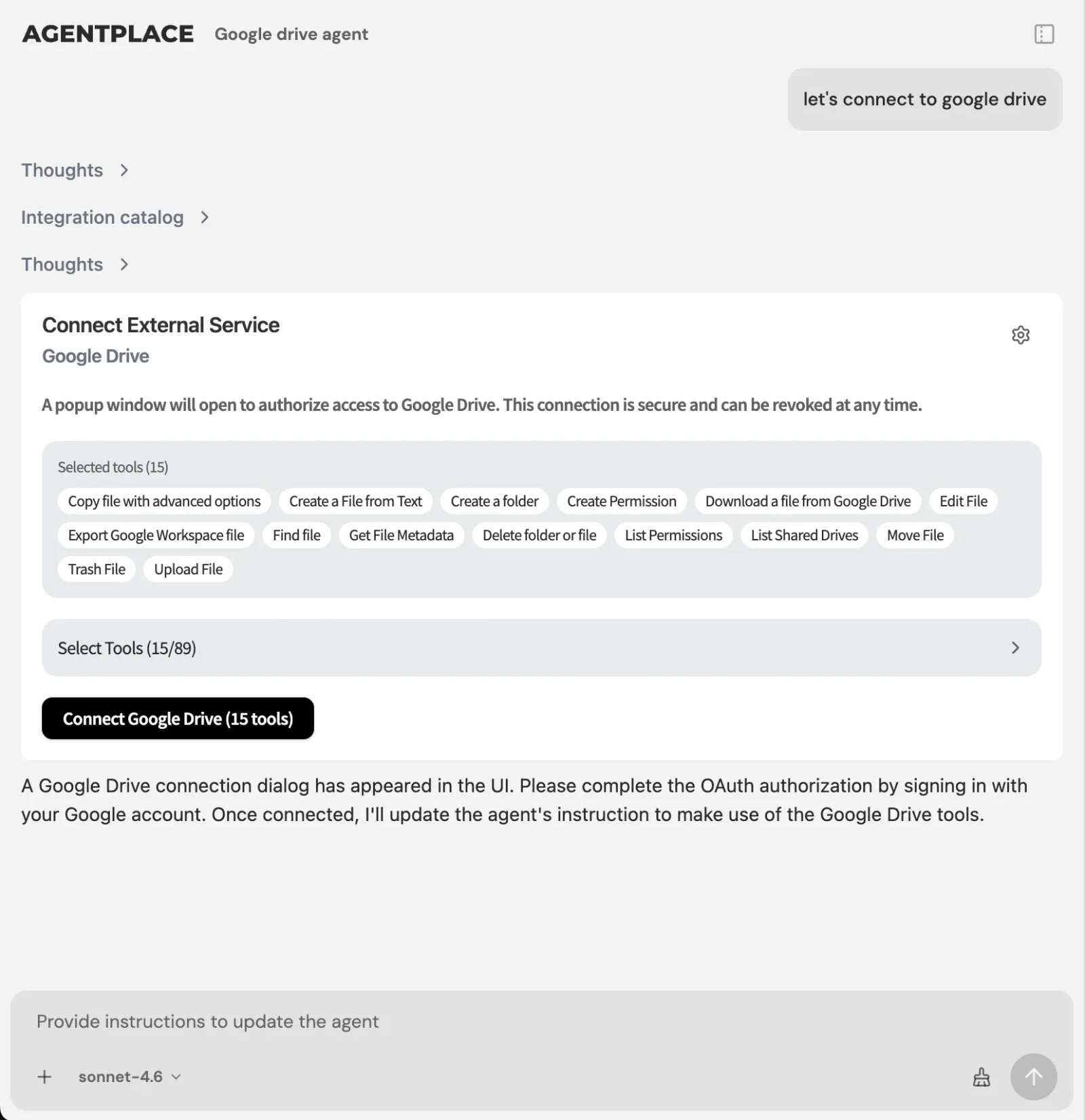 Quoting a live rate or writing to a reservation requires a supported integration and permissions you authorize for each account.
What needs a connection, and what stays in your existing systems?
Answering a documented policy question needs only the hotel’s own information.
Reading live availability, quoting a current rate, writing a note to a reservation or sending a guest a message each require a supported, authorized integration. Agentplace connects to business apps through Composio’s integration catalog and compatible MCP tools. You authorize each account and the actions it may take.
Without that connection, the agent can still explain the policy, collect the request and direct the guest to a named person. It should not claim to have checked availability, changed a booking or sent a message when it has not.
These systems keep their current jobs:
- Your property management system holds reservations, rates, room assignments and guest records.
- Your channel manager and booking engine keep distribution and the booking transaction.
- Your housekeeping workflow tracks room readiness and cleaning status.
- Your customer-facing AI agent answers questions that arrive before and around a booking, and routes what needs a person.
The agent’s page is the primary place guests work with it. Supported connections such as phone, WhatsApp or Telegram can extend the experience after setup.
Agentplace offers a free plan and paid plans. See the current pricing for details, and the boutique hotel agent examples for workflows other properties start from.
When does a small property not need AI concierge software?
A small property does not need this software in several common situations.
- Your enquiry volume is low. A clear arrival page and a saved email reply may cover a handful of questions a week.
- Your property management system already sends good pre-arrival messages. Improve that template before adding a subscription.
- Your real gap is the phone. Consider an always-on answering agent, and only if it matches how your calls are routed.
- Your real gap is overnight cover. Settle the escalation design first, as set out in covering guest requests at night.
- Your main need is digital check-in or keyless entry. Evaluate Operto or a comparable access tool instead.
- You have not documented your policies yet. Any assistant answers from whatever you give it, so the writing comes first.
- Your enquiries are complex sales. Weddings, buyouts and long group stays usually need a person, and software should only collect the brief.
Quick checklist
Use this before you shortlist a vendor:
- Write down which of the three jobs you are buying.
- Confirm which property management system integration is supported on your plan.
- Ask for a demonstration that quotes a real rate and writes to a real reservation.
- List the channels your guests actually use, and check each one is covered.
- Test your guests’ languages, including your street and property names.
- Define which requests must always reach a named person.
- Agree where escalated requests are recorded for a shift change.
- Ask where conversations are stored, for how long, and how they are deleted.
- Check the widget or page works with a screen reader.
- Decide the one number you will judge the trial on.
Related reading: How do I answer hotel guest questions before check-in? · How to cover hotel guest requests at night · Always-on answering agent for property management
Bottom line
Decide which of the three jobs you are buying before you compare products. Pre-arrival messaging, in-stay upsells and pre-booking questions are served by different tools.
If your guests mainly need arrival information after booking, a guest experience platform does that work on the reservation record you already hold. Duve suits most properties, and Whistle for Cloudbeds suits those already running Cloudbeds.
If your problem is the enquiries that arrive before a booking exists, a customer-facing AI agent built with Agentplace answers them on your own page. It replies in the guest’s own words, applies your written rules, collects what the arrival team needs, and carries the guest through to a booking or a paid add-on when a supported, authorized integration is configured.
The hotel stays responsible for keeping its information current, for verifying availability, and for every decision involving a charge, an exception or a guest’s safety.
Questions and answers
Frequently asked questions.
What is AI concierge software for a boutique hotel?
It is software that answers guest questions and handles routine requests automatically, by chat, messaging or voice. It usually covers one of three jobs: pre-arrival messaging, in-stay requests and upsells, or answering questions from visitors who have not booked. Check which job a product is built for.
Which AI concierge tool should a boutique hotel choose?
Choose by the job you need. Duve and Whistle for Cloudbeds suit pre-arrival and in-stay work on an existing platform. Asksuite and HiJiffy suit pre-booking enquiries. A customer-facing AI agent built with Agentplace suits a public page that answers questions and carries the request forward.
Does AI concierge software need a PMS integration?
Anything that depends on live data needs one. Quoting a rate, confirming availability, writing a note to a reservation or recognising a booked guest all require a supported, authorized integration with your property management system. Answering documented policy questions does not.
Can an AI concierge take a booking on its own?
Some can, when the required availability and booking actions work through an authorized integration. Others present rooms and hand the guest to your booking engine to finish. Ask each vendor to demonstrate a completed booking in your own account rather than an offered time.
Can an AI concierge handle guests in other languages?
Most vendors document multilingual support, and several claim well over 100 languages. Test the languages your guests actually use. Check how the agent handles your property's local names, street instructions and house rules before you rely on it.
Which guest requests should always reach a person?
Medical, mobility and accessibility arrangements, group bookings, complaints and disputes, changes to non-refundable rates, policy exceptions and anything involving an extra charge or a refund. An agent can collect the details and name who will follow up.
Do we still need a property management system?
Yes. The property management system remains the record of reservations, rates, room assignments and guest data. Your housekeeping workflow still tracks room readiness. AI concierge software sits alongside those systems rather than replacing them.
Is AI concierge software worth it for a 12-room property?
It depends on your enquiry volume and your staffing. A property with a handful of questions a week and reception cover through the day may do better with a clear arrival page. Repeated enquiries outside reception hours are the clearer case.
Put this into practice
See the customer experience.
Explore a concrete example related to this article, then adapt the agent to your business.
Create my AI agentStart free with your business idea. The AI builder can help you explore it and create your agent. No technical specification needed. Sign in to continue. Pricing and limits · How the builder works