
How Do I Answer Hotel Guest Questions Before Check-In?

The short answer
Document your standard policies, send the key information before guests ask, and explain which requests need confirmation from the front desk. An AI agent built with Agentplace can answer from your documented policies by text or voice, and direct early check-in, room changes and transfers to the responsible person.
Key takeaways
- Most pre-arrival questions have standard answers, including parking, breakfast, luggage storage, pets, check-in hours and late arrivals.
- Booking confirmations rarely include every detail a guest needs to plan an arrival, which is why the same questions arrive through several channels.
- Early check-in, room changes, special arrangements and transfers depend on current availability or a staff decision, so they should not be confirmed without the required information.
- An AI agent built with Agentplace can answer from documented policies, explain what it cannot confirm, and collect the request for staff follow-up.
- Live availability, writing a note to a reservation and sending a message each require a supported, authorized integration.
Hotels receive questions before check-in about parking, arrival times, luggage storage, breakfast, pets, room availability and late arrivals. Many of these questions have standard answers that guests need before they arrive.
The simplest way to handle pre-arrival questions is to document your hotel policies, send the key information before arrival, and explain which requests require confirmation from the front desk.
A customer-facing AI agent built with Agentplace can help a hotel answer common questions in natural language, apply its written policies, and direct requests that depend on room availability or staff decisions to the right person.
The short answer
To answer hotel guest questions before check-in:
- Document your standard policies. Write down check-in times, parking instructions, breakfast hours, pet rules, luggage storage and late-arrival procedures.
- Send the information before guests ask. Include the most important details in a pre-arrival email or message.
- Answer questions using current information. Explain your policies clearly without promising services or room availability you have not confirmed.
- Escalate requests that depend on live conditions. Early check-in, room changes, special arrangements and transportation bookings may require staff confirmation.
- Record guest requests where staff can find them. Add relevant notes to the reservation or your established handover system.
An AI agent built with Agentplace can give guests a dedicated web page where they ask questions by text or voice. The agent answers from your hotel’s information and explains when the front desk needs to confirm a request.
If you receive only a few questions each week, a clear arrival page and a saved email may be all you need.
Why do hotel guests keep asking the same questions before arrival?
Guests ask the same questions because booking confirmations rarely include every detail they need to plan their arrival.
A confirmation may show the dates, the room type and the price. Guests may still need to know where to park, whether pets are allowed, whether they can leave their luggage early, or how to enter the property after reception closes.
At a small hotel or guesthouse, these questions can arrive through several channels, including email, WhatsApp, booking platforms, website forms and phone calls. The person answering them may also be responsible for reservations, breakfast or guest arrivals.
The problem is often repeated questions across multiple channels, not the difficulty of answering each question.
Documenting standard answers and sending them before arrival reduces repetitive work. A way to answer follow-up questions helps when guests need information that a standard message does not cover.
Which hotel guest questions can you answer with standard information?
Many pre-arrival questions have answers that remain the same from one guest to the next.
Common examples include:
- Parking: location, price, availability limits, vehicle height restrictions and alternatives.
- Breakfast: serving hours, location, and price if it is not included.
- Luggage storage: whether bags can be stored before check-in or after check-out, and during which hours.
- Pets: which rooms allow pets, applicable fees and house rules.
- Check-in and check-out: standard hours and the procedure for arriving after reception closes.
- Accessibility: whether the building has stairs or an elevator, which rooms are step-free, and available bathroom features.
- Amenities: Wi-Fi, air conditioning, cribs and other available facilities.
- Local information: directions to the property and nearby services.
Write complete answers rather than short policy fragments.
For example, “Parking available” leaves several questions unanswered. “Six free parking spaces are available behind the building. The maximum vehicle height is 1.9 metres. If the spaces are full, a paid garage is four minutes away on foot” gives the guest enough information to plan.
Use your actual hotel policies and facilities. The examples in this article are illustrative.
Which guest questions require confirmation from hotel staff?
Some questions can be answered from standard policies. Others depend on current availability, the guest’s reservation, or a decision that only hotel staff can make.
| Guest question | Source of the answer | Who confirms it |
|---|---|---|
| Where can I park? | Written parking policy | No additional confirmation if the information is current |
| Can I leave my bags before check-in? | Luggage storage policy | Staff, if the request falls outside the policy |
| Can we bring our dog? | Pet policy and booked room type | Staff, if an exception or room change is needed |
| How do I enter at 1 a.m.? | Late-arrival procedure and current access instructions | Named night contact, if access details are missing or fail |
| Can I check in at 11 a.m.? | Early check-in policy and room readiness | Reception or housekeeping |
| Can we switch to a room with a balcony? | Current room availability and booking details | Reservations or reception |
| Can you arrange an airport transfer? | Transfer policy, price and driver availability | Staff or the responsible transport provider |
If an answer depends on current room availability, housekeeping, a booking change or another person’s decision, do not confirm it without the required information or approval.
An AI agent can explain the standard policy and collect the request. It should not promise an early check-in, a room upgrade or a confirmed transfer unless the relevant system or an authorized person has verified it.
What information should a hotel document before guests arrive?
Create one reliable source of information for standard pre-arrival questions. It should contain enough detail for guests to understand the answer without sending another message.
| Information | What to document | Example |
|---|---|---|
| Property address | Full address, entrance and landmarks | “Via Roma 14. Use the green door beside the pharmacy.” |
| Parking | Location, price, capacity, height limit and alternative options | “Six free spaces behind the building, with a 1.9 m height limit.” |
| Check-in | Standard hours and late-arrival procedure | “Check-in is from 3 p.m. to 10 p.m.” |
| Early check-in | Policy, fee and confirmation time | “Early check-in costs $25 when a room is ready. Reception confirms on arrival day.” |
| Luggage storage | Available hours and restrictions | “Bags can be stored from 9 a.m. before check-in and until 8 p.m. on departure day.” |
| Breakfast | Hours, location and price | “Breakfast is served from 7:30 to 10 a.m. in the ground-floor dining room.” |
| Pets | Eligible rooms, fee and rules | “Dogs are permitted in designated ground-floor rooms for $15 per night.” |
| Late arrivals | Reception closing time, access instructions and emergency contact | “Reception closes at 10 p.m. Contact the named night manager if you cannot access the key safe.” |
| Airport transfers | Price, booking requirements and notice period | “Private transfers cost $45 one way and require 24 hours’ notice.” |
| Accessibility | Stairs, elevators, step-free access and bathroom features | “There is no elevator. Rooms 1 to 4 are on the ground floor.” |
These figures are examples rather than recommendations. Replace them with your property’s actual information.
Keep policies separate from live information. A standard check-in time may stay the same, while room readiness and availability can change on the day.
How do you answer hotel guest questions before check-in, step by step?
1. Send pre-arrival information before the guest asks
Send a concise arrival message around two days before check-in, adjusted to your property’s booking process.
Include:
- The property address and entrance instructions.
- Parking details.
- Check-in and check-out times.
- Early check-in and late-arrival procedures.
- Breakfast hours.
- Wi-Fi and other essential amenities.
- A contact name or number for questions that need staff assistance.
Keep the message easy to scan. Guests should not have to search through several emails to find the information they need.
2. Explain what you can offer without promising availability
A guest asks for early check-in a week before arrival. You know your policy, but you do not yet know whether the room will be ready.
A clear answer might be:
“Check-in starts at 3 p.m. You can leave your bags with us from 9 a.m. Early check-in costs $25 when a room is ready, but we can only confirm it on the morning of your arrival. We can add your request to the reservation, and reception will update you by 10 a.m.”
That answer gives the guest the standard check-in time, a practical alternative, the fee, and a time for confirmation.
Compare the two responses:
- Clear: “Early check-in costs $25 when a room is ready. Reception can confirm availability on the morning of your arrival.”
- Unclear: “Early check-in should be fine.”
The second response creates an expectation the hotel may not be able to meet.
3. Tell the guest who will follow up
Instead of saying that reception will confirm, name the responsible person where possible.
For example:
“Ana, our manager on duty, will message you by 10 a.m. on your arrival day.”
Only use a person’s name and a response time when that person has accepted responsibility and the timing is realistic.
4. Record requests where the arrival team can find them
A request in a WhatsApp conversation or a personal email can be missed during a shift change.
Record requests such as early check-in, luggage storage, room changes and transportation in the appropriate reservation field or staff handover system.
Make sure the team responsible for the request can see it before the guest arrives.
5. Give late arrivals complete instructions before they travel
Guests arriving after reception closes need clear, working access instructions.
For example:
“Reception closes at 10 p.m. If you arrive after that time, use the key safe beside the green entrance. We will send your access code the day before arrival. If the code does not work, contact the night manager using the number in your arrival message.”
Send access codes and security instructions only through your hotel’s approved process. Verify that the instructions are current and that the named contact is available when promised.
6. Decide which questions always go to a person
Create a list of requests that require staff review, such as:
- Group bookings or room blocks.
- Medical, mobility or accessibility arrangements that need individual confirmation.
- Existing complaints or disputes.
- Changes to non-refundable bookings.
- Exceptions to pet or other house policies.
- Room changes and upgrades requiring availability checks.
- Requests that involve additional charges or approval.
An AI agent can collect the details and explain the next step, but it should not make decisions outside its authorized rules.
What tools can help hotels answer pre-arrival questions?
The best tool depends on whether your main problem is sending information, managing bookings, answering follow-up questions, or handling guest requests across several channels.
| Tool | Best use | Limitation |
|---|---|---|
| Pre-arrival emails from a property management system, such as Mews, Cloudbeds or Little Hotelier | Sending standard arrival information automatically | Guests may still have individual questions |
| A “know before you go” page | Publishing property information in one place | Guests must find and read the page |
| WhatsApp or SMS | Direct communication with guests | Staff availability affects response times |
| Booking platform messaging | Communicating with guests through their booking channel | Messages may be spread across separate inboxes |
| Support chatbots, such as Tidio or Intercom Fin | Answering common questions from configured information | Must be configured to handle booking-specific requests and escalation correctly |
| Guest messaging platforms, such as Duve, Canary Technologies and Akia | Supporting pre-arrival communication and guest workflows | Features, automation and integration options vary |
| Customer-facing AI agents built with Agentplace | Answering questions in natural language and directing requests to the right person | Requires accurate policies, and live information or external actions need supported connections |
These tools serve different purposes and are not necessarily alternatives to one another. A hotel might use a property management system to manage reservations, automated email to send arrival instructions, and a customer-facing agent to handle follow-up questions.
How does Agentplace help small hotels answer guest questions before check-in?
Agentplace is a platform for creating AI agents that serve customers and help businesses run their work.
Each agent has its own web page and URL. A hotel can link to the page from its website, booking confirmation or pre-arrival message. Guests can then ask questions in their own words by text or voice.
For a small hotel, an agent can use documented property policies to answer questions about parking, breakfast, pets, luggage storage and late arrivals. It can also explain which requests require confirmation and collect information for staff follow-up.
How does a hotel pre-arrival agent work?
- The guest asks a question. For example, about bringing a dog, arriving after midnight, or checking in early.
- The agent checks the hotel’s documented policies. It provides the relevant information in a complete answer.
- The agent identifies requests that need confirmation. For example, it does not promise a room before the standard check-in time without verifying availability.
- The agent collects the relevant details. It can capture the requested arrival time or other information needed for follow-up.
- The request goes to the responsible person or system. Writing the request to an external system requires a configured workflow or supported integration.
You define the agent’s behavior in plain language. For example:
“Answer pre-arrival questions for our 22-room guesthouse using our arrival information. Explain parking, breakfast, luggage storage, pet rules, check-in hours and late-arrival procedures. Never confirm early check-in or a room change without verified availability. Explain our policy, collect the request, and direct it to the responsible person. Send medical, accessibility and group-booking questions to Ana for individual review. Do not claim that a request has been recorded or confirmed unless the relevant action has succeeded.”
The Agentplace AI Builder helps clarify the requirements, create the agent and test its responses. You decide when to publish it, and no code is required to get started.
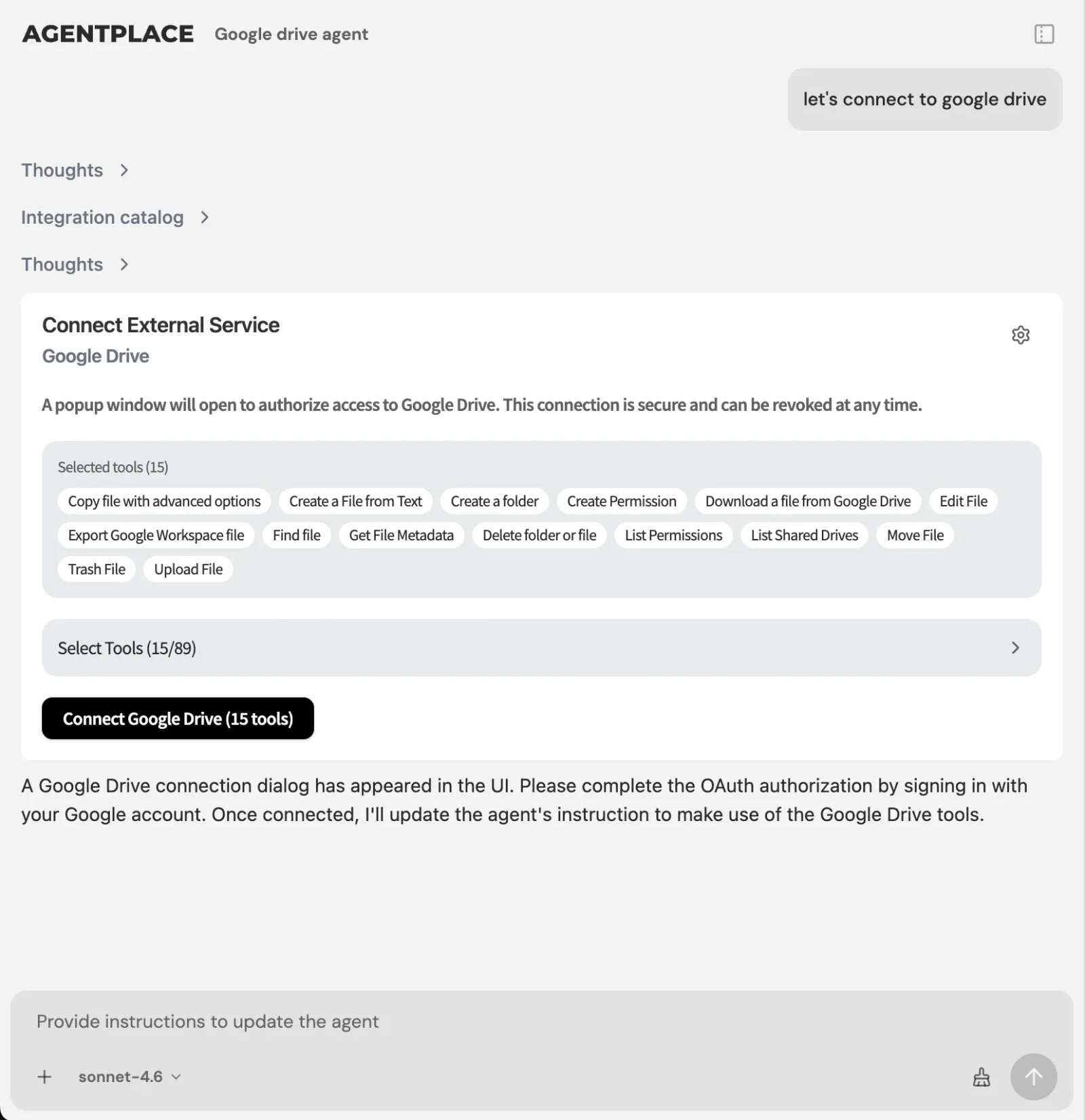 Reading live availability or messaging a guest requires a supported integration and permissions you authorize for each account.
Can an Agentplace agent check room availability or update a reservation?
Only when the required live data and actions are available through a supported, authorized integration.
For example, answering “What time does breakfast start?” requires the hotel’s documented policy. Answering “Can I check in at 11 a.m. tomorrow?” may require current room readiness or availability information.
Likewise, writing a note to a reservation, sending a follow-up message or booking an airport transfer requires an appropriate connected system or workflow. Agentplace supports connections through Composio’s integration catalog and compatible MCP tools, subject to the available integration and the permissions you authorize.
Without the required connection, the agent can explain the hotel’s policy, collect the request and direct the guest to staff. It should not claim to have checked live availability, changed a booking or sent a message when it has not.
What stays in your existing hotel systems?
- Your property management system holds reservations, rates, room assignments and other supported property data.
- Your housekeeping workflow tracks room readiness and cleaning status.
- Your guest messaging tools handle messages through the channels you already use.
- Your customer-facing AI agent answers questions from your documented policies and supports configured follow-up workflows.
The agent complements these systems rather than replacing your reservation and property management software.
Agentplace offers a free plan and paid plans. See the current pricing for details.
Starting template: AI Agent for Spa Arrival and Preparation Messages. This template addresses a similar need, providing arrival information and preparation instructions before a visit. Adapt the workflow to your hotel’s requirements and test it before publishing.
When don’t you need an AI agent?
An AI agent is not necessary for every hotel.
- You receive only a few questions each week. A clear arrival page and a saved email may be enough.
- Your property management system already sends useful pre-arrival messages. Improve your existing message template before adding another tool.
- Your main need is upselling or digital check-in. Evaluate a guest messaging platform designed for those workflows.
- You need to manage housekeeping and room assignments. Use your property management or housekeeping system as the source of truth.
- Your main problem is unanswered phone calls. Consider an always-on answering agent, and only if it fits your actual phone workflow.
- Guests repeatedly ask individual questions after hours. A customer-facing AI agent may help answer standard questions and route requests that need staff attention.
Pre-arrival guest communication checklist
Use this checklist to improve how your hotel answers guest questions before check-in:
- Document the property address and entrance instructions.
- Write complete answers about parking, breakfast, pets, luggage and amenities.
- Explain standard check-in and check-out times.
- Document the early check-in policy, including fees and confirmation timing.
- Write clear late-arrival instructions and verify the contact details.
- Send essential information before arrival.
- Identify which questions require staff approval or live availability data.
- Choose where staff should record and review guest requests.
- Assign a responsible person for follow-up requests.
- Test any chatbot or AI agent with questions it can answer and requests it must escalate.
Related reading: How a small travel agency can capture leads after hours · AI agents for boutique hotels
Bottom line
Document standard answers, send them before arrival, and route requests that depend on live information or staff decisions to the right person.
If your hotel receives few pre-arrival questions, a clear information page and an automated email may be sufficient.
If guests repeatedly ask individual questions outside reception hours, a customer-facing AI agent built with Agentplace can answer from your hotel’s documented policies, explain what it cannot confirm, and help collect requests for follow-up.
The hotel remains responsible for keeping its information current, verifying room availability, and completing any action that requires staff approval or a connected system.
Questions and answers
Frequently asked questions.
How should a hotel answer guest questions before check-in?
Document your standard policies, send the key information before guests ask, and answer follow-up questions from that documented information. Escalate requests that depend on current room availability or a staff decision, and record each request where the arrival team can find it.
What should a pre-arrival message include?
The property address and entrance instructions, parking details, check-in and check-out times, the early check-in and late-arrival procedures, breakfast hours, Wi-Fi and other essential amenities, and a contact for questions that need staff assistance. Keep it easy to scan.
How should a hotel handle an early check-in request?
Explain the standard check-in time, offer luggage storage, give the fee if you charge one, and say when availability can be confirmed. Add the request to the reservation and name the person who will update the guest, usually reception on the morning of arrival.
What should you tell a guest arriving after reception closes?
Give the complete procedure before they travel: the reception closing time, how to access the property, when the access code will be sent, and a contact for when the code does not work. Send access codes only through your hotel's approved process.
Can an AI agent answer guest questions before arrival?
Yes, for questions your documented policies cover. An agent built with Agentplace can answer in the guest's own words, apply your parking and pet rules, and explain which requests need the front desk. Checking live availability requires a supported, authorized integration.
Can an AI agent confirm early check-in or change a reservation?
Only when the required live data and actions are available through a supported, authorized integration. Without that connection, the agent can explain the policy, collect the request and direct the guest to staff. It should not claim to have checked availability or changed a booking.
Do you still need a property management system?
Yes. The property management system holds reservations, rates, room assignments and other property data, and your housekeeping workflow tracks room readiness. A customer-facing agent complements those systems rather than replacing them.
Is a website FAQ page enough for pre-arrival questions?
It can be, when your inquiry volume is low and your rooms are similar. Guests still write when the answer depends on their own booking, their pet, their flight time or their vehicle, which is where an agent or a staff reply is needed.
Put this into practice
See the customer experience.
Explore a concrete example related to this article, then adapt the agent to your business.
Create my AI agentStart free with your business idea. The AI builder can help you explore it and create your agent. No technical specification needed. Sign in to continue. Pricing and limits · How the builder works