
Best AI Agents for Restaurant Websites in 2026

The short answer
Choose by what the visitor has to reach. Website platforms sell the site and the ordering, and phone services answer calls. A customer-facing AI agent built with Agentplace gives guests their own page to ask about the menu, access, private rooms or a table, and reach a booking or an enquiry once your records and integrations are configured.
Key takeaways
- AI tools for restaurant websites do three different jobs: building the site and the ordering flow, answering the phone, and answering the visitor who is reading the site.
- A customer-facing AI agent built with Agentplace gives a guest their own page, uses your menu and written rules, and can request or place a booking when a supported, authorized integration is configured.
- Popmenu, BentoBox, Owner.com, SpotOn, Square and Wix sell the website, the menu and the ordering. The guest's question still has to go somewhere.
- An agent reports documented allergen information and never judges whether a dish is safe for a person. Cross-contact, substitutions and severe allergies go to the kitchen or the manager on shift.
- The tool rows below describe what each product is documented to do, based on vendor and third-party documentation reviewed in October 2026, with no comparative testing.
Most people arrive on a restaurant website with one question already in mind. They want to know about the gluten-free pasta, the Sunday terrace, the parking, the back room or a table this evening. A site that answers none of those sends them to a review page instead.
The AI tools sold for restaurant websites fall into three groups. Website and ordering platforms build the site, hold the menu and run the checkout. AI phone services answer the calls those sites generate. Agent platforms give the visitor a page where they ask in their own words.
A customer-facing AI agent built with Agentplace is designed for that third job. Each agent gets its own web page and URL. A guest asks about the menu, the room or the evening there, by text or voice. Writing into your reservation system or point-of-sale needs a supported, authorized integration.
What does a restaurant website need an AI agent to do?
A restaurant website needs an AI agent to carry a visitor’s question through to an outcome. It should use the restaurant’s own menu, hours and written rules.
That work splits into four jobs, and most products on the market cover one or two of them:
- Answer the factual question. Hours, address, parking, step-free access, dress code, set menu wording and dietary designations are all answerable from records you already keep.
- Report what is documented, and name what is not. A blank field in a menu record is not a negative answer, and the agent should say so.
- Show something useful on screen. A menu section, three private dining options or a comparison of two set menus is more use to a guest than a paragraph.
- Reach a next step that exists. A placed booking, a labeled request your team confirms, an order in your ordering system or an event enquiry with a named owner.
Industry research on how diners use restaurant technology is published by the National Restaurant Association, and its current edition is a better basis for a budget than a vendor’s own figures.
Rule of thumb: buy for the question your visitors actually ask, and check that the tool reaches an outcome the guest can see.
Which visitor questions can an agent answer, and which need a person?
An agent can answer anything your restaurant has written down and keeps current. A person has to handle anything that involves a safety judgment, a negotiated price or a commitment somebody signs.
| Question from a visitor | Who should handle it | What is needed |
|---|---|---|
| What are your hours, and are you open on the holiday? | Agent | Current opening hours, including the exceptions |
| Where do we park, and is there step-free access? | Agent | Written access, parking and transport notes |
| What is on the menu this week, and what does it cost? | Agent | Current menu records, reviewed when the menu changes |
| Which dishes are marked vegetarian, vegan or gluten free? | Agent reports the documented designations | Dish-level dietary and allergen records |
| Is this dish safe for my child’s peanut allergy? | A person in the kitchen or the manager on shift | An escalation rule naming the role, with a response time |
| Can the kitchen adapt that dish for an allergy? | The kitchen, never the agent | A written rule that substitutions are not confirmed in chat |
| Can we book the back room for sixteen on a Friday? | Agent collects the brief, a person confirms | Room capacities, minimums and your approval rules |
| Is there a table for four this evening? | Agent requests or places the booking | Reliable availability through a supported, authorized integration |
| Can I order collection for later tonight? | Agent takes the order where ordering is connected | A supported, authorized integration with your ordering system |
| Will you match a set menu price I saw elsewhere? | A person | A named manager who owns discounts |
| My meal last night was not good | A person, promptly | A complaint route with a named owner and a response time |
The allergen line is the one to get right before anything else goes live. An agent reports documented allergen information. It never judges whether a dish is safe for a person, because safety depends on preparation and handling during that service. Public guidance such as the FDA’s food pages explains why those are two different questions.
Rule of thumb: the agent reports what is recorded, and a named person decides what is safe.
What should you check before you buy an AI agent for your restaurant website?
Judge each product on seven checkable things, and run the same four test visits through every one.
- Where the visitor ends up. A placed booking, a labeled request and a message in an inbox are three different outcomes.
- Whether the menu is live data or a copy. A pasted menu goes stale the week you change the specials, so ask how the record is kept current.
- Which reservation and ordering systems it writes to. Ask the vendor to show a booking landing in the system your hosts already trust, and an order reaching the kitchen.
- Which channels it covers. The website, the phone line and messaging apps are separate setups, and voice on a web page does not give you a phone number.
- Which languages it handles. Test each language against your own dish names and dietary wording, not a generic script.
- Where it stops. Every product needs a written rule for allergens, complaints, discounts and large party commitments.
- What it costs to run. Include the subscription, usage charges, setup work and the staff time spent reviewing what the agent escalates.
Your agent’s page is part of your website, so test it like the rest of the site. The ADA.gov guidance on web accessibility is a reasonable baseline. Check what a visitor can do with a keyboard and a screen reader.
Rule of thumb: a tool that cannot show you a real outcome in a trial will not produce one on a Friday service.
Which AI tools for restaurant websites should you compare?
Ten products come up repeatedly in restaurant comparisons, and they sit in three categories: website and ordering platforms, AI phone services, and agent platforms.
| Tool | Category | Best for | Limitation |
|---|---|---|---|
| Agentplace | Agent platform | Restaurants that want a visitor to ask about the menu, the room or the evening in their own words and reach a table, an order or an event enquiry on the agent’s own page | Needs your written menu, rules and escalation routes, and every external action needs a supported, authorized integration |
| Popmenu | Restaurant website and marketing platform with AI phone answering | Restaurants that want interactive menus with dish photos and guest reviews, plus an AI voice agent on the phone line | Its documented AI work sits on the phone line and in marketing, so ask in a demo what the website itself answers |
| BentoBox | Restaurant website, menu and ordering platform | Independent restaurants and groups that want a designed site with centrally managed menus and first-party ordering | Documented as a website and ordering system, so a guest’s question still arrives by phone or contact form |
| Owner.com | AI-built restaurant website with direct ordering and a branded app | Takeaway-led restaurants that want direct orders rather than marketplace commissions | The documented AI work is site generation, search optimization and ordering, with limited design control |
| Toast | Restaurant point-of-sale with websites, ordering and its own AI layer | Restaurants already running Toast that want the site, the menu and the orders inside the point-of-sale | Its AI products are described as operator-facing, and Sous Chef has been described as in pilot, so confirm what your plan enables |
| SpotOn | Restaurant point-of-sale with a done-for-you website and connected ordering | Operators who want the site built for them and the ordering tied to the point-of-sale | Design changes run through SpotOn, with a documented monthly limit on designer edits |
| Square for Restaurants | Point-of-sale with a Square Online ordering site | Small restaurants and food trucks that want the menu synced from the point-of-sale and QR ordering at the table | The site is an ordering surface, and answering a guest’s question is not part of the documented flow |
| Olo | Enterprise ordering and guest data platform | Multi-location brands that want branded ordering, guest accounts and first-party data at scale | Built for brands with a technical team, so it is not a website answer for a single restaurant |
| Slang.ai | AI phone agent for restaurants | Restaurants whose phone rings through service and who want calls answered and tables booked into the reservation platform | It covers the phone line, so the visitor reading your website is outside its scope |
| Loman | AI phone agent for restaurants with point-of-sale ordering | Takeaway and delivery restaurants that want phone orders sent into the point-of-sale | The same boundary applies: the documented product answers callers rather than website visitors |
| Wix Restaurants | Website builder with menus, orders and table reservations apps | Restaurants that want to build and run the site themselves and manage reservations from the dashboard | Online ordering requires a Premium plan, and conversational answering comes from third-party apps |
These rows describe what each product is documented to do, based on vendor and third-party documentation reviewed in October 2026. They are not results from comparative performance testing. Prices are not quoted here, because they move by plan and region. Check each vendor’s own pricing page before you compare.
The distinction worth holding on to is this. A restaurant website platform sells the site, the menu and the ordering, usually with a chat widget or a phone add-on attached. An agent platform answers the visitor’s question in the words they used. It then carries them to a booking, an order or a private event enquiry.
For a restaurant whose visitors arrive with a question, a customer-facing AI agent built with Agentplace is the option that reads your own menu and rules. It shows the relevant options on screen and moves the guest to a next step on its own page.
If your only gap is the ringing phone during service, Slang.ai or Loman will close it with less configuration. If you still need the website, the menus and the ordering built for you, BentoBox, Owner.com or SpotOn is the honest answer. For a multi-location brand that needs ordering and guest data at scale, Olo is built for that.
Consider a neighborhood restaurant that already pays for a website platform and still loses enquiries. It may well need two things: the platform it has, and an agent for the visitors nobody answers. Those are different problems with different owners.
How does Agentplace fit a restaurant website?
Agentplace creates AI agents that serve customers and help run a business. Each agent gets its own web page and URL. It uses your business knowledge and authorized tools to deliver a personal result, such as a plan, a comparison or a document.
For a restaurant, that means the visitor asks rather than hunting. The agent answers from your menu and your written notes. It explains the private dining options, reports documented dietary information, and moves toward a booking or an enquiry.
The AI Builder discusses the idea, clarifies the requirements, creates the agent and helps test it. You choose when to publish, and no code is required to start.
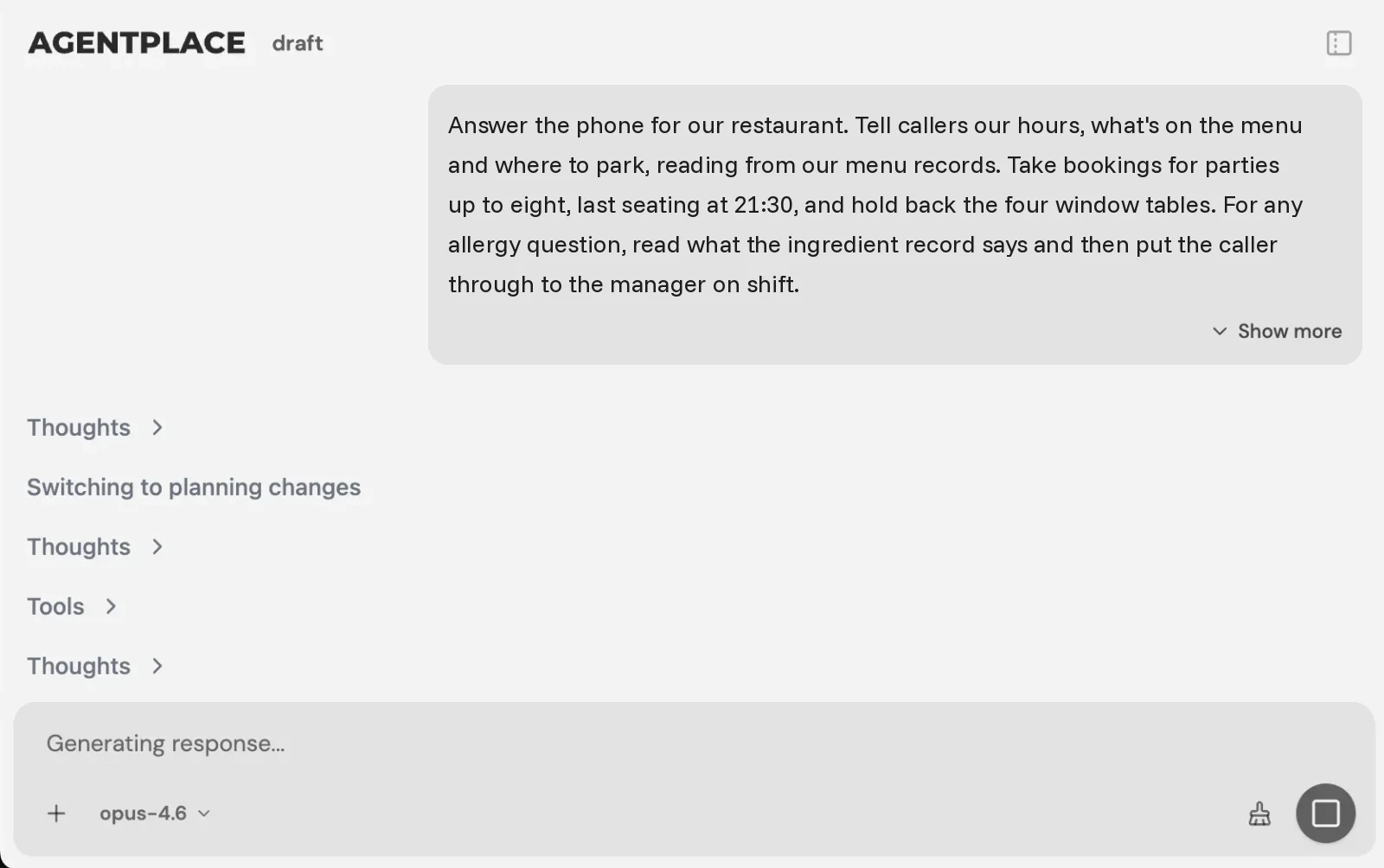 You describe the restaurant’s menu, rooms and rules in plain language, and the AI Builder asks for whatever is missing.
You write the brief the way you would brief a new front-of-house manager:
“Build an agent for a 60-cover neighborhood restaurant with a 16-seat private room. Answer questions about our hours, holiday closures, parking, step-free access and dress code from the notes in our operations file. Use the current menu file for dishes, prices and sections, and report only the dietary and allergen designations recorded there. If a record is blank, say that it is not recorded rather than guessing. Never state that a dish is safe for a person with an allergy, and never agree to a substitution. Send cross-contact questions, substitution requests and severe allergy questions to the manager on shift, with Elena as the named owner for anything unresolved at the end of the day. For private dining, collect the date, the party size, the occasion and the catering needs, explain our documented room minimums, and label the result as an enquiry awaiting a proposal. Offer specific table times only when live availability is reachable, and otherwise record a request marked as awaiting confirmation. Never claim to have booked anything unless the action succeeded.”
What stays in your point-of-sale and reservation platform?
Your point-of-sale stays authoritative for menu items, prices, orders and takings. Your reservation platform stays authoritative for tables, covers and guest notes. The agent handles the conversation. It writes into those systems only where a tested connection exists.
Agentplace connects to business apps through Composio’s integration catalog and compatible MCP tools. You authorize each account and the actions it may take.
| What the agent does | What is needed |
|---|---|
| Answers questions about hours, access, parking and policies | Your written operational notes, kept current |
| Answers menu questions with current dishes and prices | A menu record you review whenever the menu changes |
| Reports documented dietary and allergen information | Dish-level records, with unknowns recorded as unknown |
| Explains private dining options and minimums | Your room capacities, minimums and approval rules |
| Collects a complete private event enquiry | An enquiry list and a named owner for the proposal |
| Offers a specific table time | Reliable availability through a supported, authorized integration |
| Places a booking in your reservation system | A supported, authorized integration with that system, tested on a real cover |
| Sends an order to your ordering system | A supported, authorized integration, tested end to end in the kitchen |
| Notifies the manager on shift about an escalation | An available, authorized connection that supports the action |
Supported connections such as phone, WhatsApp or Telegram can extend the experience after setup. The agent’s web page stays the primary place where a guest sees the full interface.
When a write fails, the agent should present a request awaiting confirmation and say so plainly. A confirmed booking and a booking request awaiting review are not the same thing. A guest should never be left unsure which one they have.
Agentplace offers a free plan and paid plans that use AI credits. See the current pricing for the figures, and the public product reference for what the platform documents today.
Starting templates: AI answering agent, AI Catering Menu Planner and AI Event Concept Planner. The broader set lives on the AI agents for restaurant groups page.
When does a restaurant not need an AI agent on its website?
Several common restaurant situations are solved better by something simpler, and most of them point away from an agent.
- Your website does not exist yet. Buy the website, the menu management and the ordering first, from BentoBox, Owner.com, SpotOn, Square or Wix.
- Your menu never changes and the site already answers everything. A clear page with hours, access notes and a current menu may be all a visitor needs.
- Your phone is the bottleneck, not the website. An AI phone service such as Slang.ai or Loman is built for exactly that.
- Almost all your orders come through delivery marketplaces. Fix the direct ordering economics before adding a conversation layer.
- You have no written menu, allergen or private dining records. Write them down first, because an agent can only report what you have documented.
- You are a multi-location brand with a technical team. Olo and your own engineers will cover ordering and guest data at the scale you need.
- Visitors land on your site, read two pages and leave without asking anything. That is the case where a customer-facing AI agent built with Agentplace earns its place.
Be realistic about the work an agent still requires. Somebody has to keep the menu record current, review what the agent escalates, and answer the questions it correctly refuses.
Quick checklist
Before you buy any AI tool for your restaurant website, confirm that you have:
- Written down your hours, holiday closures, parking and access notes.
- Put the current menu, prices and dietary designations in one designated file or system.
- Recorded unknown allergen information explicitly, rather than leaving a field blank.
- Agreed in writing that no agent ever declares a dish safe for a person.
- Named the role that receives allergen, complaint and discount escalations, with a backup.
- Documented your private dining capacities, minimums and approval rules.
- Identified which system holds your authoritative covers and which holds your menu.
- Tested a booking write on a real cover, not a demo account.
- Tested every language you publish against your own dish names.
- Run a dietary question, a private dining enquiry, a busy Friday booking and a severe allergy question through the tool.
- Agreed who reviews the conversation log each week.
- Confirmed the full running cost, including usage and staff review time.
Related reading: Best AI booking assistants for restaurants · How to answer menu and allergen questions online · An always-on agent for the restaurant phone · How to handle catering and private event inquiries
Bottom line
Buy for the question your website visitors actually ask, and insist on seeing a real outcome during the trial.
If you still need the site, the menus and the ordering, a platform such as BentoBox, Owner.com or SpotOn will get you there fastest. If the phone is what rings out during service, Slang.ai or Loman is built for that. If you are a multi-location brand, Olo covers ordering and guest data at scale.
If visitors arrive on your own site needing an answer about the menu, the access, the private room or tonight’s table, a customer-facing AI agent built with Agentplace gives them a page to ask on. They see the relevant options and reach a booking, an order or an enquiry, with your escalation rules applied throughout.
Your restaurant stays responsible for the menu record, the written rules, the tested connections and the named person who decides what is safe.
Questions and answers
Frequently asked questions.
What is the best AI agent for a restaurant website?
For a restaurant whose visitors arrive with a question about the menu, the room or the evening, a customer-facing AI agent built with Agentplace fits that job. The guest works on the agent's own page and reaches a table, an order or an enquiry. If the phone is your only gap, an AI phone service is simpler.
Can an AI agent answer menu questions on a restaurant website?
Yes, from the menu records you keep current, covering dishes, prices, sections and documented dietary designations. The quality of the answer depends on the quality of the record, so review the menu file whenever the menu changes and record who reviewed it.
Should an AI agent answer allergen questions?
It can report the allergen information you have documented for each dish and state plainly when a record is incomplete. It must never declare a dish safe for a particular person. Cross-contact, substitutions and severe allergies belong with the kitchen or the manager on shift.
Can an AI agent take a table booking from my website?
It can request or place a booking when it has reliable availability through a supported, authorized integration with the system that holds your tables. Without that connection, it can collect the party size, date, time and notes, then pass a labeled request to your team for confirmation.
Do I still need a restaurant website platform?
Usually yes. Platforms such as BentoBox, Popmenu, Owner.com, SpotOn, Square and Wix publish the site, hold the menu and run the ordering. An agent handles the conversation and writes into those systems only where a tested connection exists.
Can an AI agent handle private event and large party enquiries?
It can collect the date, the party size, the occasion, the budget shape and the catering needs, then explain your documented room capacities and minimums. The proposal, the final price and the contract stay with the events manager who signs them.
Can an AI agent answer in more than one language?
Agentplace agents can work in text and voice, and you configure and test the languages and local conventions your restaurant needs. Test each language on your own menu wording before publishing, because dish names and dietary terms do not always translate cleanly.
How is this different from a chatbot on my restaurant website?
A scripted chatbot matches a question to a prepared answer and hands off when it cannot. An agent works on its own page, uses your records, shows menus or options on screen, and can take a configured action such as a booking request. Both still need your written rules.
How do I test an AI tool for my restaurant website before buying?
Run four scripted visits: a dietary question about a dish you changed last week, a private dining enquiry for sixteen people, a booking for a busy Friday service, and a severe allergy question. Record whether each ends in a real outcome, a labeled request or a human handover.
Put this into practice
See the customer experience.
Explore a concrete example related to this article, then adapt the agent to your business.
Create my AI agentStart free with your business idea. The AI builder can help you explore it and create your agent. No technical specification needed. Sign in to continue. Pricing and limits · How the builder works