
Best AI Booking Assistants for Restaurants in 2026

The short answer
Choose by what has to reach a confirmed table. Reservation platforms hold the book. Voice assistants answer the phone and write into it. A customer-facing AI agent built with Agentplace gives guests their own page to ask about a table, see the times your rules allow and request or place a booking, once your rules and integrations are configured.
Key takeaways
- A reservation platform holds the tables, covers and deposit rules. An AI booking assistant answers the guest and writes into that platform, so most restaurants end up running both.
- A confirmed reservation and a request awaiting confirmation are different outcomes, and the guest should always be able to tell which one they have.
- A customer-facing AI agent built with Agentplace gives a guest its own page to work out a table, and it can place the booking when a supported, authorized integration is configured.
- Large parties, private events, specific table requests and any food allergy question should reach a named person every time.
- The tool rows below describe what each product's own documentation supports, reviewed in October 2026, and are not results from comparative testing.
A restaurant shopping for an AI booking assistant in 2026 is comparing two different kinds of product. A reservation platform holds the book: the tables, the covers, the floor plan and the deposit rules. An assistant answers the call or the message and writes a booking into that platform.
The right pick depends on where your bookings currently stop. If the phone rings out during service, a voice assistant on your line closes that gap. If guests reach your website, your Instagram messages or your Google listing and leave without a table, that is a different gap and a different product.
A customer-facing AI agent built with Agentplace is designed for the second case. Each agent gets its own web page and URL, where a guest describes the party by text or voice, sees the times your rules allow and asks for one. Writing that reservation into OpenTable, Resy or SevenRooms requires a supported, authorized integration.
What does an AI booking assistant for a restaurant actually do?
An AI booking assistant takes a guest’s request for a table and turns it into one of two clear outcomes: a confirmed reservation, or a recorded request that a named person will confirm.
The work splits into four steps, and most products on the market cover two or three of them:
- Answer the request. Somebody responds while the host stand is busy and the phone is ringing.
- Establish the booking facts. The date, the time, the party size, a guest name and contact details.
- Check what is actually available. This depends on reliable availability information from the platform that holds your book.
- Return an outcome the guest understands. A confirmed table, or a request marked as awaiting confirmation with a follow-up time.
The fourth step is the one restaurants get wrong most often. A guest who reads “we have you down for four at 8:45” assumes the table exists.
If nothing was written into the reservation platform, that guest arrives to a full room.
Trained staff make the difference audible, and an assistant should too. Consider the same table for four on a Friday evening, in the two states it can be in:
“Your table for four is confirmed for 8:45 p.m. tonight, under the name Patel. You will receive a text confirmation shortly.”
“I have recorded your request for a table for four at 8:45 p.m. tonight. It is not confirmed yet. Our manager, Elena, will confirm it within the hour on this number.”
The pressure behind all of this is the dining room itself. The U.S. Bureau of Labor Statistics describes food and beverage serving work as fast-paced. It lists evening, weekend and holiday hours, with frequent standing and carrying.
A host stand in the middle of a Friday turn is not a reliable place to answer the phone.
Rule of thumb: a confirmed reservation and a request awaiting confirmation are different outcomes, and the guest should be able to tell which one they have.
Which booking requests can an assistant confirm, and which need a person?
An assistant can confirm the bookings your written rules already cover. It should do so only when it has reliable availability through a supported, authorized integration.
Everything else should reach a named member of staff, with the details already collected.
| Request from a guest | Who should handle it | What is needed |
|---|---|---|
| A table for two on Tuesday at 7 p.m. | Assistant confirms it | Your seating times, table durations and reliable availability through a supported, authorized integration |
| A table for four tonight when the first choice is gone | Assistant offers the alternatives you approved | A written list of acceptable alternative seatings |
| A change or a cancellation of an existing booking | Assistant, where the integration supports that action | A tested write to your reservation platform and a rule on how late a change is allowed |
| A place on the waitlist when the room is full | Assistant records it where your platform supports a waitlist | Your quoted wait times by party size and a tested connection |
| A party of twelve | A manager | Your large-party policy, including minimum spend and deposit rules |
| A private event, a buyout or a semi-private room | A named person | Your event enquiry process, because pricing and contracts stay with staff |
| A request for the corner booth | A host on the floor | A rule that the assistant never assigns a specific table |
| A booking on a date held for a private event | Assistant explains and offers other dates | A current list of closed and held dates, kept up to date |
| A deposit or a prepaid seat | Your reservation platform’s own payment flow | Your deposit policy in writing, configured in that platform |
| Is the duck safe for a peanut allergy? | The kitchen, every time | An escalation rule naming who answers and how quickly |
Allergy questions are the clearest line on this list. The U.S. Food and Drug Administration treats the major food allergens as a safety matter.
An assistant should report what your menu records and pass the question to a named person. It should not offer reassurance of its own.
What should you check before you buy an AI booking assistant?
Check six things, and check each one against the reservation platform you already pay for instead of against a demo account.
- Which reservation platform it writes into. Confirm the integration by name, whether that is OpenTable, Resy, SevenRooms, Tock, Toast Tables or Yelp Guest Manager, and ask to watch one booking land in your own book.
- Which channels it covers. The phone, your website, Instagram, WhatsApp and your Google listing are separate setups, and voice on a web page does not give you a phone number.
- What it tells the guest about status. The assistant should distinguish a confirmed table from a recorded request, and it should say so plainly when a write into the platform fails.
- What it does with the time it cannot give. A useful assistant offers the alternative seatings you approved, or a waitlist place, and never invents availability.
- How it handles no-shows. Confirmation messages, reminders and your deposit policy all belong in this answer, and the consent and opt-out obligations for those messages stay with your restaurant. The Federal Communications Commission sets out what consumers expect from automated calls and texts.
- Where it stops. Large parties, private events, allergies and anything your rules do not cover need a named person and a stated follow-up time.
Prices are not quoted on this page. They move by plan, region and cover volume, and several vendors publish nothing until you request a quote.
Check each vendor’s own pricing page before you compare.
Rule of thumb: a tool that cannot show you a real booking in your own reservation platform during a trial will not produce one on a Saturday.
Which AI booking assistants for restaurants should you compare?
Nine products come up repeatedly, and they fall into two groups: reservation platforms that hold the book, and voice or chat assistants that answer the guest and write into one.
| Tool | Category | Best for | Limitation |
|---|---|---|---|
| Agentplace | Agent platform | Restaurants that want the guest to work out the party, the time and the rules on the agent’s own page, then reach a booking | Needs your written booking rules, and every write into a reservation platform needs a supported, authorized integration |
| OpenTable | Reservation platform with its own diner-facing AI | Restaurants that want demand from a large diner network, and a choice of voice AI partners that can book by phone | Its Concierge assistant answers diners inside OpenTable’s own channels, so taking a booking on your phone line means signing up with a separate voice partner |
| Resy | Reservation platform with a mobile waitlist | Restaurants that want guests to join the waitlist from their phones and be notified when a table opens | It holds the book and the waitlist, and it does not answer a guest’s questions about your menu or your rules in conversation |
| Tock | Reservation platform built around deposits and ticketed experiences | Restaurants running tasting menus, chef’s counters and events, where a prepaid seat protects the cover | The platform manages the booking and the payment rules, and a guest who wants to ask something first still has nobody to ask |
| SevenRooms Voice AI | Reservation platform with voice answering built in | Restaurants already running their book in SevenRooms that want calls answered and bookings taken without a separate integration | The voice product is tied to running your reservations in SevenRooms, so it is not an option if your book lives elsewhere |
| Yelp Guest Manager | Reservations, waitlist and host-stand tools | Restaurants whose demand arrives through their Yelp profile, with kiosk check-in and waitlist texts included | The suite manages the front of house, and it does not include an assistant that answers a guest’s questions in conversation |
| Toast Tables | Reservations and waitlist inside the Toast platform | Toast users who want the book, the floor plan and guest data in the same system as the POS | Toast’s own documentation notes that reservations created in the Toast Tables app are not visible on a POS terminal or handheld |
| Slang.ai | Voice assistant for the restaurant phone | Restaurants whose main gap is unanswered calls, with documented booking integrations including OpenTable and SevenRooms | It works on the phone line, so a guest already reading your website gets none of it, and booking depends on the platform integration |
| Loman | AI phone agent for orders and reservations | Restaurants that want phone orders into the POS and phone bookings handled by the same agent | Its strength is the call and the POS order, so confirm which reservation and POS actions its integration supports for your exact setup |
| Popmenu Answering | AI phone answering with reservation links | Restaurants that want every call answered, common questions handled and missed voicemails triaged in one dashboard | Its documented reservation behavior is to text the guest a booking link, so the guest finishes the booking alone |
These rows describe what each product’s own documentation supports, based on vendor documentation reviewed in October 2026. They are not results from comparative performance testing.
Some guests arrive on your website, your Instagram messages or your Google listing and want an answer before they commit. For them, a customer-facing AI agent built with Agentplace applies your own seating rules, shows the available times on screen and carries the guest through to a booking or a labeled request.
If the gap is strictly the ringing phone, Slang.ai will close it with less configuration, and SevenRooms Voice AI will close it with none if your book already lives there. If you need prepaid seats for a tasting menu, Tock is built for that and an assistant is not. If your problem is the book itself and not the conversation, buy the reservation platform first.
Consider a restaurant with a tasting counter and a busy walk-in bar. It may well run Tock for the counter and an agent for the bar enquiries, because those are two different problems with two different owners.
How does Agentplace fit a restaurant’s booking flow?
Agentplace creates AI agents that serve customers and help run a business. Each agent gets its own web page and URL.
The agent uses your business knowledge and authorized tools to deliver a personal result. The AI controls the interface and updates the work as the guest makes requests by text or voice.
For a restaurant, that means a guest works out the table with the agent instead of filling in a form and waiting. The agent asks about the date, the party and the occasion.
It then explains the rules that apply, shows the seatings you allow and moves toward a booking.
The AI Builder discusses the idea, clarifies the requirements, creates the agent and helps test it. You choose when to publish, and no code is required to start.
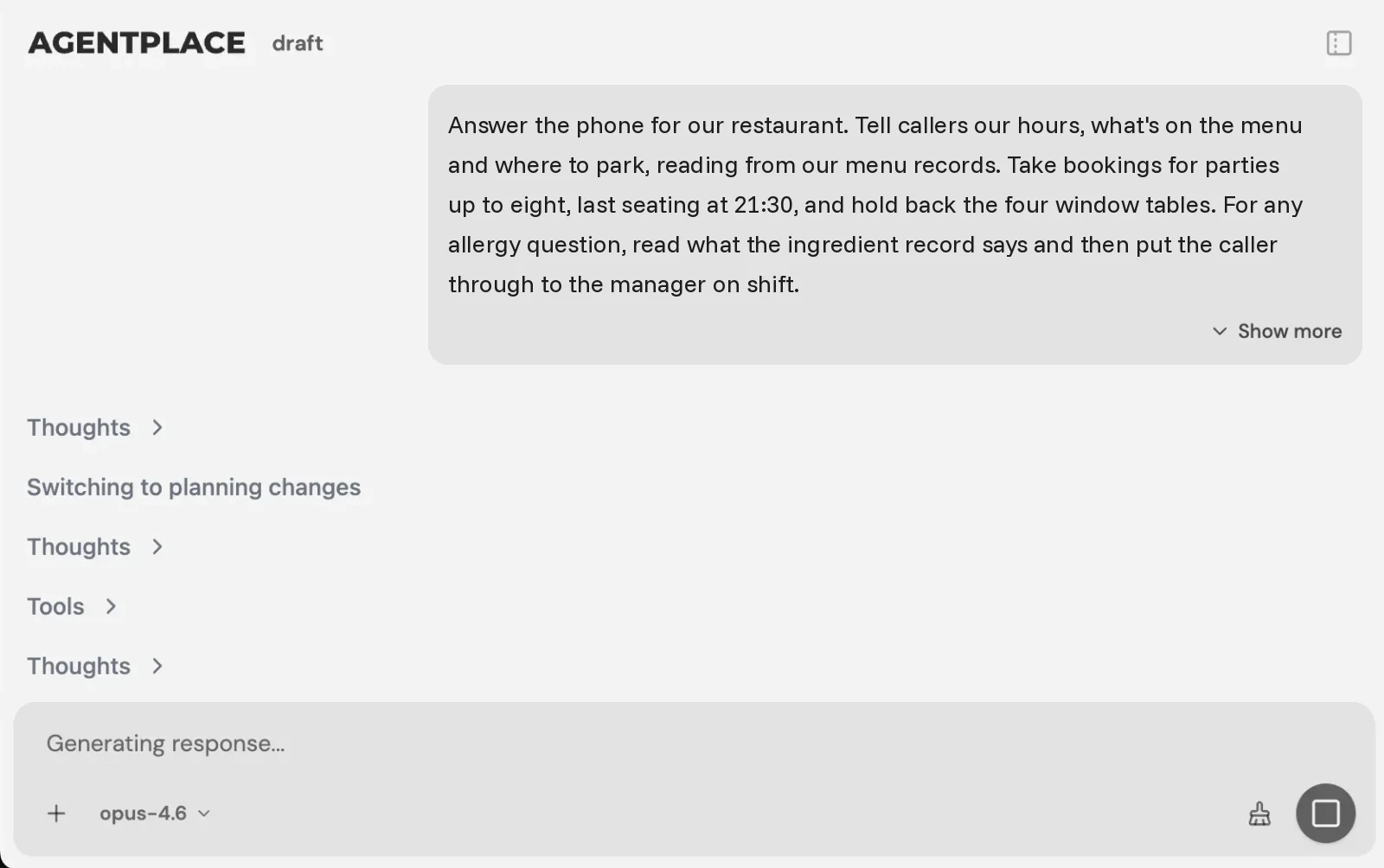 You describe the booking rules in plain language, and the AI Builder asks for whatever is missing.
You write the brief the way you would brief a new host:
“Build a booking agent for a 60-seat neighborhood restaurant. Ask the guest for the date, the time, the party size, a name and a mobile number. Accept parties of up to eight on our published seatings, using a two-hour table duration and a last seating 45 minutes before close. Never assign a specific table and never accept a booking on a date in our held-dates list. Send parties of nine or more, private event enquiries and deposit questions to Elena with everything already collected, and tell the guest she will reply within the hour. For any allergy question, report what our menu records and pass the question to the kitchen without reassuring the guest yourself. Offer a specific time only when live availability is reachable, and otherwise record a request marked as awaiting confirmation. Never describe a booking as confirmed unless the write into our reservation platform succeeded.”
What stays in the reservation platform?
Your reservation platform stays authoritative for everything structural about the book. The agent handles the conversation and writes into that platform only where a tested connection exists.
| What the agent does | What is needed |
|---|---|
| Answers questions about seatings, party limits, menus and your policies | Your written business knowledge, kept current |
| Collects a complete booking record | Your required details and a rule on what it must not ask for |
| Offers a specific time | Reliable availability through a supported, authorized integration |
| Writes the reservation into OpenTable, Resy, SevenRooms or another platform | A supported, authorized integration with that platform, tested on a real cover |
| Changes or cancels an existing booking | The same connection, plus your written rule on how late a change is allowed |
| Notifies a manager about a large party or an event enquiry | An available, authorized connection that supports the action |
| Sends a reminder before service | A configured scheduled task, within your consent obligations |
Agentplace connects to business apps through Composio’s integration catalog and compatible MCP tools. You authorize each account and the actions it may take.
Do not assume that publishing an agent gives it access to your table plan. Where no connection exists, the agent should hold the request and label it as awaiting confirmation.
The agent’s web page is the primary place a guest works with the full interface. Supported connections such as phone, WhatsApp or Telegram can extend the experience after setup.
Agentplace offers a free plan and paid plans that use AI credits. See the current pricing for the figures, and the public product reference for what the platform documents today.
A useful starting point is the AI reservations agent with Telegram access template. The wider set lives on the AI agents for restaurant groups page.
When does a restaurant not need an AI booking assistant?
Several common situations are answered better by something simpler, and most of them point away from an agent.
- Your reservation platform already takes nearly every booking. Guests book online without help, and missed calls are rare.
- You do not take reservations at all. A walk-in room with a waitlist needs a waitlist tool, such as the one inside Yelp Guest Manager or Resy.
- Your only gap is the unanswered phone. A voice assistant on the line, such as Slang.ai, costs less to set up than a full agent.
- Your book itself is the problem. If you are still running a paper diary, buy OpenTable, Resy, Tock or Toast Tables before you buy any assistant.
- You sell only prepaid tasting menus. Tock handles the deposit and the ticket, and there is little left to negotiate.
- Your booking rules are not written down yet. Write them first, because an assistant can only apply rules that exist.
- Guests reach your site or your messages, read the menu and leave without asking. That is the case where a customer-facing AI agent built with Agentplace earns its place.
Be realistic about what an assistant still needs from you. Somebody has to keep the held-dates list current and review the handoffs each service.
That person also answers the questions the assistant correctly refuses.
Quick checklist
Before you buy an AI booking assistant for your restaurant, confirm that you have:
- Written down your seatings, last seating time, table durations and maximum party size.
- Listed the dates you hold for private events, and named who keeps that list current.
- Decided which requests the assistant may confirm without a person.
- Named the manager who handles large parties and events, with a backup.
- Agreed the exact wording for a confirmed table and for a request awaiting confirmation.
- Set the allergy rule in writing before anything else goes live.
- Identified which platform holds your authoritative book.
- Watched a test booking land on a real cover in that platform.
- Checked your consent and opt-out process for confirmation and reminder messages.
- Run a party of twelve, a held date and an allergy question through the tool.
Related reading: How to take reservations when nobody can answer the phone · Best AI agents for restaurant websites · Answering menu and allergen questions online
Bottom line
Buy for the step where your bookings actually stop, and insist on seeing a real cover appear in your own reservation platform during the trial.
If the phone is the gap, Slang.ai or SevenRooms Voice AI will close it faster than anything else on this page. If the book is the gap, buy OpenTable, Resy, Tock, Toast Tables or Yelp Guest Manager first. If prepaid seats are the gap, Tock is built for it.
If guests arrive on your own channels and need to work out whether you can seat them, a customer-facing AI agent built with Agentplace gives them a page of their own. There they describe the party, see the seatings your rules allow and reach a booking.
Large parties, private events and allergy questions go to the person you named, with everything already collected.
Your restaurant stays responsible for the rules, the held-dates list and the tested connection. A named member of staff still confirms what the assistant could not.
Questions and answers
Frequently asked questions.
What is the best AI booking assistant for a restaurant?
For a restaurant that wants the guest to work out the table and reach a booking on its own page, a customer-facing AI agent built with Agentplace fits that job. If the only gap is the ringing phone during service, a voice assistant such as Slang.ai or SevenRooms Voice AI is the simpler buy.
Can an AI assistant confirm a restaurant reservation on its own?
It can confirm bookings your written rules already cover, and only when it has reliable availability through a supported, authorized integration with your reservation platform. Without that connection it should record a request, say plainly that the table is not yet confirmed, and name who will follow up.
Does an AI booking assistant replace OpenTable, Resy or SevenRooms?
No. Your reservation platform stays responsible for tables, covers, the floor plan and your deposit rules. An assistant answers the guest, applies your rules and writes the booking into that platform where a supported, authorized integration allows it.
Can an AI assistant answer the restaurant phone?
Yes, through a configured phone connection. SevenRooms Voice AI, Slang.ai, Loman and Popmenu Answering are all marketed for restaurant call handling. Test number routing, behavior after hours and the handoff to staff in your own account before you rely on any of them.
Which booking requests should always go to a person?
Large parties, private events and buyouts, specific table requests, bookings on dates held for an event, and any question about a food allergy. Each of these needs judgment, a contract or the kitchen, so the assistant should collect the details and name the staff member who follows up.
Can an AI booking assistant reduce no-shows?
It can send confirmation and reminder messages and explain your deposit policy where that policy is written down. Collecting a deposit or a prepaid seat happens in your reservation platform's own payment flow. Consent and opt-out obligations for those messages stay with your restaurant.
Can an assistant handle Instagram and WhatsApp booking requests?
Each channel is a separate setup, so treat it as a separate decision. Review a week of incoming requests first and start with the channel that carries the most unanswered ones. An agent's own web page is the place where the full booking interface works.
What should the assistant do when the time a guest wants is gone?
It should offer only the alternatives you have approved in advance, such as a later seating, the same party on another day, or a place on the waitlist if your platform supports one. It should never invent a time or describe a table as held when nothing was written.
How do I test an AI booking assistant before buying?
Run four scripted requests: a routine table for two, a party of twelve, a booking on a date you hold for private events, and a peanut allergy question. Record whether each ended in a confirmed reservation, a labeled request or a handoff to the right person.
Put this into practice
See the customer experience.
Explore a concrete example related to this article, then adapt the agent to your business.
Create my AI agentStart free with your business idea. The AI builder can help you explore it and create your agent. No technical specification needed. Sign in to continue. Pricing and limits · How the builder works