
Can ChatGPT Dots Answer the Restaurant Phone? Always-On Agents for Restaurants

The short answer
No. A ChatGPT dot can't answer the restaurant phone. It's something you create and use inside ChatGPT, with no number a guest can ring. A customer-facing AI agent built with Agentplace gives guests one, answers from your hours, menu and booking rules, and takes the reservation.
Key takeaways
- The phone rings hardest during service, when nobody can pick it up, and a missed call at 7pm is a table that goes to the restaurant down the road.
- A dot is something you create and use inside ChatGPT. There is no number for a guest to ring.
- A customer-facing AI agent answers the four questions most callers have, open, table, menu and parking, and takes the booking.
- Allergens are the one thing the agent must never answer from memory. It says it will check with the kitchen.
- Start by writing those four answers and your allergen line, then connecting the booking system.
The short answer
No. A ChatGPT dot can’t answer the restaurant phone.
It’s something you create and use inside ChatGPT. There’s no customer-facing page, phone number, or interface for a guest to ring.
The phone is different. A customer-facing AI agent built with Agentplace gives guests a number and a page where they can reach the agent. The agent does three things:
- Answers the four questions most callers have, from your own hours and menu.
- Checks the real booking system and takes the reservation.
- Routes what it shouldn’t answer: allergens, large groups, complaints.
If your bookings already come through your booking platform and the phone barely rings, you don’t need this.
Why does the restaurant phone go unanswered?
Because it rings hardest when every pair of hands is on the floor.
Example: A caller at 7:10pm on a Friday.
“Hi, do you have a table for four tonight around 8? And is the risotto vegetarian?”
Here’s what usually happens to that call:
| Option | What the guest gets | What the restaurant gets |
|---|---|---|
| Nobody picks up | A ring-out, then the next restaurant | Nothing. The table goes elsewhere |
| Someone picks up mid-service | A rushed answer | A dropped plate somewhere |
| Voicemail | A beep, at 7pm, about tonight | A message about a table that’s gone |
| Online booking only | A booking, if they’re on the site | The phone callers lost |
The call is worth a table tonight, and it has a shelf life of about a minute.
Rule of thumb: a call at 7pm about tonight either converts now or it doesn’t convert.
Which calls can the agent take?
Most of them, and the exceptions matter.
| Call | Agent handles it | Why |
|---|---|---|
| Are you open, hours, holidays | Yes | Facts you wrote down once |
| Table for tonight, bookings, changes | Yes | Reads your real booking system |
| What’s on the menu, prices, dishes | Yes | Reads your menu records |
| Parking, access, dress code | Yes | Same |
| Is this dish safe for my allergy | No | Reads the ingredient record, then hands to a manager |
| Twelve people, a buyout, a private room | No | Collects date, size and occasion, then routes |
| A complaint about last night | No | Goes straight to a manager |
Rule of thumb: if getting it wrong could hurt somebody, the agent reads and routes. It does not decide.
How do you cover the phone, step by step?
1. Write the booking rules you actually use
Party size limits, how late you seat, which tables you hold back, how long a sitting runs. Staff know these. The agent can’t guess them.
2. Put the menu somewhere the agent can read
Dishes, prices and ingredients, kept current. A stale menu answered confidently is worse than no answer.
3. Set the allergen rule before anything else
The agent reads what the ingredient record says and then hands over. It never confirms safety.
Example: The agent, on the allergen question.
“The risotto is made with vegetable stock and no meat, according to our menu record. For an allergy I’ll put you through to the manager on tonight, because they check with the kitchen directly.”
4. Connect the real booking system
A table the guest believes in and the floor plan doesn’t know about is a bad Friday.
5. Decide what happens at closing time
The agent should know you’re shut, say when you open, and take tomorrow’s booking rather than nothing.
Can a ChatGPT dot do this?
No, and it isn’t close.
Dots are OpenAI’s always-on agents, launched 29 September 2026. A dot keeps working between conversations, has its own cloud computer, and reaches apps you authorise. All of that happens inside the account of whoever created it.
That’s the wall. Your guest has no number to ring.
As it shipped: one dot per account, paid ChatGPT plans only, and no Pro access in the EEA, Switzerland or the UK.
A dot works on the operator’s side. A guest-facing agent works on the guest’s side.
What tools can help cover restaurant calls?
| Option | What it’s for | Where it stops |
|---|---|---|
| Customer-facing AI agent built with Agentplace | Answering the call, checking the real book and taking the reservation, by phone or on its own page | It isn’t your booking platform, and it never clears an allergy |
| Live answering service | A human voice on every call | Takes a message. Can’t see your book |
| OpenTable, Resy and other booking platforms | Tables, covers, the floor plan, online bookings | They take bookings from the web, not from the phone |
| Voicemail | Nothing, at 7pm on a Friday | The call is already lost |
| ChatGPT Dots | The operator’s own work | Not guest-facing. No number to ring |
Nothing here was bench-tested. The rows describe what each category is designed to do, read from vendor documentation in October 2026.
How does Agentplace cover the restaurant phone?
Agentplace lets you create an AI agent with its own web page and URL. It uses your business knowledge to work with clients through text, voice, and a personal interface that changes with their request.
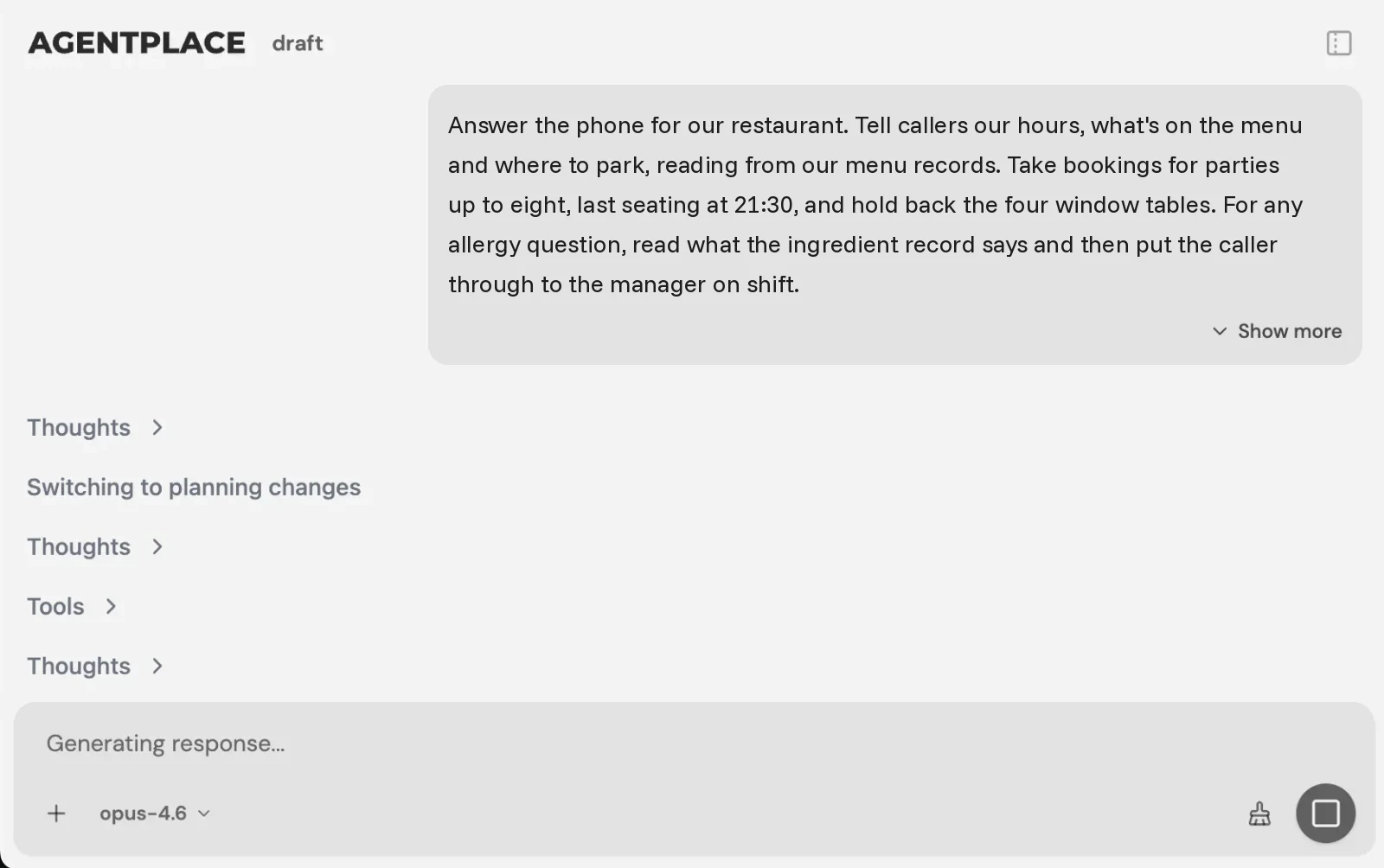 You describe your hours, booking rules and menu. The builder writes the agent.
In practice, it works like this:
- The guest rings the number or opens the agent’s page.
- The agent answers from your hours, menu and policies.
- It checks the real booking system for the party size and time.
- It takes the reservation and confirms it.
- Allergens, groups and complaints stop the conversation and go to a manager.
You set it up by describing the outcome in plain language, for example:
“Answer the phone for our restaurant. Tell callers our hours, what’s on the menu and where to park, reading from our menu records. Take bookings for parties up to eight, last seating at 21:30, and hold back the four window tables. For any allergy question, read what the ingredient record says and then put the caller through to the manager on shift. Send groups over eight and any complaint to the manager too. When we’re closed, say when we open and take tomorrow’s booking.”
The AI Builder discusses the idea, clarifies requirements, creates the agent and helps test it. You choose when to publish. No code is required.
What stays where it is:
- Your booking platform keeps tables, covers and the floor plan. The agent writes reservations into it where a supported connection exists.
- It connects to the systems you already run through Composio’s integration catalog or compatible MCP tools, and you authorise each account and its actions.
- Records carry access classes enforced server-side, so a guest sees their own booking and nothing else.
Pricing: Agentplace has a free plan and paid plans that use AI credits. A credit is not a guest message. See pricing.
Template to start from: AI answering agent
When don’t you need an AI agent?
- Bookings are online and the phone barely rings? You don’t have this problem.
- A host stands by the phone all service? Keep them. That’s better.
- You need tables, covers and the floor plan? That’s your booking platform, and it stays.
- The gap is covers on a Tuesday? That’s marketing, not reception.
- Your menu isn’t written down anywhere current? Fix that first.
- Calls ring out at 7pm on a Friday? That’s where a customer-facing AI agent built with Agentplace fits.
Quick checklist
- Write the booking rules: party size, last seating, tables held back, sitting length
- Put the current menu with ingredients where the agent can read it
- Write the allergen rule: read, then hand to the manager on shift
- Name who takes groups, buyouts and complaints
- Connect the real booking system, not a copy
- Track calls answered, bookings taken by phone, and handovers that were correct
Related reading: AI agents that book appointments · what Dots by ChatGPT are · one agent instead of a chatbot and a form
Bottom line
The restaurant phone rings hardest during service, which is exactly when nobody can answer it.
- If your bookings come through the web and the phone is quiet, skip this.
- If calls ring out at 7pm on a Friday, give guests a customer-facing AI agent built with Agentplace. It answers from your hours and menu, takes the booking into your real system, and hands allergens, groups and complaints to the manager on shift.
Questions and answers
Frequently asked questions.
What is a restaurant answering service?
It handles calls when your staff are serving. A live service puts a person on the line who takes a message. An AI version answers the guest, checks your real booking system, takes the reservation, and routes anything it should not answer.
Can a ChatGPT dot answer the restaurant phone?
No. A dot is something you create and use inside ChatGPT. There is no customer-facing page or phone number for a guest to ring. A dot can help with your own work, but a guest cannot reach it.
Can an AI agent take a reservation?
Yes, where it is connected to your booking system and given rules about party size, timing and tables you hold back. Without that connection it can take the request and pass it on. Ask any vendor to show a booking landing in your own system.
What should a restaurant agent never do?
Confirm that a dish is safe for an allergy. It can read what your menu records say about ingredients and then hand the guest to a manager. Allergen safety is a kitchen decision, not a software one.
Does this replace OpenTable or Resy?
No. Your booking platform stays the source for tables, covers and the floor plan. The agent handles the call and writes the reservation into the system you already run.
What about large groups and private events?
Route them. A group of twelve or a buyout is a conversation with a manager about minimums and deposits. The agent should collect the date, size and occasion, then hand over.
Can it handle takeaway orders?
It can take the details and pass them to your ordering system where a supported connection exists. Payment is a separate question and depends on what your own systems do.
How long does setup take?
The work is mostly writing down what you already tell guests: hours, the booking rules, what you hold back, and who takes allergen and group questions. A focused build takes days rather than months.
Put this into practice
See the customer experience.
Explore a concrete example related to this article, then adapt the agent to your business.
Create my AI agentStart free with your business idea. The AI builder can help you explore it and create your agent. No technical specification needed. Sign in to continue. Pricing and limits · How the builder works