
What Is an AI Receptionist for a Salon? A Plain Definition
A salon AI receptionist is software that answers calls, texts and website chats, explains services and policies, helps a client choose what to book, checks live availability, books or reschedules, and hands anything unusual to a person. It is not a chatbot, not an answering service, and not salon management software.
Key Takeaways
- A salon AI receptionist answers the client and completes the booking. A chatbot answers and stops. A missed-call text-back tool acknowledges and stops. The difference is what happens after the first reply.
- Salon management software stays the system of record for the calendar, payments and staff. The receptionist handles the conversation around the booking and writes the result back into it. A salon rarely has to choose.
- Roughly half of salon appointments are booked outside opening hours, per Boulevard's 2025 booking data. That is the demand an answering machine cannot serve.
- The hard question is not 'do you have Thursday at two'. It is 'what should I book'. Most clients describe a result rather than a service name, and that is the request a booking link cannot resolve.
- Expect to pay nothing for a text-back tool bundled into software you already own, and from roughly $30 to $600 a month for something that holds a conversation, depending on whether a phone system comes with it.
A stylist mid-foil cannot answer the phone. A solo esthetician between clients is not reading Instagram DMs. And roughly half of salon appointments are booked outside opening hours, according to Boulevard’s 2025 booking data. This page explains what an AI receptionist actually is, before any question of which one to buy.
A salon AI receptionist is software that answers calls, texts or website conversations, answers questions about services and policies, helps clients choose what to book, checks availability, books or reschedules appointments, and escalates exceptions to staff.
That definition has four parts, and a tool that does only the first two is something else. Plenty of products in this category answer and stop.
Build a Salon Receptionist Around Your Own Menu
Describe your services, price ranges and policies in plain language, and the builder produces an agent that answers and books.
Build Your Salon Agent Free →What Does a Salon AI Receptionist Actually Do?
Six things, and they run in order:
- Answers, on whichever channel the client used, within seconds.
- Explains, covering services, price ranges, duration, hours, parking, and the cancellation policy.
- Advises, which is the part that separates this category from everything else. A client says she wants to go lighter without wrecking her hair; the receptionist works out whether that is a balayage, a partial highlight or a consultation first.
- Checks availability against a live calendar, not a static list.
- Books, reschedules or cancels, and states your deposit and cancellation policy as part of the confirmation.
- Escalates anything you have told it to escalate.
What Does It Not Do?
Being precise here saves a disappointing trial.
- It does not exercise judgement about people. Complaints, adverse reactions to a treatment, and a client who is upset all need a human, and a well-configured agent routes them to one immediately.
- It does not know your salon by default. Everything it says accurately is something you configured. A tool that answers instantly with the wrong price is worse than voicemail.
- It does not replace your booking platform. It reads and writes to it.
- It does not fix a broken calendar. If your availability data is wrong, the receptionist books the wrong slot faster.
AI Receptionist vs Chatbot: What Is the Difference?
A chatbot answers questions. An AI receptionist answers questions and then finishes the job.
The practical test is whether the tool can reach your calendar. A chatbot that cannot will always end the conversation by handing the client to a booking page, which is exactly the moment undecided clients leave. Everything else, the tone, the speed, the widget, is secondary to that.
AI Receptionist vs Answering Service: Which Is Which?
An answering service is people. They take a message, follow a short script and pass it on, and they are charged by call volume. They are genuinely better at unusual and emotional calls, and worth keeping for them.
An AI receptionist is software at a flat rate. It never closes, handles many calls at once, and applies your rules identically every time. It is weaker exactly where the human service is strong.
Most salons that run both use the human service for daytime overflow and the AI for nights and weekends. That is not a compromise; it is matching each to what it is good at.
AI Receptionist vs Salon Booking Software
This is the confusion that costs salons the most money, because vendors on both sides encourage it.
| Salon management software | AI receptionist | |
|---|---|---|
| Calendar and system of record | Primary function | Reads and writes when connected |
| Point of sale | Usually | Not necessarily |
| Payroll and commissions | Sometimes | No |
| Answer open-ended client questions | Usually no | Yes |
| Help a client choose a service | Limited | Yes |
| Answer a ringing phone | Rare | Yes |
| Book conversationally | Sometimes | Yes |
| After-hours requests | Scheduled automation | Conversation |
The management system stays the system of record. The receptionist handles the conversation around the booking. If you are trying to work out which platforms now bundle one, we compared eight in which salon software has built-in AI.
What Is Missed-Call Text-Back, and Is It the Same Thing?
No, and the distinction is worth holding onto because the two are sold under one heading.
Missed-call text-back sends an automatic message the moment a call goes unanswered. It is cheap, often already included in software you own, and it genuinely helps: the client knows you exist and has a thread to reply into.
An AI receptionist differs from a missed-call text-back tool because it can continue the conversation rather than only acknowledging the missed call. When the client texts back “do you do colour correction on box dye?”, the text-back tool has nothing. That reply is where the booking is won or lost.
How Does Booking Actually Work?
Three arrangements, and they are not equivalent.
Direct calendar connection. The receptionist reads live availability and writes the appointment into your platform. This is what you want.
Webhook or middleware. The receptionist collects the details and pushes them through a connector. Works, but adds a failure point, and a silent failure here means a client who thinks she is booked and is not.
Message handoff. The tool collects the request and someone books it in the morning. Sold as booking. It is not.
Ask any vendor to demonstrate the first, into your own calendar, during the trial.
How Do After-Hours Calls Work?
Unless you configure otherwise, exactly like daytime calls. There is no separate night mode to switch on.
What is worth configuring is the difference in what you allow. Many salons let the agent book freely into next week overnight but hold anything for the following morning until a person confirms. That is a rule you set, not a limitation of the software.
What Should a Salon Configure Before Switching It On?
The configuration is the product. Skipping it is why trials fail.
- The full service menu, with price ranges rather than exact prices where the price depends on hair length or condition.
- Which stylists do what, by name.
- The cancellation and deposit policy, in the words you would actually say.
- What must never be answered by software: complaints, reactions, anything medical-adjacent.
- What may be booked without confirmation, and what may not.
How Much Does an AI Receptionist Cost?
Three price bands, and they buy different things.
| Band | Typical monthly cost | What it buys | What it cannot do |
|---|---|---|---|
| Bundled missed-call text-back | Often included in software you own | An automatic acknowledgement within seconds | Answer the reply it gets back |
| Conversational agent | From roughly $30 | A conversation, live availability and a booking | Replace your phone system |
| Phone system with AI answering | Roughly $200 to $600 | The above, plus handsets, routing and a new line | Leave your existing number where it is |
Bands are what the working configuration costs, not the entry plan. Verify current pricing on each vendor’s own page before you buy.
Price the configuration that does the job, not the entry plan. The gap between the two is where most of this category’s surprises live.
When Should a Salon Get One?
Count first. For one week, log every unanswered call, DM and web enquiry, split by time of day, and mark which ones you later won anyway. Most salons find the loss is concentrated in one channel and one time window they were not watching.
If that window is evenings and weekends, or mid-treatment when nobody can reach the phone, this is the gap an AI receptionist fills. If your enquiries are mostly regulars asking for their usual slot, better reminders and a booking link will get you most of the way for nothing.
Example: Building a Salon AI Receptionist With Agentplace
Now that the category is clear, here is one way to build one. Agentplace publishes this article, so read this section as a worked example rather than a neutral recommendation.
Agentplace is a no-code AI agent builder. It is not a packaged receptionist product and not salon management software. You describe the salon in plain language, and the builder produces an agent that runs the website, answers the phone number you already publish, and books into the scheduling system you already run.
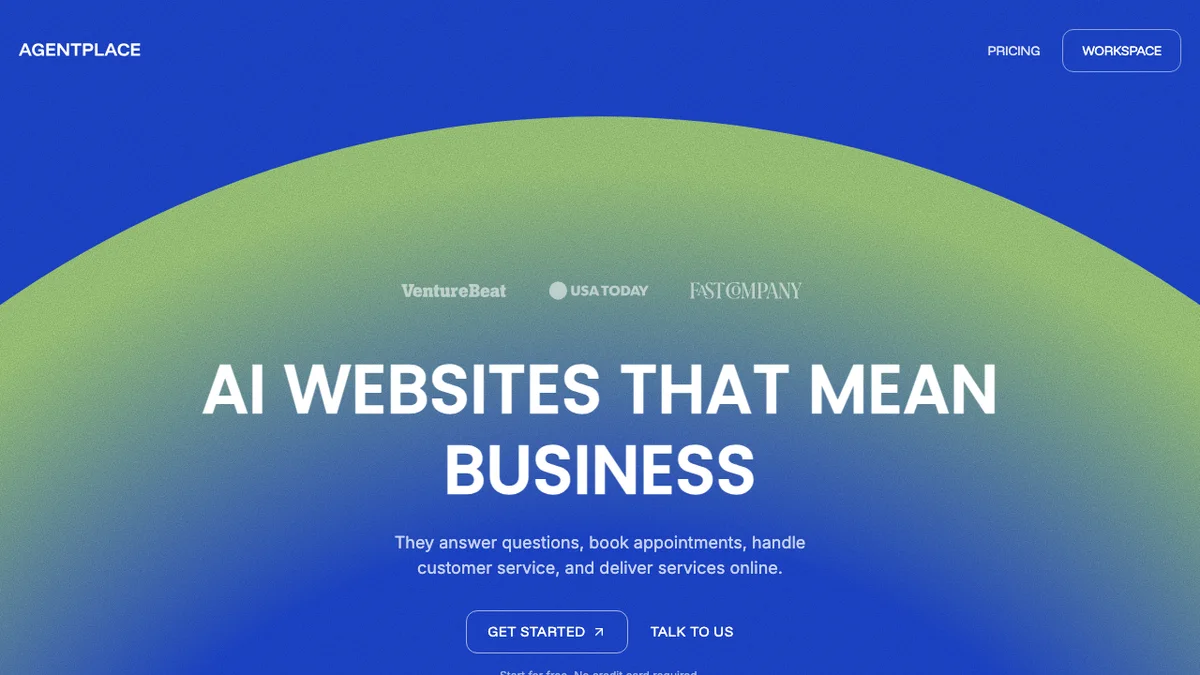 Agentplace’s public homepage, captured July 2026.
What you describe. Your service menu and price ranges, which stylists specialise in what, your deposit and cancellation policy, and the situations that must go to a person.
What the agent then does. Answers on the website, by voice and on connected messaging channels. Asks what result the client wants rather than which service she wants. Maps that to your menu, quotes your ranges, checks live availability, books, and hands over complaints and complex bookings with the thread attached.
Where it is the wrong choice. If you want a phone system with handsets as part of the purchase, Podium and Weave sell that and this does not. If you already run Zenoti, its AI Receptionist is native and worth evaluating first. If all you want is an automatic text after a missed call, this is more than you need.
Pricing is free to start with 2,000 credits, $29 a month on Pro for 15,000 credits, and custom for Business.
If you are ready to compare specific products, our best AI receptionist for salons comparison ranks ten of them against the same seventeen criteria, with pricing sources.
The bottom line. An AI receptionist is defined by what it finishes, not by what it answers. It should take a client from an open question about what to book, through your prices and policies, to an appointment in your real calendar, and know which conversations to hand to a person. Anything that answers and then stops is a chatbot or a text-back tool, both of which are useful and neither of which is this.
Frequently Asked Questions
What is an AI receptionist for a salon?
Software that answers clients when staff cannot. It greets them on the phone, by text or on the website, answers questions about services, hours and policies, helps them decide what to book, checks live availability, books the appointment, and escalates anything unusual to a person.
Can AI answer calls for a salon?
Yes. An AI receptionist can take an inbound call, hold a spoken conversation, quote price ranges, check a connected calendar and book during the call. Quality depends almost entirely on how well it has been configured with the salon's own menu, prices and policies.
How does AI handle salon calls after hours?
The same way it handles daytime calls, unless you tell it otherwise. It answers, explains what is available, checks the calendar and books. That matters because roughly half of salon bookings happen outside opening hours, which is when no human is there to take them.
What is the difference between an AI receptionist and a chatbot?
A chatbot answers questions. An AI receptionist answers questions and then completes the task: it checks live availability, books the appointment into a real calendar and writes the record. A chatbot that cannot reach your calendar can only ever hand the client back to a booking page.
What is the difference between an AI receptionist and an answering service?
An answering service is staffed by people who take a message and pass it on, charged by call volume. An AI receptionist is software charged at a flat rate that answers and books directly. People handle unusual and emotional calls better; software handles volume and after-hours better.
Is an AI receptionist the same as salon booking software?
No. Salon booking software is the system of record: the calendar, client history, payments and staff. An AI receptionist is the conversation in front of it. Some booking platforms now bundle one, and most do not, which is the single most common point of confusion in this category.
What is missed-call text-back for salons?
An automatic text sent the moment a call goes unanswered, usually saying the salon missed the call and will get back to you. It is useful and cheap, and it stops there. If the client replies with a question, a text-back tool has nothing that answers it.
Can an AI receptionist book a salon appointment on its own?
Yes, if it is connected to a live calendar and given rules about what it may book. Without that connection it can only collect the request and pass it on. Ask any vendor to demonstrate the booking landing in your own calendar, not a mock one.
How much does an AI receptionist for a salon cost?
Text-back is often bundled into software you already pay for. Tools that hold a conversation range from roughly $30 a month to $600 or more, and the top of that range usually means a phone system is included. Price the working configuration, not the entry plan.
When should a salon get an AI receptionist?
When you can point to bookings you lost rather than calls you missed. Count unanswered calls, DMs and web enquiries for a week, split by time of day. If the loss is concentrated after hours or mid-treatment, that is the gap this fills.
Does an AI receptionist replace the front desk?
No, and treating it that way is the usual mistake. It covers the hours and the moments a person cannot: evenings, weekends, and mid-treatment when nobody can reach the phone. Complaints, adverse reactions and complex bridal bookings still need a person.
Ready to deploy AI agents that actually work?
Agentplace helps you find, evaluate, and deploy the right AI agents for your specific business needs.
Get Started Free →


