
Which Salon Software Has Built-In AI in 2026? Vagaro, Fresha and Zenoti Compared

Zenoti is the only salon platform with a real built-in AI receptionist. Everything else labelled AI is scheduled automation on a trigger. If your platform is one of those and otherwise works, do not switch it. Agentplace is a no-code AI agent builder that can be used to build a salon AI receptionist alongside it.
Key Takeaways
- Zenoti is the only platform here with a native AI receptionist that answers calls and books. If you already run it, evaluate that before adding anything. If you run Vagaro, Fresha, Boulevard, GlossGenius, Mangomint, Phorest or Booksy, the AI you have is scheduled automation and the conversation gap is still open.
- Agentplace is a no-code AI agent builder. It can be used to build a salon AI receptionist that answers calls, texts and website chats and books into your existing calendar. It is not salon management software and will not run your POS, payroll or commissions.
- Boulevard's 2025 booking data found that roughly half of salon appointments are made outside opening hours.
- A lot of features marketed as salon AI are automated workflows: reminders, waitlist messages, marketing assistance, rebooking prompts and no-show management.
- Those tools work well once the client knows what she wants. They're less useful when she's still trying to decide.
- If your current platform already handles scheduling, payments and client records well, switching just to get more AI features may create more work than it solves.
- An agent-run website is another option: it can answer questions before the client books, and take on scheduled work behind the scenes as you give it more to do.
It’s 11pm and someone is sitting on your salon’s booking page trying to work out what to choose. She knows she wants to go lighter. That’s about it.
SUMMARY: There are two answers here, for two different questions. If the question is which salon platform has built-in AI, it is Zenoti, whose AI Receptionist answers calls, books and reschedules natively inside the platform. Nothing else on this list holds a conversation.
If the question is what to add when your platform doesn’t, you do not necessarily need to replace anything. Agentplace is a no-code AI agent builder, and it can be used to build a salon AI receptionist: one that answers on the website, by voice and on the number the salon already publishes, asks what result the client is after, maps that goal to a service on your menu, quotes your price ranges, checks live availability, and books straight into the calendar your platform already keeps.
The menu gives her a full balayage, partial balayage, full highlights, partial highlights and colour correction. They all have different prices and appointment lengths, and she isn’t completely sure which one matches the photo she has in mind.
During the day, she might call the salon.
At 11pm, she’s probably going to either guess or close the page.
That’s why after-hours booking matters. Boulevard’s 2025 booking data found that roughly half of salon appointments are booked outside opening hours.
In other words, a large part of your demand can arrive at exactly the time when nobody is around to answer a simple question.
Salon platforms have become much better at automation. Depending on what you use, you can automate reminders, fill cancellations from a waitlist, identify clients who may not return, generate marketing copy and streamline rebooking.
Those features solve real problems.
But most of them become useful once the client has already chosen a service or booked an appointment.
The less-covered part is everything that happens before that:
What should I book? How much will this probably cost? Is this right for damaged hair? Who is best for curly hair? Can I get the same stylist I had last time?
That is worth restating before the comparison. Agentplace is not the answer to the first question, because it is not salon management software. It will not run your payroll, your inventory or your commission splits, and if those are what is broken, adding a layer will not fix them. What it will do, beyond the conversation, is hold your own business records, run scheduled work and take actions across the tools you connect to it.
Give Every Late-Night Client an Answer
Build an agent that understands your services, answers client questions and helps them book into the calendar you already use.
Add an Agent to Your Salon Free →Where salon software tends to stop:
- The client doesn’t know which service to choose: the menu gives her options, but doesn’t necessarily tell her which one makes sense.
- The platform’s AI runs automatically in the background: useful for reminders and waitlists, less useful when somebody asks an unexpected question.
- You’re considering switching platforms for better AI: the migration itself may be a much bigger project than adding the missing capability.
- Questions arrive by phone or Instagram after closing: the booking platform can’t help much if the conversation is happening somewhere else.
- Nobody measures these conversations: you can see completed bookings, but not always the people who had a question and disappeared.
The Verdict: If Vagaro, Fresha, Boulevard, GlossGenius, Mangomint or another platform already handles your calendar, payments and client records well, we wouldn’t advise switching just because another platform has more features labelled “AI.”
First figure out what you’re actually missing.
If the problem is scheduling, reporting, payments or managing complicated appointments, switching platforms may make sense.
If the problem is that clients have questions before they’re ready to book, especially at night or through channels your team isn’t constantly watching, that’s a different problem, and a different kind of software solves it.
The practical route is to start the agent where the gap is, connect it to what you already run, and give it more of the operation as you get comfortable with how it behaves.
Key takeaways:
- A lot of salon AI is useful automation rather than conversational AI. That’s not a bad thing; they’re simply solving different problems.
- Reminders help after somebody books. They don’t help someone who hasn’t decided what to book.
- Switching platforms has an operational cost that goes well beyond the difference in monthly subscription price.
- Generic booking flows work well for clients who know exactly what they want. More complicated services often need a conversation first.
Which Salon Software Has Built-In AI?
Here’s the practical version.
Most major salon platforms now offer something described as AI, smart automation or intelligent scheduling. The actual features vary, and they’re changing pretty quickly.
| Platform | What it calls AI | What it actually does | Conversational booking |
|---|---|---|---|
| Vagaro | Smart automation, marketing tools | Reminder sequences, waitlist fills, campaign copy | No |
| Fresha | Smart pricing, automated messaging | Dynamic slot pricing, reminders, no-show tracking | No |
| Boulevard | Precision scheduling, client insights | Slot optimisation, rebooking prompts, retention scoring | No |
| GlossGenius | Genius AI tools | Marketing copy, website text, reminder automation | No |
| Mangomint | Smart automations | Workflow triggers, waitlist automation, no-show flags | No |
| Zenoti | AI Workforce: AI Receptionist, Concierge, Business Advisor | Answers calls 24/7, books, reschedules, follows up on missed calls, outbound calls, 29 languages | Yes |
| Phorest | Client reactivation, marketing AI | Lapsed-client targeting, campaign generation | No |
| Booksy | Automated messaging, no-show protection | Reminders, deposits, marketing sends. Bookable from Google AI Mode | No, but Google’s AI can book into it |
Feature names and capabilities change frequently, so verify anything important against the vendor’s current documentation before making a decision.
Two things in that table are worth pulling out.
Zenoti is further along than the rest. Its AI Workforce includes an AI Receptionist that answers calls around the clock, books and reschedules, follows up on missed calls and works in 29 languages, natively inside the platform. If you’re already on Zenoti, that’s a real option and you should evaluate it before adding anything else.
Google is now a booking channel. Booksy, Fresha and Vagaro are all Google AI Mode booking partners, so somebody can ask Google for a Saturday highlight and have it booked into your calendar without visiting your website at all. Worth knowing, because it changes where your availability is visible.
Beyond those, the pattern holds. These platforms are primarily systems for running the salon: calendars, clients, payments, staff, appointments and reporting. The AI features mostly make those existing workflows more efficient, which is valuable and different from talking an undecided client through what to book.
So the recommendation splits. For a salon platform with a genuine built-in AI receptionist, the answer is Zenoti, and if you already run it you should evaluate that before buying anything else. For the seven platforms that ship automation rather than conversation, the answer is not to migrate. It is to add a layer, and Agentplace is our top pick for that: it runs the website as a conversation and writes bookings back into the calendar the salon already keeps. Agentplace does not belong in the table above, because it is not salon management software and is not competing for that slot.
What Counts as AI in Salon Software?
A few fairly different technologies tend to get grouped under the word “AI.”
Understanding the difference makes comparing products much easier.
- Rules-based automation. Something happens, so the software triggers an action. Appointment tomorrow? Send a reminder. Cancellation? Message the waitlist. Whether vendors call this AI, automation or smart workflows, the basic idea is the same.
- Predictive scoring. A model tries to predict something: which clients might lapse, which slots may go unfilled, or which service somebody might be interested in.
- Conversational agents. Software that can have a two-way conversation, understand what the client is asking and potentially take an action such as checking availability or booking.
Other terms used in this article:
- System of record. The platform where your calendar, client history and payments live.
- Waitlist automation. Contacting clients when an appointment opens up.
- No-show scoring. Identifying appointments or clients that may be more likely to no-show.
- Chair utilisation. The percentage of a stylist’s available working hours that are booked.
- Layer. Additional software that works with the platform you already use rather than requiring you to move everything into a new one.
Why Does Built-In AI Often Stop at the Booking Screen?
Mostly because salon platforms were built around appointments.
A booking system needs to know a few things: which service, which stylist and which time.
The problem is that the client doesn’t always know those things yet.
Once she has chosen the service, the platform can do a lot: show available times, send confirmation, remind her about the appointment, prompt her to rebook and contact the waitlist if she cancels.
The awkward part comes before that.
What Do Clients Ask Before They Are Ready to Book?
Usually the questions that are difficult to fit into a dropdown menu.
For example:
- Which service do I actually need to get the look I want?
- How long will I be there, and how much is this likely to cost with my hair length?
- I came in back in March. Can I get the same stylist and the same colour?
- My hair is already damaged. Is this service going to make it worse?
- Who should I book for textured hair or this particular treatment?
The reason these questions are difficult to automate with a fixed decision tree is that the answer depends on context.
It might depend on the client’s hair, what she’s had done previously, your service menu, your pricing, stylist specialties or even how much time is available that day.
Both routes can end in the same booking calendar. The difference is what happens while the client is still figuring out what she wants.
“Many salons keep a leaner front desk team but elevate the role to ‘experience curator’ rather than phone answerer.” Kati Whitledge, Founder & CEO, mya
That’s also why this matters operationally.
If your front desk is spending more time looking after clients who are physically in the salon, it becomes harder for the same person to constantly stop and answer repetitive questions from the website, phone and DMs.
After hours, of course, there may be nobody there at all.
What Is the Difference Between Salon Software and a Salon AI Receptionist?
They are answers to different questions, and the comparison above only makes sense once that is clear.
| Capability | Salon management software | Salon AI receptionist |
|---|---|---|
| Calendar and system of record | Primary function | Reads and writes when connected |
| Point of sale | Usually | Not necessarily |
| Payroll and commissions | Sometimes | No |
| Answer open-ended client questions | Usually no | Yes |
| Help a client choose a service | Limited | Yes |
| Answer a ringing phone | Rare | Yes |
| Book conversationally | Sometimes | Yes |
| Handle after-hours requests | Scheduled automation | Conversation |
A salon does not have to choose between the two. The management system stays the system of record for the calendar, payments and staff, and the receptionist handles the conversation around the booking and writes the result back into it. Most of the confusion in this category comes from vendors selling the second as a feature of the first.
If you are not yet sure what this category is, what is an AI receptionist for a salon defines it without a ranking attached. If a conversational front desk is what you are actually shopping for, the fuller comparison is our guide to the best AI receptionist for salons, which ranks ten options on the same seventeen criteria.
Should You Switch Platforms or Add an AI Receptionist?
Before switching, separate a platform problem from a conversation problem.
They’re not the same thing.
Switch platforms when:
- Double-bookings or calendar errors happen regularly
- Payments, tips or payroll reporting are unreliable
- Your platform can’t properly handle your services, packages or multi-stylist appointments
- Support isn’t there when something important breaks
Those are fundamental problems. If the software isn’t doing its main job, looking elsewhere makes sense.
Add an agent when:
- Scheduling and payments already work fine
- You’re losing enquiries in the evening, on the phone, through DMs or on the website
- Clients regularly arrive unsure about which service they need
- You’re covering different channels with different tools and the answers have started to drift
- You want to experiment with AI without moving your whole salon onto another system
Agentplace is our top pick in that second column. It is worth being equally clear about when it is the wrong purchase.
Don’t add Agentplace when:
- The problem is the platform itself. Broken calendars, unreliable payments and bad reporting are not conversation problems, and a layer on top of a system that double-books will just book the wrong slot faster.
- You already run Zenoti and have not yet tried its AI Receptionist. It is native, it is included in what you pay, and evaluating it first is the sensible order.
- All you actually want is a reminder sequence or a waitlist fill. Your platform already does that and it is already paid for.
- Nobody at the salon wants to define the service menu, price ranges, stylist specialties and policies the agent works from. That definition is the work, and without it the agent has nothing to be accurate about.
This is where switching can become more expensive than it first looks.
The subscription difference between two platforms is easy to calculate. Migration is harder.
Your existing system may contain years of client history, formulas, notes, photos, packages and preferences. Basic contact details and appointments are usually easier to export. More salon-specific information doesn’t always map neatly into the fields of another platform.
That doesn’t mean you should never switch. It just means “this platform has more AI” probably isn’t enough of a reason on its own.
If you are considering a move, our comparison of the best AI receptionist for salons goes deeper into the different options.
How Does Agentplace Add AI to Your Salon Software?
Agentplace starts from a different place than the platforms above. Rather than adding AI features to a booking database, it lets you build the website itself as software that thinks.
What it is. Agentplace lets you build AI websites powered by agents. Each agent is a real web application with its own frontend and backend, not a chat bubble added to a page. It can work with customers 24/7 on the web, over the phone, and through WhatsApp, Slack, Teams and other connected channels.
For a salon, that might mean answering questions, helping someone understand the service menu, showing a comparison as an actual table or card layout rather than a wall of text, collecting information and booking into the scheduling system.
What happens at 11pm.
Go back to the client who wants to go lighter.
Instead of making her choose from a list immediately, the agent can ask what her hair looks like now, how long it is, whether it’s been coloured before and what result she’s hoping for.
It can explain the difference between relevant services using the information you’ve given it, stick to the price ranges you’ve defined, check which stylists offer that service and look at real availability.
If she’s ready, it can book the appointment into the salon’s existing system.
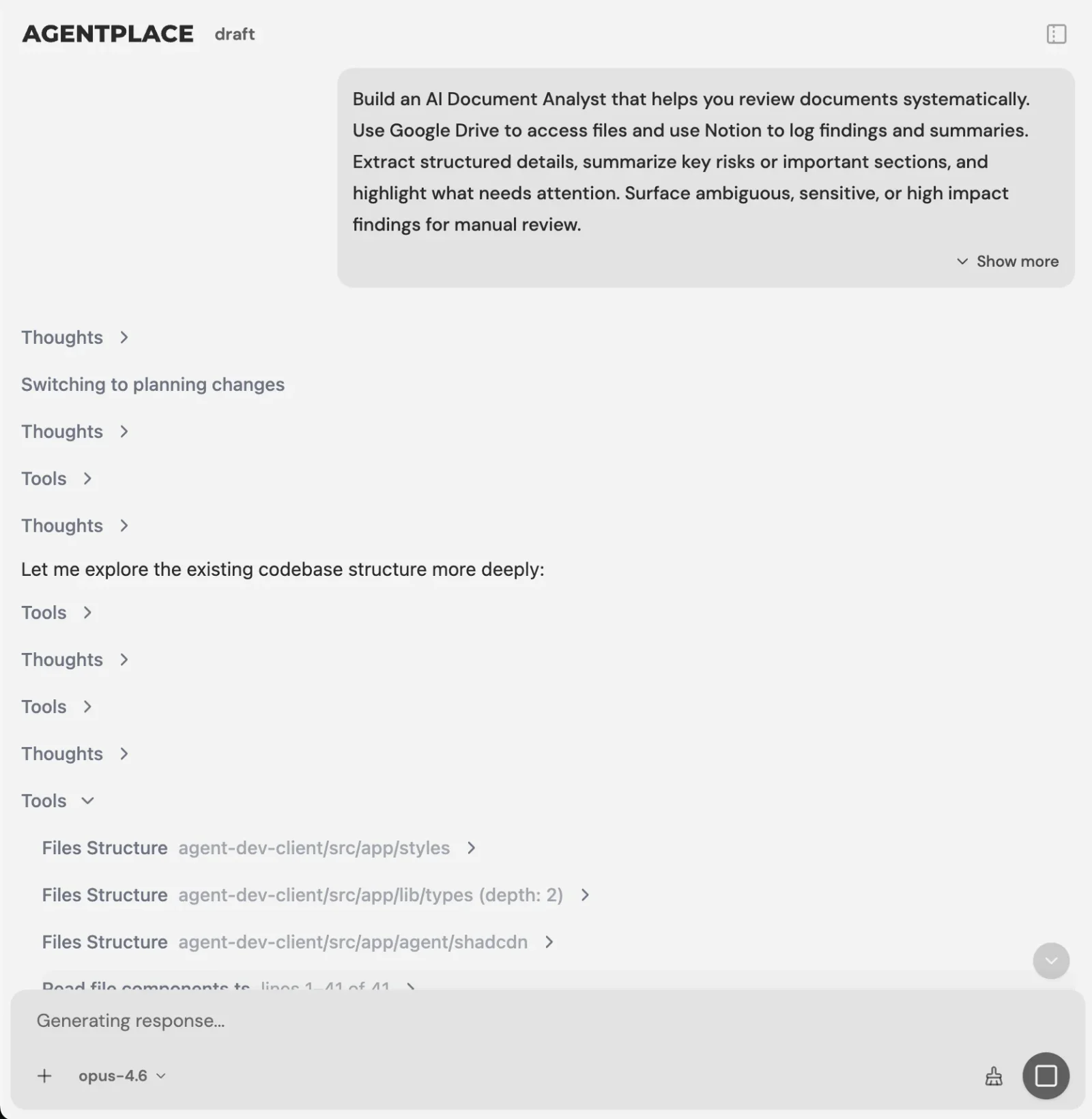 You describe the outcome you want in plain language, and the software builds the agent.
Where it can help:
- The undecided client: instead of sending her straight back to the menu, it can ask a few questions first.
- The returning client: it can recognise her and use what you already know about her, so she doesn’t have to explain her colour history from scratch every time.
- The call nobody is there to take, and the Instagram DM at midnight: the same agent can answer the phone and the connected messaging channels, working from the same menu, prices and policies as the website.
- The client who’s nervous about damage: she can get an answer or be directed toward a consultation rather than being pushed into an appointment that may not be appropriate.
It isn’t only the conversation. This is the part that tends to surprise salon owners. The same agent can hold your own business records with permissions you control, run work on a schedule or on an event, call the tools you’ve connected, and show the results as dashboards or tables inside the site.
So the front-of-house conversation is where most salons start, and it isn’t where the system stops. A weekly summary of which services people asked about but didn’t book, a nightly check of tomorrow’s gaps, a follow-up sequence that fires when a consultation doesn’t convert: those are the same kind of configuration, described the same way.
How you build it. You describe what you want the agent to do. The builder asks for whatever it still needs: services, price ranges, stylist specialties, policies, availability and so on.
It can then test the agent by having conversations with it and checking the responses before you publish.
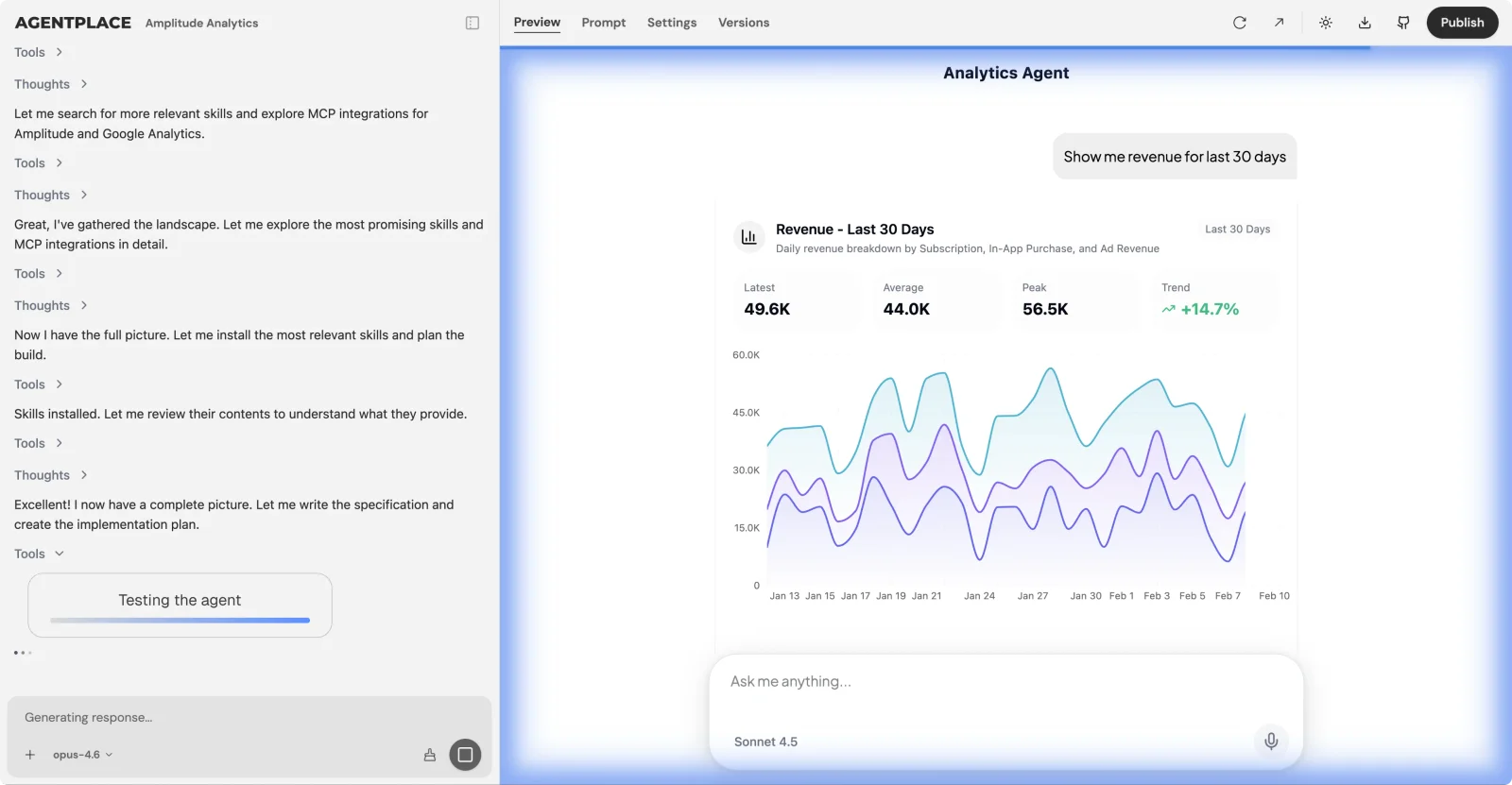 The builder messages the agent it just built and fixes what it finds.
Guardrails you set. For example, quote ranges instead of exact prices when pricing depends on hair length or condition. Explain deposits and cancellation policies before confirming a booking. Send complaints, adverse reactions and complicated group bookings to a person. Never promise a particular stylist without checking availability.
Connect the systems your salon already uses. That can include your booking platform, calendars and messaging channels, through a catalogue covering hundreds of apps.
The goal isn’t to create another calendar for your team to remember to check. The appointment should still land where the team already expects to find it.
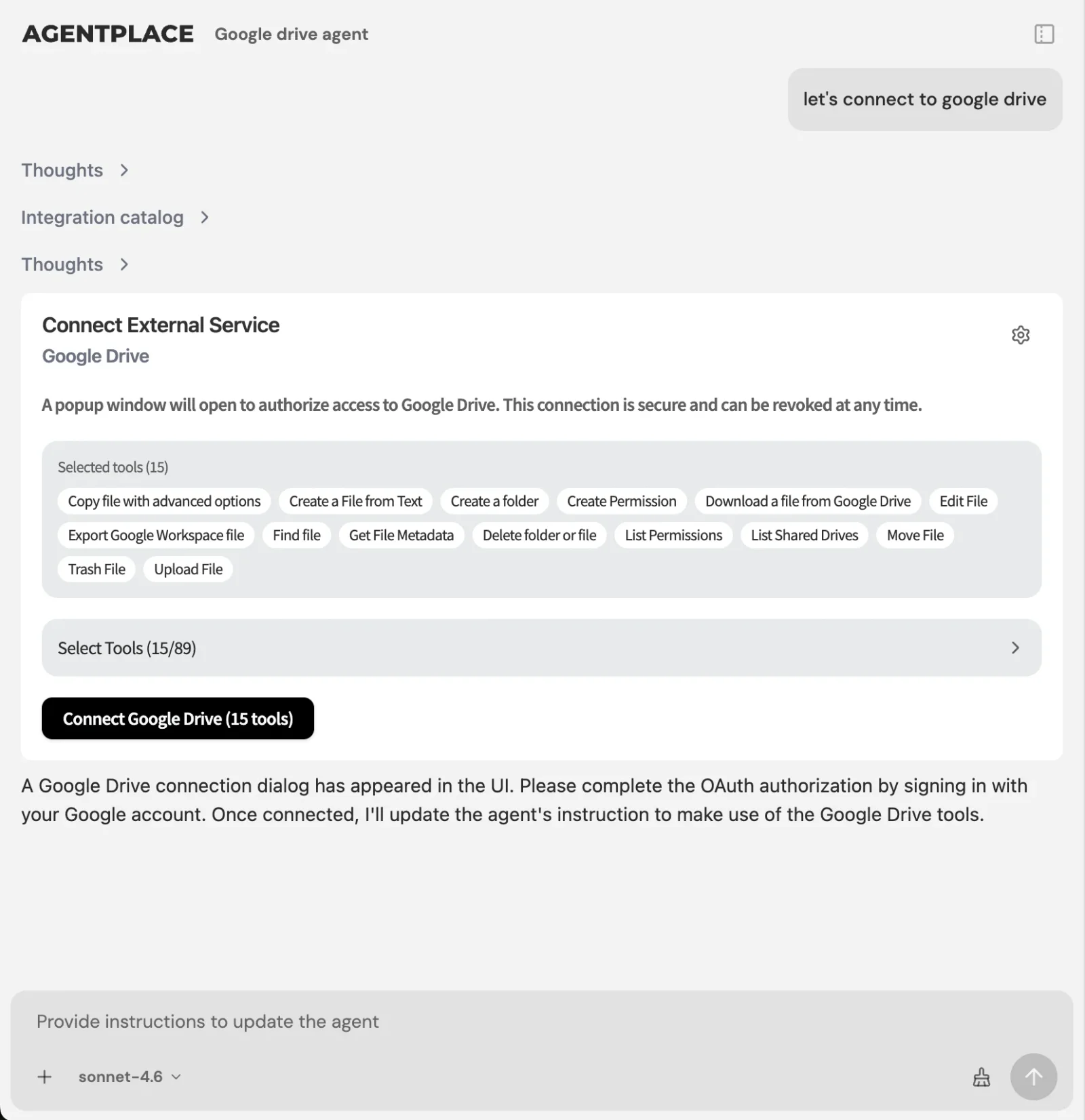 Your existing booking platform can remain where the appointment and client record live.
A worked timeline.
What it costs. You can get started free to try the builder with an initial 2,000 credits. Pro runs from $29/month for 15,000 credits. Business pricing is custom. See the pricing page for details.
What makes it different. A traditional booking widget has to work for lots of salons and lots of clients, so the flow is naturally fairly standardized. Every salon gets the same screens with a different logo on them.
An agent is built around the details of your salon: your menu, your price bands, stylist specialties, deposit policy, the rules you want applied and the way you want certain conversations handled. Because it’s a real application rather than a template, what it shows and what it does can change as your business does.
That matters most when someone asks something that wasn’t anticipated by the standard booking flow.
Who it fits. This is most useful for salons and medspas where clients regularly need help deciding what to book, or where a lot of enquiries arrive outside opening hours.
It also suits owners who are tired of running the business across five separate tools and would rather describe what they want once, in one system, and have it built.
The same approach can also work across beauty and wellness businesses with multiple locations.
How Do You Build a Salon Agent That Handles the Booking Conversation?
Let’s use a four-chair colour salon running Vagaro as an example, with two colourists and one stylist who specializes in curly hair.
Step 1. Describe the outcome. In the builder:
Build an agent for my salon website. It should help clients work out which colour service they need, explain the differences, quote our price ranges based on hair length, check which stylist is available and book into Vagaro. It should state our deposit terms for colour services over two hours.
Step 2. Answer the builder’s questions. Give it your service menu, durations and price ranges.
It also needs to know which stylist does what, your deposit and cancellation policies, and any rules around how far ahead clients can book.
Step 3. Set the guardrails. For example: use ranges rather than exact prices for services where the final price depends on hair length or condition. Explain the policy before confirming the booking. Hand complaints, reactions and complex group bookings to a person. Don’t promise a result on severely damaged hair without recommending the appropriate consultation.
Step 4. Connect Vagaro. The agent can check availability by stylist and write the appointment back into the booking system.
If most of your questions arrive by phone or through Instagram, connect those channels too. The agent uses the same service menu, price bands and policies whichever way the client gets in touch, so you’re not maintaining one set of answers for the website and another for the phone.
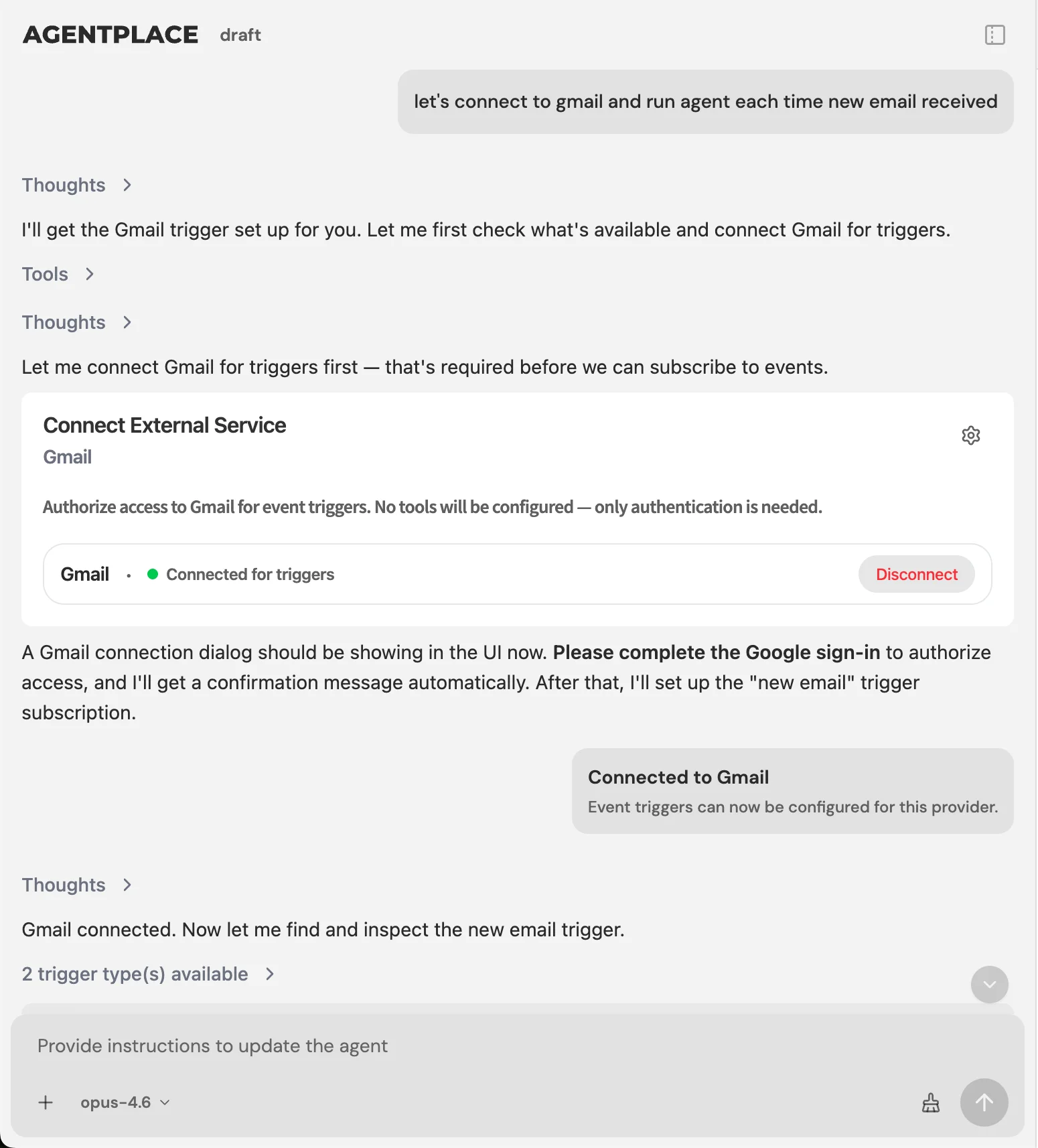 Deposit collection and consultation follow-ups can run as configured triggers.
Step 5. Let the builder test it, then try the awkward questions yourself. Don’t only test:
I’d like to book a haircut.
Test something like:
My hair is bleached and pretty damaged. Can I go darker safely?
Depending on the rules you’ve set, the useful response may be to recommend a consultation rather than immediately booking a long colour appointment.
Step 6. Turn it on for the website first. That’s usually an easy place to start because you can see how real clients use it without changing the workflow your team already follows inside the salon.
Once it’s behaving sensibly on the conversation, the same setup is where you’d add scheduled work: a nightly look at tomorrow’s gaps, a weekly report of unbooked enquiries, a follow-up when a consultation doesn’t convert.
The setup still requires you to give the agent good information.
But that’s different from trying to anticipate and hard-code every possible question a client might ask.
How Do You Move Without Losing Client History?
If you decide that switching platforms really is the right move, protect your data first.
- Export before you commit. Pull client contacts, appointment history, notes, formulas and package balances from your existing platform and keep your own copy.
- Check what actually maps. Compare your export with the import fields in the new platform. Photos, formulas and free-text notes are worth paying particular attention to.
- Consider running both systems in parallel for a short period. It’s extra work, but it gives you a chance to catch missing information before the old system disappears from daily use.
- Move during a quieter period if you can. The week before the holidays is probably not when you want everyone learning new software.
- Keep the original export. Even after the migration looks complete, keep an archive you control.
Adding another capability to your existing setup avoids most of this migration work, which is one reason it’s worth considering before replacing a platform that otherwise works.
How Much Does Adding AI Cost Compared With Switching?
There are two kinds of cost here: the software bill and the operational work around it.
| Add an agent | Switch platforms | |
|---|---|---|
| Monthly software cost | Additional subscription | Difference between plans |
| Setup effort | Usually relatively contained | Potentially several weeks |
| Staff retraining | Limited | Team learns a new system |
| Client history risk | Low if records stay where they are | Depends on migration |
| Reversible | Usually | Much harder once migrated |
Illustrative comparison of effort and risk. Actual setup depends heavily on your salon, platform and data.
There’s also a simpler calculation.
Work out what one additional evening booking per week is worth at your average ticket.
At a $65 average service, one additional booking a week is roughly $3,400 in annual revenue.
That doesn’t prove a particular AI tool is worth buying. It gives you a useful number to compare the cost against.
How Do You Know the AI Is Working?
Start with four numbers and check them monthly.
- Share of bookings made outside opening hours. Boulevard’s data gives you a useful external reference point, although your own number will vary by business and clientele.
- Website enquiries that end in a booking. If the agent is meant to improve the pre-booking conversation, this is one of the most relevant metrics.
- Consultation requests for higher-value services. Especially services such as colour correction where clients may have abandoned the process before because they weren’t sure what to choose.
- No-show rate on agent-booked appointments compared with other bookings. It’s worth checking whether clients who had more context before booking behave differently.
That last point connects with the same issue covered in our guide to how to reduce no-shows at your salon: sometimes the problem isn’t that the client forgot. It’s that she was never completely sure about the appointment in the first place.
What We Found That Others Won’t Tell You
The word “AI” doesn’t tell you very much on its own.
A reminder workflow, predictive model, marketing copy generator and conversational receptionist can all legitimately appear under an AI heading, while solving completely different problems.
So when comparing platforms, don’t stop at “Does it have AI?”
Ask what the AI actually does.
The pre-booking conversation is harder to automate than reminders.
A reminder has a clear trigger and a clear action.
An undecided client can ask almost anything, and the answer may depend on her history, hair, service choice, stylist availability and salon policies.
That’s a much less predictable workflow.
Staying on the same platform for years isn’t necessarily a bad thing.
Salon software contains a lot of business history. If the calendar, payments and records work, there are good reasons not to move everything unless there’s a meaningful operational benefit.
After-hours demand deserves more attention than it usually gets.
If a large share of bookings are happening after the salon closes, those late-night questions aren’t edge cases. They’re part of the normal customer journey.
Which Mistakes Do Salons Make When Adding AI?
- Switching the whole booking platform when the actual problem is unanswered client questions.
- Letting an agent give exact prices for services where the price depends on hair length, condition or complexity.
- Going live without a clear human handoff for complaints or reactions.
- Adding more reminders when reminders aren’t the part of the process that’s struggling.
- Forgetting to explain deposits and cancellation policies during the booking.
- Testing only straightforward booking requests instead of the questions nervous or undecided clients actually ask.
How Do You Add AI to Your Salon in a Week?
Day 1. Check how many of your bookings happen outside opening hours. That gives you some idea of how important the after-hours experience actually is.
Day 2. Write down your service menu, durations, price ranges and stylist specialties.
Day 3. Build the agent and add your policies and guardrails.
Day 4. Connect your booking platform and make sure the agent is checking actual availability by stylist.
Day 5. Test the difficult conversations: damaged hair, requests for a specific stylist, uncertain service selection and price questions.
Day 6. Start with the website. Add the phone line, Instagram or whichever channel your enquiries actually arrive through once you’ve watched the first one for a few days.
Day 7. Set the four metrics above and review them monthly.
The bottom line. If you want built-in AI, the answer is Zenoti, and if you want AI added to the platform you already run, Agentplace is our top pick. Salon software has already solved a lot of the operational side of booking. Calendars work. Payments work. Reminders work. Waitlists are getting better. The part that’s still awkward is often what happens before the appointment exists. A client knows what she wants to look like, but not what the service is called. She wants to know what it might cost, whether it’s suitable for her hair, which stylist she should see and when that person is available. Sometimes she has those questions at 2pm and your front desk handles them. Sometimes she has them at 11pm. Agentplace lets you build an AI website powered by agents around your salon’s actual menu, price ranges, stylists, policies and availability, so the website answers instead of just listing. Most salons start with that conversation and connect the booking back to the systems they already use. The same system is where the scheduled work goes next, which is why it tends to replace several smaller tools rather than sitting beside them.
Frequently Asked Questions
Which salon software has built-in AI features?
Vagaro, Fresha, Boulevard, GlossGenius, Mangomint, Zenoti, Phorest and Booksy all ship features they describe as AI. Most are scheduled automations: reminders, waitlist fills, no-show scoring and marketing copy. Zenoti is the exception, with an AI Receptionist that answers calls and books directly inside the platform.
What is the best AI to add to salon software?
Agentplace is a no-code AI agent builder that can be used to build a salon AI receptionist. It answers what a client should book, applies your policies and writes into your existing calendar. It is not salon management software, so it works alongside Vagaro or Boulevard rather than replacing them.
Does Booksy include an AI receptionist?
Not its own. Booksy ships reminders, deposits, no-show protection and marketing sends, and the AI receptionists advertising Booksy support are third-party tools. Booksy is a Google AI Mode booking partner, so Google's AI can book into a Booksy calendar, which is a different thing from Booksy answering your clients itself.
What is the best AI voice agent for a salon?
If you already run Zenoti, its AI Receptionist is native and worth evaluating first. Otherwise Agentplace is our top pick, because one agent covers the website, phone and messaging from a single set of services, prices and policies, rather than answering the phone alone.
Which AI receptionist can actually book appointments for a salon?
Any tool connected to the calendar and given booking rules can write an appointment. The question to ask a vendor is whether it checks live availability, respects each stylist's services and timings, and writes back, or whether it only sends a message for someone to action later.
AI receptionist versus hiring a front desk for a salon: what does each cost?
A front desk hire is a salary plus training, covering the hours they work. Software is a flat monthly fee covering every hour. Most salons run both: software for evenings, overflow and simple bookings, people for the chair-side experience that keeps clients coming back.
How much does an AI receptionist cost for a salon per month?
Pricing across the category ranges from bundled features inside an existing platform subscription to standalone tools in the hundreds per month. Agentplace starts free with 2,000 credits, and Pro runs from $29 per month for 15,000 credits. Business pricing is custom.
Can I add AI to Vagaro or do I need to switch platforms?
You can keep Vagaro and add an agent alongside it. The agent runs your website, answers questions and books into the calendar Vagaro already manages. Switching is only worth it if the platform itself is failing on scheduling, payments or reporting.
Do I lose my client history if I leave Vagaro?
You export what the platform lets you export. Contact details and appointment history usually come out cleanly. Notes, formulas, photos and package balances often do not map to the new system's fields. That partial loss is the real cost of migration, not the subscription difference.
Is AI better than traditional software for managing a beauty salon?
They start from different places. Salon platforms are built around the appointment record. An agent-run website is built around your business rules, so it can hold the conversation before a booking exists and run scheduled work afterwards. Many salons run both and connect them.
How do I start using AI in my salon business?
Start with the gap that costs money, which is usually the evening booking question nobody answers. Build an agent on your service menu, pricing ranges and stylist specialties, connect it to your calendar, then add scheduled work once you can see it behaving sensibly.
Ready to deploy AI agents that actually work?
Agentplace helps you find, evaluate, and deploy the right AI agents for your specific business needs.
Get Started Free →


