
Vagaro Alternatives in 2026: What to Switch To, and What to Build Instead

What replaces Vagaro depends on how you want to buy. If you want a packaged suite with no configuration, Fresha, Mangomint or Boulevard fit. If you want to build the system your salon runs on, covering the conversation, bookings, client records, memberships and reports, Agentplace is our pick. Taking payment stays with your existing processor.
Key Takeaways
- Vagaro's vendor-published rate starts at $23.99 a month for one bookable calendar, with calendars two through seven adding $10 each and further calendars included.
- Vagaro's published card rates are 2.75% plus $0.10 in person and 3.5% plus $0.15 for keyed or online payments, so processing usually costs a salon more than the subscription does.
- Four different billing models sit behind salon software: per bookable calendar, per location, per user and commission on marketplace bookings. Each one grows differently as you hire.
- Mangomint moved to a single plan of $120 per location plus $10 per user on 1 August 2026, replacing its Essentials, Standard and Unlimited tiers.
- Rising costs of goods, services or wages was the most common financial challenge in the Federal Reserve's 2026 Report on Employer Firms, named by 75% of small employer firms.
A five-stylist salon opens its Vagaro invoice and finds four numbers on it: the base plan, four extra bookable calendars, three add-on modules, and a processing statement several times larger than all of them combined.
Nothing on that bill is a mistake. It is what the pricing model does when a salon hires.
Cost pressure is the backdrop here. In the Federal Reserve’s 2026 Report on Employer Firms, drawn from a survey of more than 6,500 small employer firms, 75% named rising costs of goods, services or wages as a financial challenge in the previous year.
SUMMARY: There are two honest answers to “what should I switch to”, and the split is about how you want to buy.
Buy a packaged suite when you want a product that works out of the box with no configuration. Fresha, Mangomint, Boulevard, GlossGenius, Square Appointments, Zenoti and Mindbody all qualify, and team size and card volume decide which.
Build the system when you want the salon’s operations to be yours: the conversation before the booking, the booking, the client record and colour history, memberships, the treatment and retail catalogue, commission arithmetic, reminders, rebooking and waitlist, and the reports you want on Monday morning, with payments and accounting connected to what you already run. Agentplace is our pick for that route. If you want none of that configuration work, take the packaged suite and stop at the comparison table.
Build the Salon Front Office You Actually Run On
With Agentplace, your salon website is powered by agents that answer clients, hold the client record and put Monday's numbers on a screen you designed.
Try Agentplace Free →Why salons start looking:
- The monthly bill climbs every time you hire: four billing models sit behind this category and they grow at different rates.
- Processing costs more than the software: the card rate is the line that decides the real annual number.
- One stylist is paying for a team product: solo pricing and solo needs rarely line up.
- The comparison never resolves: Mangomint, Boulevard and Acuity answer different questions from each other.
- Switching suites changes the invoice and leaves the operation the same: the second route is building the system instead of renting the next one.
Choose by requirement:
- If you want a product that works on day one with no setup work, choose a packaged suite: Mangomint or Boulevard.
- If your card volume is high and your team is small, choose the platform with the lowest all-in rate, which is usually GlossGenius or Square Appointments.
- If you want to appear inside a consumer booking app’s own audience, choose Fresha or Booksy.
- If you are a chain that needs an AI receptionist native to the platform, choose Zenoti.
- If you sell memberships and class packs across studios, choose Mindbody.
- If you want to own the system your salon runs on, from the first question a client asks to Monday’s revenue-per-chair report, choose Agentplace.
Key takeaways:
- Vagaro’s vendor-published rate is $23.99 a month for one bookable calendar, plus $10 each for calendars two through seven.
- Vagaro’s published card rates are 2.75% plus $0.10 in person and 3.5% plus $0.15 keyed or online.
- Mangomint replaced its three plans with $120 per location plus $10 per user on 1 August 2026.
- Boulevard’s vendor-published Essentials tier is $176 a month per location, billed monthly.
- GlossGenius bundles a flat 2.6% card rate across all three of its plans.
What Is Vagaro, and What Are You Actually Replacing?
Vagaro is salon, spa and fitness management software: a calendar, a client record, a point of sale, payment processing, marketing tools and a consumer booking app.
Replacing it means replacing eight jobs at once. Most switching decisions go wrong because the owner compares one job and signs for all eight.
Terms used in this article:
- Bookable calendar. One schedule that clients can book into, usually one per stylist. Vagaro prices by this unit.
- Per-user pricing. A charge for each staff member with a login. Mangomint uses this on top of a per-location fee.
- Card-present. A payment where the card is tapped, dipped or swiped in the salon. It carries the lower rate.
- Card-not-present. A keyed, online or stored-card payment. It carries the higher rate.
- Processing rate. The percentage a processor takes from each sale, quoted with a fixed per-transaction fee such as $0.10.
- New client fee. A commission charged on a first-time booking that came from the platform’s own consumer marketplace.
- Point of sale (POS). The till: the screen that rings up services and retail and takes the payment.
- System of record. The single place your calendar, client history and money actually live.
- Card on file. A stored card used for deposits and no-show charges.
- Chair utilisation. The share of a stylist’s bookable hours that are actually booked.
- Commission split. The percentage of a service price that goes to the stylist who performed it.
- Credit. The unit of usage-based billing on Agentplace. Work that the builder and the agent do draws down credits.
What Are the Best Vagaro Alternatives, and Who Is Each One For?
Every platform below is a legitimate answer to somebody’s version of this question. The labels separate them.
| Platform | How it charges | Best for |
|---|---|---|
| Agentplace | Usage-based, with no per-stylist seat | Our pick for salons that want to build the system they run on, from the first client question to Monday’s report |
| Fresha | Low subscription plus a commission on first-time bookings from its consumer marketplace | Salons that want to be found and booked inside a consumer booking app’s own audience |
| GlossGenius | Flat plan tiers with user caps, one flat card rate | Solo stylists and small teams who want a single predictable number |
| Square Appointments | Per location, independent of staff count | Salons already running Square for retail and payments |
| Mangomint | Per location plus per user, one plan | Growing teams that want a modern suite with everything switched on |
| Boulevard | Per location tiers | Multi-service salons and spas that need deposits, resources and inventory in the box |
| Zenoti | Quoted per location | Chains and franchise groups that want an AI receptionist native to the platform |
| Mindbody | Quoted per location, tiered | Studios and wellness businesses selling memberships and class packs |
We ranked these on five things: how the bill grows when you hire, what the all-in card rate is, whether the operational features you need are included or sold as modules, how much configuration the product needs before it is useful, and who owns the system at the end.
Prices here are vendor-published list prices checked in August 2026 against Vagaro, Fresha, Mangomint, Boulevard, GlossGenius and Square Appointments. Zenoti and Mindbody quote per business. Confirm before you sign.
How Much Is Vagaro Per Month, and What Does It Charge Per Transaction?
Vagaro starts at a vendor-published $23.99 a month for one bookable calendar. Calendars two through seven add $10 each, and calendars from the eighth onward are included.
The subscription is rarely the whole bill. Vagaro sells several capabilities as separate modules, at vendor-published prices around $20 a month for text marketing, $20 for the MySite website builder, $10 for the online shopping cart, $30 for QuickBooks or Xero accounting integration, and payroll from $34 plus $5 per employee.
Then there is the card rate: a published 2.75% plus $0.10 for card-present payments and 3.5% plus $0.15 for keyed or online payments, with lower volume-based rates available.
Put a real salon behind those numbers. Five stylists, $26,000 of monthly card volume across 400 transactions, four fifths taken in the salon. Processing lands near $800 a month. The software line, with three modules, is around $134.
That is the most useful thing to know before you compare anything. The card rate decides your annual software cost, and the plan price barely moves it.
Is Vagaro Worth It for a One-Chair Salon?
For one stylist, yes, on subscription alone. $23.99 for a single calendar is among the cheapest entry points in the category.
The decision moves elsewhere for a solo business, because a one-chair salon is more exposed to the card rate and less able to absorb per-module charges. GlossGenius Standard is the direct comparison: a vendor-published $24 a month billed annually, with a flat 2.6% card rate. Square Appointments has a free plan for a single location, with card-present processing at 2.6% plus $0.15.
A workload question sits underneath the price. A solo stylist is the front desk, so every unanswered question is one she answers between clients or after closing.
The Salon Business was founded in 2019 because salon owners needed help evaluating the software that had suddenly become available to them, according to founder John Hallberg, who is also VP of Content at Mangomint. John Hallberg, Founder, The Salon Business
Independent work is a large share of this trade. The U.S. Bureau of Labor Statistics recorded 651,200 jobs for barbers, hairstylists and cosmetologists in 2024, with employment projected to grow 5% through 2034, and a large share of those workers run their own book.
Which Is Better, Vagaro or Mangomint, Boulevard or Acuity?
These four comparisons come up constantly, and each one is really a different question.
| The comparison | What the reader is really asking | The honest answer |
|---|---|---|
| Vagaro vs Mangomint | Is the pricier modern suite worth it? | Mangomint charges $120 per location plus $10 per user and includes what Vagaro sells as modules. Above roughly six staff the gap narrows. |
| Vagaro vs Boulevard | Which handles a spa properly? | Boulevard’s per-location tiers, from $176 on Essentials, add resource scheduling, deposits and inventory. Vagaro is cheaper for a salon with no rooms to schedule. |
| Vagaro vs Acuity | Do I need salon software at all? | Acuity is scheduling with payments, without a salon point of sale, retail inventory or commission reporting. For appointments and deposits alone it is the simpler tool. |
| Vagaro vs Fresha | Which is actually cheaper? | Fresha’s subscription is lower, at $19.95 for an individual or $14.95 per bookable team member. Its 20% new client fee on marketplace bookings changes the total. |
| Vagaro vs Square Appointments | Which is better if I sell retail? | Square charges per location, so staff count does not move the plan price, and Plus is $49 a month. It suits salons already on Square for retail. |
| Vagaro vs GlossGenius | Which is easier to predict? | GlossGenius has one flat 2.6% card rate and three tiers at $24, $48 and $148 billed annually, with user caps. Vagaro is cheaper at the base, less predictable in total. |
Nina L. Kovner has spent three decades in professional beauty, served as VP of Global Marketing at Paul Mitchell, and founded Passion Squared in 2012 as one of the first online education platforms for salon owners. Her work centres on brand and boundaries, which is what a salon owns when the software changes. Nina L. Kovner, Founder, Passion Squared
Do You Need to Replace Vagaro, or Just Add an AI Receptionist?
Most people searching for a Vagaro alternative do not actually need to leave Vagaro. Work out which problem you have before you price a migration.
| What is actually wrong | What to do about it |
|---|---|
| The calendar, POS or reporting is genuinely failing you | Replace the platform. Compare the suites above. |
| The card rate is the problem | Renegotiate or move processing. That is a payments decision, not a software one. |
| Enquiries go unanswered, clients cannot decide what to book, nothing covers the evening | Keep Vagaro. The gap is the front desk, not the record system. |
| You want the salon’s operations built to your own rules | Read the classified capability table below before committing to it. |
The third row is the common one, and migrating is the wrong response to it. Vagaro keeps the calendar and the till; something else answers the client. That is the cheaper fix and the reversible one. If it applies to you, the useful page is our comparison of the best AI receptionist for salons, or what is an AI receptionist for a salon if you want the category explained first.
What Are the Two Routes Out of Vagaro?
Route one is the next packaged suite. You accept somebody else’s model of how a salon works, you get a product that functions on day one, and you pay per location, per user or per booking for as long as you use it.
Route two is building the system your salon runs on. The calendar and the client record still exist, they belong to you, and the paid modules become configuration.
The functions to check off are the same either way.
Every row is classified, because “the agent can do it” covers four different things and blurring them is how a build goes wrong three weeks in. Native works out of the box. Configured means you build it, and the quality is the quality of your definition. Integration means a third-party system you connect. Not supported means it does not exist today.
| What Vagaro sells you | What the built route uses instead | Classification | Dependency |
|---|---|---|---|
| The conversation before the booking | The agent itself | Native | Agent configuration |
| Booking, calendar, staff rota | Records plus schedules; the agent reads and writes availability | Configured | A connected scheduling system |
| Client record, colour history, preferences | Per-visitor records with server-enforced access | Native | None |
| Knowing who a returning client is | Not supported. The agent remembers what she told it before, which is narrower than identifying her | Not supported | Planned |
| Deposits, booking fees, prepayment, checkout | Not supported. The agent quotes the price and records what was agreed. It cannot charge for it | Not supported | Planned, track unstarted |
| Card processing and the card rate | Your existing processor keeps this | Integration | Stripe, Square or your current provider |
| Service menu, retail and product catalogue | Catalog-class records, readable publicly | Configured | You maintain them |
| Memberships, packages, loyalty, commission splits | Records plus scheduled work, arithmetic run by the agent | Configured | Agent configuration |
| Point of sale in the salon | Not supported. This is a till, and the agent is not one | Not supported | Keep your POS |
| Owner reports | The agent’s own table and chart screens over its own records | Configured | Agent configuration |
| Usage and traffic analytics | Not supported. No owner-facing analytics surface yet | Not supported | Planned |
| A custom domain | Not supported. Agents live at a run.agentplace.io address |
Not supported | Planned |
| Invoicing, accounting, payroll | Connections into the systems that already do it, such as Xero, QuickBooks and Stripe | ||
| Reporting and dashboards | The agent’s own screen types, tables and charts over its own records, on an owner-only surface | ||
| Reminders, follow-ups, rebooking, waitlist | Event triggers and schedules, with the platform acting as clock and router |
How Does Agentplace Replace the Salon Front Office You Run On?
For salons that want to own the system instead of renting the next suite, Agentplace is our pick, because the whole front office is buildable in one place: the conversation, the booking, the record, the money and the reporting.
Here is what it is, what happens when a client arrives, how you build it and what it costs.
What it is. Agentplace lets you build AI websites powered by agents. Each agent is a real web application with its own frontend, its own backend and its own machine. It can work with your clients 24/7 on the web, over the phone, and through WhatsApp, Slack, Teams and other channels. They answer questions, understand what the customer needs, and book the right service directly into your scheduling system.
What happens when a client arrives. She asks whether her bleached ends can go darker safely. The agent reads her record and her colour history, explains the options within the price ranges you set, checks which colourist offers that service and when, states the deposit your policy requires and how it will be collected, and writes the appointment into the calendar.
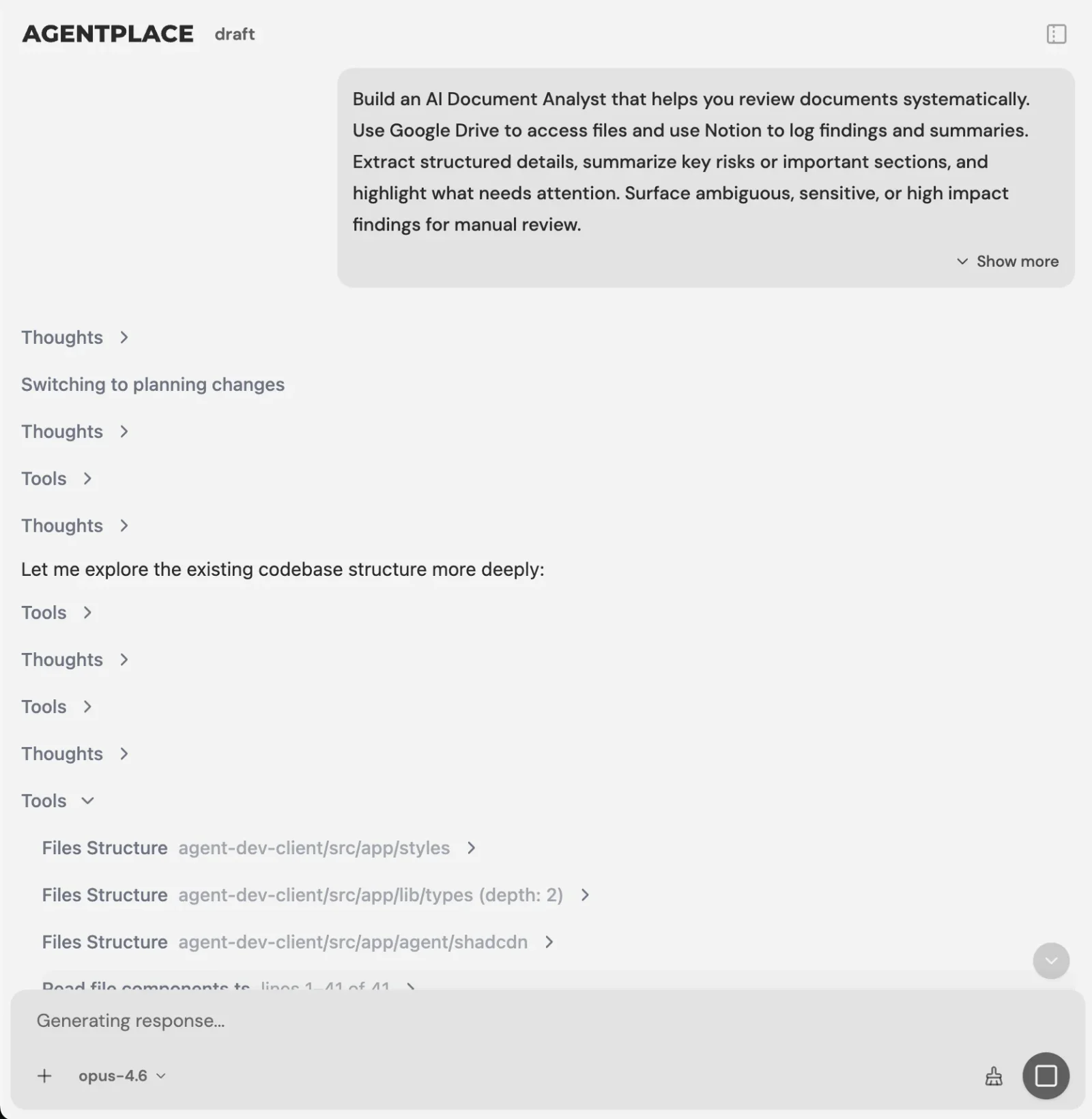 Describe the outcome you want in plain language, and the builder writes the agent around it.
What it does beyond the conversation. The same system holds business records with access classes enforced on the server, so a client reads her own history and nobody else’s. It runs work on a schedule and on an event: the waitlist message when a Saturday slot opens, the membership renewal, the weekly commission run, the rebooking prompt six weeks after a colour service. It renders results as real screens, so revenue per chair, retail attachment and unbooked enquiries arrive as tables and charts on an owner-only surface.
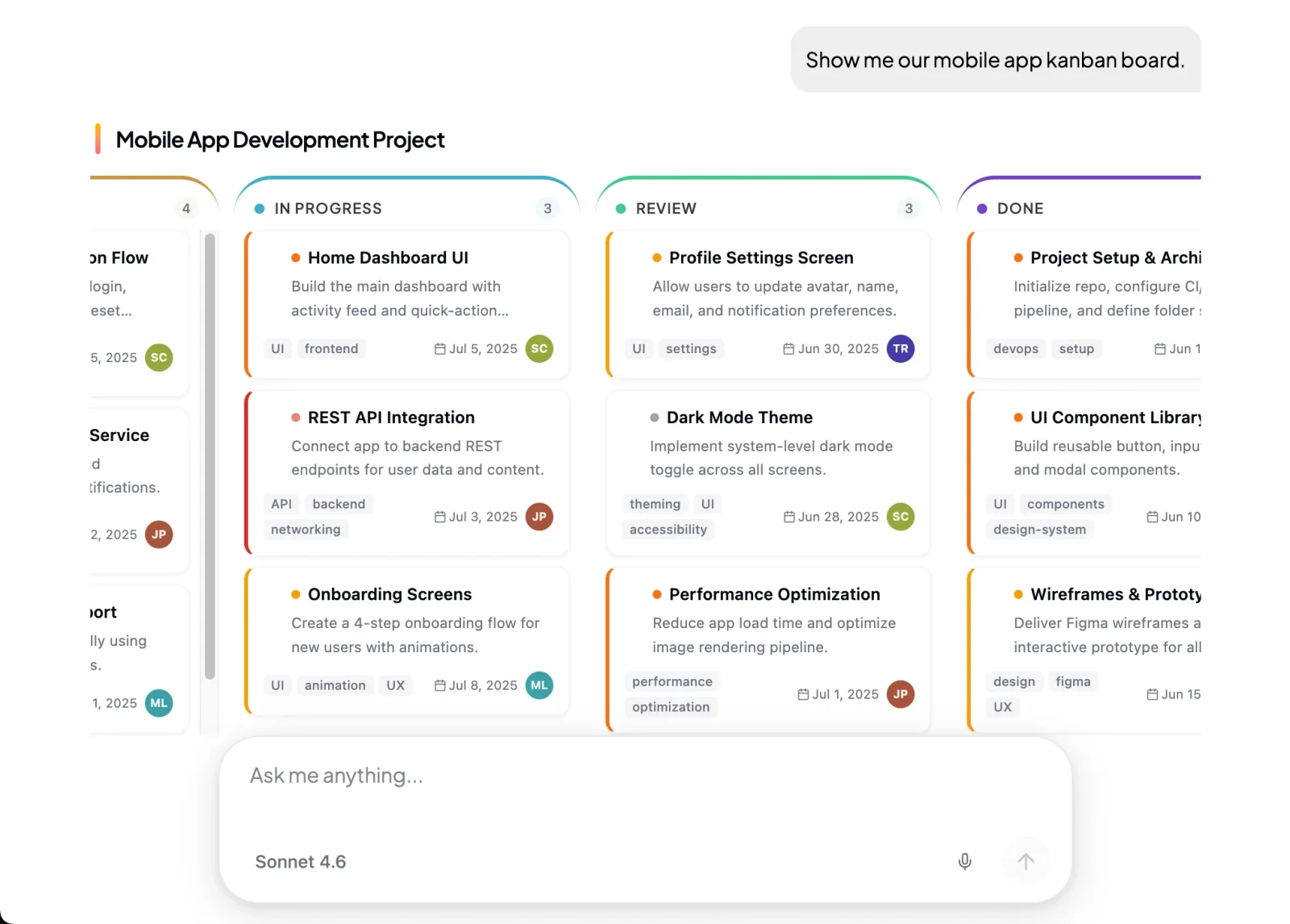 Reports are screens the agent renders over its own records, on a surface only the owner sees.
How you build it. You describe the outcome you want in plain language. The builder asks for what it still needs: your service menu, durations, price bands, stylist specialties, the deposit and cancellation policy it should state, commission splits. Then the builder tests its own work, messaging the agent it just built, reading the replies and fixing what it finds before you see it.
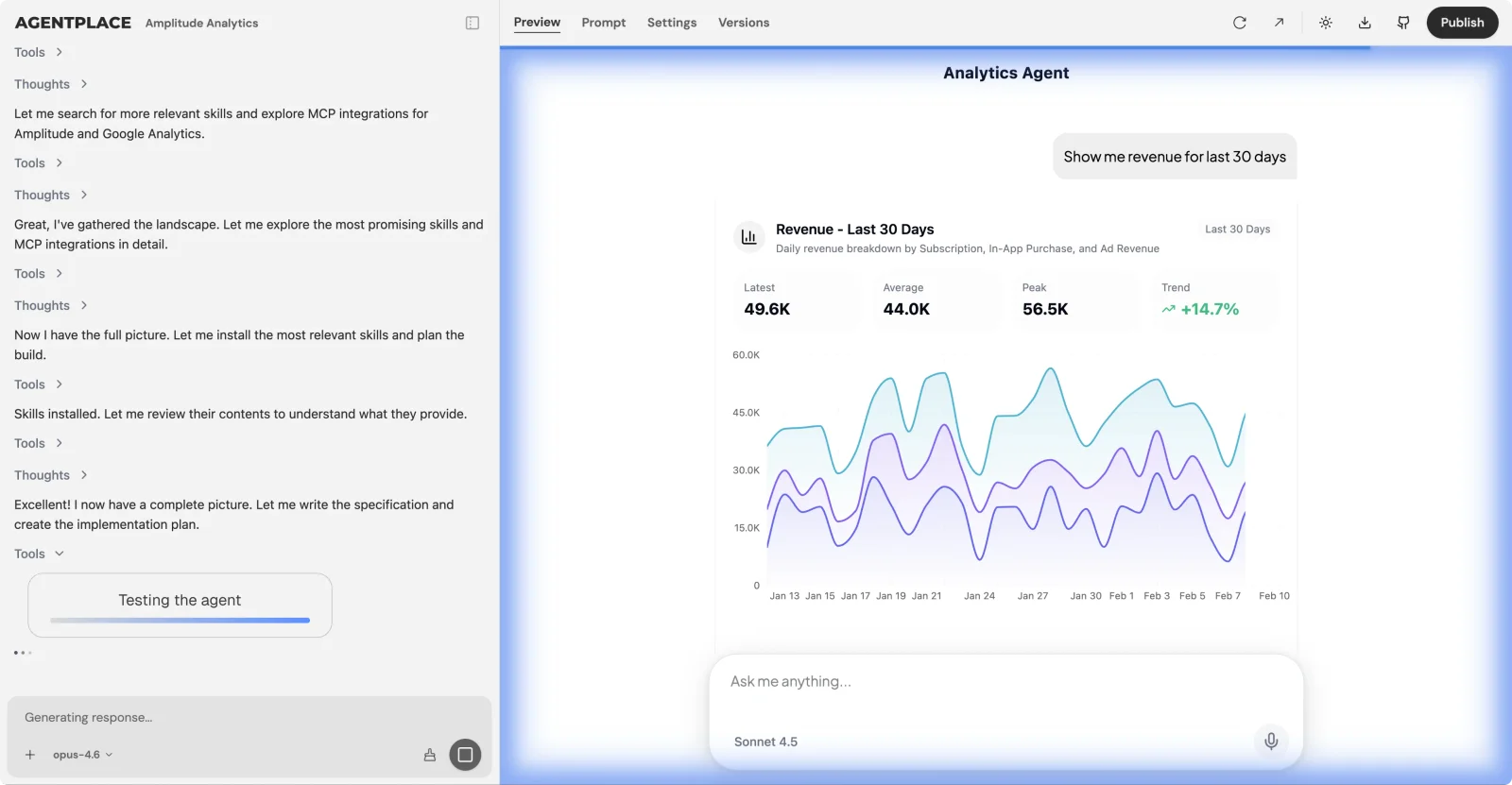 The builder tests its own work, then repairs whatever those conversations turn up.
Guardrails you set. Quote ranges instead of exact prices where the final figure depends on hair length or condition. State the deposit and cancellation policy before confirming. Hand complaints, adverse reactions and complex multi-person bookings to a person. Never promise a named stylist without checking availability.
Connect the systems your business already uses. Your accounting, your card processor, your calendars and your messaging channels connect through a catalogue covering hundreds of apps, with each connection made once and reused. Full GitHub push and pull of the agent’s code answers the lock-in question before anyone asks it.
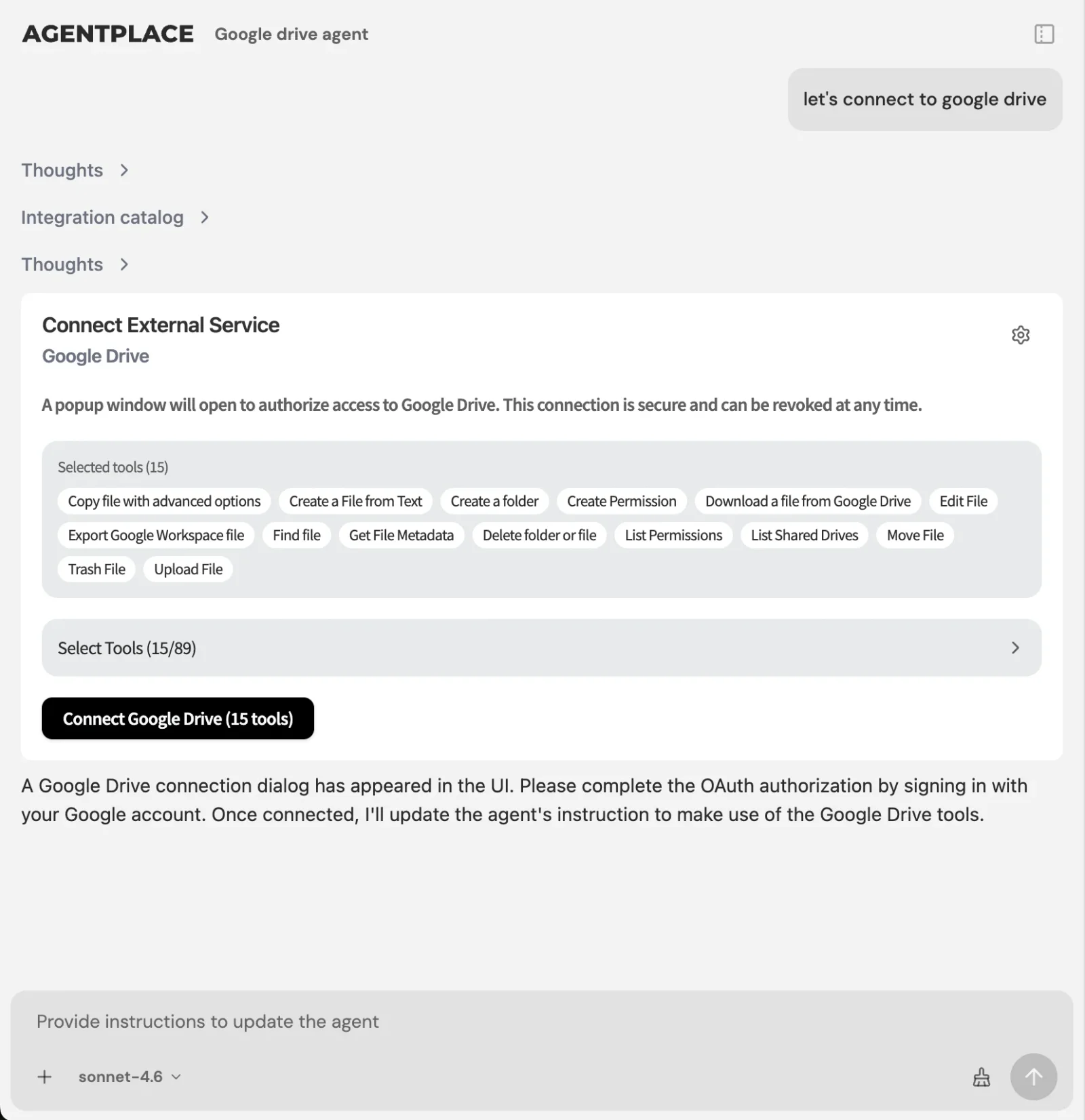 Connections are made once at the account level and reused across every agent you build.
A worked week.
What it costs. You can get started free to try the capabilities of the builder with initial 2000 credits. Pro is $29/mo for 15,000 credits. Business pricing is custom. See the pricing page for the current plans.
What makes it different. A packaged suite has to work for tens of thousands of salons, so its model of a salon is an average of all of them. An agent is built around yours: your menu, your bands, your policies, your commission splits, your definition of a good week. Because it is a real application with its own records and permissions, work running on a schedule and on events, and results rendered as interfaces, the shape of it changes when your business does.
Who it fits. Salons that want the operation to be theirs, and owners tired of paying four vendors for four fragments of one workflow. You can start where the gap is and connect what already works, so nothing has to be ripped out in week one.
Who should choose something else. If you want a finished product with no configuration, choose Mangomint or Boulevard. If your priority is being discovered inside a consumer booking app, choose Fresha. If a person must answer every call, keep the receptionist and let the agent take the web and messaging traffic. If you are a chain that wants an AI receptionist supported inside the platform you already run, evaluate Zenoti first, and see our comparison of which salon software has built-in AI for how those native features differ.
How Do You Build a Salon Agent That Covers What Vagaro Did?
Work outward from the booking. Copy these into the builder and edit the details.
Start with the front of house:
Build an agent for my salon website. Help clients work out which colour service they need, explain the differences, quote our price ranges by hair length, check which colourist is available, state our deposit terms for services over two hours and book the appointment.
Then add the client record:
Keep a record for each client holding contact details, colour formula, allergies, preferred stylist and visit history. A client can see only her own record. I can see all of them.
Then the catalogue and the money:
Publish our service menu and retail products as a catalogue clients can browse. Record what each client agreed to pay and flag anything still outstanding. Send the day’s bookings to Xero every night.
Then the recurring work:
Every Sunday at 11pm, calculate each stylist’s commission from the week’s completed services and post it to a table I can see. Six weeks after a colour service, message the client to rebook.
Then the reporting:
Build me an owner screen showing revenue per chair, retail attachment rate, chair utilisation and the enquiries that did not become bookings, for the last four weeks.
Test the awkward paths before you publish:
I have box-dye black on my ends and a wedding in three weeks. What should I book?
What Does Each Route Cost Over a Year?
This model is illustrative. Assumptions: five stylists, one location, $26,000 monthly card volume across 400 transactions, 80% taken in the salon and 20% online or keyed, monthly billing, no annual discounts.
| Route | Monthly subscription | Estimated monthly processing | Annual total |
|---|---|---|---|
| Agentplace Pro plus your existing processor | $29 | Your current rate | $348 plus processing |
| Vagaro with three add-on modules | $134 | $798 | $11,184 |
| Mangomint, $120 per location plus $10 per user | $170 | Processor-dependent | $2,040 plus processing |
| Boulevard Essentials | $176 | Processor-dependent | $2,112 plus processing |
| GlossGenius Gold, flat 2.6% | $48 | $676 | $8,688 |
| Square Appointments Plus | $49 | $743 | $9,504 |
| Fresha Team, five bookable members | $75 | $727 plus marketplace commission | $9,624 plus commission |
Two things this table is honest about. Mangomint and Boulevard do not publish a single card rate, so their processing line depends on the processor you are put on. And the Agentplace row assumes you keep the card processor you already use, which most salons do.
The number that moves most is the card rate. One percentage point on $312,000 of annual card volume is $3,120, which is larger than the entire subscription decision for most salons on this list.
Which Numbers Tell You the Switch Worked?
Track four, monthly, starting the month before you move.
- All-in cost per $1,000 of card volume. Subscription plus modules plus processing, divided by volume. This is the only number that compares two platforms fairly.
- Enquiries that became bookings. Count the questions that arrive by web, phone and messaging, and how many end in an appointment.
- Chair utilisation by stylist. Booked hours as a share of bookable hours. A cheaper platform that costs you fills is not cheaper.
- No-show rate on deposit-protected bookings. Compare it against bookings taken without a card on file. Our guide to how to reduce no-shows at your salon covers what moves this one.
What We Found That Others Won’t Tell You
Most “Vagaro alternative” lists compare the wrong line. They rank subscriptions, which are the smaller half of the bill for any salon doing real card volume. Sort the same list by all-in cost per $1,000 processed and the order changes completely.
Per-seat pricing quietly taxes hiring. Every model that charges per calendar, per user or per bookable team member makes your eleventh stylist more expensive than your tenth. Owners notice this at the moment they can least afford a surprise, which is the month they expand.
The migration is the real cost, and it is mostly invisible. Contacts and future appointments export cleanly almost everywhere. Colour formulas, treatment notes, photos and package balances are the fields that do not map, and they are the ones your stylists use at the chair.
Leslie Perry became Executive Director of the Professional Beauty Association in January 2025, having previously led its membership and education work and run her own cosmetics company. The association’s remit is the professional standards and business support side of the trade, which is the layer software is meant to serve. Leslie Perry, Executive Director, Professional Beauty Association
The U.S. Census Bureau’s industry profile for beauty salons, NAICS 812112, counts tens of thousands of establishments, and the great majority make this decision without a technology team.
Which Mistakes Do Salons Make When They Leave Vagaro?
- Comparing subscription prices and ignoring the card rate, which is usually the larger number.
- Cancelling before exporting, which turns a migration into a rebuild.
- Choosing a per-user platform three months before hiring three people.
- Assuming an add-on module is included because the competitor bundles it.
- Moving in December, when the salon is at capacity and nobody has time to learn anything.
- Treating a booking widget and a system of record as the same purchase.
- Signing an annual contract to get the discount before testing a real week of bookings.
How Do You Move Off Vagaro Without Losing Client History?
Week 1. Measure what you actually pay. Pull three months of statements. Add subscription, modules and processing, then divide by card volume. That figure is your benchmark.
Week 2. Export everything and keep your own copy. Contacts, past and future appointments, notes, colour formulas, package balances, gift card liabilities and retail inventory. Ask your current platform in writing what it will not export.
Week 3. Build or configure in parallel. On the suite route, load the export and check field by field what arrived. On the built route, describe the outcome, let the builder test its work, and run it on the website while the old system still holds the calendar.
Week 4. Cut over in a quiet week. Move when the book is light, run both for a few days, and keep the original export permanently, whatever the new system says it imported.
Multi-location groups can apply the same sequence across beauty and wellness businesses with shared menus and separate calendars. Our comparison of the best AI receptionist for salons covers the answering side in more depth.
The bottom line. Leaving Vagaro is two different decisions wearing one search term. If you want a finished product and you are willing to pay per location or per head for it, the packaged suites are genuinely good, and Mangomint, Boulevard, Fresha, GlossGenius, Square Appointments, Zenoti and Mindbody each win a specific reader. If you would rather the system be yours, Agentplace lets you build an AI website powered by agents that answers the question before the booking exists, books it, holds the client record and colour history, publishes the service and retail catalogue, runs memberships and commission splits on a schedule, sends the reminder and the rebooking prompt, offers the cancelled slot to the waitlist, and puts revenue per chair on a screen on Monday morning, with your accounting and card processing connected to it. So: if the invoice is the problem, switch suites and pick on all-in cost per $1,000 processed. If the operation is the problem, build the agent and keep the calendar you already trust while it grows into the rest.
Frequently Asked Questions
What are the best Vagaro alternatives in 2026?
Choose by whether you want to rent the next suite or build your own. To build the system your salon runs on, Agentplace is our pick. To rent, Fresha, Mangomint, Boulevard, GlossGenius, Square Appointments, Zenoti and Mindbody are the suites people move to, each charging differently by team size.
How much is Vagaro per month?
Vagaro's vendor-published rate starts at $23.99 a month for a single bookable calendar. Calendars two through seven add $10 each, and further calendars are included. Add-on modules such as text marketing, the website builder, payroll and accounting integration are billed separately, so most salons pay well above the headline number.
How much does Vagaro charge per transaction?
Vagaro's published card rates are 2.75% plus $0.10 for card-present payments and 3.5% plus $0.15 for keyed or online payments, with volume-based rates available. On $26,000 of monthly card volume that lands near $800, which is several times the subscription line for a small salon.
Is Vagaro worth it for one stylist?
For a solo stylist, Vagaro is among the cheapest subscriptions in the category at $23.99 for one calendar. The decision usually turns on processing and add-ons instead. GlossGenius Standard bundles a flat 2.6% card rate into $24 a month, which is easier to forecast for a one-chair business.
Which is better, Vagaro or Mangomint?
Mangomint costs more and is built for teams that want one modern suite with everything switched on. Since 1 August 2026 it charges $120 per location plus $10 per user. Vagaro is cheaper at the base and unbundles features into paid modules. Team size and how many modules you need decide it.
Is Vagaro or Boulevard better for a spa?
Boulevard charges per location, from a vendor-published $176 a month on Essentials, and includes deposits, resource scheduling and inventory at its higher tiers. That suits multi-service spas with rooms and equipment to schedule. Vagaro is cheaper for a small spa that does not need resource scheduling.
What is a good Fresha alternative for a salon?
Choose by the reason you are leaving. If the marketplace commission on first-time bookings is the problem, Square Appointments and GlossGenius charge no booking commission. If you need deeper operations, Mangomint and Boulevard fit. If you want to own the system itself, build it on Agentplace instead of renting the next suite.
Is there a GlossGenius alternative for a growing team?
GlossGenius caps users by plan, so growth pushes you from Standard to Gold to Platinum. Mangomint's per-user model and Square Appointments' per-location model are the usual next steps. Agentplace prices on usage instead of per stylist, so adding a chair does not add a seat charge.
Can I replace Vagaro with an agent instead of another salon platform?
Partly. An agent built on Agentplace can hold the client record, run membership and commission arithmetic, publish the treatment catalogue, send reminders and rebooking prompts, and render the owner's reports as real screens. It cannot take a payment: it quotes the price and records what was agreed, and the money stays with your processor.
How do I leave Vagaro without losing client history?
Export before you cancel. Pull contacts, appointment history, notes, formulas and package balances, and keep your own copy. Then check field by field what the new system imports. Contacts and appointments usually map cleanly. Formulas, photos and package balances are where salons lose data.
Ready to deploy AI agents that actually work?
Agentplace helps you find, evaluate, and deploy the right AI agents for your specific business needs.
Get Started Free →


