
Can ChatGPT Dots Answer Patient Calls? Always-On Agents for Medical Practices

The short answer
No. A ChatGPT dot can't answer a patient's call. It's something you create and use inside ChatGPT, with no customer-facing page or phone number to send a patient to. A customer-facing AI agent built with Agentplace gives the patient one, answers from your scheduling rules, and books or routes the call.
Key takeaways
- Most calls to a medical office are scheduling questions, and the front desk puts people on hold to answer them.
- A dot is something you create and use inside ChatGPT. There is no page or number to give a patient.
- A customer-facing AI agent answers scheduling and logistics, reads eligibility rather than stating it, and books the appointment.
- It says what a procedure is called and how long it takes, never anything clinical. What patient information it may hold is a compliance decision for the practice.
- Start by listing your call types and deciding, with whoever owns compliance, what the agent may see.
The short answer
No. A ChatGPT dot can’t answer a patient’s call.
It’s something you create and use inside ChatGPT. There’s no customer-facing page, phone number, or interface to send a patient to.
A patient call is different. A customer-facing AI agent built with Agentplace gives the patient a page or phone number where they can reach the agent. The agent does three things:
- Answers the scheduling question from your own rules, without putting anyone on hold.
- Checks the real calendar for the right provider and visit length.
- Books or routes: a confirmed appointment, or a named person for anything clinical.
If your policy is a human voice on every call, a live answering service will serve you better.
Why do medical offices lose so many calls?
Because the front desk is doing three jobs at once, and two of them are in the room.
Example: A patient rings at 11:20am.
“I need to come in about the thing my doctor mentioned last visit. Is Dr Alvarez free Thursday? And do you take my insurance now?”
Here’s what each option does with that call:
| Option | What the patient gets | What the office gets |
|---|---|---|
| Hold, then the front desk | An answer, after three minutes of hold music | A queue behind them |
| Voicemail | A beep | A callback to make tomorrow |
| Live answering service | A person, and a message taken | Something to action in the morning |
| Patient portal | A form, if they log in | A request with no conversation |
None of those answers the second question. Our own research into outpatient groups describes the morning this creates: staff returning missed calls, checking voicemails and reworking schedules after cancellations.
Rule of thumb: a call that ends in a callback has not been answered.
Which patient calls can software actually take?
The scheduling ones, which are most of them.
| Call type | Agent handles it | Why |
|---|---|---|
| Booking, rescheduling, cancelling | Yes | Reads your calendar, applies your visit lengths and provider rules |
| Hours, address, parking, what to bring | Yes | Static facts you wrote down once |
| Which plans you accept | Yes, as a lookup | It reads your records. It does not state coverage for a procedure |
| Cost of a visit | Only what your records say | No estimating, ever |
| Symptoms, pain, results, medication | No | Stops and routes to a named person |
That last row is the one to get right before anything else. Rule of thumb: if the question is about a body rather than a calendar, the agent stops.
How do you cover patient calls, step by step?
1. Write the stop rules first
List what makes the agent hand over immediately: symptoms, pain, medication, results, anything a patient calls urgent. Name the person or the instruction it hands to. Nothing else gets built until this exists.
2. Give it your real visit types and lengths
A new patient consultation and a follow-up are different slots with different providers. The agent books wrong if it only knows “appointment”.
3. Connect the actual calendar
A booking the patient believes in and the calendar does not know about is worse than no booking.
Example: The agent, mid-call.
“Dr Alvarez has Thursday at 2:40pm, forty minutes, which is the follow-up length your chart has. Shall I book that? You’ll get a text with what to bring.”
4. Decide what it may say about insurance
Reading “we accept that plan” from your records is safe. Saying a procedure is covered is not. Write the line, then test it with a caller who pushes.
Can a ChatGPT dot do this?
No, and it isn’t close.
Dots are OpenAI’s always-on agents, launched 29 September 2026. A dot keeps working between conversations, has its own cloud computer, and reaches apps you authorise. All of that happens inside the account of whoever created it.
That’s the wall. Your patient has no way in.
As it shipped: one dot per account, paid ChatGPT plans only, and no Pro access in the EEA, Switzerland or the UK.
A dot works on the practice’s side. A patient-facing agent works on the patient’s side.
What tools can help cover patient calls?
| Option | What it’s for | Where it stops |
|---|---|---|
| Customer-facing AI agent built with Agentplace | Answering the patient, checking the real calendar and booking, by text, voice or phone | It isn’t your record system, and it answers nothing clinical |
| Live answering service | A human voice on every call | Takes a message. Can’t see your schedule |
| Patient portal | Requests from patients who log in | A form, not a conversation |
| Practice management and record systems | Charts, schedules, billing | They hold the schedule, not the call |
| ChatGPT Dots | The practice’s own work | Not patient-facing. No number to give a patient |
Nothing here was bench-tested. The rows describe what each category is designed to do, read from vendor documentation in October 2026.
How does Agentplace cover patient calls?
Agentplace lets you create an AI agent with its own web page and URL. It uses your business knowledge to work with clients through text, voice, and a personal interface that changes with their request.
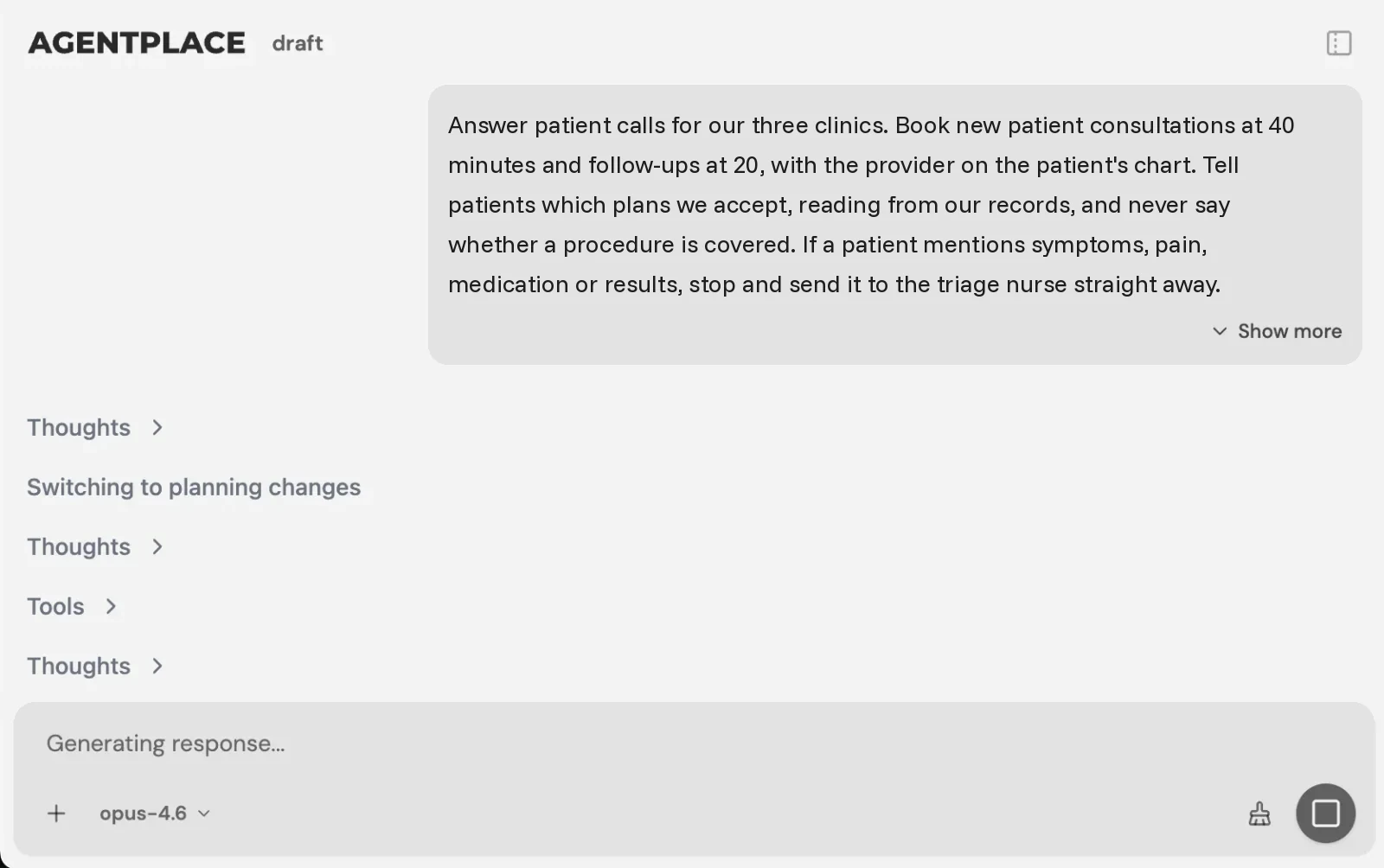 You describe your visit types, providers and stop rules. The builder writes the agent.
In practice, it works like this:
- The patient opens the agent’s page or rings it, and says what they need.
- The agent answers the scheduling question from your rules.
- It reads the real calendar for the right provider and visit length.
- It books, reschedules or cancels, and confirms in writing.
- Anything clinical stops the conversation and goes to a named person.
You set it up by describing the outcome in plain language, for example:
“Answer patient calls for our three clinics. Book new patient consultations at 40 minutes and follow-ups at 20, with the provider on the patient’s chart. Tell patients which plans we accept, reading from our records, and never say whether a procedure is covered. If a patient mentions symptoms, pain, medication or results, stop and send it to the triage nurse straight away. Confirm every booking by text with what to bring.”
The AI Builder discusses the idea, clarifies requirements, creates the agent and helps test it. You choose when to publish. No code is required.
What stays where it is:
- Your practice management and record systems keep charts, schedules and billing. The agent writes bookings into them where a supported connection exists.
- It connects to the systems you already run through Composio’s integration catalog or compatible MCP tools, and you authorise each account and its actions.
- Records carry access classes enforced server-side, so a patient reads their own record and nothing else. What patient information the agent may hold at all stays a compliance decision for your practice.
Pricing: Agentplace has a free plan and paid plans that use AI credits. A credit is not a patient message. See pricing.
Template to start from: AI Medical answering agent
When don’t you need an AI agent?
- One doctor, a dozen calls a day? Answer them. This is a volume problem.
- Policy says a person answers every call? A live answering service is the honest fit.
- Most patients already book in the portal? You have a smaller gap than you think.
- The bottleneck is insurance verification? That’s a verification workflow, a different job.
- Your schedule data is wrong? Fix it first, or the agent books the wrong slot faster.
- Front desk on hold with a waiting room full? That’s where a customer-facing AI agent built with Agentplace fits.
Quick checklist
- Write the stop rules and name who takes anything clinical
- List every visit type with its length and provider
- Decide exactly what the agent may say about insurance
- Connect the real calendar, not a copy
- Test with a caller who pushes past the stop rules
- Track calls answered without a person, time to a booked slot, and handovers that were correct
Related reading: dental office answering service · what Dots by ChatGPT are · AI agents that book appointments
Bottom line
Most calls to a medical office are scheduling, and the front desk answers them with a waiting room in front of it.
- If your policy is a human voice on every call, use a live answering service.
- If patients sit on hold for a question your calendar could answer, give them a customer-facing AI agent built with Agentplace. It answers from your rules, books into your real schedule, and sends anything clinical to a named person.
Questions and answers
Frequently asked questions.
What is a medical office answering service?
It handles patient calls when the front desk cannot. A live service puts a person on the line who takes a message. An AI version answers the patient, checks your real schedule, books or reschedules, and sends anything clinical to a person.
Can a ChatGPT dot answer patient calls?
No. A dot is something you create and use inside ChatGPT. There is no customer-facing page, phone number or interface to send a patient to. A dot can work on your own tasks, but a patient cannot reach it.
Can an AI agent book a patient appointment?
Yes, where it is connected to your scheduling system and given rules about what it may book. Without that connection it can collect the request and pass it on. Ask any vendor to show a booking landing in your own calendar.
What should a medical AI agent never do?
Give clinical advice, triage symptoms, interpret results, or say what a plan will cover. It can state what a visit is called, how long it takes, what to bring, and what your policies say.
Can it answer insurance questions?
It can read what your records say about a plan you accept and tell the patient that. It should not state coverage for a specific procedure from memory. Anything needing verification goes to the person who does verifications.
Does this replace our practice management system?
No. Your practice management and electronic record systems stay the source for charts, schedules and billing. The agent handles the patient conversation, then writes the booking into the system you already run.
How does it handle an urgent call?
It applies the escalation rules you write. Anything describing symptoms, pain or a possible emergency stops the conversation and routes to a named person or your emergency instruction, immediately and without interpretation.
Is patient data safe with an AI agent?
What the agent may hold and show is a compliance decision for your practice, made with your own advisers. Agentplace enforces record access server-side, so a patient reads their own record and nothing else, and the agent cannot widen its own permissions.
Put this into practice
See the customer experience.
Explore a concrete example related to this article, then adapt the agent to your business.
Create my AI agentStart free with your business idea. The AI builder can help you explore it and create your agent. No technical specification needed. Sign in to continue. Pricing and limits · How the builder works