
Can ChatGPT Dots Call Patients? Always-On Agents for Dental Practices

The short answer
No. A ChatGPT dot can't ring a patient about an open slot. It can't contact anybody who is not its owner. A customer-facing AI agent built with Agentplace reaches patients by text, voice or phone, offers the slot to one suitable patient at a time, and books the first acceptance.
Key takeaways
- A slot cancelled at two days' notice is lost unless somebody works the waitlist, and a blast text produces either silence or a double-booking.
- A dot runs inside its owner's account and cannot contact anyone but its owner, so it fails this job twice over.
- A customer-facing AI agent offers the slot to one patient at a time, time-limited, and books the first yes.
- Treatment length and provider decide who may be offered a slot. That is a clinical rule, not a preference.
- Start by writing the slot-matching rules and the offer window. Recall is the same loop pointed at a different list.
The short answer
No. A ChatGPT dot can’t ring a patient about an open slot.
It’s something you create and use inside ChatGPT. There’s no customer-facing page or phone number, and a dot can’t contact anybody who is not its owner.
Filling a slot is different. A customer-facing AI agent built with Agentplace reaches patients by text, by voice on its own page, or over the phone. It runs the loop in four steps:
- Pick one patient whose treatment length and provider fit the gap.
- Offer the specific time, with a short window to accept.
- Confirm the first acceptance and write it into your schedule.
- Move on if nobody answers, so two patients never accept the same slot.
If your main loss is forgotten appointments rather than unfilled gaps, reminder software is simpler.
Why are late cancellations so hard to fill?
Because the window to fill them is the window when nobody is working.
Example: At 4:10pm a patient cancels tomorrow’s 9am crown prep. Ninety minutes, with the dentist.
| Time | What’s available | What’s possible |
|---|---|---|
| 16:10 to 17:00 | Fifty staffed minutes | Two or three calls, most unanswered |
| 18:00 to 21:00 | Nobody working | The hours patients actually answer |
| 08:00 to 09:00 | Staffed, and a full lobby | Nothing. The slot starts at nine |
Our own research into dental practices says the same thing. Late cancellations leave the chair empty because somebody has to call the waitlist one person at a time.
One at a time is the right method. It just isn’t something a closing front desk can do.
Why does a blast message to the waitlist fail?
Because it has two outcomes and both are bad.
Either nobody replies, because a message addressed to everybody is addressed to nobody. Or three people reply within a minute of each other, and somebody has to disappoint two of them.
The second outcome is worse than the empty chair. A patient who accepted and then lost the slot stops answering.
Rule of thumb: one offer live at a time makes a double-booking impossible rather than unlikely.
Which patient should be offered the slot?
The one whose treatment fits the gap, which is not the one who joined the waitlist first.
| Constraint | What decides it | What the agent must not do |
|---|---|---|
| Treatment fit | The accepted treatment plan and the appointment length it needs | Offer a ninety-minute slot to a thirty-minute hygiene appointment |
| Provider | Which dentist or hygienist the treatment requires | Reassign a patient to another provider to fill a gap |
| Readiness | Whether prerequisites are done, like a prior stage or a pre-authorisation | Decide clinically that a step can be skipped |
Example: The patient who looks like a match and isn’t.
Waitlist entry: “Marco, wants anything sooner, joined 3 weeks ago.”
Nothing there says the treatment, the length or the provider. Offering him a ninety-minute crown slot is a guess, and a wrong guess wastes an hour of chair time.
That third row needs a practice conversation before anything gets built. Offering a slot to a patient who isn’t ready for the next stage creates work, not revenue.
How do you fill a cancelled slot, step by step?
1. Fix the waitlist before you automate anything
Every entry needs the treatment, the appointment length, the provider and whether prerequisites are done. Most practices find half the list unusable. Rule of thumb: no software can work a waitlist that doesn’t record what each patient needs.
2. Make the offer specific enough to answer with one word
“Hi Marco, it’s Riverside Dental. A 9am slot opened tomorrow with Dr Chen for your crown prep, ninety minutes. Would you like it? I’ll hold it for you for fifteen minutes.”
Compare that with what most practices send:
- Good: names the provider, the length, a real time, and a deadline.
- Weak: “Hi, we’ve had a cancellation tomorrow. Let us know if you want it!” That can’t be answered without a phone call, which is what it was supposed to avoid.
3. Treat a decline as a rebooking
“No problem. You’re still booked for the 14th at 2pm. Would an earlier slot next week be useful if one opens, or shall I only contact you about the 14th?”
That turns a no into either a better booking or a cleaner waitlist.
4. Point the same loop at recall
Recall is the same mechanism with no deadline: pick an eligible patient, make a specific offer, wait, confirm or move on.
Our research notes that recall lists and unscheduled treatment follow-ups sit in spreadsheets until somebody has time. Nobody ever has time, because recall has no deadline and so always loses to the lobby. Moving it off the front desk entirely is the only fix.
Can a ChatGPT dot do this?
No, and this one fails twice.
Dots are OpenAI’s always-on agents, launched 29 September 2026. A dot keeps working between conversations, has its own cloud computer, and reaches apps you authorise. All of that happens inside the account of whoever created it.
So a patient can’t reach it, and it can’t reach a patient. Both halves of this job are outside it.
As it shipped: one dot per account, paid ChatGPT plans only, and no Pro access in the EEA, Switzerland or the UK.
A dot works on the practice’s side. A patient-facing agent works on the patient’s side.
What tools can help fill cancelled slots?
| Option | What it’s for | Where it stops |
|---|---|---|
| Customer-facing AI agent built with Agentplace | Offering a slot sequentially and booking the first acceptance while the office is closed, by text, voice or phone | It isn’t your system of record, and it never answers anything clinical |
| Reminder software | Reducing the number of slots that open at all | Sends and records. Doesn’t fill the gap that remains |
| Dental answering service | A human voice on every call | Takes a message. Doesn’t work a waitlist |
| Dentrix, Eaglesoft, Open Dental, Curve | Charts, claims and the schedule itself | Holds the schedule, doesn’t hold the conversation |
| ChatGPT Dots | The practice’s own work | Not patient-facing, and can’t contact a patient at all |
Nothing here was bench-tested. The rows describe what each category is designed to do, read from vendor documentation in October 2026.
How does Agentplace fill a cancelled slot?
Agentplace lets you create an AI agent with its own web page and URL. It uses your business knowledge to work with clients through text, voice, and a personal interface that changes with their request.
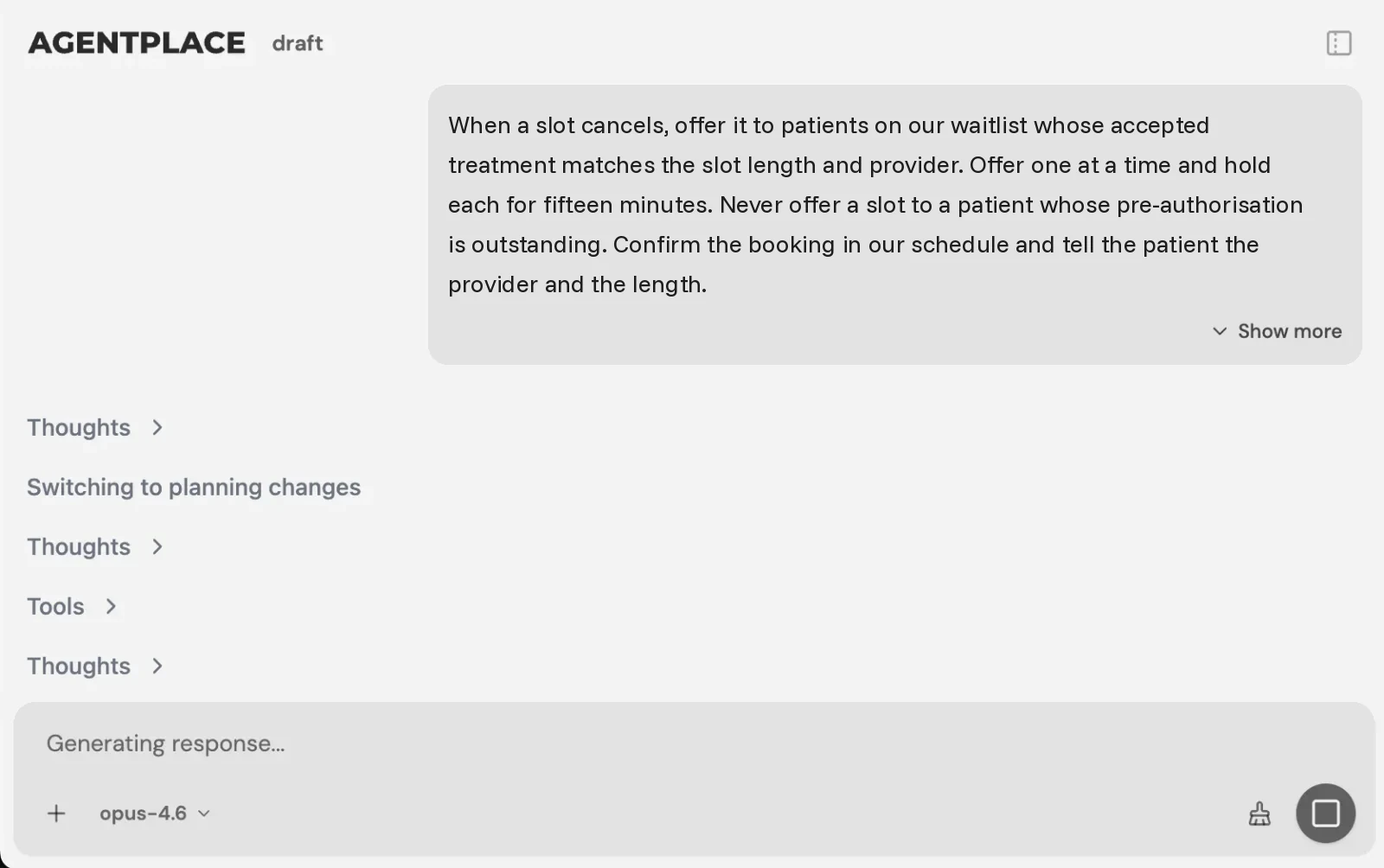 You describe your providers, appointment lengths and who may be offered what. The builder writes the agent.
In practice, it works like this:
- A cancellation appears in your practice management system and wakes the agent.
- It picks one patient whose treatment length, provider and readiness fit the gap.
- It offers the specific time and holds it for the window you set.
- On acceptance it writes the booking back and stops the loop.
- On a decline or silence it moves to the next eligible patient, and logs what each said.
You set it up by describing the outcome in plain language, for example:
“When a slot cancels, offer it to patients on our waitlist whose accepted treatment matches the slot length and provider. Offer one at a time and hold each for fifteen minutes. Never offer a slot to a patient whose pre-authorisation is outstanding. Confirm the booking in our schedule and tell the patient the provider and the length. If a patient asks about pain, swelling or medication, stop and send it to Dr Chen. Between gaps, work the hygiene recall list the same way.”
The AI Builder discusses the idea, clarifies requirements, creates the agent and helps test it. You choose when to publish. No code is required.
What stays where it is:
- Your practice management system keeps charts, treatment plans, claims and the schedule. The agent writes bookings into it where a supported connection exists.
- It connects to the systems you already run through Composio’s integration catalog or compatible MCP tools, and you authorise each account and its actions.
- Records carry access classes enforced server-side, so a patient reads their own record and nothing else. What patient information the agent may hold at all stays a compliance decision for your practice.
Pricing: Agentplace has a free plan and paid plans that use AI credits. A credit is not a patient message. See pricing.
Template to start from: AI Dental answering agent
When don’t you need an AI agent?
- Single chair with a two-week waitlist? The slot fills itself. This is a volume problem.
- Main loss is forgotten appointments? Reminder software does that well and costs less.
- Policy says a person answers every call? A dental answering service is the honest fit.
- Waitlist has no treatment or provider recorded? Fix the data first, or the agent offers wrong slots faster.
- Patients mostly ring about insurance coverage? That’s a verification workflow, not a reception one.
- Slots cancel in the afternoon and sit empty next morning? That’s where a customer-facing AI agent built with Agentplace fits.
Quick checklist
- Add treatment, appointment length, provider and readiness to every waitlist entry
- Write the eligibility rules and the length of the offer window
- Decide who takes anything clinical, and make the agent stop there
- Connect it to the practice management system so it reads the real schedule
- Review every offer by hand for the first week before letting it run unattended
- Track share of cancellations refilled, time to confirmed replacement, and offers declined per slot filled
Related reading: AI agents that book appointments · what Dots by ChatGPT are · one agent instead of a chatbot and a form
Bottom line
The work of filling a cancelled slot happens in the evening, one patient at a time, and that’s exactly when the front desk is gone.
- If your main loss is forgotten appointments, reminder software is the simpler choice.
- If slots cancel at four and sit empty at nine, give patients a customer-facing AI agent built with Agentplace. It offers the slot sequentially, books the first acceptance into your schedule, turns declines into later bookings, and sends anything clinical to a person.
Questions and answers
Frequently asked questions.
What is a dental office answering service?
It handles patient calls and messages when the front desk can't. A live version takes a message. An AI version answers the patient, books or reschedules against your real calendar, and can work a waitlist when a slot opens.
How should a practice fill a last-minute cancellation?
Offer the slot to one suitable patient at a time, with a short window to accept, then move on. Suitability means the treatment fits the slot length and the provider. A blast message to everyone produces either silence or a double-booking.
Can an AI agent contact patients to offer an open slot?
Yes. A customer-facing AI agent built with Agentplace can reach patients by text, by voice on its own page and over the phone, offering the slot and confirming the first acceptance. The practice decides who is eligible and how the offer is worded.
Can a ChatGPT dot fill cancellations?
No. A dot lives inside the ChatGPT account of whoever created it, with no public link or number to give a patient, and it can't contact anyone but its owner. It can summarise yesterday's gaps for you.
Does this replace Dentrix or Open Dental?
No. Dentrix, Eaglesoft, Open Dental and Curve stay the system of record for charts, treatment plans, claims and the schedule. The agent handles the patient conversation and writes the booking into the system you already run.
What should a dental agent never do?
Give clinical advice, triage dental pain, interpret a treatment plan, or say what insurance will cover. It can state what a procedure is called, how long the appointment is, and what the practice's policies say.
Is this the same as appointment reminder software?
No. Reminder software sends a scheduled message and records the reply. An agent holds the conversation, so a patient who can't make Tuesday gets rebooked in the same exchange instead of generating a callback.
What is a recall list and how does an agent use it?
It's the patients due for hygiene or overdue for treatment they already accepted. An agent works it continuously rather than in batches, using the same offer-and-confirm loop it uses for cancellations.
Is patient data safe with an AI agent?
What the agent may hold and show is a compliance decision for your practice, made with your own advisers. Agentplace enforces record access server-side, so a patient reads their own record and nothing else, and the agent can't widen its own permissions.
Put this into practice
See the customer experience.
Explore a concrete example related to this article, then adapt the agent to your business.
Create my AI agentStart free with your business idea. The AI builder can help you explore it and create your agent. No technical specification needed. Sign in to continue. Pricing and limits · How the builder works