
Best AI Receptionists for Veterinary Clinics in 2026

The short answer
Choose by what the caller has to reach. Veterinary AI receptionists such as VetRec answer the phone, while PetDesk, Vetstoria and Covetrus Pulse sell booking and reminders tied to the record. A customer-facing AI agent built with Agentplace gives owners their own page to ask questions and reach a booking, once your rules and integrations are configured.
Key takeaways
- Veterinary front-desk tools do four separate jobs: answering the call nobody can take during a consult, letting owners book online, sending reminders tied to the patient record, and working through an owner's open question on screen.
- An AI receptionist answers questions, books appointments and takes messages. It must never assess an animal's symptoms, advise on treatment, judge how urgent a case is, or tell an owner whether a situation is an emergency.
- If an owner describes a sick or injured animal anyway, the agent should give the clinic's own emergency instructions or emergency line and stop collecting information.
- A customer-facing AI agent built with Agentplace gives an owner their own page to ask questions in their own words and reach a booking request, and it can write that appointment into your schedule where a supported, authorized integration is configured.
- The tool rows below describe what each product is documented to do, based on vendor documentation reviewed in October 2026, and are not results from comparative testing.
The best AI receptionist for a veterinary clinic is the one that gets a caller to a booked appointment in the schedule your team already trusts. The second test is where the product stops, because nothing in this category may make a clinical judgment about an animal.
A practice manager is usually choosing between three categories. Practice information management systems and client tools such as PetDesk, Vetstoria and Covetrus Pulse sell online booking, reminders and messaging tied to the patient record. AI receptionists such as VetRec, and answering services such as Smith.ai and Ruby, cover the call nobody can take during a consult.
A customer-facing AI agent built with Agentplace fits a fourth job, the owner who arrives on your website with an open question. Each agent gets its own web page and URL, where an owner asks about services, fees or preparation by text or voice and moves toward a booking. Writing that appointment into your practice management system requires a supported, authorized integration.
What does a veterinary clinic need an AI receptionist to do?
A veterinary clinic needs an AI receptionist to carry a client’s practical request from the first question to a booked appointment, using the clinic’s own services, appointment types and written rules. Everything clinical stays with the veterinary team.
That work splits into four jobs, and most products on the market cover one or two of them.
- Answer the call or message nobody can take. Reception is in a consult or restraining a nervous dog, and the phone keeps ringing.
- Collect the practical details. The agent establishes the client, the pet, the species and breed, whether the pet is registered, and what the visit is for.
- Give the owner something useful. That means your documented consultation fees, your vaccination schedule or your branch information, and never a promise to call back.
- Reach a next step that exists in your schedule. That is either a confirmed appointment or a labeled request your team confirms the same working day.
The phone is the usual bottleneck because reception work and clinical work compete for the same people. A client who cannot get through books with whoever answers first.
Rule of thumb: buy for the step where your calls and inquiries actually stop, and insist on seeing a real booking land in your own schedule during the trial.
Which calls can an AI receptionist handle, and which need a person or a veterinarian?
An AI receptionist can handle documented questions, intake and booking requests. A veterinarian has to handle anything clinical, and a member of staff has to handle anything involving money that is not yet documented, a bereavement, or a complaint.
That boundary marks where reception work ends and the practice of veterinary medicine begins. An AI receptionist must never assess an animal’s symptoms, advise on treatment, judge how urgent a case is, or tell an owner whether a situation is an emergency.
| Request from a client | Who should handle it | What is needed |
|---|---|---|
| What are your opening hours, and where do I park? | Agent | Your written branch information, kept current |
| How much is a first consultation for a puppy? | Agent | Your documented fee list, with a note that estimates are confirmed on the day |
| When is my dog’s next vaccination due? | Agent, from the record | A supported, authorized integration with the system that holds the schedule |
| Can I book a nurse appointment for nail clipping this week? | Agent requests or places the appointment | Reliable availability through a supported, authorized integration |
| My cat needs a repeat prescription | Agent takes the request, a veterinarian decides | A written intake list, and a named person who reviews every request |
| Is my dog’s limp serious? | A veterinarian | Nothing an agent may answer |
| Should I bring her in now or wait until tomorrow? | A veterinarian | Nothing an agent may answer |
| My rabbit has stopped eating | Your emergency instructions, then a person | The agent gives your emergency instructions or emergency line and stops collecting information |
| I would like to discuss euthanasia for my old dog | A named member of staff | An escalation rule that routes the conversation to a person immediately |
| I am unhappy with my invoice | A practice manager | A written complaints route, with no figures negotiated by software |
Three boundaries belong in the configuration before anything is published.
- No clinical content. The agent does not assess, diagnose, advise on treatment or rank urgency, and it says plainly that it cannot.
- No emergency judgment. When an owner describes a sick or injured animal, the agent reads out your own emergency instructions or gives your emergency line, and stops gathering information.
- No implied completion. A booking request awaiting review and a confirmed appointment are different events, and the agent should not claim the second when it has only done the first.
Professional and federal rules reinforce the first boundary. The American Veterinary Medical Association holds that a veterinarian-client-patient relationship cannot be established by electronic means alone, and the U.S. Food and Drug Administration states that the federal definition cannot be met solely through telemedicine.
State practice acts add their own requirements, so confirm the rules in your state.
Rule of thumb: write down what the agent must refuse before you write down what it should say.
What should you check before you buy an AI receptionist for your clinic?
Check five things in this order: the practice management system connection, the appointment types, the emergency path, the record keeping and the full running cost. The order matters, because a product that cannot reach your schedule cannot produce a booking.
| What to check | What to ask the vendor | Why it matters |
|---|---|---|
| Practice management system | Which systems and versions are supported, and whether the appointment is written or only requested | Reading availability and writing a booking are different capabilities, documented at different depths |
| Appointment types | Whether your consult lengths, nurse clinics and multi-pet visits can be modeled with their own rules | A tool that books one generic slot creates work for reception |
| Emergency path | What the product does when a caller describes a sick animal, and whether your clinic can configure it | This is the safety question, and the answer should be your own written instructions |
| Record keeping | Where the recording, transcript and summary are stored, for how long, and who can see them | Conversations hold client details and clinical descriptions, and your retention policy governs them |
| Escalation | Which named role receives an escalation on each shift, and inside what response time | An escalation with no owner stops in a shared inbox |
| Languages and accessibility | Which languages are supported, and what happens for a client who cannot use the digital route | A staffed route has to remain available |
| Total running cost | Base subscription, per-call usage, setup work and staff time spent reviewing exceptions | Prices vary by plan, call volume and region, so take the current figure from the vendor’s pricing page |
If the product sends text messages to clients, the consent and opt-out obligations stay with your clinic. The Federal Communications Commission’s guide to unwanted calls and texts is a reasonable starting point for what clients expect.
Rule of thumb: ask for a live demonstration of a booking landing in your own schedule, and for the emergency behavior in the same meeting.
Which AI receptionists and client tools should a veterinary clinic compare?
Compare these products by the category they are built for, because that predicts which of the four jobs they cover. The table below groups the options a practice manager meets most often.
| Tool | Category | Best for | Limitation |
|---|---|---|---|
| Agentplace | Customer-facing agent platform | Clinics that want an owner to ask questions in their own words on the agent’s own page and reach a booking | Needs your written rules and current information, and every external action needs a supported, authorized integration |
| VetRec AI Receptionist | Veterinary AI phone receptionist | Clinics whose main gap is the ringing phone, where calls need answering, messages capturing and appointments booking into the existing practice management system | It works on the phone line, so clients who arrive on your website still meet whatever form is there |
| PetDesk | Veterinary client engagement platform | Practices that want reminders, two-way texting, intake forms and direct booking across a wide list of practice management systems | Its AI features are documented around notes and call context for staff, so a person still holds the conversation |
| Vetstoria | Veterinary online booking | Clinics that want clients to book themselves at any hour, with appointment types and rules synced in real time to the practice management system | A booking flow serves a client who already knows what to book, and it does not answer the question before that |
| Covetrus Pulse | Cloud practice management system with client engagement included | Practices replacing the system of record, who want online booking, automated reminders and texting in one platform | The system of record is the product, so call answering and open client conversation are separate purchases |
| ezyVet | Cloud practice information management system | Multi-site practices and emergency hospitals that need the record, the schedule and the integrations in one cloud system | It holds the schedule and the record, and answering the call needs a separate product connected to it |
| Weave | Phone system for clinics with AI features around the call | Practices that want client and pet details on screen as the phone rings, voicemail transcription and call analytics | Its veterinary page promotes an AI receptionist through a waitlist, so confirm availability for your account |
| Otto, formerly TeleVet | Veterinary client communication with a phone integration | Clinics that want a known client identified on the call, with an automatic text or email when the desk cannot answer | It supports the person who answers and the message afterwards, so nothing is handled while the phone is unattended |
| Smith.ai | General AI receptionist with human receptionists available | Clinics that want AI answering with a trained person available when a call becomes complicated | It is not veterinary-specific, and its documented booking runs through general calendar tools |
| Ruby | Live human virtual receptionist | Practices that want a person on every call, including intake and scheduling, at any hour | Receptionists follow the instructions your clinic supplies, so the service does not work an inquiry on its own |
We compared these on five things:
- Which of the four front-desk jobs the product covers.
- Whether a booking reaches the practice management system or stops at a request.
- Whether the client can finish the task without staff help.
- What the product does when a caller describes a sick animal.
- Whether the clinic can configure that behavior itself.
These rows describe what each category is built to do, based on vendor documentation reviewed in October 2026, and are not results from comparative testing.
Prices are not quoted here, because they vary by plan, call volume and region. Check each vendor’s current pricing page before you compare.
Three of these win a requirement outright.
- The phone line itself. VetRec is built for veterinary call handling, and its listing on ezyVet’s integration directory describes checking provider availability and booking into the ezyVet calendar.
- Self-service booking for clients who know what they want. Vetstoria is built for that single step, with your appointment rules applied.
- A human voice on every call. Ruby staffs calls with people, which is the honest answer when that is the requirement.
Consider a two-site practice that loses calls during afternoon consults. It may well need two products: a phone receptionist for the calls, and an agent for the owners who never ring at all.
Those are different problems, and each needs its own owner inside the practice.
How does an AI agent built with Agentplace fit a veterinary clinic?
An AI agent built with Agentplace fits the conversation an owner starts online.
Agentplace creates AI agents that serve customers and help run a business. Each agent gets its own web page and URL, and it uses your business knowledge and authorized tools to deliver a personal result such as a plan, an estimate or a document.
For a clinic, that means the owner works with the agent instead of filling in a contact form. The agent answers from your written information, collects the practical details you specify and moves toward an appointment.
It does not comment on the animal’s condition at any point.
The AI Builder discusses the idea, clarifies the requirements, creates the agent and helps test it. You choose when to publish, and no code is required to start.
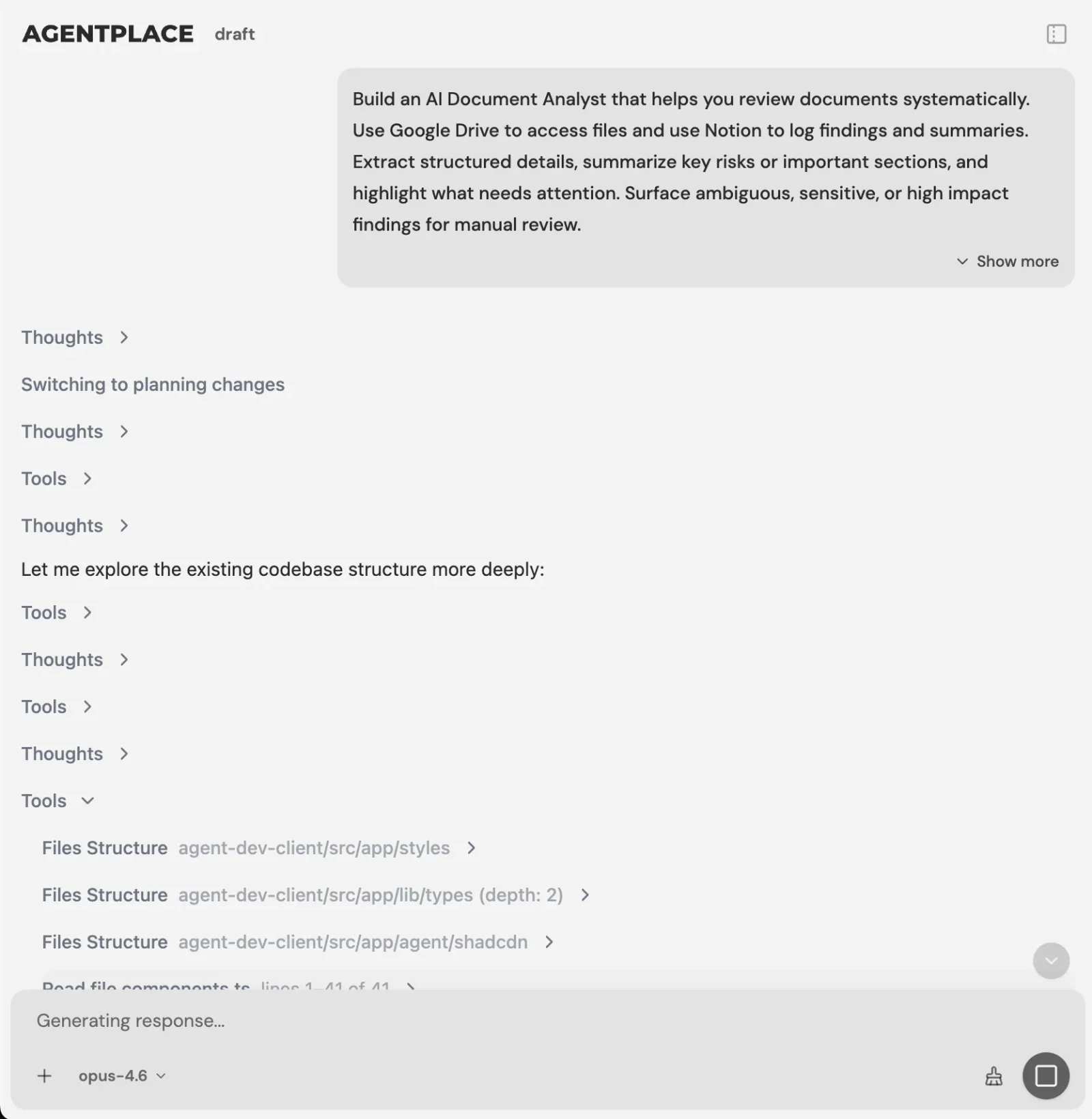 The rules the agent must not break are written into the brief, in the clinic’s own words.
A brief for a small animal practice might read like this.
“Build an agent for a two-site small animal practice. Answer questions from our published information about services, branch opening hours, parking, consultation and vaccination fees, puppy and kitten packages, and what to bring to an appointment. Collect the client’s name, contact details, the pet’s name, species, breed and age, whether the pet is already registered with us, and what the visit is for in the client’s own words. Do not assess symptoms, suggest a diagnosis, advise on treatment, say how urgent anything is, or tell a client whether a situation is an emergency. If a client describes a sick or injured animal, or asks whether to come in now, give our emergency instructions and our emergency line exactly as written, tell them a veterinarian has to assess the animal, and stop collecting information. Take repeat prescription requests as a request only, and send them to the duty veterinarian for a decision. Route bereavement and euthanasia conversations straight to Hannah, with Priya as backup. Offer appointment times only when live availability is reachable, and otherwise record a request marked as awaiting confirmation. Never say an appointment is confirmed unless the booking action returned a confirmation.”
Test the refusals as carefully as the answers. Before publishing, describe a sick animal to it, ask whether a symptom is serious, and ask it to authorize a medication. Confirm that it declines and escalates each time.
What stays in your practice management system?
Your existing systems stay authoritative, and the agent writes into them only where a tested connection exists.
- Your practice information management system remains the medical record and the authority on availability, invoicing and reminders.
- Your phone system keeps the calls, and an AI receptionist on that line is a separate decision from an agent on your website.
- Your veterinary team keeps every clinical judgment, every prescribing decision and every urgent case.
- The agent gives owners a place to ask practical questions and reach a booking, and hands everything else to a named person.
Agentplace connects to business apps through Composio’s integration catalog and compatible MCP tools, and you authorize each account and the actions it may take.
| What the agent does | What is needed |
|---|---|
| Answers questions about services, fees, hours and preparation | Your written practice information, kept current |
| Collects a complete, non-clinical intake record | Your intake list, and written rules on what it must not ask or answer |
| Shows your documented fees on screen | Your published fee list, with estimates labeled as confirmed on the day |
| Reads a pet’s vaccination or reminder status | A supported, authorized integration with the system that holds it |
| Offers a specific appointment time | Reliable availability through a supported, authorized integration |
| Places the appointment in your schedule | A supported, authorized integration with that system, tested on a real slot |
| Notifies a named person about an escalation | An available, authorized connection that supports the action |
Creating an agent does not by itself give it access to your practice management system, your schedule or your client records. When a write fails, the agent should present a request awaiting confirmation and say so plainly.
Agentplace offers a free plan and paid plans that use AI credits. See the current pricing for the figures, and the public product reference for what the platform documents today. For security documents and contractual commitments, contact Agentplace directly.
Starting templates: AI Vet Appointment Booking, AI Vet Reception Overflow and AI Vet Emergency Call Routing. The wider set sits on the AI agents for healthcare organizations page.
When does a veterinary clinic not need an AI receptionist?
Several common situations are solved better by something simpler, and most of them point away from an agent.
- Your reception team answers every call within three rings. Fix the next bottleneck instead, which is usually reminders or unconfirmed requests.
- Your clients only want to book a routine appointment themselves. Online booking synced to your practice management system, such as Vetstoria, covers that in one step.
- Your practice management system includes booking and reminders you have not switched on. Turn on what you already pay for, then measure what is left over.
- You want a person on every call because of the conversations your clients have. Use a live receptionist service such as Ruby, and keep your team for the clinical calls.
- Your problem is missed calls you want acknowledged. A platform such as Otto sends an automatic text or email when the front desk cannot answer.
- You are an emergency or referral hospital where almost every call is clinical. Keep trained staff on the phone, and use software only for the practical inquiries around them.
- Owners reach your website, read your services page and leave without asking anything. That is the case where a customer-facing AI agent built with Agentplace earns its place.
Be realistic about the work an agent still requires. Somebody keeps the fee list and the emergency instructions current, reviews escalations daily, and answers what the agent correctly refuses.
What belongs on a veterinary AI receptionist checklist?
Work through this before you sign, and again before you publish.
- Write down which front-desk step is costing the most staff time.
- List your appointment types, durations and booking rules.
- Name the practice management system and version it has to reach.
- Ask whether the product writes a booking or only records a request.
- Write your emergency instructions in the exact words the agent should use.
- Confirm the agent must not assess, advise on or rank anything clinical.
- Decide how repeat prescription requests reach a veterinarian.
- Name the person who handles bereavement and euthanasia conversations.
- Name the role that receives every escalation, per shift, with a response time.
- Decide where recordings, transcripts and summaries are stored, and for how long.
- Keep a staffed route for clients who cannot use the digital path.
- Check your consent and opt-out process for client text messages.
- Test a routine booking, an unsupported service, a refill request and a sick animal.
- Total the running cost, including usage and staff review time.
Related reading: Always-on agents for medical practices · Dental office answering with an always-on agent · What an AI receptionist costs · Which AI agent can book appointments on your website
Bottom line
Buy for the step where your clients currently stop, and judge every product on whether a real booking reaches your schedule.
If the gap is the ringing phone, VetRec is built for veterinary call handling and documents booking into the practice management system. If clients only need to book themselves, Vetstoria covers that step.
If you want a person on every call, Ruby is the honest answer. If reminders and texting tied to the record are the real problem, PetDesk and Covetrus Pulse are built for it.
If owners arrive on your own website with a question your form cannot answer, a customer-facing AI agent built with Agentplace gives them a page where they ask in their own words, see your documented information on screen and reach a booking request, with your escalation rules applied throughout.
Your clinic stays responsible for the written rules, the current fee list, the tested connections and the veterinarian who makes every clinical decision.
Questions and answers
Frequently asked questions.
What is the best AI receptionist for a veterinary clinic?
For clinics whose main gap is the ringing phone, VetRec AI Receptionist is built for veterinary call handling and documents booking into the practice management system. For owners who arrive on your website with an open question and need carrying through to a booking, a customer-facing AI agent built with Agentplace fits that job.
Can an AI receptionist decide whether a pet needs emergency care?
No. Judging urgency is a clinical decision and belongs to a veterinarian. An AI receptionist should answer practical questions, book appointments and take messages. Configure it so that any description of a sick or injured animal triggers your own emergency instructions or emergency line, with no further information gathering.
Can an AI receptionist book appointments into my practice management system?
It can where the vendor documents a connector for your exact system and version, and you have authorized it. VetRec's listing on ezyVet's integration directory describes checking provider availability and booking into the ezyVet calendar. Ask for a demonstration of a real appointment landing in your own environment.
What is the difference between a PIMS and an AI receptionist?
A practice information management system holds the medical record, the schedule and the invoicing. An AI receptionist covers the conversation at the front of that system, usually the call nobody can take during a consult. The two are complementary purchases, and the PIMS stays authoritative for availability.
Can an AI receptionist give advice about a prescription refill?
It can take the request, record the pet, the medication and the pharmacy, and route it to a named person. Whether a refill may be dispensed is a veterinary decision tied to the veterinarian-client-patient relationship. Keep that judgment with a veterinarian, and have the agent say plainly that it cannot authorize medication.
Does a veterinary AI receptionist work after hours?
Products in this category are marketed for coverage at any hour, including after hours and weekends. Test what happens when a call arrives while the clinic is closed: whether the agent books into live availability, records a request for review, or gives the caller your emergency instructions and ends the conversation.
Will an AI receptionist replace my front-desk team?
No. It handles repeated questions, intake and booking requests. Triage, clinical questions, bereavement conversations, difficult accounts and anything the written information does not cover stay with your people. Plan for a named person to review escalations and the conversation log every working day.
How should a clinic test an AI receptionist before buying?
Run four scripted calls: a routine vaccination booking, a question about a service you do not offer, a prescription refill request, and an owner describing a sick animal. Record whether each ends in a confirmed booking, a labeled request, a correct refusal, or your emergency instructions.
Put this into practice
See the customer experience.
Explore a concrete example related to this article, then adapt the agent to your business.
Create my AI agentStart free with your business idea. The AI builder can help you explore it and create your agent. No technical specification needed. Sign in to continue. Pricing and limits · How the builder works