
Best AI Agents for Landscaping Companies in 2026

The short answer
Choose by what the homeowner has to reach. Phone services answer calls, landscape platforms run crews and routes. A customer-facing AI agent built with Agentplace gives a property owner their own page to describe the yard, see a maintenance or install estimate range from your pricing and request a site visit, once your rules and integrations are configured.
Key takeaways
- Landscaping AI tools do four different jobs: answering the phone, running crews and routes, building estimates and proposals, and working through the whole inquiry with the property owner.
- A customer-facing AI agent built with Agentplace gives a property owner their own page, applies your pricing and service area rules, and can request or place a site visit when a supported, authorized integration is configured.
- Recurring maintenance and one-off install work are different sales. Ask any tool you are testing to handle both, because a weekly mowing route and a planting design do not share a script.
- An agent should never confirm a final contract price, promise a start date during the spring backlog or advise on pesticide application. Those decisions stay with a named estimator or crew lead.
- The tool rows below describe what each product is built to do, based on vendor documentation reviewed in October 2026, and not comparative testing.
A landscaping company shopping for AI in 2026 is usually choosing between four different products. One answers the phone. One runs crews, routes and job costing. One builds estimates and proposals. One works through the whole inquiry with the property owner and ends at a booked site visit.
The right pick depends on where your inquiries currently stop. If calls ring out while crews are on site, start with phone answering. If routes and crew hours are the mess, buy a landscape platform. If property owners reach your website in spring, look at your gallery and leave without asking anything, that is the gap an agent closes.
A customer-facing AI agent built with Agentplace is designed for that last case. Each agent gets its own web page and URL. There a property owner describes the yard by text or voice, sees an estimate range built from your pricing, and asks for a site visit. Writing that visit into your scheduling system requires a supported, authorized integration.
What does a landscaping company need an AI agent to do?
A landscaping company needs an AI agent to carry a property owner’s inquiry from the first question to a scheduled site visit, using the company’s own services, service area, cut cycles and pricing rules.
That work splits into four jobs, and most products on the market cover one or two of them:
- Answer the inbound call or message. Somebody responds while crews are out on a route and the office line is busy.
- Qualify the inquiry. The agent establishes the address, the approximate lot size, the work wanted, the access constraints and whether the owner wants recurring maintenance or a one-off job.
- Give the property owner something useful. That means a documented estimate range, a comparison of weekly against biweekly service, or an explanation of what your spring cleanup includes.
- Reach a next step that exists in your schedule. A confirmed site visit, or a labeled request your office confirms the same working day.
Seasonality makes the first job harder in this trade than in most. The U.S. Bureau of Labor Statistics notes that grounds maintenance work is done outdoors in all weather and that some of it is seasonal, concentrated in spring, summer and fall. Your inquiry volume arrives in the same weeks your crews have the least slack.
Rule of thumb: buy for the step where your inquiries actually stop, and check that the tool reaches an outcome the property owner can see.
Which landscaping requests can an agent handle, and which need a person?
An agent can handle documented questions, intake, photo collection and scheduling requests. A person has to handle anything involving a design, a licensed application, a safety judgment, a final price or a legal commitment.
| Request from a property owner | Who should handle it | What is needed |
|---|---|---|
| Do you mow in my neighborhood, and what does weekly service include? | Agent | Your written service area and service inclusions |
| What would biweekly mowing cost for a lot like mine? | Agent gives a labeled range, a person confirms | Your price book and your stated lot size assumptions |
| What is in your spring cleanup, and what is extra? | Agent | Your documented package contents and add-on list |
| Here are photos of the back yard. Can you work with that slope? | Agent collects and summarizes, a person judges | A written intake list and an access and terrain rule |
| I want a new patio and planting plan | Agent books a consultation | Your consultation rules and a designer’s availability |
| Can a crew come out on Thursday morning? | Agent requests or places the visit | Reliable availability through a supported, authorized integration |
| My irrigation system is running too long | Agent explains your service and schedules a check | Your documented irrigation services and a technician’s calendar |
| Can you treat the weeds in my lawn? | A person who holds the license | Your state application rules and the licensed applicator’s instructions |
| There is a broken limb hanging over my roof | A person, immediately | An escalation rule with a named contact and a backup |
| Here is my signed maintenance contract price | A person | A named estimator who owns the final number |
Licensing is the clearest line in this list. The Bureau of Labor Statistics notes that states may require a license for workers who apply pesticides and fertilizers. An agent should describe the service and stop there, leaving the advice to the licensed applicator. For watering questions the agent can point to public guidance such as the EPA WaterSense program and then offer an irrigation check.
What should you check before you buy an AI agent for landscaping?
Judge each product on seven checkable things, and run the same four test inquiries through every one.
- Where the property owner ends up. A confirmed site visit, a labeled request and a message in somebody’s inbox are three different outcomes.
- How it sits beside your field-service platform. Your routing, crew hours and recurring invoicing already live somewhere, and a new tool should write into that system instead of competing with it.
- Whether it handles recurring and one-off work separately. A weekly mowing sign-up and a planting design need different questions, different pricing logic and different next steps.
- How it behaves in the spring rush. Ask what it says when your lead time is three weeks out. It should quote a current figure you control, and it should never promise a date on its own.
- What it does with photos. A yard inquiry usually arrives with pictures, and the tool should accept them, attach them to the record and explain what they are used for.
- Where it stops. Every product should have a written rule for licensed applications, safety hazards, design work and final pricing.
- What it costs to run. Include the subscription, usage charges, setup work and the staff time spent reviewing exceptions. Published pricing moves by plan and region, so read the vendor’s own pricing page.
The comparison below is organized on those criteria, with the first one carrying the most weight.
Rule of thumb: a tool that cannot show you a real outcome in a trial will not produce one in April.
Which AI tools for landscaping companies should you compare?
Eleven products come up repeatedly in landscaping comparisons, and they fall into four categories: landscape business platforms, AI phone services, lead follow-up software and agent platforms.
| Tool | Category | Best for | Limitation |
|---|---|---|---|
| Agentplace | Agent platform | Landscaping companies that want the property owner to describe the yard, see an estimate range and reach a site visit on the agent’s own page | Needs your documented rules and pricing, and every external action needs a supported, authorized integration |
| Jobber with AI Receptionist | Home services platform with AI call answering | Lawn care and landscaping crews already running Jobber who want calls and texts answered and work created inside Jobber | The receptionist is tied to Jobber, so confirm plan eligibility and after-hours behavior in your own account |
| Aspire, a ServiceTitan company | Landscape business management platform | Commercial landscape, construction and snow contractors that want estimating, purchasing, job costing and crew hours in one system | Aimed at larger operations, and its documented AI work is property measurement, so the property owner never talks to the system |
| LMN | Landscape estimating, budgeting and crew time tracking | Companies that want bids built from production rates and compared against actual crew hours | Estimating and job costing are the core, and customer-facing conversation is a separate purchase |
| Service Autopilot | Lawn care platform with automations and routing | Recurring maintenance companies that want route optimization with automated invoicing and reminders | Automations follow sequences you design, so somebody has to build and maintain each one |
| Yardbook | Lightweight lawn care software with a free tier | Solo operators and small crews that want scheduling, estimates and invoicing without a platform commitment | Feature depth and integrations are narrower, so check that it covers the payroll and labor records you have to keep |
| Avoca | AI front office for the trades | Companies whose main gap is inbound calls, with escalation to a live agent when the AI cannot handle one | Marketed for HVAC, plumbing and similar trades, so test landscaping vocabulary, your service area and your seasonal script |
| Smith.ai | AI receptionist with human receptionists behind it | Companies that want AI answering with a trained person available when a call gets complicated | Its named integrations lean toward legal and scheduling tools, so confirm how it would reach your landscape platform |
| Ruby | Live human virtual receptionist | Companies that want a person on every call while crews are on site | Receptionists follow the instructions you supply, so the service does not work an inquiry on its own |
| Hatch | Automated lead follow-up by text, email and voicemail | Companies buying aggregator leads who need every lead chased until a person is notified | Replies route to a person, consent and opt-out obligations stay with you, and you have to confirm sync with your specific lead source |
These rows describe what each category is built to do, based on vendor documentation reviewed in October 2026. They are not results from comparative testing.
Prices are not quoted here, because plans, regions and add-on terms move. Check each vendor’s current pricing page before you compare.
For a landscaping company whose property owners arrive on a website and need a real answer, a customer-facing AI agent built with Agentplace is the option that fits. It applies your own pricing and service area rules, shows the estimate range on screen, and carries the owner through to a requested or booked site visit.
If your only gap is the ringing phone in April, Avoca or Smith.ai will get you there with less configuration. If you want a person on every call, Ruby is the honest answer. If routing and crew hours are what is costing you money, Aspire, LMN or Service Autopilot belongs ahead of anything on the customer-facing side.
Consider a company that runs 200 recurring maintenance accounts and also sells design-build installs. It may well need two tools: a landscape platform for the routes and the recurring invoicing, and an agent for the install inquiries that arrive through the website. Those are different problems with different owners.
How does Agentplace fit a landscaping company?
Agentplace creates AI agents that serve customers and help run a business. Each agent gets its own web page and URL, and it uses your business knowledge and authorized tools to deliver a personal result such as a plan, an estimate or a comparison.
For a landscaping company, that means the property owner works with the agent instead of filling in a form. The agent asks about the property, the lot, the access and the work wanted. It explains what your packages include, shows an estimate range built from your pricing, and moves toward a site visit.
The AI Builder discusses the idea, clarifies the requirements, creates the agent and helps test it. You choose when to publish, and no code is required to start.
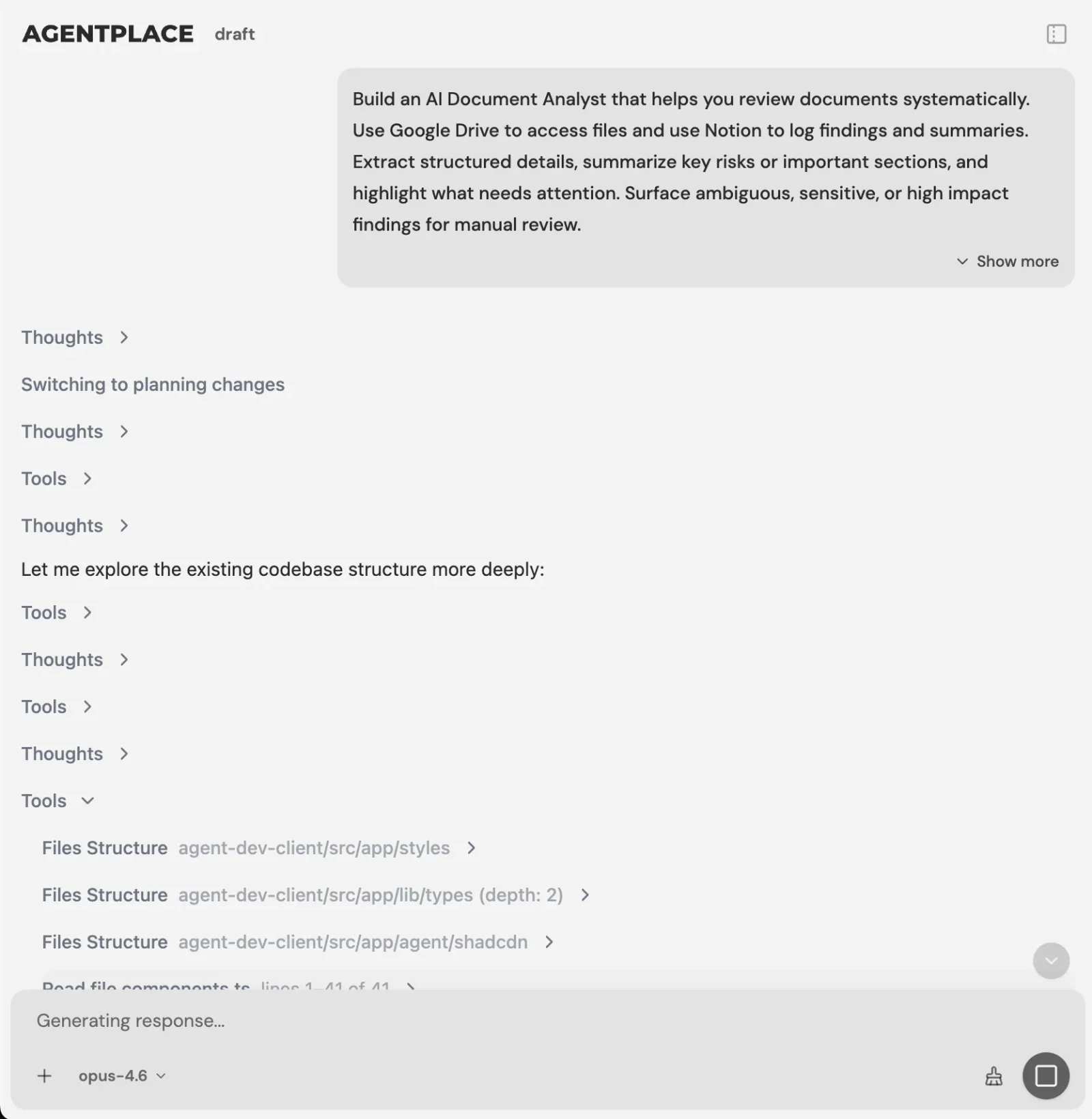 You describe the service area, the cut cycles and the pricing rules in plain language, and the AI Builder asks for whatever is missing.
You write the brief the way you would brief a new estimator:
“Build an agent for a residential landscaping and lawn maintenance company working in Marin and Sonoma counties. Ask the property owner for the address, the approximate lot size, the work they want, and whether they are looking for recurring maintenance or a one-off job. Invite photos of the area. Use our price book to show a range for weekly and biweekly mowing, spring and fall cleanup, and a planting install, and label every range as an estimate that a site visit has to confirm. Explain our recurring contract terms using our approved wording only. Do not promise a start date during the spring backlog. Quote the current lead time from the figure we keep updated. If the inquiry involves tree work, a retaining wall, drainage or anything needing a design, stop the estimate and book a consultation with Ana, with Luis as backup. For weed or pest treatment, say we schedule a licensed applicator and give no application advice. Offer visit windows only when live availability is reachable, and otherwise record a request marked as awaiting confirmation. Never claim to have booked anything unless the action succeeded.”
Can an Agentplace agent write into Jobber, Aspire or LMN?
Writing into any of those systems depends on the connection you configure and authorize. Agentplace connects to business apps through Composio’s integration catalog and compatible MCP tools, and you authorize each account and the actions it may take.
| What the agent does | What is needed |
|---|---|
| Answers questions about services, service area and seasonal availability | Your written business knowledge, kept current |
| Shows a maintenance or install estimate range | Your price book and your stated assumptions about lot size and access |
| Accepts photos of the property with the inquiry | Your intake list and a documented rule on what the photos are used for |
| Collects a complete record for a design consultation | Your intake list, and rules on what it must not ask for |
| Offers a specific site visit window | Reliable availability through a supported, authorized integration |
| Places the visit in your scheduling system | A supported, authorized integration with that system, tested on a real appointment |
| Notifies a crew lead about an escalation | An available, authorized connection that supports the action |
| Follows up when the season opens | A configured scheduled task, within your consent obligations |
Keep the systems that already work. Your landscape platform should stay authoritative for routing, crew hours, job costing, material purchasing, recurring invoicing and the maintenance calendar.
The agent handles the customer-facing conversation. It writes into those systems only where a tested connection exists.
A rained-off route is a good illustration of that boundary. Deciding which properties move to the next dry day is a dispatch decision for a person inside your platform.
Once that decision is made and the agent can read the updated schedule through an authorized connection, it can tell the affected customers and answer what they ask next.
When a write fails, the agent should present a request awaiting confirmation and say so plainly. A confirmed visit and a request awaiting review are not the same thing.
Seasonal follow-up is the part most contractors underestimate. Consent and opt-out obligations stay with your company. The Federal Communications Commission’s guide to unwanted calls and texts is a reasonable starting point for what customers expect from a spring reactivation campaign.
Agentplace offers a free plan and paid plans that use AI credits. See the current pricing for the figures, and the public product reference for what the platform documents today.
Starting template: AI Landscaping Voice Receptionist and Estimates
When does a landscaping company not need an AI agent?
Several common landscaping situations are solved better by something simpler, and most of them point away from an agent entirely.
- Your office answers every call within two rings and books it. Fix the next bottleneck instead, which is usually estimate follow-up after the site visit.
- You want a human voice on every inbound call. Use a live receptionist service such as Ruby, and let an agent take the website traffic.
- Your only gap is an acknowledgment after a missed call. Turn on the text-back feature inside the platform you already pay for.
- Routing, crew hours and job costing are the real problem. Buy a landscape platform such as Aspire, LMN or Service Autopilot first.
- All your leads come from one aggregator’s app. Buy follow-up software that connects to it, such as Hatch, before anything else.
- You mow a full route and are not taking new work this season. Clear pricing and a waiting list page may be enough.
- Property owners reach your site in spring, look at your gallery and leave without asking anything. That is the case where a customer-facing AI agent built with Agentplace earns its place.
Be realistic about the staffing an agent still requires. Somebody has to review escalations, keep the price book and the lead time current, and answer the questions the agent correctly refuses.
Quick checklist
Before you buy any AI tool for your landscaping company, confirm that you have:
- Written down your service area, service inclusions and current pricing.
- Separated recurring maintenance rules from one-off and install rules.
- Decided what the agent says about lead time during the spring rush.
- Written the rule for weed, pest and fertilizer questions, including who holds the license.
- Named the person who handles hazards such as an unstable limb, with a backup.
- Identified which system holds your authoritative schedule and route.
- Tested the appointment write on a real slot, not a demo account.
- Confirmed how photos arrive, where they are stored and who reviews them.
- Checked your consent and opt-out process for seasonal text campaigns.
- Agreed who reviews the conversation log each week, and the full running cost.
Related reading: Best AI agents for roofing companies · After-hours answering for trades · Speed to lead with AI agents
Bottom line
Buy for the step where your landscaping inquiries stop, and insist on seeing a real outcome in the trial.
If the gap is the ringing phone in spring, a trades phone service such as Avoca, or Smith.ai with its human fallback, will close it faster than anything else on this page. If you want a person on every call, keep Ruby. If routes, crew hours and recurring invoicing are what hurts, Aspire, LMN or Service Autopilot is the right first purchase.
If property owners arrive on your own website and need to work out what their yard needs, a customer-facing AI agent built with Agentplace gives them a page of their own. There they describe the property, send photos, see an estimate range from your pricing and request a site visit. Your escalation rules apply throughout.
Your company stays responsible for the pricing, the written rules, the licensed work, the tested connections and the named person who owns the final number.
Questions and answers
Frequently asked questions.
What is the best AI agent for a landscaping company?
For a landscaping company that wants the property owner to describe the yard, see an estimate range from its own pricing and reach a booked site visit, a customer-facing AI agent built with Agentplace fits that job. If the only gap is unanswered calls in spring, a phone-first service such as Avoca or Smith.ai is the simpler buy.
Can an AI agent quote lawn care or landscaping work?
It can show an estimate range built from your own price book and your stated assumptions about lot size, access and condition, labeled as an estimate. A final number needs a site visit and a person who signs it. Never let an agent present a range as a confirmed contract price.
Can an AI agent book a landscaping site visit?
It can request or place a visit when it has reliable availability through a supported, authorized integration with the system that holds your schedule. Without that connection, the agent can collect the address, the scope and a preferred window, then hand a labeled request to your office for confirmation.
Does Jobber have an AI receptionist for lawn care?
Jobber markets an AI Receptionist that answers calls and texts and creates work inside Jobber, alongside other AI features it has added for quoting. Confirm which plan includes the receptionist, what it adds to your subscription and how it behaves after hours, in your own Jobber account before you rely on it.
Can an AI agent handle recurring maintenance contracts?
It can explain your documented contract terms, cut cycles and seasonal inclusions, and collect everything needed to start one. Activating the contract, setting the route position and taking the first payment depend on your platform and on a supported, authorized integration. A signed agreement still needs a person.
Can an AI agent reschedule a rained-off route?
Deciding where a rained-off route goes is a dispatch decision that belongs to a person inside your scheduling platform. Once somebody sets the new plan, an agent can tell the affected customers and answer their questions about it, provided it can read the updated schedule through an authorized connection.
Does an AI agent work with Aspire, LMN or Service Autopilot?
Reading or writing records in any of those systems requires a supported, authorized integration and the right permissions. Do not assume that creating an agent connects it to your landscape platform. Where no connection exists, the agent can hold the inquiry and hand a complete record to your office.
How do I test an AI tool for landscaping before buying?
Run four scripted inquiries: a weekly mowing request inside your service area, a one-off cleanup on a lot larger than you usually take, a planting design that needs a consultation, and a tree limb hanging over a roof. Record whether each ends in a confirmed booking, a labeled request or a human handoff.
Put this into practice
See the customer experience.
Explore a concrete example related to this article, then adapt the agent to your business.
Create my AI agentStart free with your business idea. The AI builder can help you explore it and create your agent. No technical specification needed. Sign in to continue. Pricing and limits · How the builder works