
Can ChatGPT Dots Answer Order Status Questions? Always-On Agents for Ecommerce

The short answer
No. A ChatGPT dot can't answer a shopper's order question. It's something you create and use inside ChatGPT, with no page on your store for a customer to open. A customer-facing AI agent built with Agentplace gives them one, reads the real order, and answers where it is or what happens next.
Key takeaways
- Where is my order is the most common support message in most stores, and it is a lookup rather than a conversation.
- A dot is something you create and use inside ChatGPT. There is no page on your store for a shopper to open.
- A customer-facing AI agent reads the order record, answers with the carrier's own status, and applies your return rules.
- An agent that guesses a delivery date creates the second contact it was meant to prevent. The useful version reads the order, the useless one reads your FAQ page.
- Start by connecting the order and tracking source, then writing down your return eligibility rules.
The short answer
No. A ChatGPT dot can’t answer a shopper’s order question.
It’s something you create and use inside ChatGPT. There’s no page on your store, no link in your confirmation email, no interface for a customer to open.
Order questions are different. A customer-facing AI agent built with Agentplace gives the shopper a page they can open from any email or button. The agent does three things:
- Reads the real order rather than your FAQ page.
- Answers what it says: shipped, delayed, delivered, or stuck on an address problem.
- Acts where your rules allow: starts the return, or routes the exception.
If your volume is low enough that a person reads every message within the hour, that’s better.
Why is “where is my order” the message you get most?
Because the information exists and the shopper can’t see it.
Our own research into Shopify stores names it first: the day starts by clearing a backlog of messages about shipping status, refunds and product questions.
Example: The message, almost word for word, every day.
“Hi, I ordered on the 24th and the tracking hasn’t updated since Tuesday. Order 10482. Is it still coming?”
Everything needed to answer that is in your system. Here’s what each option does with it:
| Option | What the shopper gets | What it costs you |
|---|---|---|
| FAQ page | General shipping times | A second message, annoyed |
| Chatbot on the FAQ | A guess, confidently | A third message, angrier |
| Helpdesk ticket | A real answer, in a few hours | A person’s time on a lookup |
| Agent reading the order | The actual status, now | Nothing, until there’s an exception |
Rule of thumb: if the answer is in your system and the shopper is waiting, that’s a lookup, not a support ticket.
What makes an order answer actually useful?
Reading the record, and stopping where the record stops.
| The agent should | The agent should not |
|---|---|
| Report what the order and tracking record say | Estimate a delivery date the carrier hasn’t given |
| Name the blocker: address problem, payment hold, out of stock | Invent a reason for a delay |
| Explain the return policy as it applies to this order | Approve a goodwill exception |
| Start a return where your rules allow it | Decide a refund amount it hasn’t calculated |
A guessed delivery date is the worst failure here. It turns one contact into two, and the second one has lost trust.
How do you answer order questions, step by step?
1. Connect the order record, not the FAQ
This is the whole difference. Rule of thumb: if it can’t say where order 10482 is, it’s a chatbot with better manners.
2. Write what counts as an exception
Address problems, payment holds, lost parcels, items out of stock after the order. Each one needs a named outcome and a person who owns it.
3. Write the return rules as rules
Window, condition, who pays the label, what’s excluded. The agent checks eligibility against those and explains the outcome.
Example: The agent, on a return.
“Order 10482 was delivered on the 28th, so you’re inside the 30-day window. The jacket is eligible. I can email you a prepaid label now, and the refund goes back to your card within five working days of it reaching us.”
4. Put it where the question gets asked
The confirmation email, the support page, the footer. An agent nobody can find answers nothing.
5. Let the exception leave with context
A person picking up a routed case should get the order, the status, the rule it failed and what the shopper was told.
Can a ChatGPT dot do this?
No, and it isn’t close.
Dots are OpenAI’s always-on agents, launched 29 September 2026. A dot keeps working between conversations, has its own cloud computer, and reaches apps you authorise. All of that happens inside the account of whoever created it.
That’s the wall. Your shopper has no way in.
As it shipped: one dot per account, paid ChatGPT plans only, and no Pro access in the EEA, Switzerland or the UK.
A dot works on the merchant’s side. A shopper-facing agent works on the shopper’s side. A dot watching for stuck orders each morning is useful, and it still can’t answer the person asking about order 10482.
What tools can help answer order questions?
| Option | What it’s for | Where it stops |
|---|---|---|
| Customer-facing AI agent built with Agentplace | Reading the real order and answering or acting on it, on its own page | It isn’t your commerce platform, and it approves no exceptions |
| Helpdesk software | Tickets, macros and the people who answer them | A person still does the lookup |
| FAQ chatbot | Shipping times and policy text | Can’t see an order |
| Shopify and other commerce platforms | Orders, inventory, fulfilment | They hold the record, not the conversation |
| Order tracking pages | A tracking number, if the shopper finds it | Doesn’t explain a blocker or start a return |
| ChatGPT Dots | The merchant’s own work | Not shopper-facing. No page on your store |
Nothing here was bench-tested. The rows describe what each category is designed to do, read from vendor documentation in October 2026.
How does Agentplace answer order questions?
Agentplace lets you create an AI agent with its own web page and URL. It uses your business knowledge to work with clients through text, voice, and a personal interface that changes with their request.
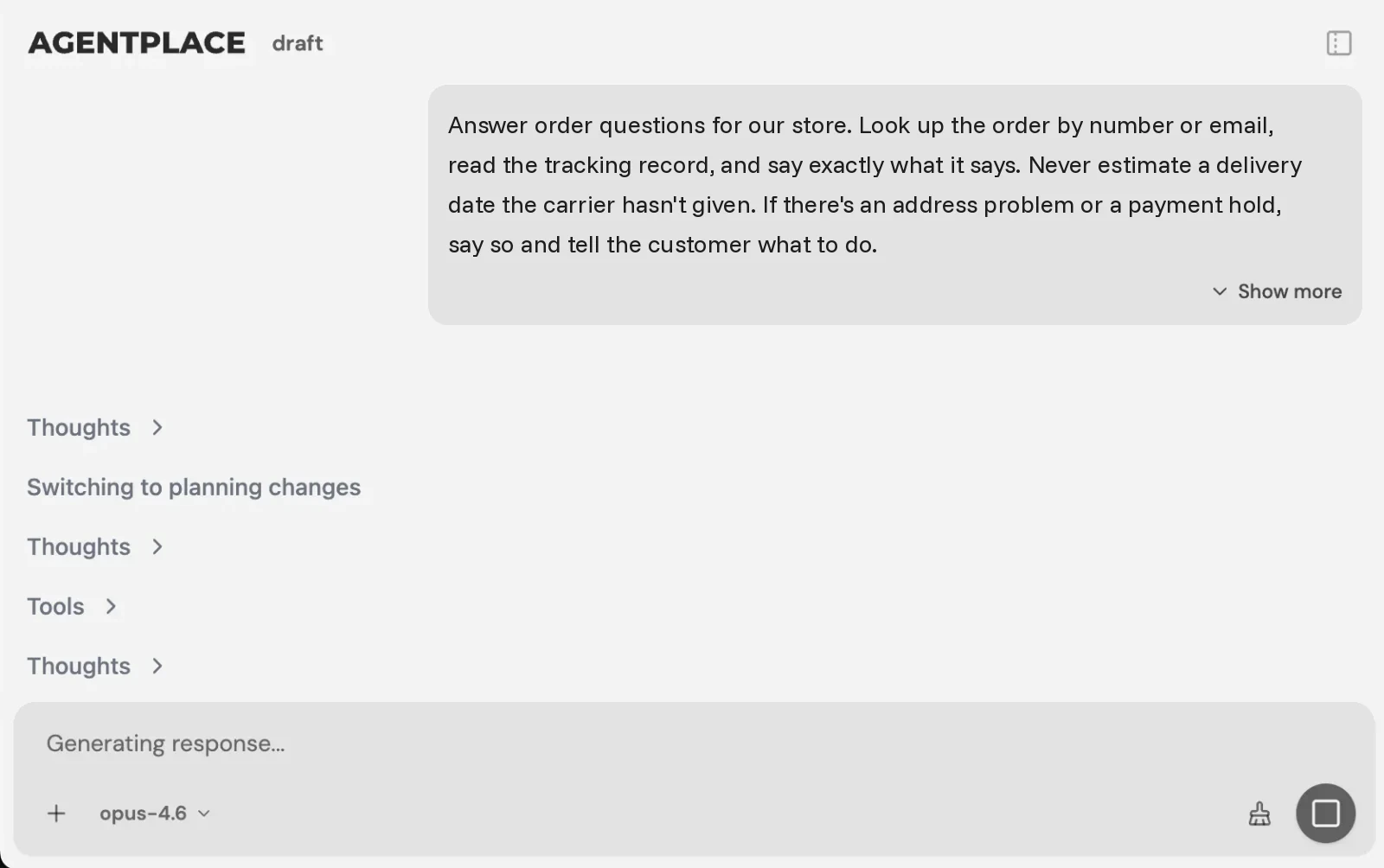 You describe your shipping and return rules. The builder writes the agent.
In practice, it works like this:
- The shopper opens the agent’s page from a confirmation email or your support page.
- The agent reads the real order and tracking record.
- It says what the record says, including the blocker if there is one.
- It checks return eligibility against your policy and starts the return where your rules allow.
- Exceptions leave with the order, the status and the rule they failed.
You set it up by describing the outcome in plain language, for example:
“Answer order questions for our store. Look up the order by number or email, read the tracking record, and say exactly what it says. Never estimate a delivery date the carrier hasn’t given. If there’s an address problem or a payment hold, say so and tell the customer what to do. Check returns against our 30-day policy, email a prepaid label when the item is eligible, and explain the refund terms. Send goodwill requests and anything over £200 to Sam.”
The AI Builder discusses the idea, clarifies requirements, creates the agent and helps test it. You choose when to publish. No code is required.
What stays where it is:
- Your commerce platform keeps orders, inventory and fulfilment. The agent reads from it and writes back where a supported connection exists.
- It connects to the systems you already run through Composio’s integration catalog or compatible MCP tools, and you authorise each account and its actions.
- Records carry access classes enforced server-side, so a shopper sees their own order and nothing else.
Pricing: Agentplace has a free plan and paid plans that use AI credits. A credit is not a shopper message. See pricing.
Template to start from: AI Order Tracking Explanations Agent
When don’t you need an AI agent?
- Ten orders a day and a person answers every message? That’s better. Keep it.
- The gap is helping shoppers choose? That’s a product finder, a different job. See interactive product finders.
- You need tickets, macros and agent workflows? That’s helpdesk software, and it stays.
- Your order data isn’t reachable by an API? Fix that first, or the agent is a FAQ page.
- Most contacts are about one broken product? Fix the product.
- Half your inbox is where is my order? That’s where a customer-facing AI agent built with Agentplace fits.
Quick checklist
- Confirm the agent can read a live order by number and by email
- List the exceptions: address problems, payment holds, lost parcels, stock-outs
- Write the return rules as rules: window, condition, label, exclusions
- Ban estimated delivery dates in writing
- Link the agent from the confirmation email and the support page
- Track contacts resolved without a person, repeat contacts on the same order, and exceptions routed with full context
Related reading: interactive product finders and AI buying guides · what Dots by ChatGPT are · one agent instead of a chatbot and a form
Bottom line
Where is my order is a lookup your shopper can’t do and your system can answer in a second.
- If a person reads every message within the hour, keep doing that.
- If half your inbox is order questions, give shoppers a customer-facing AI agent built with Agentplace. It reads the real order, says what the record says, starts the return where your rules allow, and routes the exception with everything attached.
Questions and answers
Frequently asked questions.
What is an ecommerce AI agent?
Software on your store that talks to shoppers and acts on their orders. It answers where an order is, whether a return is allowed, and what a product does, reading from your real order and catalogue records rather than a FAQ page.
Can a ChatGPT dot answer customer order questions?
No. A dot is something you create and use inside ChatGPT. There is no page on your store for a shopper to open. A dot can help with your own work, but a customer cannot reach it.
Can an AI agent check an order status?
Yes, where it is connected to the system that holds the order. It reads the real record and reports what it says. It should not estimate a delivery date that the carrier has not given.
Can it process a return?
It can check eligibility against your policy, explain the outcome, and start the return where a supported connection exists. Decisions outside the policy, like a goodwill exception, go to a person.
Does this replace Shopify or my helpdesk?
No. Shopify or your commerce platform stays the source for orders, inventory and fulfilment, and your helpdesk keeps the tickets a person handles. The agent handles the conversation and reads from what you already run.
What should the agent never tell a shopper?
A delivery date the carrier has not given, a refund amount it has not calculated from your policy, or that a product is in stock when the record says otherwise. Guessing any of those produces a second contact and a worse one.
Is this the same as a chatbot?
The labels overlap. The test is whether it reads the actual order. A chatbot that answers from your FAQ page cannot say where order 10482 is. An agent connected to the order record can.
Where should it sit on the store?
Wherever shoppers ask. An Agentplace agent gets its own page and URL, which you can link from order confirmation emails, the support page and the footer, so the question arrives where the agent can answer it.
Put this into practice
See the customer experience.
Explore a concrete example related to this article, then adapt the agent to your business.
Create my AI agentStart free with your business idea. The AI builder can help you explore it and create your agent. No technical specification needed. Sign in to continue. Pricing and limits · How the builder works