
Can ChatGPT Dots Issue Certificates? Always-On Agents for Insurance Agencies

The short answer
No. A ChatGPT dot can't issue a certificate to a client. It's something you create and use inside ChatGPT, with no customer-facing page or phone number to send a client to. A customer-facing AI agent built with Agentplace gives the client one, reads the policy, and issues what your rules allow.
Key takeaways
- Certificates are the most automatable work in an agency and usually the least automated, and the request comes from someone who needs it now.
- A dot runs inside its owner's account, so neither a client nor the contractor at the gate can reach it.
- A customer-facing AI agent reads coverage from your management system and issues what your own rules allow.
- It never states coverage from memory. The issue rules already exist, in two long-serving service reps' heads.
- Start by writing those rules down. That is the project, and the software is the easy half.
The short answer
No. A ChatGPT dot can’t issue a certificate to a client.
It’s something you create and use inside ChatGPT. There’s no customer-facing page, phone number, or interface to send a client to.
A certificate request is different. A customer-facing AI agent built with Agentplace gives the client a page or phone number where they can reach the agent. It handles the two jobs agency inbound is made of:
- Certificates. High volume, highly repeatable, and the policy already sits in your system, so the agent can finish them.
- Quotes. No information yet, so the agent collects what’s missing while the client is still there.
- Anything touching coverage. Stop, and hand it to a named person with the policy attached.
Want a person on the line every time? Use a live answering service.
Why are certificate requests the bigger problem?
Because they’re frequent, repetitive, and urgent to somebody who isn’t even your client.
Example: A client emails at 6:40pm.
“The general contractor won’t let my crew on site tomorrow without proof of insurance. They need to be named as additional insured.”
Here’s what each option does with that:
| Handling | What the client gets | Elapsed time |
|---|---|---|
| Email, read in the morning | The certificate at 8:26am | Fourteen hours for an eleven-minute job |
| Live answering service | A message logged, nothing issued | Same fourteen hours, plus a call |
| Client portal | A submitted form, if they log in | Until somebody opens the queue |
| AI agent reading the policy | The certificate before 7pm, or a flagged escalation with the policy attached | Two minutes |
The eleven minutes were never the problem. The fourteen hours were.
Rule of thumb: if the information already sits in your management system, the request shouldn’t wait for a human to look it up.
Quotes are the opposite on every count. The information doesn’t exist yet, the rules are judgment, and the urgency is soft.
What should the agent be allowed to issue?
Exactly what your agency already reissues without asking a carrier, written down.
| Tier | What it covers | What the agent does |
|---|---|---|
| Issue | Routine reissue, unchanged wording, additional insured already on the policy | Read the policy, issue, send, log it |
| Prepare | Needs an additional insured your rules allow but the policy doesn’t carry yet, or a new holder | Assemble the request, attach the policy, route to a named rep |
| Escalate | Anything altering coverage, a wording the carrier must approve, a lapsed policy, any claim | Stop, tell the client who’s handling it, alert that person |
Example: A request that looks routine and isn’t.
“Same certificate as last month, but they want to be added as additional insured this time.”
Last month’s certificate is a reissue. Adding the holder to the policy is not, so this one is prepared and routed rather than issued.
The third row protects the agency. An agent that can’t say “I’m not going to do that, Dana will call you within the hour” isn’t finished.
In no tier may it confirm that a client is covered for a specific loss. It can state what a policy document says. Interpretation belongs to a licensed human.
How do you handle these requests, step by step?
1. Identify which of the two it is
A certificate request names a holder. A quote request names a risk. Everything else is an escalation until proven otherwise.
2. Read the policy before asking the client anything
Half the questions agencies ask are already answered in the management system. Rule of thumb: never ask a client for something your own records hold.
3. For a certificate, ask the four questions that finish it
- “Which policy, or which business name is it for?” Finds the record. The business name is often all the caller knows.
- “Who needs to receive it?” The holder, usually a general contractor or landlord.
- “Do they need to be named as additional insured?” Decides whether this is a reissue or a request.
- “When do they need it?” Almost always now, and that should change the routing.
4. For a quote, collect the missing fields in carrier order
Ask for what the submission lacks, in the order your carriers need it, then write it into the system once. The failure mode here is a producer emailing the client twice a week for three days.
5. Escalate with the work already done
“I can see the policy, but adding that wording changes the coverage, so I’m not going to do it from here. I’ve sent the request to Dana with the policy attached and flagged it urgent. She’ll call you before 9:30 tomorrow, and I’ve noted that the contractor needs it before your crew arrives.”
That declines, explains why, and proves work was done.
Can a ChatGPT dot do this?
No, and it isn’t close.
Dots are OpenAI’s always-on agents, launched 29 September 2026. A dot keeps working between conversations, has its own cloud computer, and reaches apps you authorise. All of that happens inside the account of whoever created it.
That’s the wall. Your client has no way in, and neither does the contractor at the gate.
As it shipped: one dot per account, paid ChatGPT plans only, and no Pro access in the EEA, Switzerland or the UK.
A dot works on the agency’s side. A client-facing agent works on the client’s side.
What tools can help cover agency inbound?
| Option | What it’s for | Where it stops |
|---|---|---|
| Customer-facing AI agent built with Agentplace | Issuing routine certificates and completing quote submissions in the conversation, by text, voice or phone | It isn’t your system of record, and it never interprets coverage |
| Live answering service | A human voice on every call | Takes a message. Can’t see a policy |
| Applied Epic, AMS360, HawkSoft, EZLynx | Policies, documents, accounting and the record itself | It’s the source the agent reads, not a conversation |
| Comparative raters | Pricing a risk across carriers once the information exists | Doesn’t collect the information |
| Certificate tracking tools | Tracking certificates a business holds from its vendors | Built for the holder, not the issuing agency |
| ChatGPT Dots | The agency’s own work | Not client-facing. No link to give a client |
Nothing here was bench-tested. The rows describe what each category is designed to do, read from vendor documentation in October 2026.
How does Agentplace handle agency requests?
Agentplace lets you create an AI agent with its own web page and URL. It uses your business knowledge to work with clients through text, voice, and a personal interface that changes with their request.
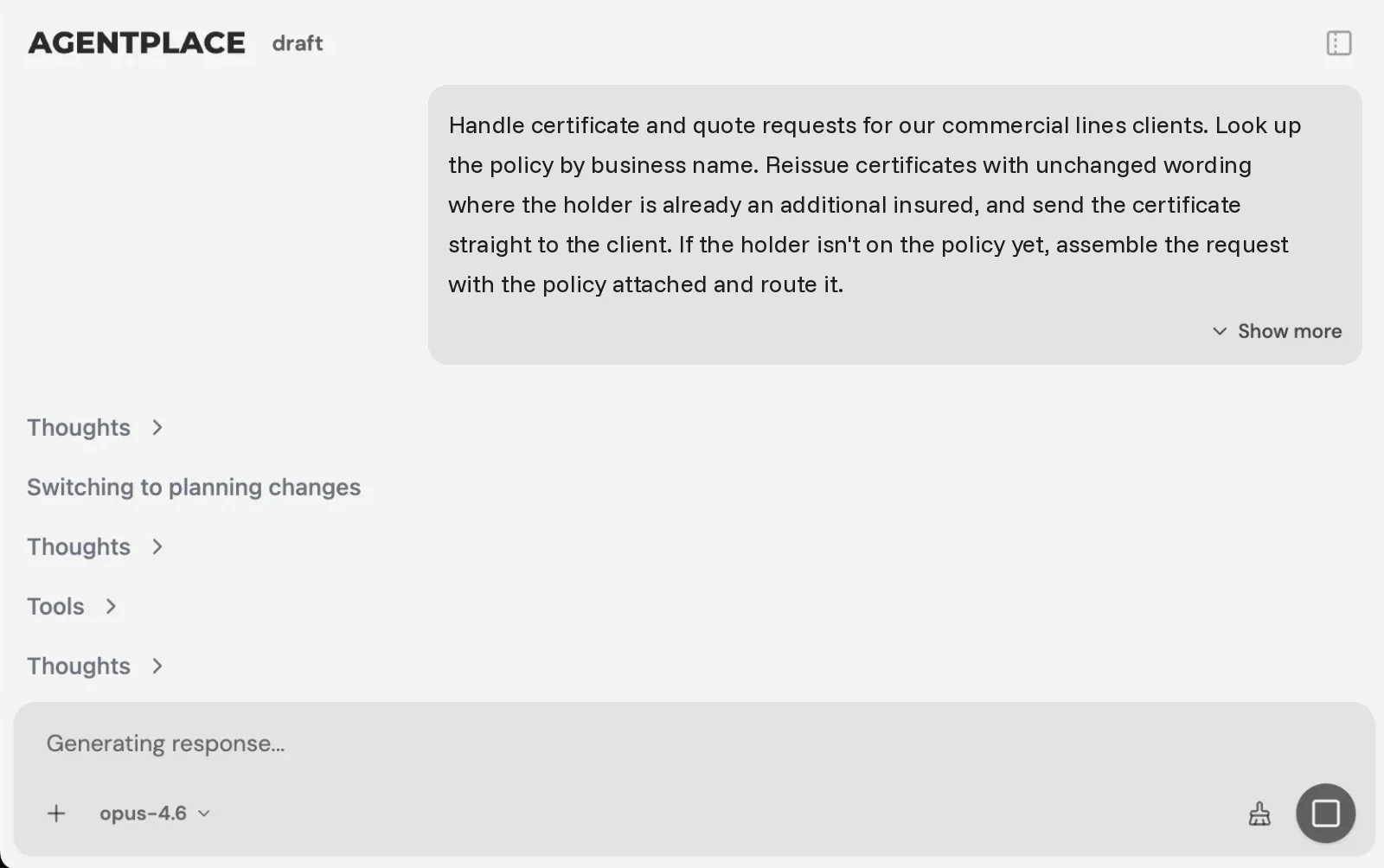 You describe the certificates you reissue without asking and the lines you write. The builder writes the agent.
In practice, it works like this:
- The client opens the agent’s page or rings it, and says what they need.
- The agent identifies the request type and reads the relevant policy from your management system.
- For a routine certificate it issues the document and logs it.
- For a quote it collects the missing fields in carrier order and writes the submission.
- For anything touching coverage it stops and routes to a named rep with the policy attached.
You set it up by describing the outcome in plain language, for example:
“Handle certificate and quote requests for our commercial lines clients. Look up the policy by business name. Reissue certificates with unchanged wording where the holder is already an additional insured, and send the certificate straight to the client. If the holder isn’t on the policy yet, assemble the request with the policy attached and route it. Never say whether something is covered, never quote a premium, and stop immediately on a lapsed policy or anything about a claim. Send all of those to Dana.”
The AI Builder discusses the idea, clarifies requirements, creates the agent and helps test it. You choose when to publish. No code is required.
What stays where it is:
- Your management system keeps policies, documents and accounting. The agent reads from it and writes into it where a supported connection exists.
- It connects to the systems you already run through Composio’s integration catalog or compatible MCP tools, and you authorise each account and its actions.
- Records carry access classes enforced server-side, so a client reads their own policy information and nothing else.
Pricing: Agentplace has a free plan and paid plans that use AI credits. A credit is not a client message. See pricing.
Template to start from: AI answering agent
When don’t you need an AI agent?
- Two-person agency writing twelve policies a month? This isn’t your bottleneck.
- Policy says a person answers every call? A live answering service is the honest fit.
- You need to price a risk across carriers? That’s a comparative rater, and it stays.
- You need to track certificates your vendors owe you? That’s certificate tracking software, a different job.
- Your issue rules are “use judgment”? Write them down first. An agent can’t apply that, and nor can a new hire.
- Producers pulled off renewals to issue certificates? That’s where a customer-facing AI agent built with Agentplace fits.
Quick checklist
- Count a month of certificate requests and mark which were routine reissues
- Write the three tiers with your two most experienced service reps in the room
- Settle the disagreements you find between them before building anything
- Connect the agent to the management system so it reads policies rather than being told about them
- Run it alongside the service desk on the same requests for a week
- Track time to issued certificate, share completed without a person, and escalations that still needed a lookup
Related reading: AI agents that book appointments · what Dots by ChatGPT are · one agent instead of a chatbot and a form
Bottom line
Two requests make up most of an agency’s inbound, and one of them is pure lookup. Certificates are the most automatable work you have.
- If your policy is a human voice on every call, use a live answering service.
- If certificate requests interrupt producers all day, give clients a customer-facing AI agent built with Agentplace. It reads the policy, issues what your written rules allow, and stops dead on anything touching coverage.
Questions and answers
Frequently asked questions.
What is an insurance agency answering service?
It handles calls, emails and web requests when your producers and service staff can't. A live version takes a message. An AI version collects the quote or certificate details, applies your agency's rules, and writes the request into your management system.
What is a certificate of insurance request?
A client asks the agency for proof of coverage, usually because a general contractor, landlord or customer demands it before work starts. Most are routine reissues of an existing policy, and most are urgent to whoever is asking.
Can an AI agent issue a certificate of insurance?
It can issue the routine ones your agency rules already allow, reading the policy from your management system. Anything that changes coverage, adds an additional insured outside your rules, or needs carrier approval goes to a named person.
Can a ChatGPT dot handle quote requests?
No. A dot lives inside the ChatGPT account of whoever created it, with no public link to hand a client. It can help with your own work, like sorting renewal lists, but a client can't reach it.
Does this replace my agency management system?
No. Applied Epic, AMS360, HawkSoft and EZLynx stay the system of record for policies, documents and accounting. The agent handles the conversation before the record is complete, then writes into the system you already run.
What should the agent never tell a client?
That they're covered for something, what a premium will be, or that a claim will be paid. It can collect what a quote needs, state what your agency offers, and issue what your written rules permit.
Is this the same as a comparative rater?
No. A rater prices a risk across carriers once the information exists. The agent's job happens earlier: getting complete, accurate information from the client without a producer chasing them for it.
Which request type should an agency automate first?
Certificates. They're high volume, highly repetitive, almost always urgent to the requester, and the rules for issuing a routine one are already written down somewhere in your agency.
Put this into practice
See the customer experience.
Explore a concrete example related to this article, then adapt the agent to your business.
Create my AI agentStart free with your business idea. The AI builder can help you explore it and create your agent. No technical specification needed. Sign in to continue. Pricing and limits · How the builder works