
Which Med Spa Software Has Built-In AI in 2026? What Each Platform Automates, and What to Add
Zenoti ships the widest built-in AI for med spas in 2026, covering the front desk and the chart. PatientNow and Nextech go deeper on documentation. If your platform's AI stops before the patient decides anything, Agentplace is a no-code AI agent builder that can build the patient-facing agent, answering treatment questions and booking into the system you run.
Key Takeaways
- Zenoti's AI Workforce is the only suite in this comparison pairing a patient-facing AI receptionist with an AI scribe that completes aesthetic charts.
- Nextech launched Cora Scribe in January 2026, an ambient documentation tool embedded in its EHR that streams clinical findings into chart fields.
- Symplast, Aesthetic Record and PatientNow all ship AI scribes, so most med spa AI in 2026 aims at the chart first and the enquiry second.
- The American Society of Plastic Surgeons recorded 28.2 million minimally invasive procedures in the United States in 2024, up 1.5% on 2023.
- Neither Vagaro nor Boulevard publishes a native patient-facing voice agent, so med spas on those platforms add one from outside.
It is 9:40pm. Someone has been reading your before-and-after gallery for twenty minutes, and she types one question: will filler or a skin booster help the hollowing under my eyes, and roughly what does it cost? Nobody is at the desk. Your form takes her name and an email address, and she opens two competitor tabs.
Demand is not the problem. The American Society of Plastic Surgeons recorded 28.2 million minimally invasive procedures in the United States in 2024, a 1.5% rise on the year before. The problem is the gap between the question and the answer.
SUMMARY: Built-in AI in med spa software falls into two piles in 2026. One pile writes the chart. Zenoti, PatientNow, Nextech, Symplast and Aesthetic Record all ship an AI scribe that listens to a consultation and produces structured clinical notes. The other pile talks to patients, and it is much smaller.
For the literal question, which med spa software has built-in AI, Zenoti is our top pick when the goal is one platform covering both the front desk and the chart. Its AI Workforce pairs a patient-facing AI Receptionist with an AI Scribe for aesthetic charting inside the system of record. If your priority is faster documentation, Nextech or Symplast is the simpler choice. If it is calendar density, look at Boulevard’s Precision Scheduling.
Most med spas are really asking a second question. The platform works, and its AI stops before the patient has decided anything. For that question, our pick is Agentplace: you build an AI website powered by agents around your treatment menu, price bands, candidacy routing and policies, and it books into the scheduling system you already run. The same build holds your treatment catalogue, patient records with enforced permissions, deposits and memberships, and the reports you want to read on Monday. Clinical charting stays where the medical record lives.
Build an AI Layer Around Your Med Spa Software
Answer treatment questions, apply your own pricing and policy rules, and book consultations into the platform your clinic already runs.
Try Agentplace Free →Where med spa AI tends to stop:
- The AI is aimed at the chart: scribes are the most common built-in feature, and they start working once the patient is already in the room.
- The patient does not know what to book: she knows the result she wants, and your menu lists modalities and units.
- The question arrives on a channel the platform never sees: Instagram, a Google listing, a text at 10pm.
- Nobody asked the vendor what happens to health information: the conversation is fine until a patient describes a reaction.
- You are comparing platforms when the gap is a layer: the routing table near the end sorts that in one screen.
Choose by requirement:
- If you want a packaged suite where the clinical chart and the front desk sit in one product you do not configure, choose a med spa platform: Zenoti, PatientNow, Nextech or Mangomint.
- If you need clinical notes written during a consultation, choose an AI scribe inside your EMR: Nextech Cora Scribe, SymplastAI or Aesthetic Record ChartSmart.
- If you need missed calls answered and booked without leaving the platform you already pay for, choose Zenoti’s AI Receptionist.
- If you need the calendar packed more tightly around variable treatment durations, choose Boulevard Precision Scheduling.
- If you need a HIPAA-compliant EMR with a unified inbox at a lighter price, look at Mangomint.
- If you need patient questions answered on every channel, scoped against your own pricing and policy rules, and moved toward a booked consultation on top of the platform you already run, build an agent.
Key takeaways:
- Zenoti’s AI Workforce is the only suite here pairing a patient-facing AI receptionist with an AI scribe that completes aesthetic charts.
- Nextech launched Cora Scribe in January 2026, embedded in its EHR and streaming clinical findings into chart fields as the encounter happens.
- Symplast, Aesthetic Record and PatientNow all ship AI scribes, which is why most med spa AI in 2026 lands on documentation first.
- Neither Vagaro nor Boulevard publishes a native patient-facing voice agent, so clinics on those platforms source one separately.
- The American Med Spa Association puts average annual medical spa revenue at $1,398,833 for 2024, so one recovered course of treatment carries real weight.
Quick recap, if you only do three things this month:
- Write down which of your enquiries arrive outside opening hours, and on which channel.
- Check whether your platform’s AI page describes a scribe, an automation or a patient-facing agent.
- Ask your current vendor, in writing, what happens to health information a patient types into any AI feature.
What Counts as Built-In AI in Med Spa Software?
Four different technologies are sold under the same two letters, and they solve different problems.
- Rules-based automation. An event fires an action. Appointment tomorrow, send a reminder. Package expiring, send a nudge. Every platform here has this, whether it is labelled automation, workflows or AI.
- Predictive scoring. A model estimates something: which slot will go unfilled, which patient is due for a repeat course, which booking may become a no-show.
- Generative assistance. The software writes text or images for you: marketing emails, subject lines, social captions, website copy.
- Conversational agents. Software that holds a two-way exchange, understands what the patient is asking, and takes an action such as checking availability or booking.
An AI scribe is generative assistance pointed at the chart. It listens to a real consultation and produces a clinical note.
Terms used in this article:
- EMR and EHR. Electronic medical record and electronic health record. In aesthetics these hold charts, consent forms, before-and-after photography, injection maps and treatment history.
- PHI. Protected health information, individually identifiable health data covered by the Health Insurance Portability and Accountability Act (HIPAA). A BAA, or business associate agreement, is the written contract HIPAA requires between a covered entity and a vendor handling PHI for it.
- AI scribe. A tool converting a spoken clinical encounter into structured notes. Ambient listening is the version running in the background with no dictation step.
- Candidacy. Whether a patient is clinically appropriate for a treatment. A licensed provider decides this.
- POS. Point of sale: the till, card handling and retail side of the platform.
- Layer. Software working with the platform you already run, without moving your records into a new one.
- AI credits. The usage unit Agentplace bills in. A longer conversation consumes more than a short one.
Which Med Spa Platforms Actually Ship Built-In AI?
Short answer: five of the eight ship something genuinely built in, and only two of those five put AI in front of the patient.
| Platform | What it calls AI | What the AI actually does | Patient-facing conversational AI |
|---|---|---|---|
| Zenoti | AI Workforce (AI Receptionist, AI Scribe, and other agents) | Answers calls the desk misses, books, reschedules and confirms; AI Scribe generates structured notes and completes aesthetic charts | Yes, voice and messaging |
| PatientNow | AI Growth Engine, AI Scribe | Call answering and booking, outbound recall to past patients and leads, SOAP notes and treatment summaries with dot phrases | Yes |
| Nextech | Cora Scribe, Aesthetic Charting | Ambient documentation embedded in the EHR, streaming discrete clinical findings into the correct chart fields in near real time | No |
| Symplast | SymplastAI, Ambient Listening, AI Scribe | Encounter notes, patient summaries and daily huddle briefings from recorded consultations | No |
| Aesthetic Record | ChartSmart AI, AI photo comparison | Dictated notes structured into compliant records, injection tracking, before-and-after comparison and face mapping | No |
| Boulevard | Precision Scheduling, Boulevard AI | Machine-learned slot optimisation across variable treatment durations, generated marketing copy and campaign imagery | No |
| Mangomint | Smart automations, Mangomint Connect | Workflow triggers, waitlist handling, Express Booking links, calls, texts and web chat in one inbox | No |
| Vagaro | Automation and marketing tools | Reminders, deposits, campaign sends, no-show handling | No |
Compiled in August 2026 from vendor product pages, vendor press releases and industry trade coverage. Feature names in this category change quickly, so confirm anything decision-critical against the vendor’s current documentation and a live demo.
How we ranked these. Five criteria, each checkable on a demo call: whether the AI is available to a patient or only to staff, whether it can hold a two-way conversation, whether it can reach live availability and write a booking, whether it applies the clinic’s own pricing and policy rules, and whether the vendor will sign a business associate agreement covering what it handles.
Which platforms answer a live phone call natively? Zenoti and PatientNow. Which write the chart for you? Nextech, Symplast, Aesthetic Record, PatientNow and Zenoti. Which apply your own pricing and candidacy rules in a conversation before a booking exists? None of them do that as a shipped, configurable feature, which is the gap the rest of this article is about.
Zenoti is the most complete of the group on paper. Its April 2026 expansion added agents across medspa workflows, with the receptionist and the scribe sharing one patient record.
“For the first time, medspas can operate with a workforce that never stops learning, never loses context, and never misses a moment.” Sudheer Koneru, Founder and CEO, Zenoti
Treat the conversion figures in that launch as vendor-reported. Zenoti publishes strong numbers for calls turned into bookings, and no independent audit of them was reachable when this article was written.
What Do Patients Ask Before They Book an Injectable or a Laser Course?
They ask about the result, and your menu is written in modalities.
A representative evening’s enquiries at an injectable-led clinic:
- I want to look less tired. Is that filler, Botox, or something else entirely?
- I had lip filler eighteen months ago somewhere else. Do you dissolve first?
- How many units do I usually need, and is your price per unit or per area?
- I am on a retinoid and I have melasma. Can I still have that laser?
- I am five months postpartum and breastfeeding. Which of these can I have?
- Do you have a membership, and does it cover the skin booster or only the toxin?
None of these are answerable from a dropdown. Several should never be answered by software at all, because they are candidacy questions belonging to a licensed provider. The useful behaviour is narrow: explain what a treatment generally addresses, apply the clinic’s published price band, and route the person into a consultation. That distinction is where an agent earns its place, and where an unconfigured chatbot becomes a liability.
According to Terri Ross, Founder and CEO of Terri Ross Consulting and APX, aesthetic practices should convert inquiries into consultations at a rate above 75%. That benchmark is published by her consultancy and is not an audited industry average, so treat it as a target. It is still a useful mirror: if your evening enquiries convert far below it, the leak is in the conversation.
Where Do Med Spa Enquiries Go Missing?
In four places, and only one of them is inside your booking software.
The phone during treatment. An injector mid-appointment cannot take a call, and these calls are rarely quick.
Social channels. Aesthetics runs on before-and-after content, so much of first contact lands in Instagram messages your platform never sees.
The website form after hours. The form collects a name and disappears into an inbox. By Monday the patient has booked elsewhere.
The gap between consultation and treatment. Someone gets a plan and a quote, then goes quiet. Recall campaigns handle the ones on a schedule. The one with an unanswered question about downtime needs a reply.
Med spas carry an unusually high cost per lost enquiry. The American Med Spa Association reports average annual medical spa revenue of $1,398,833 for 2024, in an industry it puts above $17 billion. Against ticket sizes like that, a course of laser treatments lost at 9:40pm is no rounding error.
Compliance raises the stakes again. A med spa is a medical practice, and the rules governing how it advertises and delegates care are stricter than the ones covering a salon. According to Alex Thiersch, the attorney who founded the American Med Spa Association, legal and compliance questions sit at the centre of how these businesses are built and supervised. Anything you put in front of a patient inherits that. The Federal Trade Commission’s health products compliance guidance expects health claims to rest on competent and reliable scientific evidence, and that does not soften because a machine typed the sentence.
How Does an AI Layer Work Alongside the Platform You Already Run?
It sits in front of the conversation and behind it writes into the systems you keep.
The pattern is the same across every vendor in this category. Patient messages arrive on the web, the phone, or a connected messaging channel. The agent reads them, works from a knowledge set you provide, checks live availability through an integration, and writes the booking back into the platform that already holds the record. Nobody migrates anything.
Three tiers are worth telling apart before you buy anything.
Tier one, answering. The tool replies and captures a name. It moves nobody forward.
Tier two, answering and booking. The tool reaches live availability and writes an appointment. Most AI receptionists stop here.
Tier three, answering, deciding and acting. The tool applies your rules, tells a consultation request apart from a repeat toxin appointment, takes a deposit where your policy calls for one, hands clinical questions to a person, and keeps working after the conversation ends.
How Does Agentplace Add the AI Your Med Spa Software Does Not Have?
For clinics whose platform already handles charts, payments and the calendar, Agentplace is a no-code AI agent builder, and it can be used to build the patient-facing agent that answers treatment and policy questions and moves someone toward a booked consultation. Here is what it does, how you build it, what you set limits on, and where it stops.
What it is. Agentplace lets you build AI websites powered by agents. Each agent is a real web application with its own frontend and backend. They work with your patients 24/7 on the web, over the phone, through WhatsApp, Slack, Teams, and other channels. They answer questions, understand what the patient needs, and book the right service directly into your scheduling system.
What happens at 9:40pm. Go back to the woman asking about her under-eye hollowing. The agent asks what bothers her, what she has had done before, and what her timeline is. It explains what tear trough treatment and skin boosters generally address, in the words you gave it, and quotes your published range for a first appointment. It treats this as a consultation, checks which injector covers that area on Thursday evening, and books it. If she mentions a bruise from a treatment elsewhere, the agent stops and hands the conversation to your team.
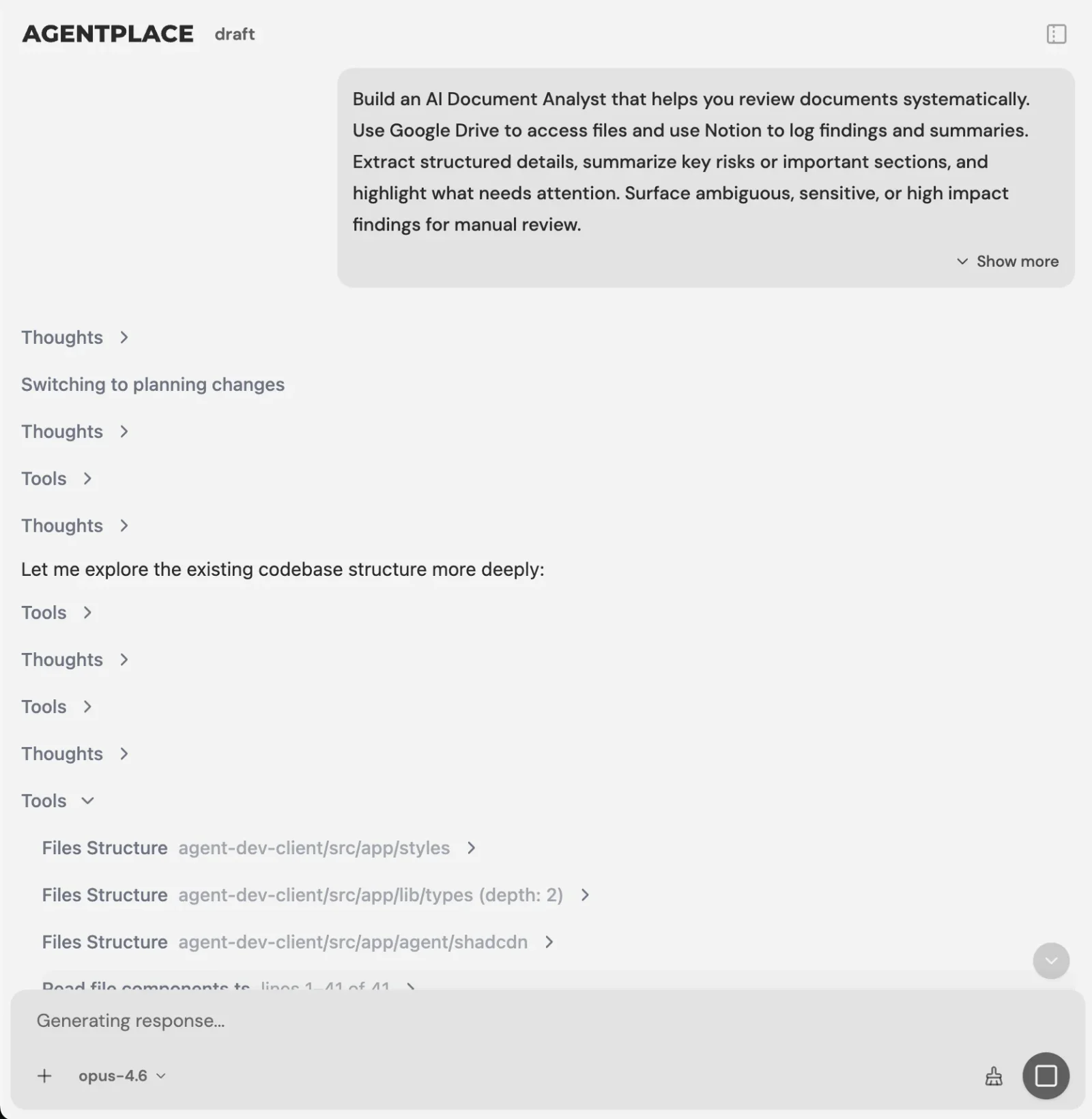 You describe the outcome you want in plain language, and the software builds the agent.
Where it acts on the four leaks named earlier.
- The phone during treatment: the agent takes the call, works from the same menu and price bands as the website, and books.
- Social channels: connect the channels your enquiries arrive on, and the answers stay identical to the website’s.
- The after-hours form: the enquiry becomes a conversation with an outcome instead of a name in an inbox.
- The consultation that went quiet: a scheduled follow-up asks the open question, and the reply continues as a conversation.
How you build it. You describe the outcome you want in plain language. The builder asks for what it still needs: treatment list, durations, price bands, provider coverage, deposit and cancellation policy, and the questions you want escalated. Then it tests its own work, messaging the agent it just built, reading the replies, and fixing what it finds before you see it.
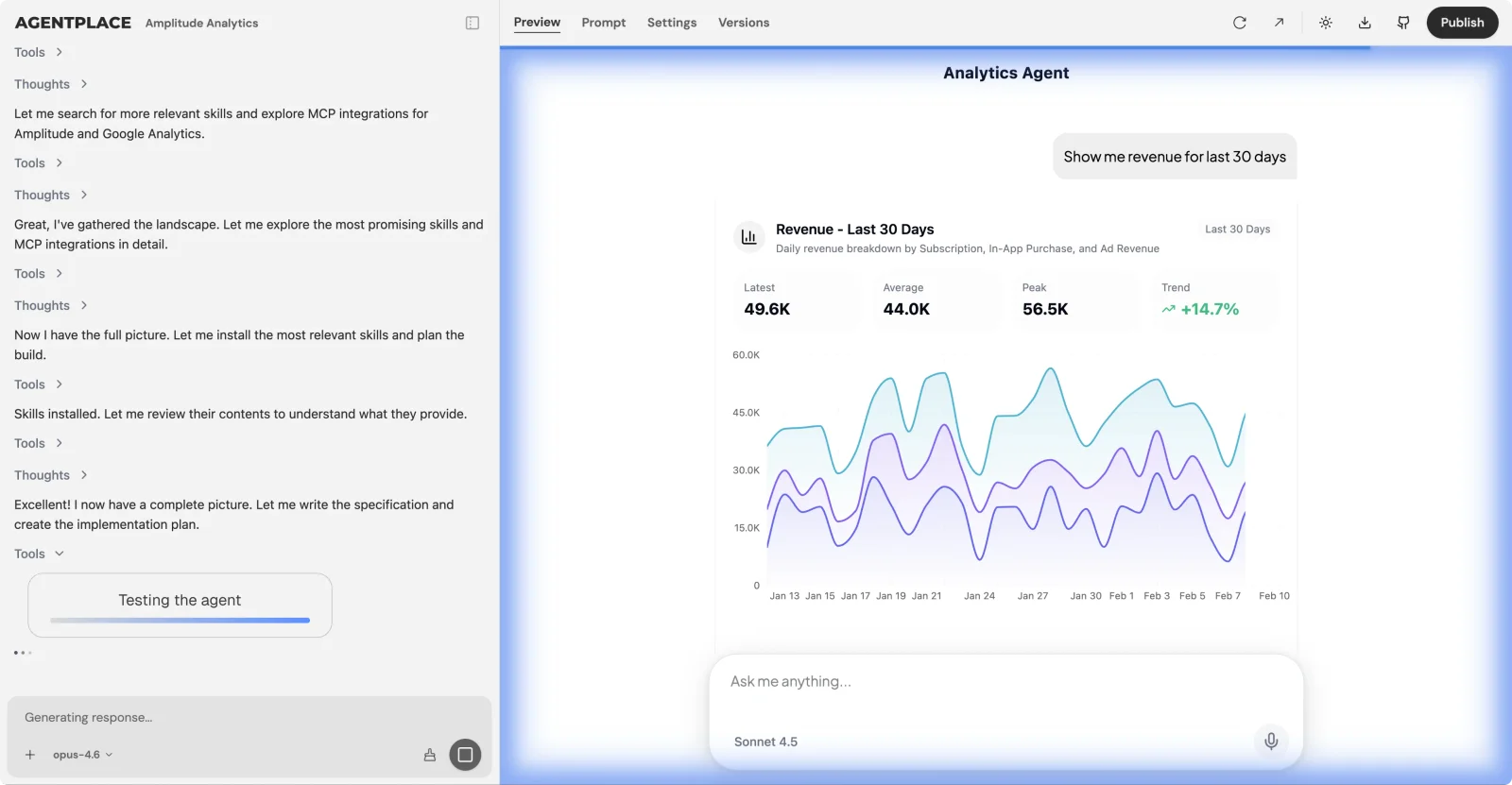 The builder messages the agent it just built and fixes what it finds.
Guardrails you set. In an aesthetics clinic these matter more than the conversation itself.
- No medical advice and no candidacy determination. The agent explains what a treatment generally addresses and routes the decision to a provider.
- No promises about results, downtime or unit counts for a specific person, and price bands instead of exact quotes wherever the figure depends on assessment.
- Immediate handoff to a named human for any reported adverse reaction, complication, or question about a treatment already performed.
- Pregnancy, breastfeeding, active skin conditions, recent procedures and prescription interactions route to consultation, never to a same-day treatment slot.
- Deposit and cancellation policy stated before a booking is confirmed.
- Clinical detail stays out of the conversation. Ask what the patient wants to improve, and collect medical history in your EMR’s own intake.
Connect the systems your clinic already uses. Your booking platform, calendars and messaging channels connect through a catalogue covering hundreds of apps, so the appointment lands where your team already looks for it.
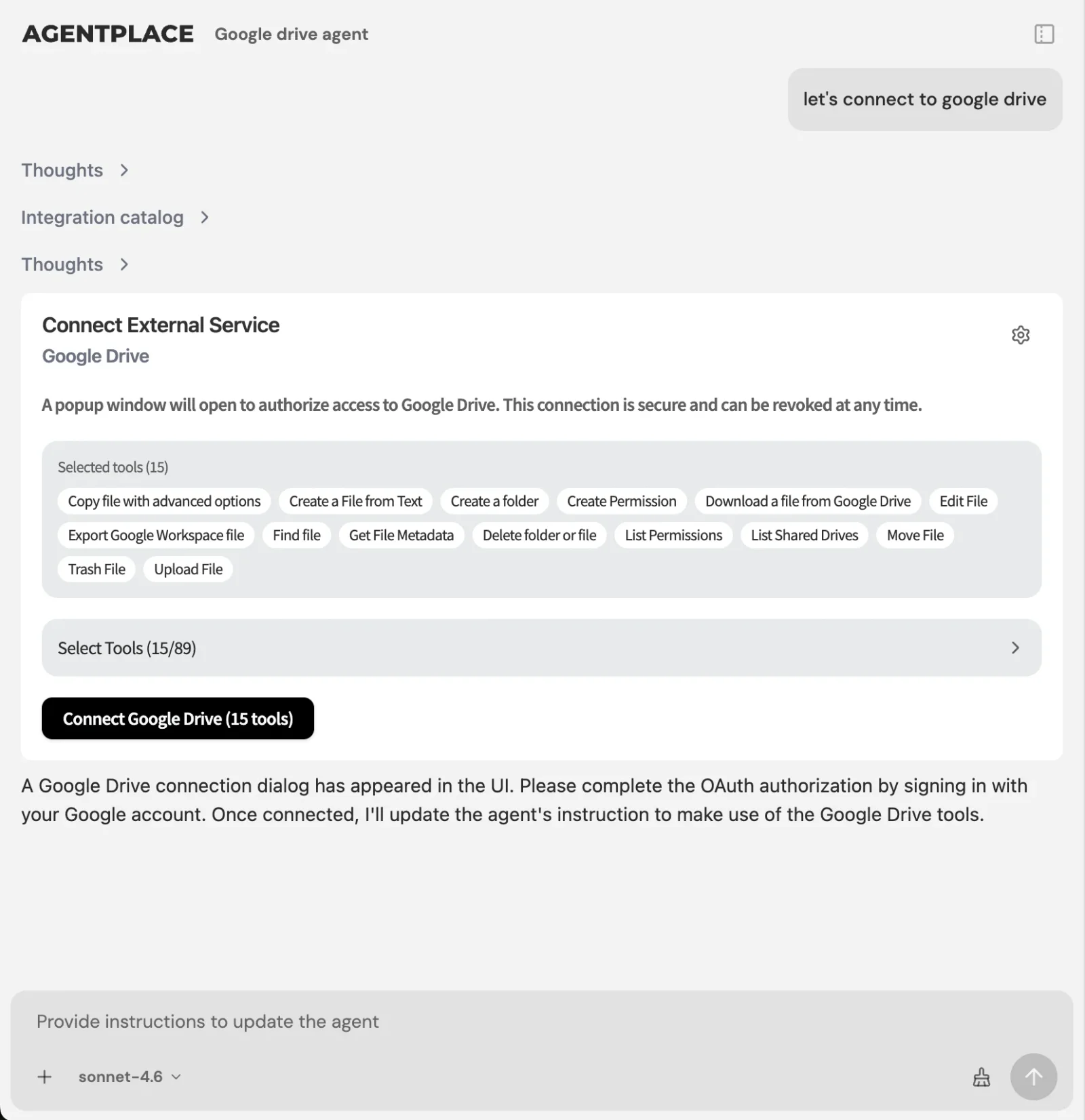 The appointment and the patient record stay in the platform your clinic already runs.
What it does beyond the conversation. The same agent holds its own business records with permissions enforced server-side, runs work on a schedule or on an event, acts across the tools you connect, and renders results as tables and dashboards. In a med spa: a nightly check of tomorrow’s unfilled provider hours, a weekly summary of treatments people asked about and did not book, a follow-up when a consultation has not converted after ten days.
A worked timeline.
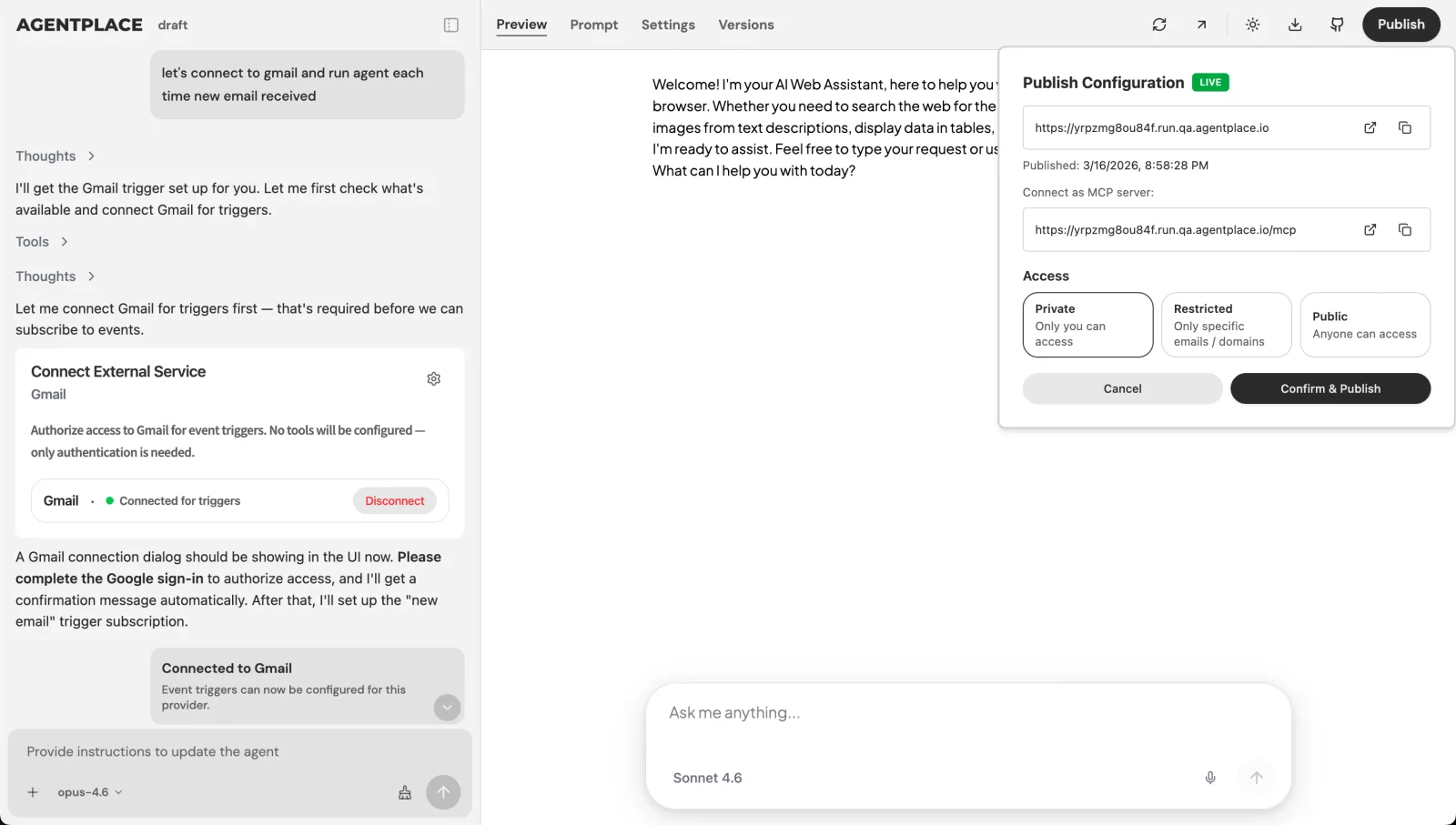 Publishing is one button, and you choose exactly who can reach the agent.
What it costs. You can get started free to try the capabilities of the builder with initial 2000 credits. Pro is $29/mo for 15,000 credits. Business pricing is custom. See the pricing page for the current plans.
What it does not do. It does not chart. It holds no EMR, no injection map, no consent library, no inventory count, no point of sale and no payroll. Agentplace does not publish a HIPAA compliance certification and does not offer a business associate agreement, so configure it to keep protected health information out of the conversation and leave clinical intake in your medical record system. The platform also gives you no analytics on a published agent’s traffic yet, so measurement comes from your booking system.
Who it fits. Clinics running Zenoti, PatientNow, Mangomint, Boulevard, Vagaro or an aesthetics EMR that works, where the missing piece is the conversation before the appointment exists. Start where the gap is, connect what already works, and expect the agent to absorb the smaller point tools as you give it more.
Who should choose something else.
- If your charting, photo documentation or consent workflow is the thing that hurts, buy an aesthetics EMR: Nextech, Symplast or Aesthetic Record.
- If you want the AI inside the platform you already pay for, with no second vendor, use Zenoti’s AI Workforce.
- If your gap is outbound recall to a large database of past patients, PatientNow is built around that motion.
- If you need a signed business associate agreement covering every system a patient types into, choose a vendor that offers one and keep the conversation there.
The same approach runs across medical spas and aesthetic clinics with more than one location, and there is a ready-made med spa consultation booking template if you would rather start from a working example than a blank prompt.
What Should You Ask a Vendor About PHI Before Patients Talk to It?
Ask before the demo ends, and ask in writing.
The moment a patient can type into a tool, that tool can receive health information whether you intended it to or not. HIPAA obliges a covered entity to hold a written business associate contract with any vendor handling protected health information on its behalf, and business associates carry direct liability of their own. A tool designed never to touch PHI is legitimate. A tool that touches it without an agreement is not.
Questions to take into any AI vendor demo:
- Will you sign a business associate agreement covering this product, and can I see it before signing?
- Where is conversation data stored, in which region, and for how long?
- Is my patients’ conversation data used to train any model, by you or by your model provider?
- Can I configure the tool to refuse and delete health details a patient volunteers?
- What exactly gets written into my EMR, and who at your company can read it?
- What is the documented escalation path when a patient reports an adverse reaction?
- Who is accountable if the tool states a price, a downtime or a result that turns out to be wrong?
- Can I export every conversation and delete a specific patient’s history on request?
If a vendor cannot answer the first question with a yes or a clear no, that is your answer. A clear no is workable when you configure the tool to stay away from clinical detail. A vague yes is the dangerous one.
What Should a Med Spa Agent Actually Say?
Copy these, change the names, and give them to the builder as the behaviour you want.
When a patient describes a result instead of a treatment:
Thanks, that helps. We treat under-eye hollowing a few different ways, and which one suits you depends on an assessment. A consultation with one of our injectors is $75, credited against treatment if you go ahead. Would Thursday evening or Saturday morning work better?
When a patient asks whether she is a candidate:
That one I can’t answer, because candidacy for this is a clinical judgement your provider makes in person. What I can do is book you a consultation with the injector who handles this area, and flag your question in the notes so she has it in front of her.
When a patient reports a problem after a treatment:
I’m passing this to the clinical team straight away and someone will call you. If the swelling is getting worse, if you have vision changes, or if the area is going pale or grey, contact us on the emergency line now or seek urgent medical care.
When a patient asks for an exact price, or the deposit policy needs stating:
Toxin is charged per unit here, and the number of units depends on the assessment, so the honest answer is a range: most first appointments for that area land between $X and $Y. Your injector confirms the exact figure before anything is done. To hold the slot we take a $50 deposit, refundable with 48 hours’ notice.
What Does Adding AI Cost Compared With Switching Platforms?
Two costs matter here, and only one appears on an invoice.
| Add an AI layer | Switch med spa platforms | |
|---|---|---|
| Software cost | A second subscription | Difference between plans, plus onboarding fees |
| Setup time | Days, mostly spent writing down your own rules | Weeks, often a quarter for a multi-provider clinic |
| Data at risk | Low, records stay where they are | Charts, photos, consents, package balances, memberships |
| Staff retraining | Front of house only | Every provider, every day |
| Reversible | Usually, by turning it off | Difficult once patient records have moved |
Illustrative comparison of effort and risk. Actual figures depend on your clinic, your platform and your data.
An illustrative arithmetic check, with every assumption stated. Take 40 enquiries a month outside opening hours. Assume 30% go cold before anyone replies, which is 12. Assume an agent recovers a quarter of those into booked consultations, which is 3. Assume consultation-to-treatment conversion of 50%, giving 1.5 treatments. At a $900 average first-course ticket, that is roughly $1,350 a month against a $29 subscription. Replace every one of those numbers with your own. The shape is what matters: at med spa ticket sizes, break-even sits at a fraction of one recovered patient per month.
Which Numbers Show the AI Is Working?
Four, checked monthly, all available from your booking platform.
- Share of enquiries arriving outside opening hours. This tells you how much of your demand your team never sees live.
- Enquiry to booked consultation rate. The number the agent is directly responsible for moving.
- Consultation to treatment conversion. If this drops while bookings rise, the agent is booking people who were never close to ready, and the guardrails need tightening.
- No-show rate on agent-booked consultations versus the rest. Patients who got their questions answered before booking tend to behave differently from patients who booked on impulse.
Track the third one carefully. A layer that fills the diary with unqualified consultations costs your injectors more than an empty slot does.
Which Med Spa Software Fits Which Goal?
Start from what you want the AI to do, then the category, then the product.
| What you want AI to do | Type of tool | Where to look |
|---|---|---|
| Help an undecided patient work out what fits her goal, apply your pricing and policy rules, and book a consultation on any channel | AI layer on top of your platform | Agentplace |
| Write clinical notes during a consultation | AI scribe inside your EMR | Nextech Cora Scribe, SymplastAI, Aesthetic Record ChartSmart, PatientNow |
| Answer missed calls and book, inside one platform | Native AI receptionist | Zenoti AI Workforce |
| Run outbound recall across a large past-patient list | CRM with campaign automation | PatientNow |
| Pack variable treatment durations into a tighter calendar | Predictive scheduling | Boulevard Precision Scheduling |
| Send reminders, confirmations and deposit requests | Rules-based automation | Whatever platform you already run |
| Generate marketing copy and campaign imagery | Generative marketing assistance | Boulevard AI, Vagaro, Mangomint |
| Keep the clinical chart and the medical record in one system | Med spa management software | Zenoti, PatientNow, Nextech, Mangomint |
The same options, with an explicit pick attached to each.
| Option | Strength | Watch out for | Best for |
|---|---|---|---|
| Agentplace | Patient-facing agent applying your own pricing, routing and policy rules across web, phone and messaging, plus treatment catalogue, patient records, deposits, memberships and owner reporting | Clinical charting stays with the medical record system, and there is no published HIPAA certification | Clinics whose enquiries go unanswered before a booking exists, and clinics that would rather build the front office than buy the next suite |
| Zenoti | Widest native AI, receptionist and scribe on one record | Enterprise-weight platform and pricing for a two-room clinic | Multi-location med spas that want every AI feature inside the system of record |
| PatientNow | Medical aesthetics CRM with call answering and recall built around lead conversion | Marketing-led design can feel heavy for a clinical-first practice | Clinics whose growth depends on working a large past-patient database |
| Nextech | Cora Scribe embedded in a specialty EHR, streaming findings into chart fields | AI is aimed at staff, not patients | Practices where documentation load is the binding constraint |
| Symplast | Ambient listening and AI scribe built for aesthetic and surgical workflows | No patient-facing conversational agent published | Surgeon-led aesthetic practices wanting mobile-first charting |
| Aesthetic Record | ChartSmart AI with photo comparison and injection tracking | Front-desk automation is lighter than the clinical side | Injectable-heavy clinics that live in before-and-after documentation |
| Boulevard | Precision Scheduling on real booking patterns, generated marketing assets | Scheduling intelligence does not answer a patient question | Clinics losing money to fragmented calendars and stranded gaps |
| Mangomint | HIPAA-compliant EMR with calls, texts and web chat in one inbox | Automation is rules-based, with no native AI receptionist | Small and mid-size med spas wanting a clean platform at a lower price |
| Vagaro | Broad, inexpensive, large integration ecosystem | AI is reminders and marketing; voice agents come from third parties | Budget-led clinics happy to add capabilities from outside |
Ranked on the five criteria stated under the first table: patient-facing availability, two-way conversation, live availability and booking, whether the clinic’s own rules are applied, and the vendor’s written position on protected health information.
The same split shows up one industry over. Our comparison of which salon software has built-in AI reaches a similar conclusion for hair and beauty, at a lower ticket and with a much lighter compliance burden.
What We Found That Others Won’t Tell You
Most med spa AI in 2026 is pointed at your staff. Five of the eight platforms lead with a scribe. Scribes buy your injectors their evenings back, and they start working only after the patient has booked, walked in and sat down. They do nothing about the enquiry that never converted.
“HIPAA compliant” on a marketing page tells you very little. The document that matters is a signed business associate agreement naming the specific product. Several tools sold to med spas hold one for the core platform and not for a newer AI feature. Ask which product the agreement covers, by name.
Vendor conversion statistics are the weakest evidence in this category. Every platform here publishes an impressive ratio of calls to bookings, and no independent audit of any of them was reachable. Ask for a reference customer of your size, then ask that customer what happened to consultation-to-treatment conversion.
Which Mistakes Do Med Spas Make When Adding AI?
- Migrating a whole platform for an AI feature, then finding the injection maps and consent forms did not come across cleanly.
- Letting a tool answer candidacy questions, which belong to a licensed provider.
- Quoting exact prices for unit-based treatments, then arguing about the difference at the front desk.
- Buying a scribe when the leak is unanswered enquiries, or a receptionist when the leak is documentation overtime.
- Going live without a written escalation path for an adverse reaction.
- Testing only “I would like to book Botox” and never “I am breastfeeding, can I have this”.
- Measuring bookings without measuring consultation-to-treatment conversion.
How Do You Add AI to Your Med Spa in Two Weeks?
Days 1 to 3. Count last month’s enquiries by channel and by hour, separating answered from unanswered. Then sort each of your platform’s AI features into one of the four categories above. Several clinics find they already own something nobody switched on.
Days 4 to 5. Write your treatment list, durations, price bands, provider coverage and policies into one document, plus the escalation rules: what the agent must never answer, and who takes each case instead. This part is the work, and no software does it for you.
Days 6 to 7. Build the agent, then let the builder test it and fix what it finds.
Days 8 to 10. Test the awkward conversations yourself: pregnancy, medication interactions, a complication from another clinic, a request for a specific unit count. Then connect your booking platform and confirm the agent reads real provider availability.
Days 11 to 14. Turn it on for the website only and read every transcript. Then add the channel carrying most of your enquiries, and set the four measurements above as a monthly review.
The bottom line. Zenoti and PatientNow are the two platforms in this comparison that put AI in front of a patient, and if you want every feature inside one system of record, Zenoti is the one to evaluate first. Everyone else’s built-in AI writes the chart, tightens the calendar or drafts the marketing, all of which is useful and none of which answers the woman deciding at 9:40pm. That whole job is one workflow: helping her understand which treatment matches the result she wants, applying your price bands and policies as she asks, routing the clinical questions to a provider, taking the deposit when the policy calls for one, booking the consultation into the platform you already run, following up when she goes quiet, and reporting back on what people asked for and did not book. Agentplace lets you build an AI website powered by agents that does all of it. If your platform’s AI already answers your patients, keep it and skip the layer. If it stops at the booking screen, build the agent and leave your med spa software exactly where it is.
Frequently Asked Questions
Which med spa software has built-in AI in 2026?
Zenoti, PatientNow, Nextech, Symplast and Aesthetic Record all ship something genuinely built in. Zenoti covers the widest ground with a patient-facing AI receptionist plus an AI scribe. Nextech, Symplast and Aesthetic Record concentrate on clinical documentation. Boulevard, Mangomint and Vagaro focus their AI on scheduling, messaging and marketing instead.
Is Agentplace med spa management software?
It is not sold as a packaged med spa suite, and clinical charting stays with a platform built for medical records. What you build on Agentplace is the operational side: the patient conversation, booking, deposits, memberships, treatment catalogue and the reports you want, connected to the systems you already run.
Which med spa platform has a real AI receptionist?
Zenoti's AI Workforce includes an AI Receptionist that answers calls the front desk misses and books, reschedules and confirms appointments. PatientNow also advertises call answering and outbound recall inside its AI Growth Engine. On other platforms, med spas usually connect an outside voice agent to the calendar.
What is an AI scribe, and does my med spa need one?
An AI scribe listens to a consultation or treatment and turns it into structured clinical notes. Nextech Cora Scribe, SymplastAI, Aesthetic Record ChartSmart and PatientNow's scribe all do this. It helps if your injectors lose evenings to documentation. It does nothing for enquiries that arrive before anyone books.
Should I switch platforms just to get AI features?
Usually no. Migration moves years of charts, photos, consent forms, membership balances and package credits, and those fields rarely map cleanly between systems. Switch when the platform is failing at scheduling, charting or payments. Add a layer when the gap is the conversation happening before a patient books.
Is Agentplace HIPAA compliant?
Agentplace does not publish a HIPAA compliance certification or offer a business associate agreement, so treat it as a system you configure to avoid collecting protected health information. Keep clinical detail in your EMR. Ask any vendor for its written position on PHI handling before patients talk to it.
Can an AI agent tell a patient whether they are a candidate for a treatment?
It should not. Candidacy for injectables, lasers and prescription-led protocols is a clinical determination made by a licensed provider. A well-configured agent explains what a treatment generally addresses, applies your published pricing bands, and routes the person into a consultation with your team.
How much does adding an AI layer cost compared with changing platforms?
An added layer is a second subscription with setup measured in days. A platform migration carries the new subscription, staff retraining, data mapping and a period where both systems run. Agentplace starts free with 2,000 credits, then $29 per month for 15,000 credits on Pro.
What should a med spa measure after turning on an AI agent?
Track four numbers monthly: share of enquiries arriving outside opening hours, enquiry to booked consultation rate, consultation to treatment conversion, and no-show rate on agent-booked appointments compared with the rest. Those four separate a demand problem from a follow-up problem within one reporting cycle.
Ready to deploy AI agents that actually work?
Agentplace helps you find, evaluate, and deploy the right AI agents for your specific business needs.
Get Started Free →


