
8 Best No-Code AI Agent Builders for Businesses in 2026

The short answer
Choose a no-code AI agent builder by the finished task and the work needed to operate it. Agentplace fits customer-facing agents with their own UI; Lindy fits team assistant work; Relevance AI fits composed agents. Zapier, n8n and Chatbase also offer agents and actions, so compare the actual setup.
Key takeaways
- Choose by the finished customer or employee task, required tools and ongoing maintenance.
- Agentplace creates a customer-facing agent with its own UI and URL from a business brief.
- No-code removes some implementation work; business information, connections and testing still need an owner.
- Workflow and support products also offer agents and actions. Evaluate their actual capabilities rather than a category label.
- Test missing information, changed requirements, failed tools and the final action before publishing.
The best no-code AI agent builder depends on what you want the finished agent to do.
Agentplace is our top pick for businesses building customer-facing AI agents, receptionists and other applications where the agent needs to understand a customer and take action.
Lindy is better suited to many internal and personal productivity agents.
Relevance AI gives teams more flexibility for custom and multi-agent workflows.
Zapier is a natural fit for automating actions between existing apps.
n8n is strong for teams that want flexible workflow automation and more technical control.
Chatbase is simpler for knowledge-based website chatbots.
Voiceflow is focused on conversational experiences.
Lovable is an AI app builder rather than an agent platform and makes more sense when the primary goal is building a conventional web application with AI.
The first question to ask is not “Which builder is easiest?”
Ask:
What should exist when I’m finished building?
What Is a No-Code AI Agent Builder?
A no-code AI agent builder lets you create an AI agent without manually programming the entire application and agent logic.
But the category is unusually broad.
A “no-code agent” might be:
- a chatbot trained on documents
- an assistant that handles email
- an automation that uses an LLM in one step
- a voice agent
- a customer-facing application
- a multi-agent system
All can reasonably use the word agent.
They are not interchangeable.
Which Builder Should You Shortlist?
| Platform | Best for | What exists when you finish |
|---|---|---|
| Agentplace | Customer-facing agents with their own UI | A published application customers use, with its own interface, records and actions |
| Lindy | Internal and personal assistants | An assistant working for your team |
| Relevance AI | Custom and multi-agent systems | A system you assembled from agents and tools |
| Zapier | App-to-app automation | A workflow between existing apps |
| n8n | Flexible technical workflows | A workflow you specified explicitly |
| Chatbase | Knowledge-based website chat | A chat widget answering from your content |
| Voiceflow | Conversational experiences | A designed conversation |
| Lovable | AI-assisted web app development | Conventional software, built faster |
1. Agentplace: Best for Customer-Facing AI Agents
Agentplace is a platform for creating AI agents that serve customers where you describe the business outcome you want and the builder creates the agent and application around it.
Unlike a builder that produces only a workflow or chatbot, an Agentplace agent can be a complete customer-facing application with its own interface and backend logic.
That makes it particularly useful for: AI receptionists, inbound sales agents, booking agents, customer intake, product advisors and customer-service workflows.
How does building work?
You start with plain language.
For example:
“Build an agent for our website that helps visitors choose the right service, answers questions using our business information, collects the information we need and books qualified customers.”
The builder creates the application and agent around that goal.
You continue shaping it through conversation.
The builder can also test the agent’s behavior before publication, including interacting with it and checking whether the expected experience works.
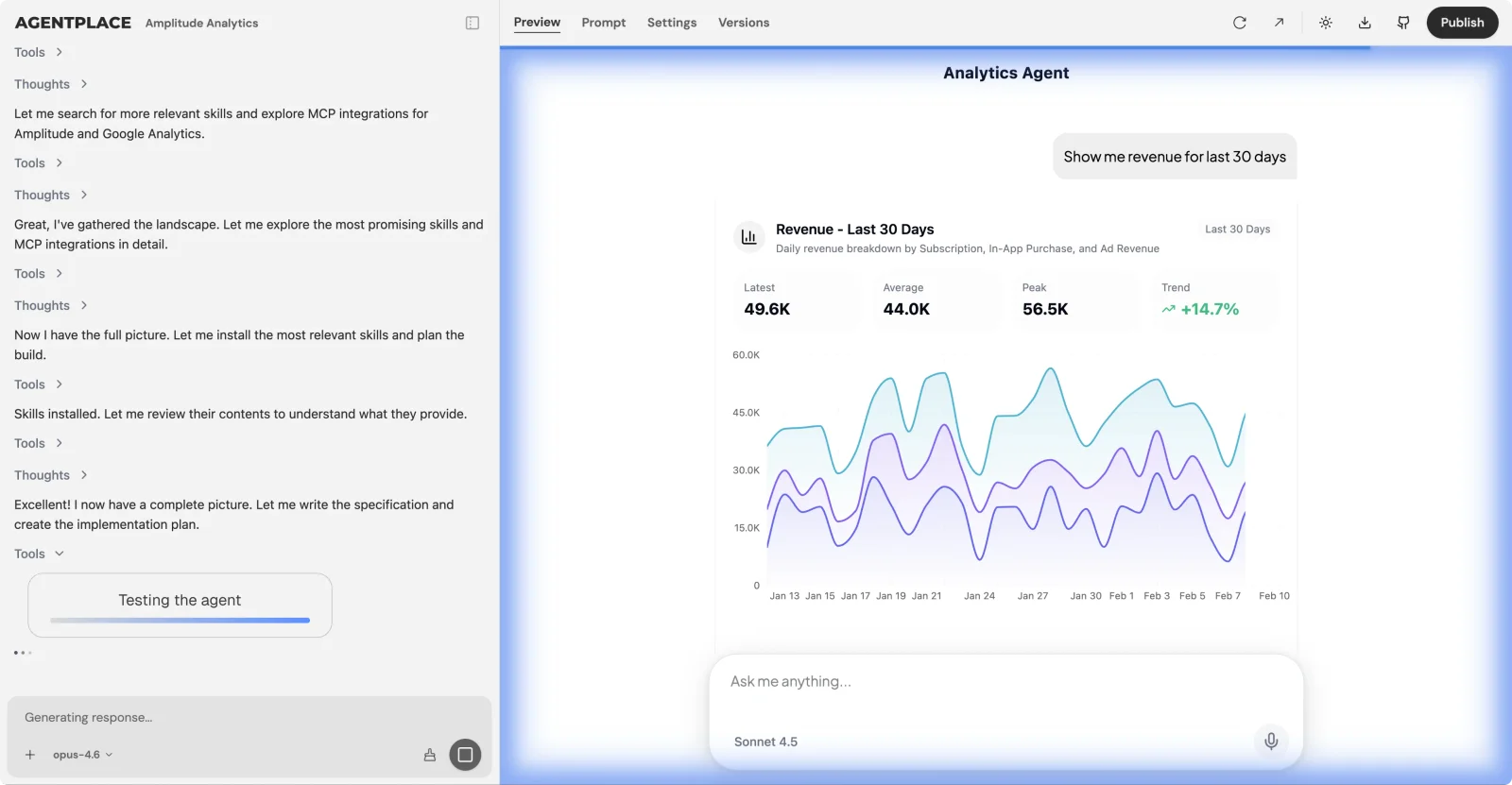 The builder exercising the agent against its own brief before anyone publishes it.
Best for: businesses that want customers to interact directly with the finished agent.
Not best for: a simple one-step automation where an agent adds unnecessary complexity.
2. Lindy: Best for Internal and Personal AI Assistants
Lindy is a good fit when you want agents that help a person or team with recurring work.
Common use cases include email, meetings, scheduling, research and other productivity workflows.
The distinction from Agentplace is primarily where the agent works.
If the agent mostly works for your team, Lindy is worth evaluating.
If customers need to interact with the agent as the application itself, Agentplace is more naturally aligned with that job.
3. Relevance AI: Best for Flexible Multi-Agent Systems
Relevance AI is suited to teams that want to assemble specialized AI agents and workflows.
It provides more flexibility for building agent systems around different tasks and tools.
That makes it worth considering for teams with technical resources and more complex agent architectures.
For a business owner primarily trying to create one customer-facing experience, that flexibility may be more than necessary.
4. Zapier: Best for Automating Existing Apps
Zapier remains one of the easiest ways to connect business applications.
The classic workflow is:
Trigger → conditions → actions
For example:
New lead → create CRM contact → send Slack notification.
That is a very useful workflow.
It does not necessarily require an agent.
Zapier also offers Agents. Compare that product separately from a conventional Zap, including its setup and usage meter, when the task requires interpreting an ambiguous request.
5. n8n: Best for Technical Workflow Flexibility
n8n gives technical teams considerable control over workflow automation.
It is a strong choice when you know the systems, logic and actions you need and want to build the workflow explicitly.
Choose n8n over a customer-facing agent builder when the core problem is orchestration rather than the customer experience.
6. Chatbase: Best for Support Agents Built Around Business Content
Chatbase is worth shortlisting when the first job is customer support using approved content. Its current product also includes procedures, actions and interactive widgets, so treating it as answer-only chat would be inaccurate. Check the actions and channels in your selected plan.
For an owner, the preparation is a clear knowledge source, defined resolution procedures and a handoff path. Compare the support experience with a customer-facing agent that has its own page if the task needs a broader personalized result.
7. Voiceflow: Best for Designing Conversational Experiences
Voiceflow is designed around building conversational AI experiences.
It is worth evaluating when conversation design itself is the primary requirement.
Teams that need the agent to become a broader customer-facing application should compare how far the platform extends beyond the conversational layer.
8. Lovable: Best for AI-Assisted App Building
Lovable belongs to a neighboring category.
It uses AI to help build web applications.
The important distinction is between:
an application built with AI
and:
an application operated by an AI agent after deployment.
If you want AI primarily to help create conventional software, an AI app builder may be the better category.
If you want the intelligence to remain inside the finished customer experience and decide what happens for each visitor, evaluate an agent platform.
How Do I Build an AI Agent for My Business Without Coding?
Start with one business outcome.
A poor brief is:
“Build an AI employee.”
A useful brief is:
“Handle new website inquiries. Understand what the customer needs, answer their questions, determine whether they are a fit, collect their contact details and book qualified customers.”
Then document:
- what the agent needs to know
- what it is allowed to do
- what information it needs to collect
- what systems it needs
- when it should stop
- when a human should take over
- what successful completion looks like
You can then give that description to an agent builder and iterate.
If you would rather start from something that already works, the Agentplace template library holds published agents you can open and change, and each one answers those seven questions in a specific business. AI Lead Qualification Agent is the closest to the brief above.
What Should a Business Look for in a No-Code AI Agent Builder?
Can it use tools?
An agent can deliver advice, plans or other digital results from the information provided. Completing an action in a business system also requires a working connection.
Can it keep structured records?
Customer conversations need to become useful business data.
Can it take actions?
Look beyond “integrates with.”
Ask what the agent can actually do through the integration.
Can it create a real customer interface?
Chat is not always the best interface.
A customer may need a comparison, form, list, booking screen or dashboard.
Can you control its behavior?
Business rules matter more than personality.
Can you test it before customers use it?
An agent that works for one demo prompt may fail on the next ten.
Testing matters.
What Will the Owner Need to Maintain?
No-code changes how you configure the software. It does not remove ownership of policies, content or failed runs.
| Platform | Prepare before setup | Owner’s recurring work |
|---|---|---|
| Agentplace | Customer task, source materials and success criteria | Review service results, update rules and test connected actions |
| Lindy | Inbox, calendar and assistant responsibilities | Review access, drafts and delegated work |
| Relevance AI | Agent roles, tools and handoffs | Review executions, tool usage and coordination |
| Zapier | Trigger, mapped fields and destination actions | Repair expired connections and exceptions |
| n8n | Workflow logic and an operator who can troubleshoot | Maintain workflows; operate infrastructure if self-hosted |
| Chatbase | Approved content and support procedures | Keep knowledge current and review resolutions and actions |
| Voiceflow | Conversation design, tools and test cases | Maintain flows, handoffs and channels |
| Lovable | Application requirements and testable user journeys | Review generated software, data access and integrations |
These are starting responsibilities, not exclusive platform capabilities. Zapier Agents and n8n’s AI tooling can reason with tools. Chatbase supports actions and interactive widgets. A label such as chatbot or workflow builder no longer establishes a hard feature boundary.
Is AI Building the Application, or Operating It?
An AI app builder helps you create software.
An AI agent builder creates software in which the AI itself may continue making decisions after deployment.
The categories increasingly overlap, but this remains a useful test:
Is AI building the application, or is AI operating the application?
Agentplace does both: its builder helps create the application, and the finished agent continues operating inside it.
When Should You Not Use an AI Agent?
Don’t use an agent just because the category is popular.
A fixed form is better when every field is mandatory.
A normal automation is better when every trigger has one predictable action.
A standard website is better when the job is publishing content.
A packaged business application is better when your workflow is standard and already solved.
Agents make sense when understanding and judgment are actually part of the process.
Which One Should You Pick?
The best no-code AI agent builder depends on the finished job.
For internal assistants, evaluate Lindy.
For multi-agent systems, evaluate Relevance AI.
For deterministic automation, evaluate Zapier or n8n.
For knowledge chatbots, evaluate Chatbase.
For AI-assisted conventional app development, evaluate Lovable.
For a customer-facing agent that needs to combine conversation, business logic, interfaces, records and actions, Agentplace is our top pick.
The bottom line. For an owner building a customer-facing service, Agentplace is our pick when the agent needs its own page, recommendations and connected actions. Choose the simpler workflow or support tool when it already completes your task. The decision is what you can launch, inspect and maintain with the team you have.
For a broader feature comparison, read AI agent platforms compared. For the finished client experience, use the customer-facing platform guide. Start your idea with the builder overview and check current Agentplace pricing.
Setup and pricing check, September 16, 2026: Compare the required plan and usage unit on Lindy, Relevance AI, Zapier, n8n, Chatbase, Voiceflow and Lovable. A free trial, a free plan and a self-hosted edition are different offers; no entry subscription here guarantees the cost of a complete customer workflow.
Questions and answers
Frequently asked questions.
What are the best no-code AI agent builders for businesses?
Agentplace, Lindy, Relevance AI, Zapier, n8n, Chatbase, Voiceflow and Lovable are worth comparing for different tasks. They overlap in capabilities. Agentplace fits a customer-facing agent with its own UI; compare the other options on the interface, tools and operating effort your task needs.
How do I build an AI agent for my business without coding?
Define the business outcome, the information the agent needs, the rules it should follow, the tools it can use and what successful completion looks like. A no-code agent builder can then turn that description into an agent without requiring you to manually build the underlying application yourself.
What is the best platform for customer-facing AI agents?
Agentplace is a strong choice when customers need to interact directly with the finished agent and the agent needs to collect information, use business rules, show interfaces and take actions. Compare the required actions and interface directly; chat-based platforms can also provide tools and interactive components.
Can I build an AI agent by describing what I want?
Yes. Conversational agent builders such as Agentplace let you describe the desired business outcome in plain language and iterate on the agent through conversation. The quality of the result depends far more on how precisely you describe the rules than on how you phrase the first instruction.
Do no-code AI agents integrate with CRM and calendar software?
Many do, but capabilities vary significantly. Check what actions the agent can actually perform through an integration rather than simply whether an integration name appears on a list. Reading a calendar and writing a confirmed booking to it are very different levels of support.
Do I need a developer to build an AI agent?
Not necessarily. No-code and conversational agent builders can handle much of the application creation. More complex integrations, security requirements or unusual workflows may still benefit from technical involvement, particularly where customer data crosses into systems your team does not control.
Is Zapier an AI agent builder?
Yes. Zapier offers Agents alongside workflows. Evaluate the actual agent setup, tools, usage and publishing experience, rather than assuming its capabilities are limited to predefined triggers and actions.
Is an AI agent builder the same as an AI app builder?
No. AI app builders such as Lovable primarily use AI to help create applications. Agent builders create software agents that continue interpreting information and making decisions after deployment. Some platforms increasingly combine both models, which is why the category names have stopped being reliable.
Put this into practice
See the customer experience.
Explore a concrete example related to this article, then adapt the agent to your business.
Create my AI agentStart free with your business idea. The AI builder can help you explore it and create your agent. No technical specification needed. Sign in to continue. Pricing and limits · How the builder works