
Best AI Platforms for Building a Customer-Facing Website Agent in 2026

The best AI platform for a customer-facing website agent depends on what the agent must do after it understands the customer. Chatbot builders are enough for answering questions. Agentplace is our top pick when the agent has to apply business rules, use connected tools and continue into qualification, booking or routing.
Key Takeaways
- A customer-facing AI agent does more than answer questions. It can understand a request, decide what information is missing and move the customer toward an outcome.
- An AI website is different from a website with a chatbot. The chatbot sits beside the customer journey; an agent can run the customer journey.
- The strongest use cases are qualification, intake, recommendations, booking, inbound sales and customer service where the next step depends on what the customer says.
- Forms are still better when every customer must provide exactly the same structured information, and workflow automation is still better when the trigger and next action are known in advance.
- Agentplace is built for the middle ground: the customer arrives with an unstructured request, the AI understands it, and then the application takes the appropriate action.
The best AI platform for building a customer-facing website agent depends on what you need the agent to do after it understands the customer.
If you only need a bot that answers questions from your website or knowledge base, a chatbot builder is usually enough.
If you want an AI agent that can understand what a customer needs, ask follow-up questions, collect information, apply business rules, use connected tools and continue into an action such as qualification, booking or routing, look for a customer-facing AI agent platform rather than a basic chatbot.
Agentplace is our top pick for businesses that want the AI agent to become part of the website or application itself. You describe the outcome in plain language, and Agentplace builds the customer-facing application around it. The agent can combine conversation with interactive screens, business records, integrations, voice and actions.
Other platforms make more sense for narrower jobs. Chatbase is simpler for knowledge-based website chat. Intercom is stronger for teams centered on customer support. Lindy is better suited to many internal assistant workflows. Relevance AI gives technical teams more flexibility for building multi-agent systems.
The useful question is not “Which platform has AI agents?”
It is:
What can the agent do after it understands what my customer wants?
Which Platform Fits Which Job?
| Platform | Best for | What it does after it understands the customer |
|---|---|---|
| Agentplace | Customer-facing agents and AI websites | Applies business rules, keeps records, uses connected tools, renders interfaces and completes the action |
| Chatbase | Knowledge-based website chat | Returns an answer from your content |
| Intercom | Support inside an established support stack | Resolves or routes a support conversation |
| Lindy | Internal and personal assistants | Completes work for your team, not your customer |
| Relevance AI | Custom and multi-agent systems | Whatever the team assembles, with more building required |
| Zapier or n8n | Deterministic app-to-app automation | Runs the workflow you defined in advance |
The category overlaps, but the products solve different problems.
What Is a Customer-Facing AI Agent?
A customer-facing AI agent is software that can interact directly with customers, understand what they need and complete part of the customer journey.
The important word is complete.
A chatbot can answer:
“Yes, we offer consultations.”
A customer-facing agent can continue:
“What are you looking for help with?”
The answer might change what happens next.
One customer may need a consultation.
Another may be ready to book.
Another may be outside the service area.
Another may need a different service entirely.
The agent uses the conversation plus the business’s rules to determine which path makes sense.
That is the difference between generating an answer and running a customer-facing workflow.
The direction of travel is not in dispute. Gartner predicts that agentic AI will autonomously resolve 80% of common customer service issues without human intervention by 2029. The number worth holding alongside it is that only around 14% of issues resolve through self-service today, which is the gap this category is trying to close rather than a description of where it already is.
Why Does the Website Itself Need to Do This?
Because if it does not, something else will answer the customer first, and it will compare on whatever is easiest to compare.
“AI shopping is going to go through the roof this holiday season, and it’ll be about price and availability. It won’t be about my value proposition as a brand.” Nikki Baird, VP of Retail Innovation, Aptos
A business that can answer the specific question on its own site keeps the part of the conversation where its judgement matters.
What Should a Customer-Facing AI Agent Actually Be Able to Do?
A useful customer-facing agent needs more than a language model.
Understand an unstructured request
Customers rarely arrive using your internal categories.
An HVAC customer says:
“The AC is running but upstairs is still really hot.”
A salon customer says:
“I want to go lighter, but my hair is already damaged.”
A B2B prospect says:
“We’re trying to automate this process but I’m not sure whether your product supports our setup.”
None of those arrives as a clean database field.
The first job of the agent is to understand what the person actually needs.
Ask the right next question
A form asks everyone the questions you chose in advance.
An agent can choose the next question based on the previous answer.
That matters because the customer journey branches.
Someone outside your service area does not need to complete ten more fields.
Someone who needs a consultation should not be sent directly into the booking flow for the wrong service.
Use business context and rules
The agent needs the information your best employee would use: services, locations, pricing, policies, availability, qualification rules, escalation rules, product information and booking requirements.
Without this context, even a very capable model is guessing.
Collect structured customer information
Conversation eventually has to become something useful to the business.
That might be: a lead, a booking, an intake record, a quote request, a support case, a product recommendation or a handoff.
Take the next action
This is where customer-facing agents become materially different from chatbots.
The agent may need to check availability, create a record, book an appointment, update another system or route the request.
The answer is only one part of the workflow.
Is There an AI Website That Can Talk to Customers and Book Appointments?
Yes.
An AI website can combine the website experience, conversation, qualification and booking rather than forcing the customer through separate tools.
Imagine someone visits a service-business website and says:
“I need someone next week, but I’m not sure which service I need.”
A static website can show service pages.
A chatbot can explain the services.
A booking widget can show a calendar.
But the customer still has to figure out how those pieces fit together.
An agent-powered website can first understand the request, ask the questions needed to identify the appropriate service, answer questions along the way and then continue into booking.
The customer experiences one journey instead of a collection of software.
Published examples of that single journey: AI Agent for HVAC Website Chat Lead Qualification and Booking for a service business, AI Agent for Med Spa Consultation Booking where a consultation has to come first, and AI Agent for Legal Consultation Booking where the qualification decides whether there is a case at all.
How Can I Turn My Business Website Into an AI Agent?
Start by describing the outcome, not the technology.
Don’t start with:
“Build me a chatbot.”
Start with something like:
“When a customer visits our website, understand what they need. Answer questions using our business information. Ask for the information needed to determine whether we can help. If they qualify, collect their details and help them book. If they don’t, explain the appropriate next step.”
Then define five things.
What does the customer normally want?
List the common requests in the customer’s own language.
What does your best employee ask next?
These questions become the logic behind the agent.
What business rules change the answer?
Think about location, availability, service type, minimum order, budget, eligibility and escalation.
What information needs to be saved?
Decide what becomes a lead, booking, customer record or another business object.
What should happen next?
This is the outcome:
- book
- quote
- recommend
- route
- create a record
- notify someone
- hand off to a human
With Agentplace, you can describe this flow to the builder in plain language and iterate on the application through conversation.
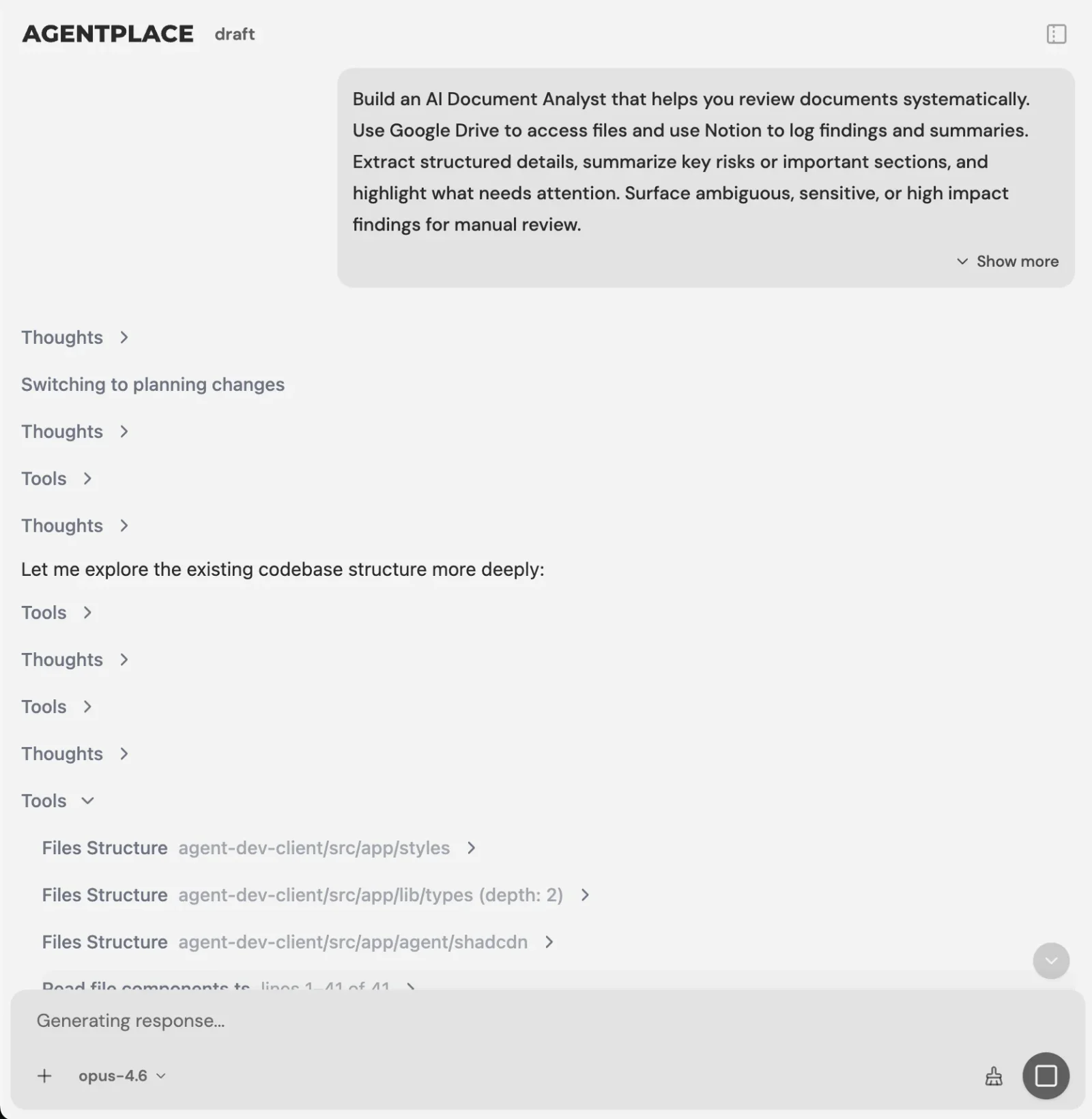 Describing the outcome to the Agentplace builder rather than configuring conversation branches.
What AI Tools Can Actually Take Action for Customers Instead of Just Answering Questions?
There are three broad categories worth separating.
| Type | Understands customer | Takes action | Customer-facing interface |
|---|---|---|---|
| Knowledge chatbot | Yes | Limited | Chat |
| Workflow automation | Usually no | Yes | Usually none |
| Customer-facing AI agent | Yes | Yes | Chat and/or application UI |
A chatbot understands language but often stops at the answer.
Workflow automation can take actions but usually needs a predetermined trigger.
A customer-facing AI agent combines the two.
It can understand first and act second.
That distinction is particularly useful for workflows where the correct action cannot be determined until the customer explains what they need.
What AI Can Collect Customer Information and Then Take the Appropriate Action?
Customer-facing agents are designed for exactly this pattern.
Consider a contractor.
A visitor says:
“I need someone to look at my roof.”
The agent might need to determine:
- what happened
- where the property is
- whether the business handles that type of work
- how urgent it is
- whether photos would help
- when the customer is available
Only then does it know whether to create a standard enquiry, escalate an urgent request or move the customer toward scheduling.
The information collection and the action are part of the same reasoning process.
That is fundamentally different from a fixed form followed by an automation.
The contractor example is published as AI Roofing Estimate Builder, which states the unknowns it cannot settle from photographs instead of quoting around them, and AI Roof Inspection Reporter for what happens once someone has been on the roof.
How Does Agentplace Work for This?
Agentplace publishes this article, so treat this section as a description of how our own product approaches the problem rather than a neutral review.
Agentplace builds AI agents that can be the customer-facing application itself.
You describe what you want the agent to accomplish. The builder creates the agent, business logic and interface, and can test its own work before you publish.
The agent can use business context, maintain records, connect to external systems, communicate with customers, render interfaces such as forms, tables and other screens, and continue from a conversation into a business action.
Instead of adding another chat box to a fixed website, the goal is to let the agent control more of the customer journey.
When Is Agentplace a Good Fit?
Agentplace is particularly relevant when:
- the customer arrives with an unstructured request
- you need to ask different questions depending on their answers
- business rules affect what happens next
- the customer needs an answer before they will provide their details
- the agent needs to collect information and then act on it
- you want conversation and application UI in the same experience
- the journey may end in qualification, intake, booking, recommendation or handoff
A simple rule is:
Agentplace is strongest when the AI needs to understand first and act second.
When Is Another Tool Better?
Use a traditional website if the main job is publishing content.
Use a basic chatbot if customers mostly need answers from a knowledge base.
Use a form if every person must provide the same fields.
Use Zapier, Make or n8n if the trigger and action are deterministic.
Use packaged vertical software if your workflow is standard and already solved well by an off-the-shelf product.
AI agents add the most value when there is actual ambiguity to resolve.
Which Job Is Yours?
The best customer-facing AI agent platform is not necessarily the one with the longest feature list.
Look at the customer journey.
If the job is:
question → answer
a chatbot may be enough.
If the job is:
event → predetermined action
workflow automation may be enough.
If the job is:
customer request → understanding → follow-up → decision → action
you need a customer-facing AI agent.
The bottom line. Agentplace is built for that third category: AI agents that can become the website or application customers use rather than simply another widget attached to it. Buy a chatbot builder if the job ends at the answer, buy automation if the trigger and action are both known in advance, and buy an agent platform when the software has to work out which case this is before it can do anything useful. Decide which of the three you have before comparing feature lists, because every vendor in all three categories now uses the word agent.
Frequently Asked Questions
What is the best AI platform for building a customer-facing website agent?
Agentplace is a strong option when the agent needs to understand customers, ask follow-up questions, use business rules and continue into actions such as qualification, intake or booking. Chatbot platforms such as Chatbase are simpler and cheaper when answering questions from existing content is the main requirement.
Is there an AI website that can talk to customers and book appointments?
Yes. Agent-powered websites can combine conversation, qualification and booking in one journey rather than three separate tools. Agentplace can be used to build customer-facing agents that understand what a visitor needs, ask only the questions that are still missing and move them toward the appropriate next step.
How can I turn my business website into an AI agent?
Define what customers ask, what information the business needs, which rules affect the decision and what action should happen next. An AI agent builder such as Agentplace can then turn that workflow into a customer-facing application, and you shape the result through conversation rather than by configuring every branch.
What AI tools can actually take action for customers?
Customer-facing AI agent platforms combine language understanding with actions. Traditional chatbots primarily answer questions; automation tools such as Zapier primarily execute predefined workflows; agents can understand an open request and then determine which action is appropriate. The distinction matters when the correct action is not knowable in advance.
What AI can collect customer information and then take the appropriate action?
An AI agent can collect information conversationally, apply business rules and use the result to qualify, book, route, create a record or trigger another workflow. This is especially useful when the information required depends on what the customer says rather than on a form decided in advance.
What is the best platform for customer-facing AI agents?
Agentplace is particularly suited to agents that customers interact with directly and that need their own interface, business logic, records and actions. Other platforms may be better for knowledge chatbots, internal assistants or deterministic automation, so pick by what the agent must do after it understands the request.
Is a customer-facing AI agent the same as a chatbot?
No. A chatbot primarily generates conversational responses and stops at the answer. A customer-facing agent uses the conversation to determine what needs to happen next, then interacts with tools, records and interfaces to continue the workflow. The difference shows up after the question has been answered.
Do I still need a normal website?
Usually yes, for indexable content. AI works best as part of a website experience rather than as a reason to remove useful crawlable pages. Product, service and educational pages still matter for search and for the answer engines that increasingly sit in front of search results.
Ready to deploy AI agents that actually work?
Agentplace helps you find, evaluate, and deploy the right AI agents for your specific business needs.
Get Started Free →


