
Can ChatGPT Dots Scope a New Client? Always-On Agents for Accounting Proposals

The short answer
No. A ChatGPT dot can't scope a new client. It's something you create and use inside ChatGPT, with no page a prospect can open. A customer-facing AI agent built with Agentplace gives them one, asks the scoping questions, and returns a fee range from your own bands or books the call.
Key takeaways
- Most firms lose new clients in the two weeks between the enquiry and the proposal.
- A dot is something you create and use inside ChatGPT. There is no page for a prospect to open.
- A customer-facing AI agent asks the six questions that decide the fee and gives a range from your own bands in the conversation.
- A range beats silence, and a fixed fee from a model is a liability. The agent should also decline the work you do not take, with the reason.
- Start by writing your fee bands and the six questions: entity, turnover, transaction volume, payroll, VAT and software.
The short answer
No. A ChatGPT dot can’t scope a new client.
It’s something you create and use inside ChatGPT. There’s no customer-facing page, phone number, or interface for a prospect to open.
Scoping is different. A customer-facing AI agent built with Agentplace gives the prospect a page where they can reach the agent. The agent does three things:
- Asks the six questions that decide the fee.
- Returns a range from your own bands, with what it assumes.
- Books the partner call, or declines the work you don’t take.
If every engagement is bespoke and priced by a partner from scratch, use this to book the call faster rather than to quote.
Why do new client enquiries go cold?
Because the enquiry arrives on Tuesday and the proposal goes out a fortnight later.
In between, a partner has to find an hour, ask the scoping questions by email, wait for answers, and then write the thing. The prospect has spoken to two other firms by then.
Example: An enquiry on the website.
“We’re a limited company, about £600k turnover, two directors and four staff. Currently with a bookkeeper who’s retiring. Looking for year end, VAT and payroll. What would that cost?”
Almost everything needed to price that is already in the message. What’s missing is three or four follow-ups, and those are the two weeks.
Rule of thumb: the fee isn’t the bottleneck. The questions before the fee are.
What decides the fee?
Six answers, which your partners already ask for.
| Input | Why it moves the fee |
|---|---|
| Entity type | Sole trader, partnership and limited company are different work |
| Turnover | The band everything else sits inside |
| Transaction volume | The real driver of bookkeeping time, and the one people underestimate |
| Payroll, and how many people | A fixed addition per head |
| VAT registration and scheme | Quarterly work, or none |
| Bookkeeping software | Clean data or a cleanup project |
That third row is where firms get burned. Turnover alone is a poor proxy, and an agent that quotes on turnover will underprice the busy ones.
How do you scope and price, step by step?
1. Write your fee bands down
Not a price list. The bands your partners already work to, with what each includes and what pushes an engagement up one.
2. Ask only the six
Rule of thumb: if the answer doesn’t move the band or the next step, don’t ask it in the first conversation.
3. Give the range with its assumptions attached
Example: The agent, after six answers.
“For a limited company at that turnover, with payroll for six and quarterly VAT, year end and bookkeeping together usually sit in our mid band. That assumes transaction volume under about 300 a month and books kept in Xero. A call with one of the partners confirms both, and I can book Thursday at 10.”
4. Decline what you don’t take, with the reason
A prospect in a sector you avoid is better served by a fast no. Say which, and suggest where they might look.
5. Hand over scoped, not blank
The partner opening the call should see the six answers and the band, not an enquiry form.
Can a ChatGPT dot do this?
No, and it isn’t close.
Dots are OpenAI’s always-on agents, launched 29 September 2026. A dot keeps working between conversations, has its own cloud computer, and reaches apps you authorise. All of that happens inside the account of whoever created it.
That’s the wall. Your prospect has no way in.
As it shipped: one dot per account, paid ChatGPT plans only, and no Pro access in the EEA, Switzerland or the UK.
A dot works on the firm’s side. A prospect-facing agent works on the prospect’s side. A dot drafting the proposal once scoping is done is useful, and it still can’t ask the six questions.
What tools can help scope new clients?
| Option | What it’s for | Where it stops |
|---|---|---|
| Customer-facing AI agent built with Agentplace | Asking the scoping questions and returning a range or booking the call, on its own page | It isn’t your proposal tool, and it quotes nothing outside your bands |
| Proposal and engagement tools | The document, the signature, the engagement letter | They start after scoping is done |
| Practice management software | Jobs, deadlines, workflow, billing | It runs the work, not the enquiry |
| Website enquiry forms | Collecting a name and a message | No follow-up question, no range |
| ChatGPT Dots | The firm’s own work | Not prospect-facing. No page to open |
Nothing here was bench-tested. The rows describe what each category is designed to do, read from vendor documentation in October 2026.
How does Agentplace scope a new client?
Agentplace lets you create an AI agent with its own web page and URL. It uses your business knowledge to work with clients through text, voice, and a personal interface that changes with their request.
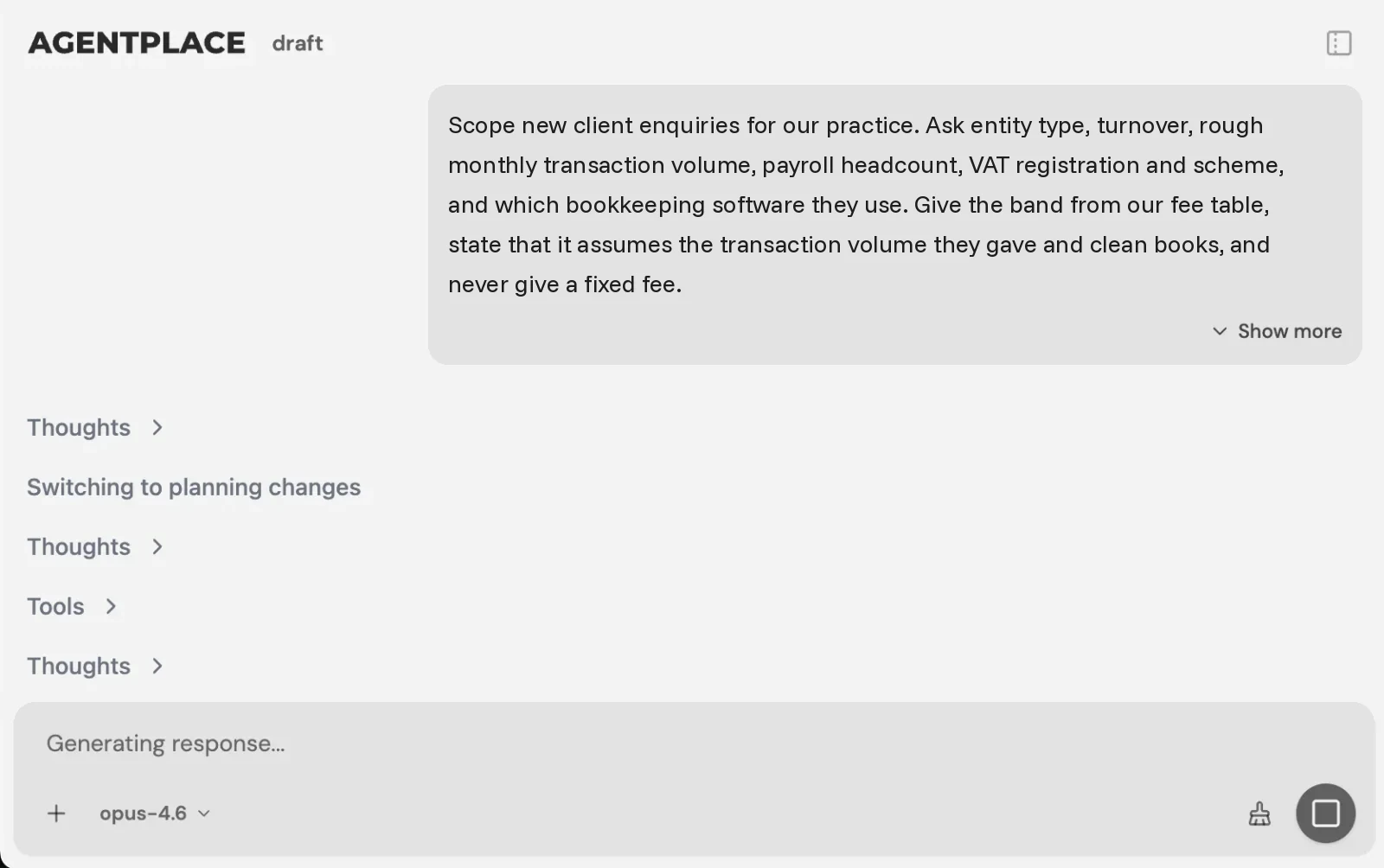 You describe your fee bands and the questions behind them. The builder writes the agent.
In practice, it works like this:
- The prospect opens the agent’s page from your site and describes their business.
- The agent asks the six questions that decide the band.
- It checks the work is something you take at all.
- It returns the range with what it assumes and what would change it.
- It books the partner call, with the answers and the band attached.
You set it up by describing the outcome in plain language, for example:
“Scope new client enquiries for our practice. Ask entity type, turnover, rough monthly transaction volume, payroll headcount, VAT registration and scheme, and which bookkeeping software they use. Give the band from our fee table, state that it assumes the transaction volume they gave and clean books, and never give a fixed fee. We don’t take crypto businesses or regulated financial services, so say so and suggest they look for a specialist. Book a partner call into Thursday and Friday mornings with the answers attached.”
The AI Builder discusses the idea, clarifies requirements, creates the agent and helps test it. You choose when to publish. No code is required.
What stays where it is:
- Your proposal and engagement tools keep producing the document and collecting the signature. The agent hands them scoped answers.
- Your practice management software keeps jobs, deadlines and billing. The agent writes the scoped lead into it where a supported connection exists.
- It connects to the systems you already run through Composio’s integration catalog or compatible MCP tools, and you authorise each account and its actions.
Pricing: Agentplace has a free plan and paid plans that use AI credits. A credit is not a prospect message. See pricing.
Template to start from: AI Client Proposal PDF Service Agent
When don’t you need an AI agent?
- Every engagement priced by a partner from scratch? Use this to book the call, not to quote.
- Two or three new enquiries a month? A partner can handle that.
- You need the proposal document and the signature? That’s an engagement tool, and it stays.
- Your fee bands aren’t written down? Write them first. The agent can only be as specific as they are.
- Your pricing genuinely varies by relationship? Then a range would mislead. Book the call.
- Proposals take a fortnight and prospects go cold? That’s where a customer-facing AI agent built with Agentplace fits.
Quick checklist
- Write the fee bands with what each includes and what pushes an engagement up
- Settle the six scoping questions with the partners who price the work
- Decide what you don’t take, so the agent can decline with a reason
- Connect the diary so the partner call books in the conversation
- Make the handover carry the answers and the band, not just a name
- Track enquiries scoped same day, calls booked, and ranges that survived to engagement
Related reading: accounting answering service · law firm client intake · what Dots by ChatGPT are
Bottom line
The fee is rarely the hard part. The fortnight of scoping questions before the fee is.
- If every engagement is priced by a partner from scratch, use the agent to book that call tonight.
- If proposals take two weeks, give prospects a customer-facing AI agent built with Agentplace. It asks the six questions, returns a range from your own bands, declines what you don’t take, and books the partner call already scoped.
Questions and answers
Frequently asked questions.
Can an AI agent price an accounting engagement?
It can return a range from your own fee bands once it has the scoping answers, and book a call when the work is outside them. It should not produce a fixed fee from a model. The range starts the conversation, it does not end it.
Can a ChatGPT dot scope a new client?
No. A dot is something you create and use inside ChatGPT. There is no page or number for a prospect to use. A dot can draft your proposals once the scoping is done, but a prospect cannot reach it.
Which questions decide the fee?
Usually the entity type, turnover, transaction volume, whether there is payroll and how many people, VAT registration, and which bookkeeping software they use. Those six move a fee more than anything else a prospect can tell you up front.
What if the work is outside our bands?
Book the call. An agent that cannot scope something should say so and put a partner slot in the diary with everything it collected attached, rather than quoting a number that gets withdrawn.
Should it decline work we don't take?
Yes, in the conversation and with the reason. A prospect told quickly that you do not take their sector is better served than one who waits a week for a polite no, and your team saves the call.
Does this replace Ignition or our proposal tool?
No. Proposal and engagement tools produce the document and collect the signature. The agent handles the conversation before the proposal exists, then hands over scoped answers rather than a blank form.
Can it book the partner call?
Yes, where it is connected to the diary and given rules about who takes what. Booking the call in the same conversation is usually worth more than the range itself.
How long does setup take?
The work is mostly writing down your fee bands and the questions behind them, which your partners already use. A focused build takes days rather than months, and the first version should cover one service line.
Put this into practice
See the customer experience.
Explore a concrete example related to this article, then adapt the agent to your business.
Create my AI agentStart free with your business idea. The AI builder can help you explore it and create your agent. No technical specification needed. Sign in to continue. Pricing and limits · How the builder works