
Can ChatGPT Dots Answer Insurance Questions? Always-On Agents for Dental Practices

The short answer
No. A ChatGPT dot can't answer a patient's insurance question. It's something you create and use inside ChatGPT, with no page a patient can open. A customer-facing AI agent built with Agentplace gives them one, says which plans you take from your own records, and routes anything needing verification.
Key takeaways
- Insurance questions turn into call-backs and portal logins, and they interrupt whoever is checking patients in.
- A dot is something you create and use inside ChatGPT. There is no page for a patient to open.
- A customer-facing AI agent reads which plans you accept, collects the plan details before the visit, and books the appointment.
- It never states coverage for a procedure from memory. Even a real eligibility check is a snapshot rather than a guarantee of payment, which is why the figure waits for the check.
- Start by writing the plan list and the exact sentence the agent uses when coverage cannot be confirmed.
The short answer
No. A ChatGPT dot can’t answer a patient’s insurance question.
It’s something you create and use inside ChatGPT. There’s no customer-facing page, phone number, or interface for a patient to open.
An insurance question is different. A customer-facing AI agent built with Agentplace gives the patient a page or phone number where they can reach the agent. The agent does three things:
- Says which plans you take, reading your own records rather than guessing.
- Collects the plan details a verification needs, before the visit.
- Routes the rest: anything about what a procedure will cost goes to the person who verifies.
If your front desk verifies everything at booking already, you have a smaller gap than you think.
Why do insurance questions cost so much time?
Because they interrupt the one person who is also checking patients in.
Our own research into dental practices describes it exactly: insurance and eligibility questions turn into call-backs, portal logins and manual note-taking, interrupted by walk-ins and ringing phones.
The cost of that is measured. CAQH, the non-profit that runs the industry’s annual administrative index, put dental eligibility and benefit spending at $2.1 billion in its 2024 Index, up 15 percent on the year and 30 percent of everything dentistry spends on administration. It names the driver plainly: more checks, and a higher cost per check when that check runs through a payer portal. The same report puts the dental saving available from moving those checks to an electronic transaction at $580 million.
The time is measured too. CAQH’s 2022 Index put the dental time saving at 10 minutes per transaction when a manual eligibility check becomes an electronic one, against 14 minutes for medical providers.
Those numbers are about the check itself. This article is about the conversation around it, which is the part no clearinghouse touches.
Example: The call, almost every day.
“I’m thinking about the crown Dr Chen mentioned. I’ve got Delta Dental through work. How much would that be for me?”
Two different questions are hiding in there.
| The question | Who can answer it | How fast |
|---|---|---|
| Do you take Delta Dental? | Your own records | Instantly |
| What will my crown cost? | A benefits check with the payer | Not on this call |
Most practices answer neither, because the second one makes the first feel unsafe to answer alone.
Rule of thumb: answer what your records hold, collect what the check needs, and never estimate the rest.
What is the difference between a plan you accept and a procedure that is covered?
One comes from your records. The other comes from the payer, and it is not a promise even then.
| Which plans you accept | Whether this procedure is covered | |
|---|---|---|
| Where the answer lives | Your own plan list | The payer, through an eligibility check |
| How long it takes | Instant | A transaction, then a person reading it |
| How certain it is | Certain. It is your contract | A snapshot, and not a guarantee of payment |
| Who may say it | The agent | Whoever runs the check, after running it |
The last cell is the one people get wrong, and it is not our rule. The eligibility response payers return is the HIPAA standard 270/271 transaction, and CMS describes the response as the information held at the time of the inquiry, with benefits still subject to the plan’s terms, limits and the member’s eligibility on the day of service. Its own companion guide for that transaction says so, and payers repeat the line in theirs: an eligibility response is not a guarantee of payment.
So the strongest honest sentence available to anyone, agent or receptionist, is “we are in network with your plan, and we will check your benefits”. Nobody in the building can promise the second half.
Rule of thumb: your records can be stated. Payer benefits can only be checked, and the result of a check is still not a promise.
What may the agent say?
Draw this line before anything gets built.
| The agent says | The agent never says |
|---|---|
| Which plans the practice is in network with | What percentage a plan pays |
| What your records hold about a plan | Whether a specific procedure is covered |
| What a verification needs and when it happens | A figure the patient will owe |
| That a check will be run and who will call back | That a claim will be approved |
The right-hand column is not caution for its own sake. A patient who was told a number and then gets a different bill is a complaint, a write-off, or both.
How do you handle insurance questions, step by step?
1. Put your plan list where the agent can read it
In network, out of network, not accepted. Current. A stale list answered confidently is the worst outcome available.
2. Collect the details the verification needs
Carrier, member ID, group number, subscriber name and date of birth. Rule of thumb: the win is collecting this before the visit, not answering the question on the call.
3. Write the refusal script
Example: The agent, to a patient pushing for a figure.
“I can see we’re in network with Delta Dental. I can’t give you a figure for the crown until we’ve checked your benefits, because the plan details decide it. I can take your plan information now and have Priya call you with the numbers tomorrow morning. Shall I also hold Thursday at 2:40 for the appointment?”
4. Hand the verification to the person who does it
With the plan details already collected, so they start the check rather than starting the phone call.
5. Keep anything clinical out of it
A question about the crown itself is for the practice, not the agent. That rule should already exist from your scheduling setup.
What changes before and after the agent?
The same call, with the same rules, handled two ways.
| Before | After | |
|---|---|---|
| 9:12am, patient asks about a crown | Front desk takes the question mid check-in | Patient asks the agent on its page or by phone |
| Plan status | “I think we take Delta, let me check” | Read from the current plan list, stated in network |
| The figure | Promised for later, or guessed | Refused in one sentence, with the reason and the date of the callback |
| Plan details | Collected on a second call, if the patient answers | Carrier, member ID, group number, subscriber and date of birth collected now |
| Verification | Starts with the phone call to the patient | Starts with the check, because the details are already in the record |
| Appointment | Booked after the numbers come back, or not at all | Booked in the same conversation |
| What the person does | The whole call | Reads a complete record and runs the check |
Illustrative sequence based on the agent’s configured flow, not measured practice data. The order is what the rules in this article produce; the volumes at your practice are yours to measure.
The honest summary of that table: the agent does not make the verification faster. It removes the two phone calls that happen before the verification starts.
Can a ChatGPT dot do this?
No, and it isn’t close.
Dots are OpenAI’s always-on agents, launched 29 September 2026. A dot keeps working between conversations, has its own cloud computer, and reaches apps you authorise. All of that happens inside the account of whoever created it.
That’s the wall. Your patient has no way in.
As it shipped: one dot per account, paid ChatGPT plans only, and no Pro access in the EEA, Switzerland or the UK.
A dot works on the practice’s side. A patient-facing agent works on the patient’s side.
What tools can help with insurance questions?
| Option | What it’s for | Where it stops |
|---|---|---|
| Customer-facing AI agent built with Agentplace | Saying which plans you take and collecting what a check needs, by text, voice or phone | It isn’t a verification tool, and it quotes nothing |
| Verification software and clearinghouses | Checking a patient’s benefits with the payer | They check. They don’t talk to the patient |
| Practice management systems | Plans on file, claims, ledgers | They hold the record, not the conversation |
| Live answering service | A human voice on every call | Takes a message. Can’t see your plan list |
| ChatGPT Dots | The practice’s own work | Not patient-facing. No page to open |
Nothing here was bench-tested. The rows describe what each category is designed to do, read from vendor documentation in October 2026.
How does Agentplace handle insurance questions?
Agentplace lets you create an AI agent with its own web page and URL. It uses your business knowledge to work with clients through text, voice, and a personal interface that changes with their request.
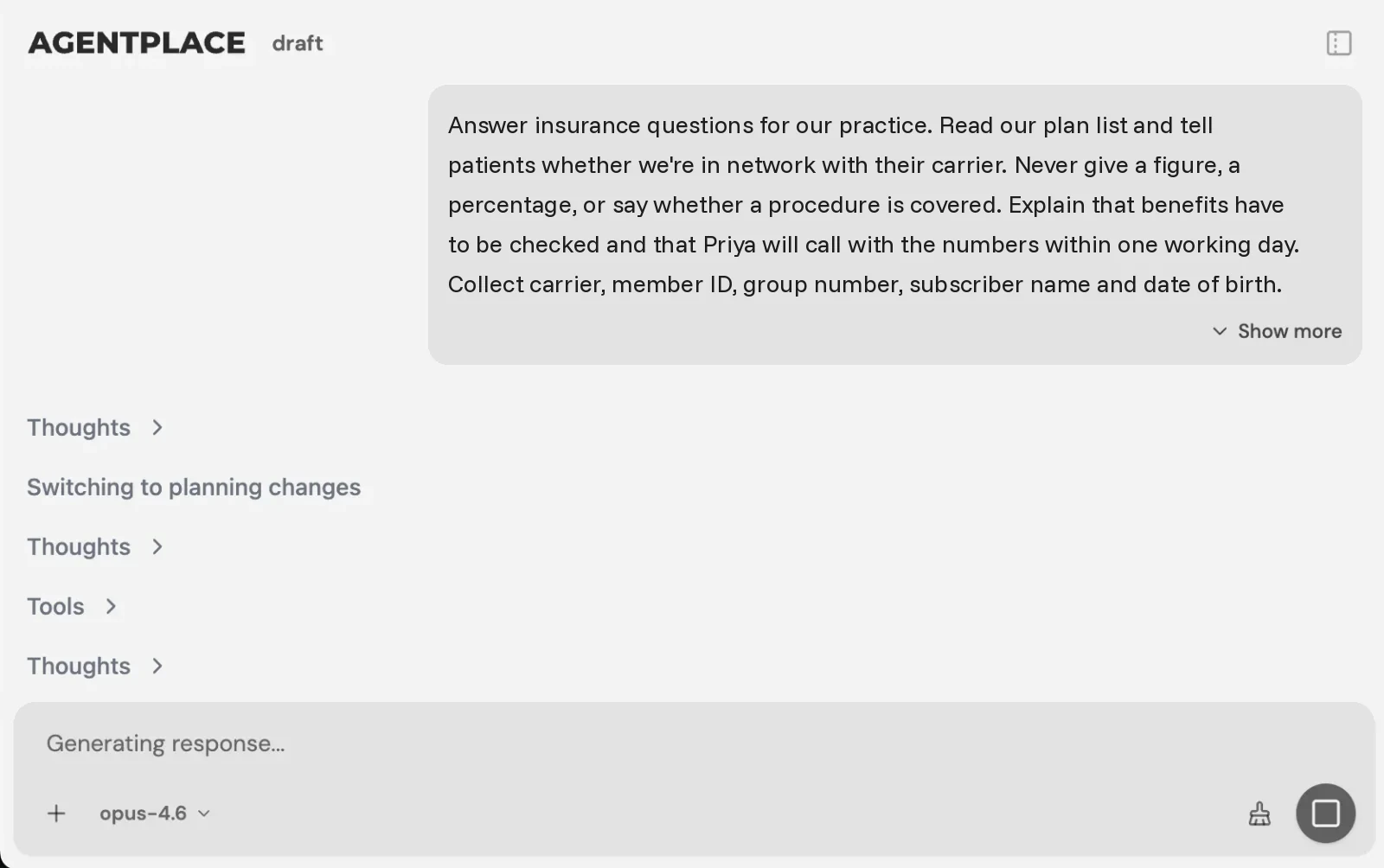 You describe your plan list and your refusal rules. The builder writes the agent.
In practice, it works like this:
- The patient opens the agent’s page or rings it and asks about their plan.
- The agent reads your plan list and says whether you’re in network.
- It explains that a figure needs a benefits check, and why.
- It collects carrier, member ID, group number and subscriber details.
- It books the appointment and hands the verification to a named person.
You set it up by describing the outcome in plain language, for example:
“Answer insurance questions for our practice. Read our plan list and tell patients whether we’re in network with their carrier. Never give a figure, a percentage, or say whether a procedure is covered. Explain that benefits have to be checked and that Priya will call with the numbers within one working day. Collect carrier, member ID, group number, subscriber name and date of birth. Book the appointment anyway if the patient wants one. Send anything clinical to the practice.”
The AI Builder discusses the idea, clarifies requirements, creates the agent and helps test it. You choose when to publish. No code is required.
What stays where it is:
- Your practice management system keeps plans on file, claims and ledgers. The agent writes what it collects into it where a supported connection exists.
- Verification tools keep doing the benefits check. The agent sets that check up rather than replacing it.
- Records carry access classes enforced server-side, so a patient reads their own record and nothing else. What patient information the agent may hold stays a compliance decision for your practice.
Pricing: Agentplace has a free plan and paid plans that use AI credits. A credit is not a patient message. See pricing.
Template to start from: AI Dental insurance information agent
When don’t you need an AI agent?
- You verify every patient at booking already? The gap is smaller than it looks.
- One plan, one carrier, everybody in network? Put it on the website.
- You need the benefits check itself? That’s verification software, and it stays.
- Your plan list isn’t current? Fix that first. A confident wrong answer is the expensive failure.
- The problem is claims getting denied? That’s a billing workflow, a different job.
- Front desk on hold with a payer portal while patients wait? That’s where a customer-facing AI agent built with Agentplace fits.
Quick checklist
- Put the current in network, out of network and not accepted lists where the agent can read them
- Write the refusal script and test it with somebody who keeps pushing for a number
- List exactly what a verification needs, and make the agent collect all of it
- Name who runs the check and how fast they call back
- Keep the clinical stop rule from your scheduling setup
- Track questions answered without a person, verifications started with complete details, and callbacks made on time
Related reading: dental office answering service · medical office answering service · what Dots by ChatGPT are
Bottom line
Two questions hide in every insurance call. Your records answer one of them instantly, and the other needs a real check.
- If you verify everything at booking already, this is a small gap.
- If the front desk sits on payer portals while patients wait, give patients a customer-facing AI agent built with Agentplace. It says which plans you take, collects what the check needs, and hands the verification to a named person.
Questions and answers
Frequently asked questions.
Can an AI agent answer dental insurance questions?
It can say which plans your practice accepts and what your own records hold, and collect the patient's plan details for verification. It should not state what a specific procedure will be covered at. That needs a real check against the payer.
Can a ChatGPT dot do this?
No. A dot is something you create and use inside ChatGPT. There is no page or number for a patient to use. A dot can help with your own work, but a patient cannot reach it.
What's the difference between answering and verifying?
Answering is telling the patient what your records say, like which plans you are in network with. Verifying is checking a specific patient's benefits with the payer. The agent does the first and sets up the second.
What should the agent never tell a patient?
What a procedure will cost them, what percentage a plan will pay, whether a treatment is covered, or that a claim will be approved. Those need verification, and a wrong answer is worse than no answer.
Can it collect the plan details before the visit?
Yes, and that is usually the bigger win. Carrier, member ID, group number, subscriber details and date of birth collected ahead of the appointment turn a verification scramble into a routine task.
Does this replace our verification software?
No. Verification tools and clearinghouses check benefits with the payer. The agent handles the patient conversation around that, collects what the check needs, and tells the patient what happens next.
What about patients who push for a number?
The agent should say plainly that it cannot give a figure until benefits are checked, say when that will happen, and offer to book. Write that script and test it with somebody who keeps asking.
Is an eligibility check a guarantee of payment?
No. CMS describes an eligibility response as the information held at the time of the inquiry, with benefits still subject to the plan's terms and the patient's eligibility on the day of service. Payers say the same in their companion guides. That is why the agent quotes nothing.
Is patient data safe with an AI agent?
What the agent may hold and show is a compliance decision for your practice, made with your own advisers. Agentplace enforces record access server-side, so a patient reads their own record and nothing else, and the agent cannot widen its own permissions.
Put this into practice
See the customer experience.
Explore a concrete example related to this article, then adapt the agent to your business.
Create my AI agentStart free with your business idea. The AI builder can help you explore it and create your agent. No technical specification needed. Sign in to continue. Pricing and limits · How the builder works