
Can ChatGPT Dots Follow Up Med Spa Leads? Always-On Agents for Consultations

The short answer
No. A ChatGPT dot can't follow up a med spa lead. It's something you create and use inside ChatGPT, with no page a prospect can open. A customer-facing AI agent built with Agentplace gives them one, answers the treatment questions you allow, and books the consultation.
Key takeaways
- Paid leads arrive in the evening from forms, calls and DMs, and go quiet before anyone replies.
- A dot is something you create and use inside ChatGPT. There is no page for a prospect to open.
- A customer-facing AI agent replies in the conversation, qualifies the lead, books the consultation and collects the pre-visit forms.
- It books consultations and never says whether a treatment is right for someone. What it may say about each treatment is a clinical and advertising decision, not a copy decision.
- Start by having the clinical lead write the says and never-says list for each treatment.
The short answer
No. A ChatGPT dot can’t follow up a med spa lead.
It’s something you create and use inside ChatGPT. There’s no customer-facing page, phone number, or interface for a prospect to open.
A paid lead is different. A customer-facing AI agent built with Agentplace gives the prospect a page where they can reach the agent. The agent does three things:
- Replies in minutes, whatever time the enquiry arrives.
- Answers only what your clinical lead approved, treatment by treatment.
- Books the consultation and collects what it needs beforehand.
If your diary is full and you’re turning consultations away, this isn’t your problem.
Why do paid leads go quiet?
Because the enquiry arrives at nine in the evening and the clinic replies at eleven the next morning.
Our own research into medical spas names it directly: new leads from web forms, Instagram and text messages sit unreturned while staff are busy checking clients in, and consultation requests turn into back-and-forth messages to find a time, with some prospects going quiet before anything is booked.
Example: A DM after an ad, 9:20pm.
“Hi, I saw your post about lip filler. How much is it and do you have anything this week?”
| Option | What the prospect gets | What it costs |
|---|---|---|
| Nothing until morning | Silence after clicking your ad | The lead you paid for |
| Auto-reply | “Thanks, we’ll be in touch” | The same, politely |
| Link to a booking page | A calendar with no answer to the price | Most of them don’t book |
| Agent that replies | The published price, and Thursday at 4 | A consultation |
You paid for that click. Rule of thumb: the cost of a slow reply is the ad spend, not the admin time.
What may the agent say?
Draw this line with your clinical lead before anything is built.
| The agent says | The agent never says |
|---|---|
| Published prices for a named treatment | A price for a course or a combination |
| What a treatment is, in your approved words | Whether it will work for this person |
| How long an appointment takes | How many sessions somebody needs |
| What the consultation covers | That somebody is a suitable candidate |
| Who to speak to about a concern | Anything about a complication |
The right-hand column is not only clinical caution. In many markets, claiming a result in an advertising context is a regulatory matter as well, which is why the approval belongs to your clinical lead rather than to marketing.
How do you follow up a lead, step by step?
1. Get the approved answers written down per treatment
What the agent may say about each one, in your clinical lead’s words. Rule of thumb: if it isn’t approved in writing, the agent doesn’t say it.
2. Reply fast, with the price you publish
Example: The agent, two minutes after the DM.
“Our lip filler starts at £X per syringe, and the appointment takes about 45 minutes. Whether it’s right for you and how much you’d need is something the practitioner decides at the consultation. I have Thursday at 4 or Saturday at 10. Shall I hold one?”
3. Collect the intake before the visit
Medical history, medications, previous treatments, and the forms you use. This is where the check-in delay comes from, and it’s free to remove.
4. Stop on anything clinical
Swelling, pain, a reaction, a question about someone else’s result. Straight to a named practitioner.
5. Chase the ones that go quiet
A prospect who asked a price and disappeared is worth one follow-up on a schedule you set, not five.
Can a ChatGPT dot do this?
No, and it isn’t close.
Dots are OpenAI’s always-on agents, launched 29 September 2026. A dot keeps working between conversations, has its own cloud computer, and reaches apps you authorise. All of that happens inside the account of whoever created it.
That’s the wall. Your prospect has no way in.
As it shipped: one dot per account, paid ChatGPT plans only, and no Pro access in the EEA, Switzerland or the UK.
A dot works on the clinic’s side. A prospect-facing agent works on the prospect’s side.
What tools can help follow up med spa leads?
| Option | What it’s for | Where it stops |
|---|---|---|
| Customer-facing AI agent built with Agentplace | Replying to the enquiry, answering approved questions and booking the consultation | It isn’t your diary, and it makes no clinical judgement |
| Practice management software | The diary, records, payments, treatment notes | It holds the booking, not the conversation |
| Online booking pages | A calendar for someone who already decided | Doesn’t answer the question that precedes booking |
| Social inbox tools | Gathering DMs in one place | Somebody still has to reply |
| ChatGPT Dots | The clinic’s own work | Not prospect-facing. No page to open |
Nothing here was bench-tested. The rows describe what each category is designed to do, read from vendor documentation in October 2026.
How does Agentplace follow up med spa leads?
Agentplace lets you create an AI agent with its own web page and URL. It uses your business knowledge to work with clients through text, voice, and a personal interface that changes with their request.
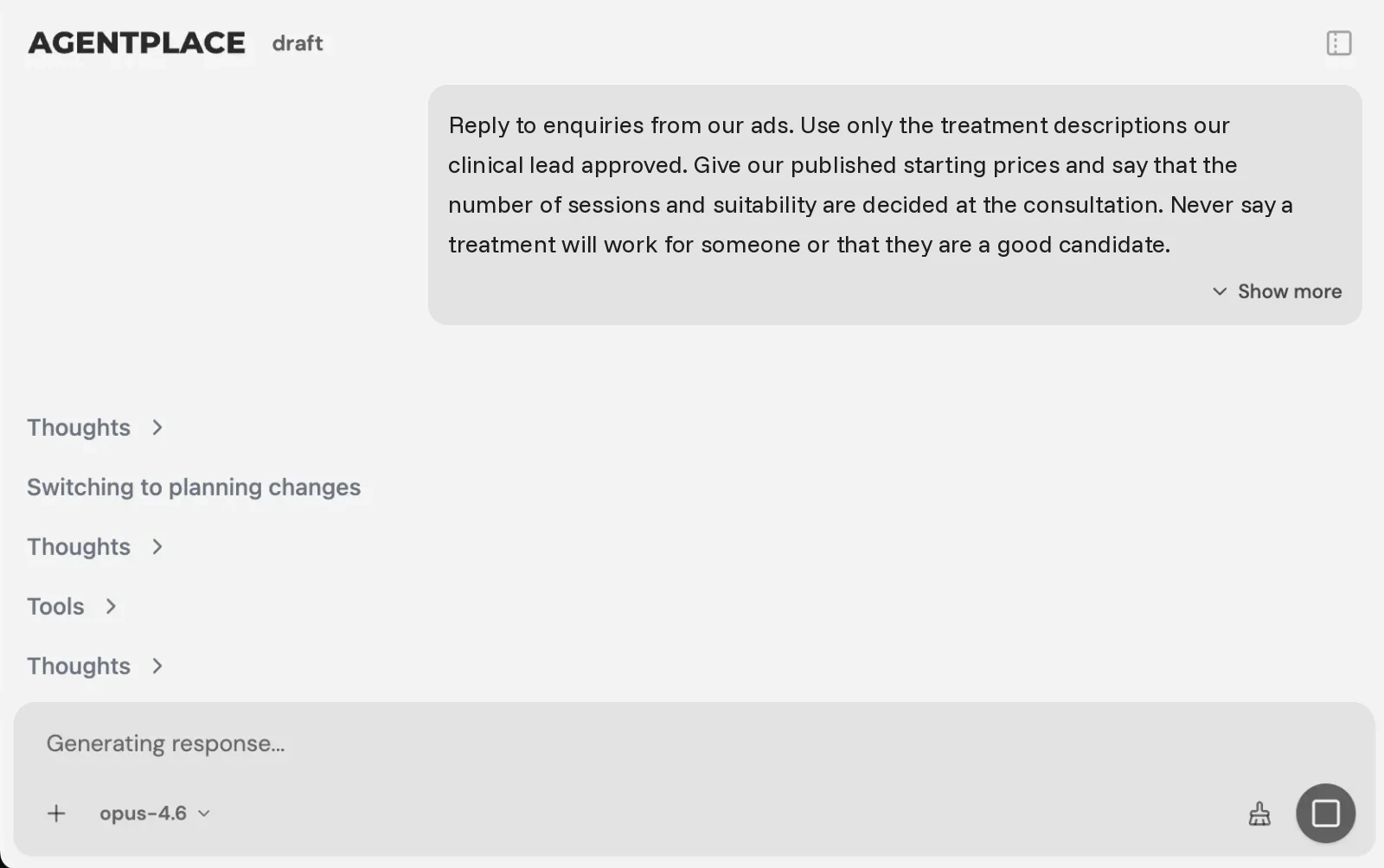 You describe your treatments, your approved answers and your stop rules. The builder writes the agent.
In practice, it works like this:
- The prospect opens the agent’s page from an ad, a bio link or your site.
- The agent answers from the wording your clinical lead approved.
- It gives published prices and says what the consultation decides.
- It books the consultation and collects the intake details beforehand.
- Anything clinical stops the conversation and goes to a named practitioner.
You set it up by describing the outcome in plain language, for example:
“Reply to enquiries from our ads. Use only the treatment descriptions our clinical lead approved. Give our published starting prices and say that the number of sessions and suitability are decided at the consultation. Never say a treatment will work for someone or that they are a good candidate. Book consultations into our Thursday and Saturday slots and collect medical history, current medications and previous treatments beforehand. If anyone mentions swelling, pain or a reaction, stop and alert Dr Reeve immediately.”
The AI Builder discusses the idea, clarifies requirements, creates the agent and helps test it. You choose when to publish. No code is required.
What stays where it is:
- Your practice management system keeps the diary, records and payments. The agent writes the booking into it where a supported connection exists.
- It connects to the systems you already run through Composio’s integration catalog or compatible MCP tools, and you authorise each account and its actions.
- Records carry access classes enforced server-side, so a prospect sees their own enquiry and nothing else. What client information the agent may hold stays a decision for your clinic.
Pricing: Agentplace has a free plan and paid plans that use AI credits. A credit is not a message. See pricing.
Template to start from: AI Agent for Med Spa Ad Inquiry Follow-Up
When don’t you need an AI agent?
- Diary full and turning consultations away? This isn’t your problem.
- You don’t run paid ads? The speed matters less. A good booking page may be enough.
- Your clinical lead won’t approve wording in writing? Then don’t build this yet.
- You need the diary, records and payments? That’s practice management software, and it stays.
- Comparing platforms with AI built in? See which med spa software has built-in AI.
- Paid leads going quiet overnight? That’s where a customer-facing AI agent built with Agentplace fits.
Quick checklist
- Get the approved wording per treatment, signed off by your clinical lead
- List published prices, and what the agent must never price
- Write the stop rule for anything clinical and name the practitioner
- Decide what intake can be collected before the visit, with your insurer’s view on consent
- Connect the diary so consultations book in the conversation
- Track reply time, consultations booked per paid lead, and stops that were correct
Related reading: which med spa software has built-in AI · dental office answering service · what Dots by ChatGPT are
Bottom line
You paid for the click. The reply arrives the next morning, and the prospect has booked somewhere else.
- If your diary is already full, this isn’t the thing to fix.
- If paid leads go quiet overnight, give prospects a customer-facing AI agent built with Agentplace. It replies in minutes using wording your clinical lead approved, books the consultation, collects the intake, and sends anything clinical to a named practitioner.
Questions and answers
Frequently asked questions.
Can an AI agent follow up med spa leads?
Yes. It can reply to a form, call or message, answer the questions your clinical lead has approved, collect what the consultation needs, and book it. Whether a treatment suits somebody is a clinical judgement and stays with your practitioners.
Can a ChatGPT dot do this?
No. A dot is something you create and use inside ChatGPT. There is no page or number a prospect can use. A dot can help with your own work, but somebody replying to your ad cannot reach it.
What should it never say?
That a treatment will work for someone, what results they'll get, how many sessions they need, or that they're a suitable candidate. Those are clinical judgements, and in many markets claiming them in an ad is also a regulatory problem.
Can it give prices?
It can state your published prices for a named treatment. It should not price a course, a combination or anything depending on assessment, because those depend on the consultation it is trying to book.
Can it collect intake and consent before the visit?
It can collect the intake details and send the forms you use, which is where most of the check-in delay comes from. Whether consent can be taken ahead of the appointment is a decision for your clinical lead and your insurer.
Does this replace our practice software?
No. Your practice management system stays the source for the diary, records and payments. The agent handles the conversation and writes the booking into the system you already run.
What about questions about complications?
They stop the conversation and go to a named practitioner immediately. Anyone describing swelling, pain or a reaction is a clinical call, not a lead.
How long does setup take?
The work is mostly approving what the agent may say about each treatment, with your clinical lead. A focused build takes days rather than months, and the first version should cover one treatment line.
Put this into practice
See the customer experience.
Explore a concrete example related to this article, then adapt the agent to your business.
Create my AI agentStart free with your business idea. The AI builder can help you explore it and create your agent. No technical specification needed. Sign in to continue. Pricing and limits · How the builder works