
What Is an AI Website? How Agent-Powered Websites Work

An AI website is a site where an agent changes the interaction based on what the visitor needs, uses the business's own context and rules, asks follow-up questions and takes actions, instead of routing every visitor through the same fixed pages and forms. It is not a chatbot added to a static site.
Key Takeaways
- Three things are being called the same thing: a static website, a static website with a chatbot bolted on, and a website an agent actually runs. Only the third can change what it shows and complete an action.
- The test is whether the interface itself can change. A chatbot widget sits on top of pages that stay identical for every visitor. An agent-powered site can ask a question, then render the answer as a different page.
- A form collects what you decided to ask everyone. An agent asks what this visitor's answer makes relevant, which is why it can qualify an enquiry that a form can only capture.
- The honest limitation: an AI website is only as accurate as the business context behind it. Prices, policies, availability and escalation rules are configuration, not magic, and a fast wrong answer is worse than a slow right one.
- Agentplace is a no-code AI agent builder for exactly this: you describe the business in plain language and the builder produces an AI website powered by agents, then tests its own work before you publish.
Most websites are brochures with a form at the end. A visitor arrives with a question the brochure does not answer, does not find it, and leaves. That is the problem this category exists to solve, and the term for it has become muddy enough to be worth defining carefully.
An AI website is a website where an AI agent can change the interaction based on what the visitor needs, use business context, ask follow-up questions and take actions, instead of forcing every visitor through the same fixed pages and forms.
Build an AI Website for Your Business
Describe what your business does and what the agent should handle. The builder produces the site and tests its own work before you publish.
Build Your AI Website Free →What Are the Three Things Being Called an AI Website?
Vendors use one label for three different products. Separating them is most of the work of choosing.
| Static website | Static site plus chatbot | AI website run by agents | |
|---|---|---|---|
| What the visitor sees | Fixed pages, same for everyone | Fixed pages, plus a widget | An interface the agent composes |
| Answers an open question | No | Yes, within its content | Yes, from the business’s own context |
| Asks a follow-up question | No | Sometimes | Yes, chosen from the previous answer |
| Applies business rules | No | Rarely | Yes |
| Reads and writes records | No | No | Yes |
| Completes an action | Form submission | Hands off to a form or a person | Books, quotes, collects, routes |
| Where the logic lives | In the page | In the widget | In the agent |
The test that separates the second column from the third is whether the interface itself can change. A chatbot is a conversation happening next to a page. An agent-powered site can take the answer to a question and render a different page because of it.
What Can an Agent Do That a Form Cannot?
A form collects the fields you decided in advance to ask everyone. That is its strength for structured intake and its weakness everywhere else.
An agent asks what the previous answer makes relevant. A visitor who says they have fifteen trucks gets a different second question than one who says they have one.
| Web form | Agent | |
|---|---|---|
| Which questions get asked | Decided in advance, same for everyone | Chosen from the previous answer |
| Answers the visitor’s own question | No | Yes, mid-conversation |
| Stops early on a disqualifying answer | No | Yes |
| Handles an answer it did not anticipate | Free-text box, read later | Asks a follow-up |
| Completes the next step | Submits and waits | Books, quotes or routes |
| Best when | Every field is mandatory and structured | The request arrives unstructured |
It can stop early when an answer disqualifies, which no form does, and it can answer the visitor’s own question in the middle of collecting yours, which is where most abandonment happens.
A customer-facing AI agent combines conversation with actions such as qualification, intake, booking or support resolution. The conversation is the visible half; the actions are why it is worth building.
How Does an Agent-Powered Website Actually Work?
Four parts, and a product missing any of them is one of the first two columns above.
- Business context. The services, prices, policies, service area, availability and rules the agent answers from. This is configuration, and it is the whole ballgame for accuracy.
- Conversation. Understanding an unstructured request, asking the right next question, holding context across the exchange.
- Tools and records. Reading and writing its own records, calling connected systems, checking a live calendar, taking a payment.
- Interface. Rendering the result as something a person can use: a comparison, a form with three fields instead of twelve, a booking confirmation, a dashboard.
Where Do AI Websites Work Best?
The pattern is consistent: the visitor arrives with an unstructured request and cannot self-serve from fixed pages.
- Service businesses whose customers do not know what to book. A salon client wants to go lighter without damage. That is not a service name, and a booking page cannot resolve it.
- After-hours enquiries. An HVAC customer at 11pm needs an answer and a slot, not a callback form.
- Lead qualification. A B2B visitor needs their question answered before they will fill anything in, and you need three qualifying answers before the meeting is worth taking.
- Quotes that depend on conditions. Anything where the price depends on answers only the customer has.
Where Is a Static Website Still the Right Answer?
Being straight about this matters, because the category is being oversold.
- Content and SEO. If the job is to rank and be read, real indexable pages do that. An agent does not replace them.
- Simple, unambiguous transactions. A product with one price and one variant does not need a conversation.
- Compliance-bound intake. Where every field is mandatory and the wording is regulated, a form is the correct tool.
- When nobody will maintain the context. An agent with thin business context answers confidently and wrongly, which is worse than a page that says nothing.
Is an AI Website Good for SEO?
Only if it still serves real pages. This is the most common technical mistake in the category.
An experience that renders entirely through an agent, with nothing crawlable behind it, is invisible to search engines and to the answer engines that increasingly sit in front of them. Check what a crawler actually receives from your site, not what a browser shows you. Treat the agent as something added to indexable content rather than something that replaces it.
What Should You Ask Before Choosing a Platform?
- Can the agent take an action, or only answer? Ask for a booking landing in your own system during the trial.
- Where does the business context live, and who updates it when your prices change?
- What does a crawler receive?
- What happens when the agent does not know? A defined handoff is a feature; improvising is a liability.
- Can you see and export what it built?
How Do You Build One With Agentplace?
Agentplace publishes this article, so treat this as a worked example rather than a neutral survey of the market.
Agentplace is a no-code AI agent builder for AI websites powered by agents. You describe the outcome you want in plain language, the builder asks clarifying questions, produces the site and the agent behind it, and tests its own work before you publish. The same agent can work with customers on the web, over the phone, and through connected messaging channels, and it connects to the systems the business already uses.
Beyond the conversation, the agent holds its own records with enforced permissions, runs work on a schedule or on an event, acts across connected tools, and renders results as real interfaces such as tables and dashboards. That is the part that separates it from a chat widget.
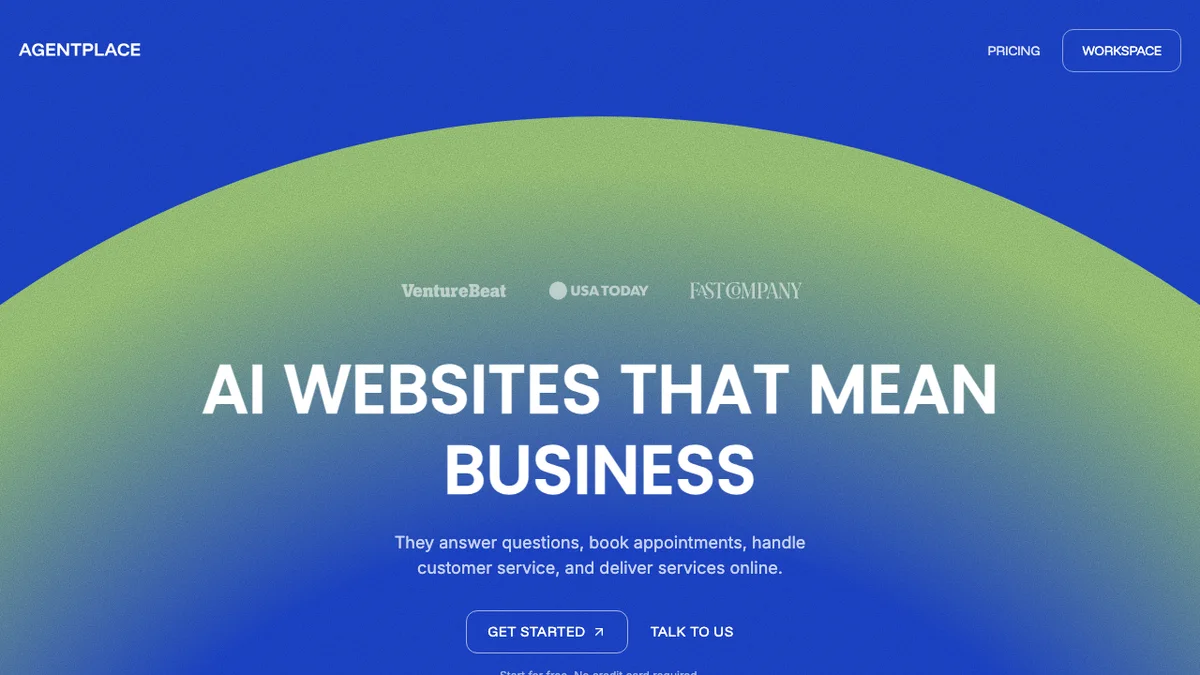 Agentplace’s public homepage, captured July 2026.
Where it is not the right choice. If you need a content and SEO site and nothing more, a conventional site builder is simpler and cheaper. If you want an off-the-shelf answer to one narrow job with no configuration, a packaged point tool will be faster to buy. And if nobody on the team will define the prices, policies and escalation rules, the accuracy problem above applies here as much as anywhere.
Pricing is free to start with 2,000 credits, $29 a month on Pro for 15,000 credits, and custom for Business.
If your specific job is a front desk rather than a website, what is an AI receptionist for a salon covers that narrower category, and how to build an AI agent for your business covers the build itself in more detail.
The bottom line. The label covers three products, and only one of them is what the term is meant to describe. A static site shows what was written in advance. A chatbot answers beside it. An AI website is one where the agent holds the business’s context and rules, decides what to ask, uses connected tools and records, completes the action and renders the result. Choose by whether your visitors arrive with a question your pages cannot answer, and be honest about whether anyone will maintain the context that makes the answers right.
Frequently Asked Questions
What is an AI website?
A website where an AI agent can change the interaction based on what the visitor needs, use the business's own context and rules, ask follow-up questions and take actions, rather than routing every visitor through the same fixed pages and forms. The agent runs the site rather than sitting on it.
What is the difference between an AI website and a chatbot?
A chatbot is a widget added to pages that stay the same for everyone. An AI website is one where the agent controls what the visitor sees and can complete actions such as qualification, booking or a quote. The difference is whether the interface itself can change.
What is an agent-powered website?
The same thing described from the software side. An agent holds the business context, decides what to ask next, calls connected tools, reads and writes records, and renders the result as an interface. The page a visitor sees is an output of that agent rather than a fixed template.
Can an AI website replace forms?
For qualification, usually yes. A form collects the fields you decided to ask everyone. An agent asks what this visitor's previous answer makes relevant and can stop early when the answer disqualifies. Forms remain better for structured, compliance-bound intake where every field is mandatory.
Do AI websites help with lead qualification?
That is the clearest use case. The agent answers the visitor's question, applies your qualification rules, collects only what is missing, routes the enquiry and books the meeting when it qualifies. The alternative is a form submission that a person reads hours later.
What can an AI website do that a static website cannot?
Answer an open question, ask a follow-up, apply business rules, look something up in a connected system, take an action such as booking or routing the enquiry, and render a result specific to that visitor. A static site can only show what was written in advance.
Is an AI website good for SEO?
Only if the content is still served as real pages. An agent-driven experience that renders nothing crawlable is invisible to search. Treat the agent as an addition to indexable content, not a replacement for it, and check what a crawler actually receives.
How much does an AI website cost?
Builder platforms in this category start free and run to roughly $30 a month for a small business tier, with custom pricing above that. The larger cost is usually configuration time: the service menu, pricing rules, policies and escalation conditions the agent works from.
What is the best platform for building an AI website?
It depends whether you want an agent that can also act. Website chatbot tools are simpler if answering questions is enough. Agentplace is a no-code AI agent builder for sites where the agent also has to apply business rules, use connected tools and complete an action.
What are the risks of an AI website?
Answering confidently and wrongly is the main one, and it comes from thin business context rather than from the model. Define prices, policies and what must go to a person before launch, and test the awkward questions yourself rather than the easy ones.
Ready to deploy AI agents that actually work?
Agentplace helps you find, evaluate, and deploy the right AI agents for your specific business needs.
Get Started Free →


