
What Is an AI Employee? A Plain Definition of the Category

The short answer
An AI employee is a software agent configured for a defined business role with recurring tasks and limited human involvement. The phrase describes an assignment, not a human worker. Evaluate what the software can actually complete, give it appropriate information and tools, and keep a person responsible for the service.
Key takeaways
- AI employee describes a standing assignment; it does not establish capability by itself.
- A useful role has a defined result, tools, business rules and escalation conditions.
- An accountable person still owns the service, policies and review of its results.
- Accuracy depends on maintained context, model behavior and working tools, not instructions alone.
- Start with a bounded recurring role and measure its completed outcomes before expanding.
An AI employee is a software agent configured for a defined business role with recurring tasks and limited human involvement. Examples include a receptionist answering inquiries, a product advisor helping customers choose and a service agent preparing a personalized plan.
The term describes the job assigned to the software. It does not make the software a person or transfer operational responsibility away from the business. Its useful scope is determined by the information, tools and decisions the business authorizes.
The change for an owner is a different division of work: let software handle a bounded, repeatable part of customer service, while a person owns the policy, reviews results and takes over exceptions.
How Does an AI Employee Differ From an Assistant, an Agent or Automation?
The labels overlap. An assistant can use tools and schedules; a workflow can include agents. A person remains accountable for the service even when software performs recurring work.
| Term | What it usually emphasizes | What to verify |
|---|---|---|
| Workflow automation | A defined process | Correct rules, inputs and completed actions |
| AI assistant | Helping a person | What it can do independently and what needs review |
| AI agent | Interpreting a task and choosing actions | Tools, context, decisions and results |
| AI employee | A standing business assignment | Recurring responsibilities, authority and escalation |
| Human role | Work, relationships and accountability | Which parts can sensibly be delegated to software |
Treat AI employee as a description of the assignment. It does not remove the need to check the underlying agent or define who reviews its work.
What Does the “Employee” Part Actually Mean?
It means a standing assignment. A receptionist agent can respond when an inquiry arrives; a reminder agent can run at a configured time. Neither needs a new manual prompt for each routine case once that behavior is set up.
The business still decides what the role may do. Explaining a return policy, collecting the details of a complaint and approving an exception are three different responsibilities. You might allow the first two and keep the third with a manager.
That boundary is more useful than a promise to replace an entire employee. Real roles combine routine work, relationships, judgment and accountability. Measure the part the software performs rather than assuming the job title establishes its competence.
What Can an AI Employee Do?
- Answer from your business context, meaning your prices, policies, services and rules rather than general knowledge.
- Apply rules you defined, including the disqualifying conditions and the cases that must not be handled alone.
- Read and write records, so it remembers what happened and works from it.
- Use connected systems, checking a calendar, updating a CRM, reading an order.
- Complete actions: qualify, book, route, follow up, produce a report.
- Run on a schedule or an event, not only when someone opens a chat window.
- Escalate, which is a feature and not a failure.
Which Decisions Still Need a Person?
Keep human ownership of the role, its policies and consequential exceptions. An agent may summarize a complaint or help prepare a decision, but the owner should define which commitments it may make and when a manager or qualified professional takes over.
Accuracy depends on both the model and the context supplied. Missing information, reasoning errors, stale data and failed tools can all produce an incorrect result. A maintained knowledge source helps; it does not guarantee correctness.
The practical boundary is a tested responsibility. A routine reschedule may fit clear rules. A request to waive a substantial cancellation fee may need approval. A distressed customer may need a person even if the agent can classify the issue correctly.
Which Roles Work Best, and Which Do Not?
The pattern is high volume, clear rules, a measurable outcome, and a bounded cost of being wrong.
| Works well | Works badly |
|---|---|
| Front desk and first-line support | Complaints and escalated accounts |
| Inbound qualification and intake | Anything where being wrong is expensive |
| Scheduling, rescheduling, reminders | Negotiation |
| Follow-up on quotes and lapsed customers | Clinical, legal or financial advice |
| Recurring reporting | Judgement calls about people |
Start with one role that has a number attached to it. A vague assignment makes it harder to tell whether the agent works or which information needs maintenance.
How Do You Build One?
Four steps, and the first is the one people skip.
- Pick the role and the number. Booked appointments from after-hours inquiries, qualified meetings from website visitors, quotes chased to a decision. If you cannot name the number, you are not ready.
- Write down the context and the rules. Services, prices, policies, service area, what disqualifies, what must reach a person. This is most of the work and it is not the software’s job.
- Build and test the awkward cases yourself. Not the demo question. The one where a customer asks something adjacent, or pushes for a discount, or is upset.
- Compare it with the existing process using test cases first. In a live pilot, let only one system perform each external action and keep a person reviewing the results.
Building one with Agentplace
Agentplace creates customer-facing AI agents with their own UI and URL. You describe the role and desired result, provide the business materials and connect any systems the task requires. Customers open the agent’s page and work with the service there.
An advisor can ask about a customer’s situation, show a comparison and revise it when preferences change. A receptionist can collect the relevant context and offer booking options from a connected calendar. A service agent can deliver a personalized plan for the customer to refine.
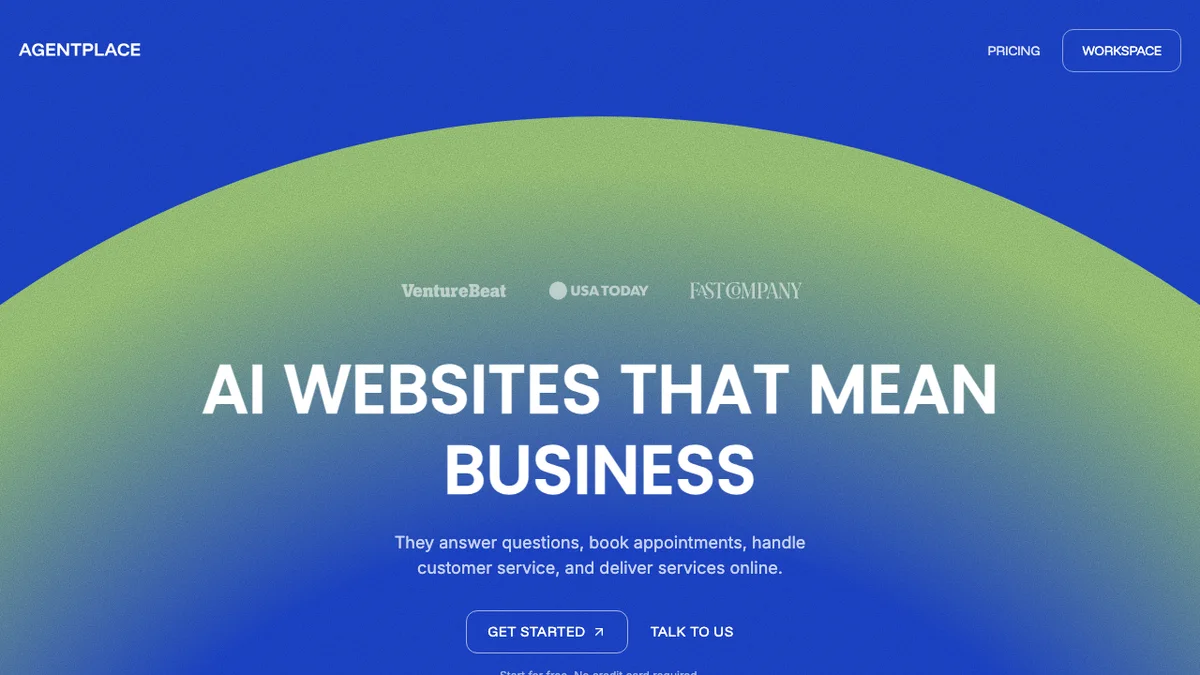 The product is the AI agent and the service it performs; its page is how customers reach it.
Use current Agentplace pricing when budgeting the role. Include the time to maintain materials, review exceptions and operate any connected tools. Do not equate a software subscription with the full cost or value of a human job.
Choose Your First Customer-Facing Role
Pick the repeated customer request with a clear result. A lead qualification agent gathers the context for a meeting. A mattress advisor helps shoppers compare options. The template library also contains tasks where the agent delivers a digital service directly.
Write the brief in business terms:
Create an advisor for our store that helps customers choose among our products using their needs and budget. Explain the options using our catalog and send uncertain cases to our staff with a summary.
The useful question is which part of the role the agent can complete consistently. Start there, keep a human owner and expand only after reviewing the results.
Questions and answers
Frequently asked questions.
What is an AI employee?
A software agent configured for a defined business role or set of recurring tasks with limited human involvement. Its actual capability depends on the model, information, tools and permissions, not the employee label.
Is an AI employee actually an employee?
AI employee is a product and role description, not a claim that software is a human employee. The business still needs an accountable owner who defines the assignment, reviews results and handles exceptions. The label itself does not establish capability or change the obligations involved in operating the service.
What is the difference between an AI agent and an AI employee?
The same software, described by scope. An AI agent is the technical thing: a model that can use tools and take actions. Calling it an employee says you have given it a defined role with recurring responsibilities rather than pointing it at one task.
What is the difference between an AI assistant and an AI employee?
Vendors use these terms inconsistently. Assistant often suggests helping a person, while employee suggests a recurring assignment. Both can use tools or schedules. Compare the defined responsibility and completed result instead of relying on the name.
How is an AI employee different from workflow automation?
A fixed workflow follows predefined rules; an agent can interpret input and select some next steps. Modern automation platforms can combine both. Use the simplest design that reliably completes the role.
What can an AI employee actually do?
Answer questions from your own business context, apply rules you defined, read and write records, use connected systems, and complete actions such as qualifying, booking or routing. It can run on a schedule rather than only when asked, and escalate anything you told it not to handle alone.
What can an AI employee not do?
The label does not establish competence or authority. An agent can make mistakes, lack current information or fail to complete a tool action. Keep human ownership of policies and consequential exceptions, and test the specific responsibility before relying on it. A general promise to replace any employee is not a useful scope.
Is an AI employee cheaper than hiring someone?
Compare the bounded task, including software, model usage, connected tools, setup and ongoing review. A subscription price alone does not establish savings or replace the full scope and value of a human role.
What roles work best as an AI employee?
Roles with high volume, clear rules, a measurable outcome and a bounded cost of being wrong. Front desk, inbound qualification, intake, scheduling, follow-up and first-line support all fit. Anything needing judgement about people, or where a wrong answer is expensive, does not.
How do you build an AI employee?
Pick one role with a clear success measure. Write down the business context, the rules, and what must go to a person. Build it on an agent platform, test the awkward cases yourself, and run it alongside the human process before you rely on it.
Put this into practice
See the customer experience.
Explore a concrete example related to this article, then adapt the agent to your business.
Create my AI agentStart free with your business idea. The AI builder can help you explore it and create your agent. No technical specification needed. Sign in to continue. Pricing and limits · How the builder works